From
Wolfram Nickel/SP-X | Translated by AI
5 min Reading Time
Sports cars like the 1800 ES "Snow White's Coffin" established Volvo as a design brand. The 780 coupe, the 480 shooting brake, and a two-door 850 were intended to continue this success.
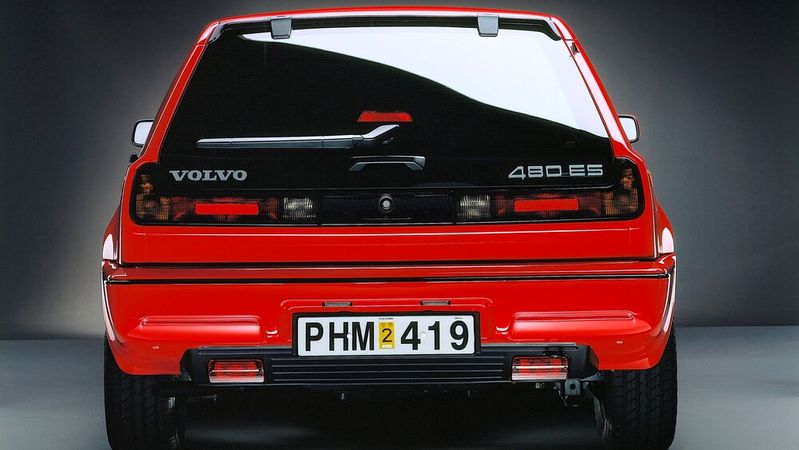
The glass tailgate of the 1985 Volvo 480 ES referenced the legendary 1800 ES "Snow White's Coffin," but technically, the 480 ES embodied progress.
(Image: Volvo)
It was the year of exaggerated shoulder pads, neon colors, and preppy hairstyles—and extravagant coupes for fashion-conscious high earners: in 1985, Volvo presented the 780 Coupe, built by Carrozzeria Bertone in Turin. "Calling the Volvo 780 Coupe the most luxurious Volvo of all time would be a pure understatement," claimed an advertising campaign about the elegant 15.7 feet-long two-door car, which was primarily intended to succeed in the US market. "Styled by Bertone in Italy, who is also responsible for the legendary look of Ferrari and Lamborghini," Volvo's advertising tried to dramatize the design of this flagship model.
The wedge-shaped style of an Italian supercar was certainly not in question for the Gran Turismo with a maximum of 125 kW/170 hp, but Bertone, in cooperation with Volvo chief designer Jan Wilsgaard, succeeded in transforming the boxy 760 sedan into the harmoniously proportioned 780. With this, Volvo targeted German competitors such as the BMW 6 Series or Mercedes CE (W123), but also the Cadillac Allanté, developed with Pininfarina from 1987, and the Chrysler TC by Maserati, first unveiled in 1986. Italian Alta Moda was in demand in the US, and Volvo hoped to secure a share of the luxury market.
In 1980s Europe, with fashion from Adidas and Nike or white tennis socks, the expensive but by no means fast Volvo 780 resonated with the times in only a few countries and reached Germany only through unofficial channels. For the Old World, Volvo instead surprised with the compact 480: a wedge-shaped sports estate with a large glass tailgate, following in the tradition of the iconic 1800 ES "Snow White's Coffin."
Cult Sports Cars Establish Volvo's Sporty Image
In fact, it was the cult sports cars Volvo P1800 from 1960 and Volvo 1800 ES from 1971 that earned the Swedes their place in the club of sports car manufacturers—after an attempt with the fiberglass roadster P1900 failed in 1956. But when Swedish King Carl XVI Gustaf drove a P1800, Hollywood star Roger Moore battled evil with a P1800 in the TV series "The Saint," and the P1800 eventually evolved into the 1800 ES in 1971, pioneering the modern shooting brake—Volvo became known as a brand for seductively beautiful designs.
Sedans and wagons like the 240/260 duo continued to deliver large sales volumes, but the 262 Coupé, produced by Bertone starting in 1977, confirmed how sought-after sporty Volvos were among individualists. When film star Michael J. Fox traveled in a DeLorean sports coupé in the 1985 US blockbuster "Back to the Future," US action hero Sylvester Stallone dominated screens with "Rambo II" and "Rocky IV," and Nintendo sparked a video game craze with the Entertainment System (NES) in the US that also swept into Europe, Volvo made another attempt at capturing the profitable US market. This time, two Swedes were meant to win over American hearts: the luxury coupé Volvo 780 and the compact lifestyle four-cylinder Volvo 480.
US Approval Thanks to Pop-Up Headlight Trick
Despite its wedge-shaped body with pop-up headlights, the compact Volvo 480 met the strict crash criteria required in the land of US President Ronald Reagan. Even the cool pop-up headlights were a concession to American regulations, which mandated a minimum height for the headlights. With a radiator grille hidden beneath the front bumper, the 480 was a charismatic shooting brake that even made Japanese sport wagons like the Honda Accord Aerodeck appear dull.
Especially in the US versions planned by Volvo: even a supercharged version with a G-Lader was considered, along with several two-seater convertible studies featuring fully retractable roofs. At the 1990 Geneva Motor Show, a Volvo 480 Cabrio was celebrated by enthusiastic visitors, despite its rather unappealing fixed roll bar. However, after a supplier went bankrupt, the sun-seekers disappeared into the Volvo Museum. A one-off also remained the fully electric Volvo 480 built in 1986, whose 15.6-kWh battery provided energy for a range of 75 miles.
The development team for the 480, which, incidentally, was based not in Sweden but in the Netherlands, even worked on prototypes of a mid-engine two-seater. The first Volvo with front-wheel drive was built in the Born plant, which the Gothenburg company established after acquiring the Dutch car manufacturer Daf.
Plans for the USA
Volvo originally planned to produce at least 35,000 units of the 480 annually, with 25,000 destined for North America alone. In reality, however, sales of the four-cylinder engine, which initially suffered from quality deficiencies and offered optional turbocharging (70 kW/95 hp to 90 kW/122 hp), languished below 10,000 units in most years, leading the company to suddenly lose the confidence to export across the Atlantic. Nevertheless, the Volvo remained in production for ten years, demonstrating just how ahead of its time the 480 was: it featured the world's first fiberglass hood with a honeycomb structure and a futuristic cockpit design with pushbuttons inspired by the F-16 fighter jet.
Date: 08.12.2025
Naturally, we always handle your personal data responsibly. Any personal data we receive from you is processed in accordance with applicable data protection legislation. For detailed information please see our privacy policy.
Consent to the use of data for promotional purposes
I hereby consent to Vogel Communications Group GmbH & Co. KG, Max-Planck-Str. 7-9, 97082 Würzburg including any affiliated companies according to §§ 15 et seq. AktG (hereafter: Vogel Communications Group) using my e-mail address to send editorial newsletters. A list of all affiliated companies can be found here
Newsletter content may include all products and services of any companies mentioned above, including for example specialist journals and books, events and fairs as well as event-related products and services, print and digital media offers and services such as additional (editorial) newsletters, raffles, lead campaigns, market research both online and offline, specialist webportals and e-learning offers. In case my personal telephone number has also been collected, it may be used for offers of aforementioned products, for services of the companies mentioned above, and market research purposes.
Additionally, my consent also includes the processing of my email address and telephone number for data matching for marketing purposes with select advertising partners such as LinkedIn, Google, and Meta. For this, Vogel Communications Group may transmit said data in hashed form to the advertising partners who then use said data to determine whether I am also a member of the mentioned advertising partner portals. Vogel Communications Group uses this feature for the purposes of re-targeting (up-selling, cross-selling, and customer loyalty), generating so-called look-alike audiences for acquisition of new customers, and as basis for exclusion for on-going advertising campaigns. Further information can be found in section “data matching for marketing purposes”.
In case I access protected data on Internet portals of Vogel Communications Group including any affiliated companies according to §§ 15 et seq. AktG, I need to provide further data in order to register for the access to such content. In return for this free access to editorial content, my data may be used in accordance with this consent for the purposes stated here. This does not apply to data matching for marketing purposes.
Right of revocation
I understand that I can revoke my consent at will. My revocation does not change the lawfulness of data processing that was conducted based on my consent leading up to my revocation. One option to declare my revocation is to use the contact form found at https://contact.vogel.de. In case I no longer wish to receive certain newsletters, I have subscribed to, I can also click on the unsubscribe link included at the end of a newsletter. Further information regarding my right of revocation and the implementation of it as well as the consequences of my revocation can be found in the data protection declaration, section editorial newsletter.
The electronic command center, the so-called Central Electronic Module (CEM), controlled up to 27 different functions. A brave new world that only became standard in the compact class years later.
780 Remains An Expensive Niche Sports Car
Only 8,518 units of the Volvo 780 were sold over five years, despite costing as much in Europe as a Jaguar XJ-S V12 or Porsche 911, both of which had nearly double the power of the 105 kW/143 hp V6. However, the Bertone-designed Volvo offered an option for savings: like the Mercedes 300 CD Turbo (W123) in the US, the Italian-built Swede was optionally available with an efficient diesel engine—albeit a six-cylinder. More dynamism came with the four-cylinder turbo, which Volvo CEO Pehr Gyllenhammar received for his 50th birthday: painted fire red—Gyllenhammar's favorite color—and fitted with striking red leather interior, the Bertone coupé reached nearly 125 mph.
Instead of an impressive Vmax, the two-door offered an unrivaled fully equipped standard package, which included air conditioning, a trip computer, an audio system, and electric operation for windows, seats, the sunroof, and exterior mirrors. Technically, the Volvo 780 incorporated all the evolutions introduced in the 760 GLE sedan: in 1988, a multilink rear suspension replaced the solid rear axle, and for 1990, the final production year, Volvo equipped the coupé with a limited-slip differential.
Volvo 850 Coupe
Volvo without an elite coupé now seemed unthinkable, and so Gyllenhammar tasked his design department in September 1993 with finalizing a two-door Volvo 850. The first prototypes of the five-cylinder front-wheel-drive model were painted fire red—but before Gyllenhammar could approve production, he was forced to resign in December 1993, and the sporty Volvo 850 disappeared into storage. Thus, in 1997, it was up to the Volvo C70 to continue the Swedish coupé tradition.



:quality(80)/p7i.vogel.de/wcms/a0/47/a04725ef9bd09fb6c9341a1bea1b5d93/0130443083v1.jpeg "Here, a type of plastic pallet is produced by thermoforming (vacuum forming or deep drawing) at the corresponding division of New England Plastics in the USA. This division, which specializes in so-called liners, is now part of Ringmetall ... (Image:New England Plastics)")
:quality(80)/p7i.vogel.de/wcms/23/99/23992bf2dcdc432c9b7209c34a4a7c48/0129733089v1.jpeg "Stork relies on the modular Neoswiss turning system from Iscar to shorten the set-up times for its sliding headstock lathes and work more productively. (Image:Iscar)")
:quality(80)/p7i.vogel.de/wcms/7d/e2/7de2923434b2f1a78ba5482d8d335269/0113143253v1.jpeg "In our China Market Insider we regularly provide you with relevant information directly from China. (Image:© Eisenhans - stock.adobe.com)")
:quality(80)/p7i.vogel.de/wcms/9d/2b/9d2b802f800e5caf17b2831e74228cd3/screenshot-202026-03-03-20103822-609x343v1v1.png "Visual comparison: on the left, a clean, burr-free cut edge; on the right, typical burr formation with oxidation discoloration. This illustrates how strongly parameter control and gas management influence the quality of the result. (CO₂ laser, oxygen cutting gas, sheet thickness approx. 15 mm). (Image:Picture: Rime)")
:quality(80)/p7i.vogel.de/wcms/b7/36/b736dfebc16c42d6901d0d0e1f390493/3d-druck-20factory-20--20ki-20generiert-1920x1079v1.png "(Source: AI-generated)")
:quality(80)/p7i.vogel.de/wcms/79/b2/79b21aad663f4a7bd4472afc1c1afc62/0130433994v1.jpeg "Mission Joyride: The free-flying robot (shown here in the rendering) will relieve the ISS crew of logistics tasks from 2027 with its two mechanical arms. (Image:Icarus Robotics)")
:quality(80)/p7i.vogel.de/wcms/6b/45/6b4546fa6ebf305c3660326909363f32/0130437089v1.jpeg "Industrial AI in action: Rockwell Automation presents practical solutions for self-controlling production systems at the Hannover Messe. (Image:Rainer Jensen, Deutsche Messe)")
:quality(80)/p7i.vogel.de/wcms/78/e9/78e9188c25a8a94e67c34c9bf8ffe495/visual-agile-20robots-20and-20google-20deepmind-20partner-20to-20bring-20intelligence-20to-20robotics-2500x1406v1v1.jpeg "Together, the partners are developing adaptable, intelligent robots for a wide range of applications (Image:Agile Robots SE)")
:quality(80)/p7i.vogel.de/wcms/59/a2/59a2b11f0aa1b700eff02addd5de8703/adobestock-1788280853--c2-a9-20satria-20-e2-80-93-20stock-adobe-com-5081x2860v1v1.jpeg "Quantum computers require extreme cooling to temperatures close to absolute zero in order to keep qubits stable. (Image:satria - stock.adobe.com)")
:quality(80)/p7i.vogel.de/wcms/49/38/493876a248943456b7e4a6db6edfc454/0130230765v1.jpeg "Safe and reliable in aircraft construction: light-curing adhesive bond combined with universal fastening elements. (Source: Delo)")
:quality(80)/p7i.vogel.de/wcms/b5/c7/b5c749d16c8a2e789c1469c2c8c1c387/0130452780v1.jpeg "Volvo Trucks completes road tests with its new hydrogen-powered trucks. (Image:Volvo Trucks)")
:quality(80)/p7i.vogel.de/wcms/ba/69/ba6975f417a85147084f38dc2cd209e2/0130451386v1.jpeg "Together with Nvidia, Hyundai wants to develop an architecture that will be used for level 4 robotaxis (image) as well as for level 2 customer vehicles. (Image:Hyundai)")
:quality(80)/p7i.vogel.de/wcms/93/4d/934de334b47abaa526c78cba1417d7af/0130343495v1.jpeg "The new SU7 is available in three price categories, \"Standard\", \"Pro\" and \"Max\" (Image:Xiaomi)")
:quality(80)/p7i.vogel.de/wcms/df/a0/dfa048434bb94f1b7d030e346b25b3ae/0130373541v1.jpeg "From August, BMW will be producing the i3 at its main plant in Munich - which the car manufacturer has extensively rebuilt for this purpose. (Image:Rainer Haeckl)")
:quality(80)/p7i.vogel.de/wcms/ee/09/ee09acbd6dc896df25affaa9e871e6e5/0130440053v1.jpeg "IMS chip module for simple system integration into an ion mobility spectrometer. (Image:Fraunhofer IPMS)")
:quality(80)/p7i.vogel.de/wcms/10/6c/106cd22de5f68a0f74639d654827228c/0130345302v1.jpeg "Made in India: According to the India Electronics and Semiconductor Association (IESA), the country should be able to produce between 75 and 80 million chips by the beginning of 2027, once the plants currently under construction become operational. (Image:Pixabay (Montage: Sebastian Gerstl))")
:quality(80)/p7i.vogel.de/wcms/a5/ed/a5ed6fda029d362732a293d6b19d74c4/0130444216v1.jpeg "Thirteen executives from the Chinese chip industry have drawn up a plan to achieve an 80% self-sufficiency rate for semiconductors by 2030. (Image:Maxim_Kazmin - stock.adobe.com)")
:quality(80)/p7i.vogel.de/wcms/31/a6/31a646018b34d8e0a44bfc8bf17837f6/0130361632v1.jpeg "For many companies, PFAS are considered indispensable in electronics production. (Image:freely licensed)")
:quality(80)/p7i.vogel.de/wcms/a6/fb/a6fb60b20744e79a3c578207d50dd27e/0127590822v1.jpeg "With the 480, Volvo also experimented with fully electric and V6 variants, but in the end, they stuck with the tried-and-true four-cylinder turbo, among others.(Image: Volvo)")
:quality(80)/p7i.vogel.de/wcms/f1/b3/f1b34d88abe428074b50e26662ce2728/0127590833v1.jpeg "The Volvo 480 was built in the Netherlands, just like the 440, 460, and previously the DAF legacy Volvo 66.(Image: autodrome)")
:quality(80)/p7i.vogel.de/wcms/1f/45/1f459ec1c3598ede8fefefc1ae3dc8c6/0127590821v1.jpeg "Forerunner of the compact volume models Volvo 440 and 460: As the first Volvo, the shooting brake 480 built in the Netherlands featured front-wheel drive.(Image: Volvo)")
:quality(80)/p7i.vogel.de/wcms/c8/52/c85212605dc1553665f7d5f050643dcd/0127590825v1.jpeg "The open sunseeker Volvo 480 Turbo Cabrio debuted at the 1990 Geneva Motor Show but never went into production.(Image: autodrome)")
:quality(80):fill(efefef,0)/p7i.vogel.de/wcms/67/ad/67adf4a647532/elatec-wp-machine-authentication.png "Elatec WP Machine Authentication")
:quality(80)/p7i.vogel.de/wcms/44/05/440559a04db9caf972de61aa993b028c/0124649008v1.jpeg "The Vantage Roadster is a luxury-class sports convertible with a V8 engine and 665 horsepower, wrapped in stunning design. (Aston Martin/Andy Morgan)")
:quality(80)/p7i.vogel.de/wcms/4b/02/4b028c57c5be11412e036a0b55167089/0125639067v1.jpeg "Honda brings back the Prelude. (Image:Honda)")