Dallara is known as a motorsport icon, but has also launched a street-legal vehicle with the Stradale. The company focuses on digital vehicle development and uses Creo from PTC for this purpose. The following article outlines the benefits that result from this.
Dallara relies on Creo from PTC for vehicle development.
(Image: Dallara | Alessandro Barteletti)
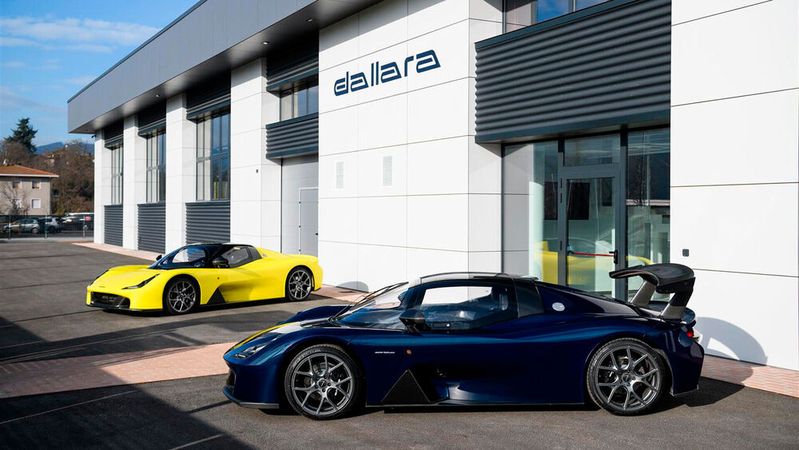
From its headquarters in Varano de' Melegari in northern Italy, Dallara not only develops high-performance vehicles for the racetrack but increasingly also street-legal models like the Dallara Stradale. All vehicles share a consistently digitized development process—from the concept idea through aerodynamic design to the final lightweight construction component layout.
A Different Approach to Vehicle Development
The technical standard at Dallara is high, but the approach differs significantly from traditional OEM structures. Instead of integrating drive units into an existing architecture, the engineers at Dallara develop their vehicles starting from the powertrain. This methodology allows each vehicle to be viewed as a functional overall system—tuned for weight distribution, aerodynamics, and efficiency.
In doing so, the design teams benefit from an integrated, digital development process. Creo serves as a central tool to model and optimize the body, chassis, and interior structure in a single environment. The software enables the design of complex geometries with high precision and early validation through simulation. Changes can be implemented iteratively without compromising the consistency of the overall system.
Race Car Meets Road Vehicle
A striking example of this philosophy is the Dallara Stradale. The vehicle was developed to combine the driving characteristics of a race car with the everyday usability of a road vehicle. The design started in 2015, with the goal of creating an extraordinarily light, aerodynamically refined vehicle that is also street legal.
With lateral acceleration of up to 2G on standard tires, the Stradale sets new standards. The key to success lies not only in mechanical tuning but also in the consistent use of digital tools in the design process. The designers and engineers use Creo to align every line of the vehicle for minimal turbulence and maximum stability—in close cooperation with wind tunnel tests and virtual simulation environments.
Sustainability Begins in the Design Process
At the heart of vehicle development is not only performance but increasingly also energy efficiency. Dallara pursues a development approach where sustainability does not stand at the end of the value chain, but begins in the design. The vehicles are designed to be as lightweight as possible, materials are used selectively, and each component is optimized for its impact on air resistance and energy consumption.
Through the close integration of design, simulation, and analysis in Creo, this process can be efficiently replicated. The software allows for early exploration of different material and structural variants, enabling informed decisions. This helps to reduce energy consumption without compromising dynamics or safety.
Digital Development as a Driver
The advantages of digital development extend beyond the individual vehicle. Processes can be standardized, insights transferred between projects, and development teams networked across locations. Especially for a company like Dallara, which is active in international racing series such as IndyCar, Formula 2, Formula 3, and Super Formula—often as the sole chassis manufacturer—this means a strategic advantage.
Creo supports this approach with a modular, scalable CAD framework. From the concept phase to the production-ready drawing, all information remains consistent. Adjustments in the specifications or new aerodynamic requirements can be directly incorporated into the existing model. This accelerates development cycles and increases responsiveness to changing demands.
Promoting Young Talent in the Motor Valley
In addition to technical innovation, Dallara is also committed to knowledge transfer. In cooperation with four universities in the Emilia-Romagna region, nine master's degree programs in engineering have been developed. The aim is to specifically prepare young talent for the demands of vehicle development in the digital age—with a focus on simulation, materials science, aerodynamics, and CAD-based design.
Here, practical experience also plays a central role: students work with the same digital tools as the engineers at Dallara. This not only creates a direct connection to real vehicle development but also fosters an understanding of the relevance of integrative design processes—from the initial draft to the finished component.
Digital Development as an Enabler for Efficiency
Dallara exemplifies how high-performance engineering, sustainability, and digital transformation can be combined. The consistent use of PTC Creo not only enables excellent aerodynamic concepts and lightweight architectures but also makes complex developments manageable – both on the racetrack and in series vehicle production. It's not just technology that is the focus, but a systemic development approach that understands sustainability as an integral part of modern mobility. (se)
Date: 08.12.2025
Naturally, we always handle your personal data responsibly. Any personal data we receive from you is processed in accordance with applicable data protection legislation. For detailed information please see our privacy policy.
Consent to the use of data for promotional purposes
I hereby consent to Vogel Communications Group GmbH & Co. KG, Max-Planck-Str. 7-9, 97082 Würzburg including any affiliated companies according to §§ 15 et seq. AktG (hereafter: Vogel Communications Group) using my e-mail address to send editorial newsletters. A list of all affiliated companies can be found here
Newsletter content may include all products and services of any companies mentioned above, including for example specialist journals and books, events and fairs as well as event-related products and services, print and digital media offers and services such as additional (editorial) newsletters, raffles, lead campaigns, market research both online and offline, specialist webportals and e-learning offers. In case my personal telephone number has also been collected, it may be used for offers of aforementioned products, for services of the companies mentioned above, and market research purposes.
Additionally, my consent also includes the processing of my email address and telephone number for data matching for marketing purposes with select advertising partners such as LinkedIn, Google, and Meta. For this, Vogel Communications Group may transmit said data in hashed form to the advertising partners who then use said data to determine whether I am also a member of the mentioned advertising partner portals. Vogel Communications Group uses this feature for the purposes of re-targeting (up-selling, cross-selling, and customer loyalty), generating so-called look-alike audiences for acquisition of new customers, and as basis for exclusion for on-going advertising campaigns. Further information can be found in section “data matching for marketing purposes”.
In case I access protected data on Internet portals of Vogel Communications Group including any affiliated companies according to §§ 15 et seq. AktG, I need to provide further data in order to register for the access to such content. In return for this free access to editorial content, my data may be used in accordance with this consent for the purposes stated here. This does not apply to data matching for marketing purposes.
Right of revocation
I understand that I can revoke my consent at will. My revocation does not change the lawfulness of data processing that was conducted based on my consent leading up to my revocation. One option to declare my revocation is to use the contact form found at https://contact.vogel.de. In case I no longer wish to receive certain newsletters, I have subscribed to, I can also click on the unsubscribe link included at the end of a newsletter. Further information regarding my right of revocation and the implementation of it as well as the consequences of my revocation can be found in the data protection declaration, section editorial newsletter.
*Michele Del Mondo is Senior Director Global Advisor Automotive at PTC.



:quality(80)/p7i.vogel.de/wcms/dd/08/dd086510d9ae7b50181f6070e4463b44/0129363730v1.jpeg "Typical application for ionizing devices: Wrapping films. (Picture: ©Adobe Stock/SMC)")
:quality(80)/p7i.vogel.de/wcms/35/57/3557c819943c53acec41a0ccba87da4f/0130049064v1.jpeg "Researchers at the Fraunhofer IWU in Chemnitz have long known that many typical sheet metal parts can be manufactured more cost-effectively using hollow embossing rollers. Now there is news to report ... (Image:Fraunhofer IWU)")
:quality(80)/p7i.vogel.de/wcms/59/02/590246e3b3f415c65edbee377c14ca77/26-06-pi-fraunhofer-iws-41450-direktplattieren-pic-01-7771x4369v1v1.jpeg "The Fraunhofer IWS has developed the new \"direct laser cladding\" process, which creates a functional layer directly on the base body by applying a strip-shaped metal to rotationally symmetrical components in a spiral and bonding it locally by laser. (Image:Christoph Wilsnack/Fraunhofer IWS)")
:quality(80)/p7i.vogel.de/wcms/73/60/73608418789b1d9c393f5e2fa974eda2/0130209906v1.jpeg "The robots of the X6 generation from b+m enable very high painting quality and are also particularly compact and easy to maintain. (Image:Beckhoff)")
:quality(80)/p7i.vogel.de/wcms/78/e9/78e9188c25a8a94e67c34c9bf8ffe495/visual-agile-20robots-20and-20google-20deepmind-20partner-20to-20bring-20intelligence-20to-20robotics-2500x1406v1v1.jpeg "Together, the partners are developing adaptable, intelligent robots for a wide range of applications (Image:Agile Robots SE)")
:quality(80)/p7i.vogel.de/wcms/e7/66/e7669ecf0260ae8fc54c214e34e4902a/0130316817v1.jpeg "Siemens and Palo Alto Networks offer tested cybersecurity solution for industrial 5G. (Image:Siemens)")
:quality(80)/p7i.vogel.de/wcms/9f/55/9f55324832c4f426958031375124d9de/siemens-20ubtech-20hmnd-1920x1079v1v1.png "Ready for the factory floor: While Ubtech is planning mass production, Siemens is already testing humanoids in real factory applications in Erlangen. (Image:Siemens)")
:quality(80)/p7i.vogel.de/wcms/11/36/113695ed260e29c8c2d9d39dc5f9d869/0130213768v1.jpeg "AI can work cheaply in China and deliver the results rapidly all over the world. (Image:Dall-E / AI-generated)")
:quality(80)/p7i.vogel.de/wcms/62/5f/625f41e87ebfef156a98c8e6393e32fd/0130211654v1.jpeg "Axial flux motors have some advantages over radial flux motor—but their production is currently still expensive. (Image:RWTH Aachen University)")
:quality(80)/p7i.vogel.de/wcms/77/9b/779b0685d010dfe45c9c2cb1cfecd467/0128886425v1.jpeg "The BlueEye is the first \"real\" hyperspectral camera for the UV range and covers the wavelength range from 220 to 380nm. (Image:Inno-spec GmbH)")
:quality(80)/p7i.vogel.de/wcms/e4/51/e451d52ce0182fb0aaa46a5774f832ef/26-04-pi-fraunhofer-iws-21160-bioslide-pic-01-4128x2321v1v1.jpeg "With the BioSlide research project, the Fraunhofer IWS is investigating how sliding systems can be designed to be more sustainable and energy-efficient. New materials can be tested in a particularly application-oriented manner on this plain bearing test stand. (Image:Fraunhofer IWS)")
![Thanks to advanced 3D printing technology, a more efficient use of resources should contribute to lower-emission aviation—this is the goal of ['skai]-lab. (Image:Oleksandr Pashchenko - stock.adobe.com / AI-generated)](https://cdn1.vogel.de/nghHNSbySccfOjG3n1qCA-FVOjQ=/288x162/smart/filters:format(jpg):quality(80)/p7i.vogel.de/wcms/62/64/626424c97a16e69f871bf216c9629c2a/adobestock-1927043193--c2-a9-20oleksandr-20pashchenko-20-e2-80-93-20stock-adobe-com-ki-generiertv1v1.jpeg "Thanks to advanced 3D printing technology, a more efficient use of resources should contribute to lower-emission aviation—this is the goal of ['skai]-lab. (Image:Oleksandr Pashchenko - stock.adobe.com / AI-generated)")
:quality(80)/p7i.vogel.de/wcms/c3/c4/c3c4ce270b083eeac55654148611f064/0130237945v1.jpeg "China is not giving up on hydrogen, but is intensifying its efforts. (Image:freely licensed from Pixabay)")
:quality(80)/p7i.vogel.de/wcms/4e/c0/4ec0bd19390b169edfa23677373dcdf1/0130260089v1.jpeg "Renewable fuels can supply European road traffic, according to a study. (Image:Aral)")
:quality(80)/p7i.vogel.de/wcms/6f/c9/6fc9050301d745cad25585c6780f8f51/0130197341v1.jpeg "Production facilities are a worthwhile target and are therefore at risk. (Image:ABB Robotics)")
:quality(80)/p7i.vogel.de/wcms/b6/62/b662adc2cec8227d8172509bbfb6ee42/25c0207-107-4961x2789v1v1.jpeg "The GLB is the second model based on Mercedes' new MMA platform. Apparently, Geely's platform is better and cheaper, which is why the two companies are negotiating a partnership. (Image:Mercedes-Benz)")
:quality(80)/p7i.vogel.de/wcms/4d/dd/4dddf438e91f394c04a095dbfd109d1c/0130236430v1.jpeg "Measurement modules: The 720301 module in combination with the SL2000 enables RMS and power calculations, among other things. (Image:Yokogawa)")
:quality(80)/p7i.vogel.de/wcms/61/fc/61fcf95f5cca15494ad18343901ae585/0130317237v1.jpeg "With the AGI CPU, Arm says it is taking a \"historic step\": With the processor aimed at AI in data centers, the company is presenting itself for the first time as a provider of its own chips, not just as a pure IP licensor. (Image:Arm)")
:quality(80)/p7i.vogel.de/wcms/82/90/8290dfe3595b6c6b33726ae8b76172c7/0130319587v1.jpeg "The concept image illustrates how the pattern of tiny protrusions and depressions created on the substrate (MgO, bottom) controls the arrangement of atoms in the superconducting material (YBCO, top). At the interface between the two layers, an electronic structure enables superconductivity to occur at higher temperatures than previously possible. (Image:Chalmers University of Technology / Riccardo Arpaia)")
:fill(fff,0)/p7i.vogel.de/companies/68/a4/68a47beec75ce/logo-cmyk-de.jpeg "logo-cmyk-de (https://www.datatec.eu/)")
:fill(fff,0)/p7i.vogel.de/companies/69/88/69882c428938e/tmts2026-ticec-banner-en-2000px.png "tmts2026-ticec-banner-en-2000px (https://www.tmts.tw/en)")
:fill(fff,0)/p7i.vogel.de/companies/67/eb/67eba621ef6ea/logo2.png "logo2 (Wuxi InfiMotion)")
:quality(80)/p7i.vogel.de/wcms/f9/a1/f9a1188aa07870feb5dae6734be1a861/0124249329v1.jpeg "Design is increasingly becoming a distinguishing feature for vehicles. So it is no wonder that car manufacturers are increasingly using the Milan Design Week as a stage for their models. (Image:Dirk customer)")
:quality(80):fill(efefef,0)/p7i.vogel.de/wcms/67/ad/67adf4a647532/elatec-wp-machine-authentication.png "Elatec WP Machine Authentication")
:quality(80)/p7i.vogel.de/wcms/38/b8/38b82d581c31e0a4544b230d3369289a/0126101964v1.jpeg "PTC accelerates the development and simulation of AI infrastructures and complex products with Nvidia Omniverse. (Image:PTC)")
:quality(80)/p7i.vogel.de/wcms/0b/d1/0bd1965d7c0d5aeff9226a59b201a993/5660-1529x860v1.png "MBSE proves especially valuable wherever system complexity, variant diversity, and safety requirements must be addressed simultaneously. (Image: AI-generated with DALL-E)")