A novel measurement method enables optimized battery management in electric cars. Impedance spectroscopy from Fraunhofer IFAM analyzes detailed measurement data on battery condition in real time during operation. This makes it possible to use batteries even for safety-critical applications.
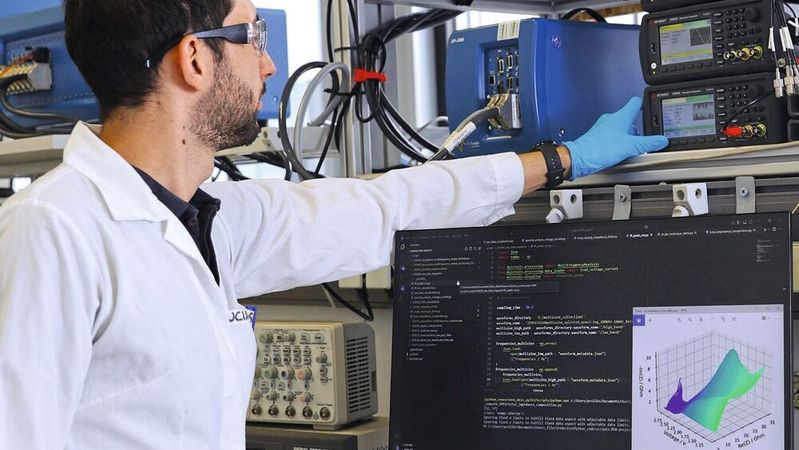
Laboratory setup for computer-assisted real-time impedance measurement on a lithium-ion battery cell for condition analysis.
(Image: Fraunhofer IFAM)
Powerful and safe batteries are a key component for the success of electromobility. Accordingly, measuring a battery's capacity and condition is crucial. The most informative method here is impedance spectroscopy. Impedance itself cannot be measured directly; it is calculated from the ratio of current to voltage. It provides information about the state of charge (SOC) and allows conclusions to be drawn about the internal condition, including cathodes, anodes, or electrolytes (SoH, State of Health), as well as the safety condition.
To obtain all the necessary data, complex measurements and analysis methods are required. Furthermore, impedance measurement has so far only been feasible during rest periods. It typically takes up to twenty minutes before the data for battery characterization is available.
The information provides a precise, in-depth, and differentiated picture of the battery's interior.
Determine Measurement Values for the First Time During Ongoing Operation
Researchers at the Fraunhofer Institute for Manufacturing Technology and Advanced Materials—IFAM—have further developed the method under the leadership of Prof. Fabio La Mantia. Dynamic impedance spectroscopy now makes it possible, for the first time, to obtain measurement data on the battery's status during ongoing operation and make them available in real time. The information gathered goes far beyond just details about charge capacity or remaining operating time; it provides a precise, in-depth, and differentiated picture of the battery's internal structure. This also allows for the individual prediction of the battery cell's potential lifespan.
Existing battery charge level displays, which are integrated into vehicle electronics in electric cars, for example, also measure continuously during use but provide less information, respond significantly slower, and are less accurate.
“Dynamic impedance spectroscopy initially opens up new possibilities for optimizing battery management and thus extends the lifespan of batteries. Additionally, it paves the way for the use of batteries in safety-critical applications,” explains project manager Dr. Hermann Pleteit.
High-Resolution Measurement Method And Direct Analysis
In the novel method, a multi-frequency test signal is superimposed onto the discharge or charge current. The different frequencies provide insights into the status of specific components or processes within the battery. The response signal of current and voltage is measured up to one million times per second. All data from the high-resolution measurement process are fed into simultaneous data processing. From this, software calculates the impedance values' progression and deduces the condition of the respective battery cell.
We have developed algorithms that significantly reduce the data volume before analysis without distorting the information.
Dr. Hermann Pleteit., project manager, Fraunhofer IFAM
To ensure that results are available in real time despite the enormous volume of data generated during high-resolution measurements, the Fraunhofer researchers applied an additional trick. "We developed algorithms that significantly reduce the data volumes before analysis without distorting the information," says Pleteit. This way, real-time monitoring of all aspects of the battery's condition through impedance spectroscopy offers significant advantages.
Impedance also allows conclusions to be drawn about the temperature inside the cell. Therefore, battery management systems can, for example, immediately detect during an electric vehicle's operation if a cell heats up significantly in a specific area using impedance data. They can then shut down the cell or reduce its performance. Traditional temperature sensors become unnecessary; they are mounted on the battery's outer casing and detect thermal issues only with a delay, often when it is too late and the cell is already damaged.
Charging stations for electric vehicles also benefit from this. For instance, one could choose between particularly fast charging and slower but more gentle charging. During a quick stop at a rest area, the battery management system ensures fast charging without causing dangerous temperature spikes or overloading the internal components. If the car is parked at the charging station for several hours, the management system charges the battery slowly and gently to extend its lifespan.
Such systems could be used in eco-friendly electric aircraft. This market is just beginning to develop.
Dr. Hermann Pleteit., project manager, Fraunhofer IFAM
Application Also Interesting for Renewable Energy And Aviation
Providers of renewable energy such as wind or photovoltaic systems, which need to balance fluctuations in power production with energy storage, gain stable and consistently controllable battery systems with Fraunhofer technology.
Date: 08.12.2025
Naturally, we always handle your personal data responsibly. Any personal data we receive from you is processed in accordance with applicable data protection legislation. For detailed information please see our privacy policy.
Consent to the use of data for promotional purposes
I hereby consent to Vogel Communications Group GmbH & Co. KG, Max-Planck-Str. 7-9, 97082 Würzburg including any affiliated companies according to §§ 15 et seq. AktG (hereafter: Vogel Communications Group) using my e-mail address to send editorial newsletters. A list of all affiliated companies can be found here
Newsletter content may include all products and services of any companies mentioned above, including for example specialist journals and books, events and fairs as well as event-related products and services, print and digital media offers and services such as additional (editorial) newsletters, raffles, lead campaigns, market research both online and offline, specialist webportals and e-learning offers. In case my personal telephone number has also been collected, it may be used for offers of aforementioned products, for services of the companies mentioned above, and market research purposes.
Additionally, my consent also includes the processing of my email address and telephone number for data matching for marketing purposes with select advertising partners such as LinkedIn, Google, and Meta. For this, Vogel Communications Group may transmit said data in hashed form to the advertising partners who then use said data to determine whether I am also a member of the mentioned advertising partner portals. Vogel Communications Group uses this feature for the purposes of re-targeting (up-selling, cross-selling, and customer loyalty), generating so-called look-alike audiences for acquisition of new customers, and as basis for exclusion for on-going advertising campaigns. Further information can be found in section “data matching for marketing purposes”.
In case I access protected data on Internet portals of Vogel Communications Group including any affiliated companies according to §§ 15 et seq. AktG, I need to provide further data in order to register for the access to such content. In return for this free access to editorial content, my data may be used in accordance with this consent for the purposes stated here. This does not apply to data matching for marketing purposes.
Right of revocation
I understand that I can revoke my consent at will. My revocation does not change the lawfulness of data processing that was conducted based on my consent leading up to my revocation. One option to declare my revocation is to use the contact form found at https://contact.vogel.de. In case I no longer wish to receive certain newsletters, I have subscribed to, I can also click on the unsubscribe link included at the end of a newsletter. Further information regarding my right of revocation and the implementation of it as well as the consequences of my revocation can be found in the data protection declaration, section editorial newsletter.
Real-time condition monitoring even makes it possible to consider future use in safety-critical scenarios. “Such systems could be used in eco-friendly electric aircraft, for example. This market is just beginning to develop. Manufacturers in the shipping industry are also showing interest,” says Pleteit.
Impedance spectroscopy is not only suitable for the currently common lithium-ion batteries, but the method is also applicable to battery types based on solid-state, sodium-ion, or lithium-sulfur technologies, as well as other future technologies.



:quality(80)/p7i.vogel.de/wcms/a0/47/a04725ef9bd09fb6c9341a1bea1b5d93/0130443083v1.jpeg "Here, a type of plastic pallet is produced by thermoforming (vacuum forming or deep drawing) at the corresponding division of New England Plastics in the USA. This division, which specializes in so-called liners, is now part of Ringmetall ... (Image:New England Plastics)")
:quality(80)/p7i.vogel.de/wcms/e3/42/e342b3c593ea92d56604d3be969e9c9a/0130437231v1.jpeg "Daimler Truck will be building even more trucks at its Czech plant in Cheb in the future. This is because it is now being expanded for strategic cost-saving reasons ... (Image:Daimler Truck)")
:quality(80)/p7i.vogel.de/wcms/23/99/23992bf2dcdc432c9b7209c34a4a7c48/0129733089v1.jpeg "Stork relies on the modular Neoswiss turning system from Iscar to shorten the set-up times for its sliding headstock lathes and work more productively. (Image:Iscar)")
:quality(80)/p7i.vogel.de/wcms/7d/e2/7de2923434b2f1a78ba5482d8d335269/0113143253v1.jpeg "In our China Market Insider we regularly provide you with relevant information directly from China. (Image:© Eisenhans - stock.adobe.com)")
:quality(80)/p7i.vogel.de/wcms/b7/36/b736dfebc16c42d6901d0d0e1f390493/3d-druck-20factory-20--20ki-20generiert-1920x1079v1.png "(Source: AI-generated)")
:quality(80)/p7i.vogel.de/wcms/79/b2/79b21aad663f4a7bd4472afc1c1afc62/0130433994v1.jpeg "Mission Joyride: The free-flying robot (shown here in the rendering) will relieve the ISS crew of logistics tasks from 2027 with its two mechanical arms. (Image:Icarus Robotics)")
:quality(80)/p7i.vogel.de/wcms/6b/45/6b4546fa6ebf305c3660326909363f32/0130437089v1.jpeg "Industrial AI in action: Rockwell Automation presents practical solutions for self-controlling production systems at the Hannover Messe. (Image:Rainer Jensen, Deutsche Messe)")
:quality(80)/p7i.vogel.de/wcms/78/e9/78e9188c25a8a94e67c34c9bf8ffe495/visual-agile-20robots-20and-20google-20deepmind-20partner-20to-20bring-20intelligence-20to-20robotics-2500x1406v1v1.jpeg "Together, the partners are developing adaptable, intelligent robots for a wide range of applications (Image:Agile Robots SE)")
:quality(80)/p7i.vogel.de/wcms/59/a2/59a2b11f0aa1b700eff02addd5de8703/adobestock-1788280853--c2-a9-20satria-20-e2-80-93-20stock-adobe-com-5081x2860v1v1.jpeg "Quantum computers require extreme cooling to temperatures close to absolute zero in order to keep qubits stable. (Image:satria - stock.adobe.com)")
:quality(80)/p7i.vogel.de/wcms/62/5f/625f41e87ebfef156a98c8e6393e32fd/0130211654v1.jpeg "Axial flux motors have some advantages over radial flux motor—but their production is currently still expensive. (Image:RWTH Aachen University)")
:quality(80)/p7i.vogel.de/wcms/f6/ae/f6aec4f6241b36ed5e3a990ac9176b42/0130429460v1.jpeg "Verne, Pony.ai and Uber want to launch a robotaxi service in Europe. (Image:Verne)")
:quality(80)/p7i.vogel.de/wcms/d7/88/d788699f2974708a332baa4e7a62fa9e/0130438967v1.jpeg "Skoda is withdrawing from China. The brand has produced well over three million vehicles there. (Image:Skoda car)")
:quality(80)/p7i.vogel.de/wcms/b0/43/b043b86899837532aad62d63368a917a/0130371361v1.jpeg "Skoda leaves the chinese market.
(Image:Skoda)")
:quality(80)/p7i.vogel.de/wcms/c3/c4/c3c4ce270b083eeac55654148611f064/0130237945v1.jpeg "China is not giving up on hydrogen, but is intensifying its efforts. (Image:freely licensed from Pixabay)")
:quality(80)/p7i.vogel.de/wcms/ee/09/ee09acbd6dc896df25affaa9e871e6e5/0130440053v1.jpeg "IMS chip module for simple system integration into an ion mobility spectrometer. (Image:Fraunhofer IPMS)")
:quality(80)/p7i.vogel.de/wcms/10/6c/106cd22de5f68a0f74639d654827228c/0130345302v1.jpeg "Made in India: According to the India Electronics and Semiconductor Association (IESA), the country should be able to produce between 75 and 80 million chips by the beginning of 2027, once the plants currently under construction become operational. (Image:Pixabay (Montage: Sebastian Gerstl))")
:quality(80)/p7i.vogel.de/wcms/a5/ed/a5ed6fda029d362732a293d6b19d74c4/0130444216v1.jpeg "Thirteen executives from the Chinese chip industry have drawn up a plan to achieve an 80% self-sufficiency rate for semiconductors by 2030. (Image:Maxim_Kazmin - stock.adobe.com)")
:quality(80)/p7i.vogel.de/wcms/31/a6/31a646018b34d8e0a44bfc8bf17837f6/0130361632v1.jpeg "For many companies, PFAS are considered indispensable in electronics production. (Image:freely licensed)")
:quality(80)/p7i.vogel.de/wcms/53/6d/536d1bcea1368ec71b5c3671f9a00020/0125827323v1.jpeg "The image shows a layered structure of transition metals (blue) and sulfur (yellow). The space between the layers can be occupied by sodium ions (purple) and organic solvent molecules (red, brown). (Image:Y. Sun et al., Nature Materials 2025)")
:quality(80)/p7i.vogel.de/wcms/ae/ef/aeefd454917c2812921ef0ec7a698c0b/0129906834v1.jpeg "NXP has developed a method of bringing laboratory-quality battery cell diagnostics directly into electric vehicles. (Image:NXP)")
:quality(80)/p7i.vogel.de/wcms/95/9a/959aa9590fd5a3954ab0ab2a6edfbec9/0128962648v1.jpeg "Electrochemical analysis: With the help of slurry analysis, efficiency in the development of lithium-ion batteries can be increased. Using suitable hardware, developers can determine the ideal ratio between active material and conductive additives. (Image:Hioki)")