September 23, the U.S. Department of Commerce submitted a legislative proposal that calls for banning key technologies from China for connected vehicles. Effectively, this would mean the import of almost all vehicles manufactured in China would be banned—and also pose significant challenges for European car manufacturers.
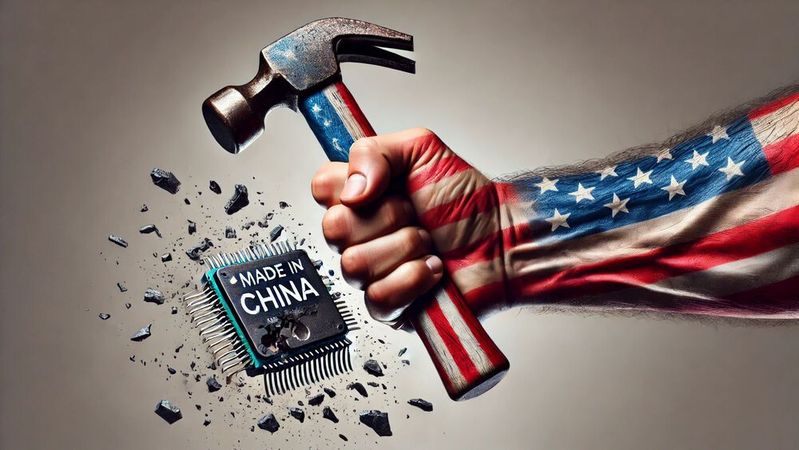
Drastic Measures: The United States aims to completely ban ADAS software and hardware, as well as connectivity technologies coming from China and used in connected vehicles, from U.S. roads by 2030.
(Image: AI-generated / DALL-E)
In the longstanding technology trade dispute, the next level of escalation is emerging: The US government has announced a complete ban on the import of key technologies from Chinese and Russian production for connected and autonomous vehicles by no later than 2030. The US Department of Commerce introduced the corresponding legislative proposal on September 23, 2024.
Software bans by 2027, hardware components by 2030
Accordingly, by the year 2027, connected and autonomous vehicles approved for the American market will no longer contain any software originating from China or Russia. By the vehicle model year 2030, this ban will also extend to certain hardware technologies necessary for connectivity and ADAS (Advanced Driver-Assistance Systems). Depending on the vehicle manufacturers' production cycle and the duration of the approval process, effectively from the year 2029, none of the affected components will be installed if the vehicle is to be approved for the US market.
The restrictions are extensive and include systems and components that connect the vehicle to the outside world, including Bluetooth, cellular, satellite, and Wi-Fi modules. Additionally, testing autonomous vehicles that use corresponding technologies from China will be completely prohibited on American roads.
Consequently, the United States is significantly intensifying its ongoing restrictions on vehicles, software, and components manufactured in China. At the beginning of this month, the Biden administration decided on steep tariff increases on Chinese imports, including a [100 percent tariff on electric vehicles as well as new increases on batteries for electric vehicles and key minerals].
Concerns regarding espionage and disruptions of critical infrastructure
So far, the US government has only published a notice of proposed rulemaking (NPRM). If this is enacted into law as proposed, it would prohibit the sale or import of connected vehicles containing the mentioned technologies, as well as the import of certain components from "countries of concern." This primarily refers to China and Russia, as well as "entities with sufficient connections to the People's Republic of China or Russia." While this regulation would effectively ban Chinese vehicles completely from American roads, it would also impose significant obstacles for European manufacturers: to gain approval in the United States, they must demonstrate that none of the components affected by the regulation and made in China are used.
"Chinese automakers are trying to dominate the technologies for connected vehicles in the United States and globally," the Biden Administration stated during the recent tightening of trade laws. "This poses a new threat to our national security, including through our supply chains." There are serious concerns that Chinese companies might use their vehicle technologies to collect data about US drivers and infrastructure and relay it to their government. This includes data collected inside the vehicle, such as sensitive driver and passenger information, as well as cameras and sensors that enable automated driving systems and record detailed information about American infrastructure. Additionally, there are concerns about potential foreign manipulation of internet-connected vehicles and navigation systems.
The White House initiated an investigation in February regarding these potential dangers. The current legislative proposal is the result of this study. "If foreign adversaries develop software for a vehicle, it can be used for surveillance and be remotely controlled, which threatens the privacy and safety of Americans on the road,"CNBC quotes US Commerce Secretary Gina Raimondo."In an extreme situation, a foreign adversary could shut down all vehicles operating in the United States at the same time, or take control of them, thereby causing accidents and blocking roads." Therefore, the hardware and software components in connected vehicles covered by the ban would enable the collection of information about geographical areas or critical infrastructure, and thus offer malicious actors the opportunity to disrupt the operation of the infrastructure or the vehicles themselves.
Possible exemptions still under consideration
The Alliance for Automotive Innovation (AAI), a trade group representing automakers like Volkswagen, General Motors, Toyota, and Hyundai, has already warned about a too stringent timeline for these bans. They pointed out that replacing such key components in upcoming vehicle models would be very cost- and time-intensive. The group highlighted that hardware and software for connected vehicles are developed globally, including in China, but could not provide specific details on the extent to which components manufactured in China are currently predominant in U.S. models.
Additionally, it should be investigated what happens with components that are manufactured in Mexico or South America. The USA has a free trade agreement with Mexico; however, Chinese companies have been producing electronic components in South America for some time now and labeling them for Mexico. Critics warn that Chinese products might effectively enter the US market this way.
Date: 08.12.2025
Naturally, we always handle your personal data responsibly. Any personal data we receive from you is processed in accordance with applicable data protection legislation. For detailed information please see our privacy policy.
Consent to the use of data for promotional purposes
I hereby consent to Vogel Communications Group GmbH & Co. KG, Max-Planck-Str. 7-9, 97082 Würzburg including any affiliated companies according to §§ 15 et seq. AktG (hereafter: Vogel Communications Group) using my e-mail address to send editorial newsletters. A list of all affiliated companies can be found here
Newsletter content may include all products and services of any companies mentioned above, including for example specialist journals and books, events and fairs as well as event-related products and services, print and digital media offers and services such as additional (editorial) newsletters, raffles, lead campaigns, market research both online and offline, specialist webportals and e-learning offers. In case my personal telephone number has also been collected, it may be used for offers of aforementioned products, for services of the companies mentioned above, and market research purposes.
Additionally, my consent also includes the processing of my email address and telephone number for data matching for marketing purposes with select advertising partners such as LinkedIn, Google, and Meta. For this, Vogel Communications Group may transmit said data in hashed form to the advertising partners who then use said data to determine whether I am also a member of the mentioned advertising partner portals. Vogel Communications Group uses this feature for the purposes of re-targeting (up-selling, cross-selling, and customer loyalty), generating so-called look-alike audiences for acquisition of new customers, and as basis for exclusion for on-going advertising campaigns. Further information can be found in section “data matching for marketing purposes”.
In case I access protected data on Internet portals of Vogel Communications Group including any affiliated companies according to §§ 15 et seq. AktG, I need to provide further data in order to register for the access to such content. In return for this free access to editorial content, my data may be used in accordance with this consent for the purposes stated here. This does not apply to data matching for marketing purposes.
Right of revocation
I understand that I can revoke my consent at will. My revocation does not change the lawfulness of data processing that was conducted based on my consent leading up to my revocation. One option to declare my revocation is to use the contact form found at https://contact.vogel.de. In case I no longer wish to receive certain newsletters, I have subscribed to, I can also click on the unsubscribe link included at the end of a newsletter. Further information regarding my right of revocation and the implementation of it as well as the consequences of my revocation can be found in the data protection declaration, section editorial newsletter.
The timeline for when the final regulations will be enacted is not yet known, as a final version is still being drafted. The US Department of Commerce has announced plans to closely collaborate with the industry, political allies and partners of the USA, and other stakeholders throughout the regulatory process to minimize unintended economic consequences or disruptions. For instance, procedures are being developed that might allow smaller vehicle manufacturers to be temporarily or completely exempt from the regulations in exceptional cases. At the same time, it was emphasized that all measures will be taken in the interest of the national security of the USA.
China responds calmly, central bank enacts economic aid
Initially, the Chinese economy appeared unimpressed by the latest US maneuvers in the trade dispute: According to CNBC, all Chinese vehicle manufacturers listed on the Hong Kong stock exchange experienced a slight increase in value.
This may also be related to the announcement by the Chinese central bank to provide a comprehensive investment package of 800 billion yuan (approximately 101 billion euros) to reinvigorate the recently faltering Chinese economy and ensure the liquidity of troubled Chinese companies. According to the China Automobile Dealers Association (CADA), auto dealers in the country had to absorb a total loss of 138 billion yuan (17.55 billion euros) in the first eight months of the year, as they were forced to sell new cars at significant discounts.



:quality(80)/p7i.vogel.de/wcms/a0/47/a04725ef9bd09fb6c9341a1bea1b5d93/0130443083v1.jpeg "Here, a type of plastic pallet is produced by thermoforming (vacuum forming or deep drawing) at the corresponding division of New England Plastics in the USA. This division, which specializes in so-called liners, is now part of Ringmetall ... (Image:New England Plastics)")
:quality(80)/p7i.vogel.de/wcms/23/99/23992bf2dcdc432c9b7209c34a4a7c48/0129733089v1.jpeg "Stork relies on the modular Neoswiss turning system from Iscar to shorten the set-up times for its sliding headstock lathes and work more productively. (Image:Iscar)")
:quality(80)/p7i.vogel.de/wcms/7d/e2/7de2923434b2f1a78ba5482d8d335269/0113143253v1.jpeg "In our China Market Insider we regularly provide you with relevant information directly from China. (Image:© Eisenhans - stock.adobe.com)")
:quality(80)/p7i.vogel.de/wcms/9d/2b/9d2b802f800e5caf17b2831e74228cd3/screenshot-202026-03-03-20103822-609x343v1v1.png "Visual comparison: on the left, a clean, burr-free cut edge; on the right, typical burr formation with oxidation discoloration. This illustrates how strongly parameter control and gas management influence the quality of the result. (CO₂ laser, oxygen cutting gas, sheet thickness approx. 15 mm). (Image:Picture: Rime)")
:quality(80)/p7i.vogel.de/wcms/b7/36/b736dfebc16c42d6901d0d0e1f390493/3d-druck-20factory-20--20ki-20generiert-1920x1079v1.png "(Source: AI-generated)")
:quality(80)/p7i.vogel.de/wcms/79/b2/79b21aad663f4a7bd4472afc1c1afc62/0130433994v1.jpeg "Mission Joyride: The free-flying robot (shown here in the rendering) will relieve the ISS crew of logistics tasks from 2027 with its two mechanical arms. (Image:Icarus Robotics)")
:quality(80)/p7i.vogel.de/wcms/6b/45/6b4546fa6ebf305c3660326909363f32/0130437089v1.jpeg "Industrial AI in action: Rockwell Automation presents practical solutions for self-controlling production systems at the Hannover Messe. (Image:Rainer Jensen, Deutsche Messe)")
:quality(80)/p7i.vogel.de/wcms/78/e9/78e9188c25a8a94e67c34c9bf8ffe495/visual-agile-20robots-20and-20google-20deepmind-20partner-20to-20bring-20intelligence-20to-20robotics-2500x1406v1v1.jpeg "Together, the partners are developing adaptable, intelligent robots for a wide range of applications (Image:Agile Robots SE)")
:quality(80)/p7i.vogel.de/wcms/59/a2/59a2b11f0aa1b700eff02addd5de8703/adobestock-1788280853--c2-a9-20satria-20-e2-80-93-20stock-adobe-com-5081x2860v1v1.jpeg "Quantum computers require extreme cooling to temperatures close to absolute zero in order to keep qubits stable. (Image:satria - stock.adobe.com)")
:quality(80)/p7i.vogel.de/wcms/62/5f/625f41e87ebfef156a98c8e6393e32fd/0130211654v1.jpeg "Axial flux motors have some advantages over radial flux motor—but their production is currently still expensive. (Image:RWTH Aachen University)")
:quality(80)/p7i.vogel.de/wcms/b5/c7/b5c749d16c8a2e789c1469c2c8c1c387/0130452780v1.jpeg "Volvo Trucks completes road tests with its new hydrogen-powered trucks. (Image:Volvo Trucks)")
:quality(80)/p7i.vogel.de/wcms/ba/69/ba6975f417a85147084f38dc2cd209e2/0130451386v1.jpeg "Together with Nvidia, Hyundai wants to develop an architecture that will be used for level 4 robotaxis (image) as well as for level 2 customer vehicles. (Image:Hyundai)")
:quality(80)/p7i.vogel.de/wcms/93/4d/934de334b47abaa526c78cba1417d7af/0130343495v1.jpeg "The new SU7 is available in three price categories, \"Standard\", \"Pro\" and \"Max\" (Image:Xiaomi)")
:quality(80)/p7i.vogel.de/wcms/df/a0/dfa048434bb94f1b7d030e346b25b3ae/0130373541v1.jpeg "From August, BMW will be producing the i3 at its main plant in Munich - which the car manufacturer has extensively rebuilt for this purpose. (Image:Rainer Haeckl)")
:quality(80)/p7i.vogel.de/wcms/ee/09/ee09acbd6dc896df25affaa9e871e6e5/0130440053v1.jpeg "IMS chip module for simple system integration into an ion mobility spectrometer. (Image:Fraunhofer IPMS)")
:quality(80)/p7i.vogel.de/wcms/10/6c/106cd22de5f68a0f74639d654827228c/0130345302v1.jpeg "Made in India: According to the India Electronics and Semiconductor Association (IESA), the country should be able to produce between 75 and 80 million chips by the beginning of 2027, once the plants currently under construction become operational. (Image:Pixabay (Montage: Sebastian Gerstl))")
:quality(80)/p7i.vogel.de/wcms/a5/ed/a5ed6fda029d362732a293d6b19d74c4/0130444216v1.jpeg "Thirteen executives from the Chinese chip industry have drawn up a plan to achieve an 80% self-sufficiency rate for semiconductors by 2030. (Image:Maxim_Kazmin - stock.adobe.com)")
:quality(80)/p7i.vogel.de/wcms/31/a6/31a646018b34d8e0a44bfc8bf17837f6/0130361632v1.jpeg "For many companies, PFAS are considered indispensable in electronics production. (Image:freely licensed)")
:fill(fff,0)/images.vogel.de/vogelonline/companyimg/76800/76895/65.jpg "FAULHABER_120mm.jpg ()")
:quality(80)/p7i.vogel.de/wcms/98/f4/98f4d32f11a3ecb4ae3911e8cd9df779/0118509994.jpeg "The tariffs on Chinese goods being imported into the US are being significantly increased in some cases. (Image:Royalty-free)")
:quality(80)/p7i.vogel.de/wcms/48/3b/483bf2210f6160df5b2ff1ff895ec228/0124197821v1.jpeg "The \"Connected Vehicles Final Rule\" presents challenges for automakers and suppliers. (Image:Dall-E / AI-generated)")
:quality(80)/p7i.vogel.de/wcms/0a/a1/0aa140e8ef31c75db3527570f3f98920/0129006304v1.jpeg "The planned EU regulation to exclude Chinese technologies from sectors such as telecommunications or power supplies would hit Chinese manufacturers such as Huawei, ZTE or JA Solar Technology particularly hard. The Chinese solar industry in particular would have to prepare for bankruptcies. Chinese politicians have expressed correspondingly harsh criticism of the plans. (Image:freely licensed)")