Since August 6, 2025, a 15% tariff has been in effect in the USA on goods from the EU. However, US President Trump is already preparing the next broadside: He wants 100% tariffs on all semiconductor products—unless companies produce them in the USA.
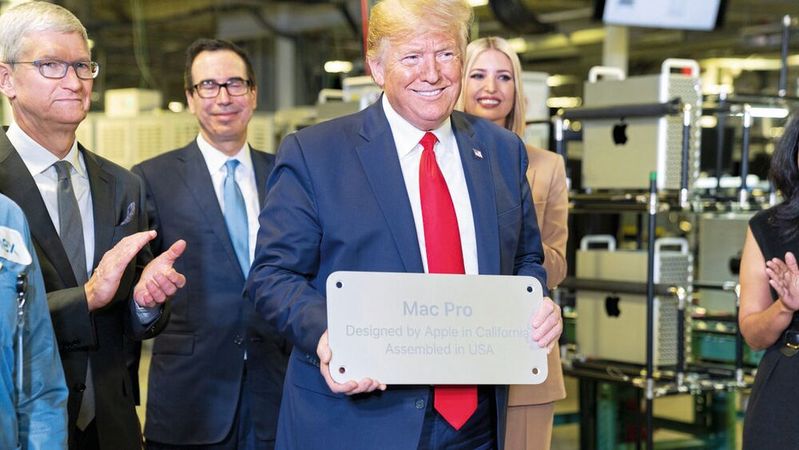
Donald Trump and Apple CEO Tim Cook during a visit by the US President to Apple's Flextronics International LTD-Austin Product Introduction Center facility during Trump's first term in November 2019. At a White House press conference last Wednesday, where Apple pledged to invest $100 billion in its US manufacturing facilities, the US President pulled out a current favorite topic: 100% tariffs on all semiconductors. This contradicts existing agreements, such as those with South Korea and the EU...
Tariffs, tariffs, and more tariffs. US President Donald Trump regularly and proudly claims that the word "tariff" is one of his favorite words in the dictionary. He sees tariffs as the ultimate weapon in the economic battle against the rest of the world. He has his sights set on the chip industry in particular: At the beginning of the year, Trump publicly stated his intention to impose tariffs of up to 100% on semiconductors. The goal behind this: to stimulate domestic industry, reduce dependence on foreign imports, and encourage companies from Asia or the EU to invest in manufacturing in the USA.
As Soon As the First Tariffs Take Effect, the President Causes Confusion Again
When the sweeping attack came in April, in which numerous countries and economic areas were—seemingly arbitrarily—subjected to so-called "reciprocal tariffs," this caused confusion and uncertainty, particularly in the semiconductor market. Initially, it was stated that semiconductor products were exempt from customs duties. Then the Ministry of Commerce published a tariff list showing that this only applied to a small portion of semiconductor products—and, above all, that manufacturing equipment was not exempt. After several weeks of chaotic back-and-forth, the semiconductor issue became surprisingly quiet. Instead, negotiations were held with many countries regarding the level of the general new tariffs from the respective foreign countries.
A 15% tariff was agreed with the EU. This is now officially in effect (as of August 8, 2025). And now Trump is pulling out his old favorite topic again: semiconductor tariffs! It's supposed to be a 100% tariff surcharge on all foreign companies—yes, honestly, really! At least, that's what US President Donald Trump announced once again, this time at a press conference in the White House, which Apple CEO Tim Cook was also present. However, there is a major, serious exception: The tariffs will not apply to companies that manufacture in the US or have committed to doing so.
The "Exceptions" Would Completely Distort the Global Market
The reason for Tim Cook's attendance was actually something else: He announced that Apple would invest 100 billion USD in its production facilities in the United States over the coming years. But, of course, it wouldn't be an announcement under the Trump administration without the US President immediately claiming it for his own credit.
For companies like Apple that have committed to manufacturing in the United States, he told reporters in the Oval Office: "There will be no charge." At the same time, he issued a warning to companies that had announced investment plans in the US but—like TSMC—wanted to make this dependent on possible semiconductor tariffs (or the lack thereof): "If for any reason you say you're going to build and then you don't build, we will calculate that after the fact, it adds up, and we will bill you for the cost at a later date, you have to pay, and that's a guarantee," Trump added in his usual style.
It sounds like another bombshell—but once again, Trump has only expressed his own opinion, without this being a real government decision at this point. A formal announcement on semiconductor tariffs remains pending, and it remains unclear how this will affect companies and countries around the world. It's, once again, adding fuel to a chaotic, raging fire.
Accordingly, Trump's comments on Wednesday once again triggered an immediate flood of reactions from affected countries and business associations, as reported by the Reuters news agency. South Korea's top trade representative stated on Thursday that major chip manufacturers Samsung Electronics and SK Hynix would not be subject to the 100 percent tariffs. Furthermore, South Korea had already firmly agreed, as part of a trade agreement between Washington and Seoul, that there would only be "best-case tariffs for semiconductors" between the countries.
On the other hand, the president of the Philippine semiconductor industry, Dan Lachica, stated that Trump's plan was "devastating" for his country. His counterpart from Malaysia expressed similar concerns. Both nations have increasingly established themselves in recent years as cost-effective locations for the final assembly of semiconductors, especially in the packaging sector.
Liu Chin-ching, Minister of the Taiwanese National Development Council, told reporters on Thursday that Taiwanese companies are building US factories or acquiring US companies with local factories, as well as collaborating with US chip manufacturers to counteract potential chip tariffs. If these statements are true, the Taiwanese chip contract manufacturer TSMC will likely escape relatively unscathed. After all, the company is currently investing heavily in expanding its chip production facilities in Arizona. This means that even major TSMC customers like Nvidia and AMD are likely to escape with only a few minor injuries.
Date: 08.12.2025
Naturally, we always handle your personal data responsibly. Any personal data we receive from you is processed in accordance with applicable data protection legislation. For detailed information please see our privacy policy.
Consent to the use of data for promotional purposes
I hereby consent to Vogel Communications Group GmbH & Co. KG, Max-Planck-Str. 7-9, 97082 Würzburg including any affiliated companies according to §§ 15 et seq. AktG (hereafter: Vogel Communications Group) using my e-mail address to send editorial newsletters. A list of all affiliated companies can be found here
Newsletter content may include all products and services of any companies mentioned above, including for example specialist journals and books, events and fairs as well as event-related products and services, print and digital media offers and services such as additional (editorial) newsletters, raffles, lead campaigns, market research both online and offline, specialist webportals and e-learning offers. In case my personal telephone number has also been collected, it may be used for offers of aforementioned products, for services of the companies mentioned above, and market research purposes.
Additionally, my consent also includes the processing of my email address and telephone number for data matching for marketing purposes with select advertising partners such as LinkedIn, Google, and Meta. For this, Vogel Communications Group may transmit said data in hashed form to the advertising partners who then use said data to determine whether I am also a member of the mentioned advertising partner portals. Vogel Communications Group uses this feature for the purposes of re-targeting (up-selling, cross-selling, and customer loyalty), generating so-called look-alike audiences for acquisition of new customers, and as basis for exclusion for on-going advertising campaigns. Further information can be found in section “data matching for marketing purposes”.
In case I access protected data on Internet portals of Vogel Communications Group including any affiliated companies according to §§ 15 et seq. AktG, I need to provide further data in order to register for the access to such content. In return for this free access to editorial content, my data may be used in accordance with this consent for the purposes stated here. This does not apply to data matching for marketing purposes.
Right of revocation
I understand that I can revoke my consent at will. My revocation does not change the lawfulness of data processing that was conducted based on my consent leading up to my revocation. One option to declare my revocation is to use the contact form found at https://contact.vogel.de. In case I no longer wish to receive certain newsletters, I have subscribed to, I can also click on the unsubscribe link included at the end of a newsletter. Further information regarding my right of revocation and the implementation of it as well as the consequences of my revocation can be found in the data protection declaration, section editorial newsletter.
It would be a prime example of extreme capitalism: Large companies that can invest billions would emerge unscathed. Small businesses, on the other hand, could be completely ruined. "Large, well-capitalized companies that can afford to manufacture in America will benefit the most. It's survival of the largest," Brian Jacobsen, chief economist at investment advisory firm Annex Wealth Management, told Reuters.
Vague, Ambiguous, And Contradictory—As Usual
And of course, one thing remains unclear: Does this only apply to individual semiconductors—or also to end products in which these semiconductors are incorporated? Sure, chips from Chinese manufacturers like SMIC or Huawei would almost certainly not be exempt. But chips from these companies are used in numerous devices or components manufactured in other Asian countries. "If these tariffs were imposed without a component tariff, it probably wouldn't make much of a difference," Martin Chorzempa, senior fellow at the Peterson Institute for International Economics, told Reuters reporters. In other words, it would be much ado about nothing.
Trump, on the other hand, remains convinced that chip companies will expand production in the US through such a drastic step. This, as many economic observers have been reiterating for months, would massively increase the prices of electronics in the US in general, since chips and end products are produced in Asia. Everything manufactured using processes below 5 nanometers currently comes exclusively from Taiwan—and the new TSMC facilities in Arizona won't change that. And industry experts consider it highly questionable whether Intel's 18-A process will have any lasting impact on this.
And, of course, it remains unclear what would happen to the tariff agreements already made with individual trade zones. After all, the EU recently agreed with the USA on a 15% tariff. This also specifically affects products like cars, medical products, and devices—and semiconductors! (sg)



:quality(80)/p7i.vogel.de/wcms/3f/32/3f3272843333b0e8215db84152362ba8/0132070616v1.jpeg "Linear guides combined with other components form complex systems for automation. (Image:IEF-Werner)")
:quality(80)/p7i.vogel.de/wcms/77/34/7734860be08e4d07f4c3c9e6cc24a0c1/0132067866v1.jpeg "There are only two and a half months left until AMB 2026. As summer comes to an end, Kasto is significantly turning up the heat in terms of sawing technology. The central highlight is called Kastossb, which has been significantly improved. But there's more ... (Image: Kasto)")
:quality(80)/p7i.vogel.de/wcms/e8/44/e84497c2e3533f93e29c3f73384db4ac/0132054545v1.jpeg "Maros Sefcovic is the EU Trade Commissioner. He has now spoken with China's Trade Minister Wang Wentao on the topic of avoiding a trade war. It appears that both trade regions are approaching each other. Some points of the possibilities are expected to be implemented in the fall ... (Image: EU)")
:quality(80)/p7i.vogel.de/wcms/de/45/de450b818441760d51de9d8d1895e8b3/0131815699v1.jpeg "HAM's carbide and PCD tools feature mirror-smooth surfaces and defined cutting edge preparations, even in catalog items, ensuring optimal chip removal. They are therefore perfect for minimal quantity lubrication. (Image:HAM)")
:quality(80)/p7i.vogel.de/wcms/84/39/8439dc34d0a08cdd8c3bc644bd856d89/mohamed-hassan-financial-4560047-1280v1.jpeg "The biggest AI cost traps – from data preparation to unpredictable cloud fees. (Source: )")
:quality(80)/p7i.vogel.de/wcms/5b/e5/5be54d16dd8c406b9cd9dbc892f580cb/0132041722v1.jpeg "Figure 03 in action: Thanks to tactile sensors and cameras in its hands, the robot sequences delivered components for assembly. (Image: BMW)")
:quality(80)/p7i.vogel.de/wcms/b2/98/b29878b3d1e7521d48202dfab2f3c4c8/0131991662v1.jpeg "Collaborative Industry brings people and robots together. (Image: ©Emma - stock.adobe.com / AI-generated)")
:quality(80)/p7i.vogel.de/wcms/49/54/495466c2d41b13c5c3da89d985429692/adobestock-2071878125v1.jpeg "Until now, workers had to painstakingly inspect power lines by hand, a tough and dangerous job. The robotic snake takes over the riskiest climbing tasks for them. (Source: © Kingdola – stock.adobe.com/AI-generated)")
:quality(80)/p7i.vogel.de/wcms/15/00/1500298944949437fde0e0ba332eaa3c/adobestock-1898612059v1.jpeg "(Source: Anusa - stock.adobe.com)")
:quality(80)/p7i.vogel.de/wcms/5f/59/5f59f681a45fb2359bb8c8c07d4adb55/siemens-pave360-automotive-01v1.jpeg "Virtual twins, AI-powered tests, and new validation concepts: vehicle development is becoming increasingly software-driven—and is thus gaining speed. (Image: Siemens)")
:quality(80)/p7i.vogel.de/wcms/03/c2/03c2c967f78f3530377c100f88c4dd45/0132009221v1.jpeg "At Fraunhofer IAP, they have managed to achieve strong adhesive bonds virtually at the push of a button. Adhesive capsules are the secret... (Image: Fraunhofer IAP)")
:quality(80)/p7i.vogel.de/wcms/2e/3e/2e3e7b223f8074157a0892f8c37d8905/bild1-pgn-plus-anwendungsbild-07-04-2018v1.jpeg "Thanks to a digital solution for material selection, Schunk was able to identify new emission-reducing approaches and reduce the CO2 output of products. (Source: Schunk)")
:quality(80)/p7i.vogel.de/wcms/b6/bb/b6bbb8b6cfc885e28518d42d31efaaa4/org-blobs-user-response-file-output-e3944719-21bc-489b-908d-2e20572fbcf0-file-1782765707127-jpgv1.jpeg "In China, several companies are working on sodium-ion batteries for heavy trucks. (Image: )")
:quality(80)/p7i.vogel.de/wcms/bd/28/bd28688c768b9a6ab0fbfe23bd355643/0132083515v1.jpeg "Europe's car manufacturers may soon have the Chinese competition right on their doorstep! This is because they are increasingly looking for factories in Europe to bypass new additional tariffs on hybrids. BYD will start manufacturing in Hungary this year and likely elsewhere too... (Image: BYD)")
:quality(80)/p7i.vogel.de/wcms/2a/7d/2a7d061766e1b35d02e969606076158e/0132082107v1.jpeg "By separating the drive board and application, the driverless vehicle U-Shift II becomes a versatile multi-talent for shuttle and logistics services. (Image: KIT)")
:quality(80)/p7i.vogel.de/wcms/55/e3/55e36b0fa8130f29e52a6a6030b2ff40/0132081018v1.jpeg "Maintenance before failure instead of repair afterward: Volkswagen is expanding its digital services for commercial vehicle fleets and focusing more on data-driven service processes. (Image: Connected cars)")
:quality(80)/p7i.vogel.de/wcms/8d/24/8d24f9d5df2b6958b142559871f71368/0132044695v1.jpeg "Robotic systems that execute the surgeon's motion commands with high precision, in real time, and with millimeter accuracy while filtering out even the finest tremors are already successfully in use in clinics. Now, the combination of this technology with data glasses promises another innovation boost. (Image: University Hospital Leipzig I Lilly Schmidt)")
:quality(80)/p7i.vogel.de/wcms/34/35/343546492e5c94ace15547a93f6cadbf/0131809751v1.jpeg "In the field of electromobility, installation contactors are used, for example, in AC charging stations to make charging safer and more reliable. (Image:AI-generated)")
:quality(80)/p7i.vogel.de/wcms/7c/4b/7c4b417f16efbc4289b0265029b8488c/0132061205v1.jpeg "Cold-plate cooling in detail: For completely fanless server environments, Solidigm has developed a liquid-cooled SSD design that dissipates the extreme heat of densely packed AI storage systems via direct contact (direct-to-chip). (Image:Solidigm)")
:quality(80)/p7i.vogel.de/wcms/fb/7a/fb7a7e5fb00d1aa0ea14ae80b5aee985/0132016773v1.jpeg "With the validation of the laser amplifier on an ion trap quantum computer from \"NeQxt,\" in collaboration with Fraunhofer IZM in Berlin, a building block for Europe's technological sovereignty in quantum computing is being established. (Image: \"NeQxt\")")
:fill(fff,0)/images.vogel.de/vogelonline/companyimg/76800/76895/65.jpg "FAULHABER_120mm.jpg ()")
:fill(fff,0)/p7i.vogel.de/companies/69/88/69882c428938e/tmts2026-ticec-banner-en-2000px.png "tmts2026-ticec-banner-en-2000px (https://www.tmts.tw/en)")
:quality(80):fill(efefef,0)/p7i.vogel.de/wcms/67/ad/67adf92d254d2/elatec-wp-smart-factory.png "Elatec WP Smart Factory")
:quality(80)/p7i.vogel.de/wcms/ff/10/ff103cc3a0e70a865e433e48c7c89d92/0131202314v1.jpeg "Revival of the partnership: Apple is apparently planning to produce future processors in Intel's US plants. (Image:Intel Corp.)")
:quality(80)/p7i.vogel.de/wcms/25/11/25111828d56b46dc0dc3b717ac2dfcfa/0129276081v1.jpeg "According to media reports, Ford is negotiating with Geely about cooperation in production and technology. (Image:Ford)")