The automotive industry is increasingly relying on immersive technology such as virtual and mixed reality (XR) and digital twins in its manufacturing processes. Find out why this is the case and how other industries can benefit here.
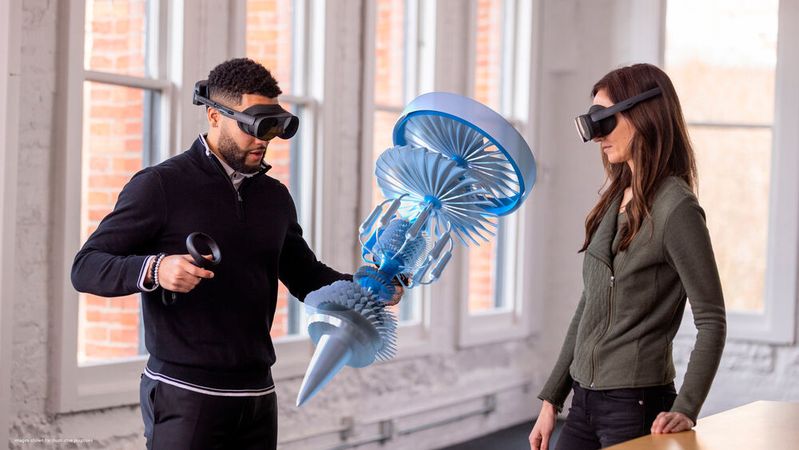
XR headsets equipped with RGB passthrough color cameras enable companies to integrate 3D models into real environments, allowing 1:1 testing of layouts and workflows on-site without physical reconstruction.
(Image: HTC Vive)
Thomas Dexmier is VP Sales and Marketing EMEA at HTC Vive.
The automotive industry has always been one of the most important drivers of innovation in the economy. This applies not only to the products themselves but also to their development processes. Automotive manufacturers constantly face the complex challenge of finding and implementing new and innovative methods for sustainable and efficient production planning and optimization.
In recent years, immersive technologies such as virtual reality (VR) and mixed reality (MR)—collectively referred to as extended reality (XR)—in combination with digital twins have opened up new opportunities for companies to implement more efficient, precise, and safer manufacturing processes.
Digital Twins And XR Revolutionize Production Processes
Visualization is one of the key drivers of XR in the manufacturing sector. Digital twins, which are virtual 3D models of real physical objects or systems, can be used in automotive production to examine and optimize nearly every aspect of a production process—from factory layout planning to maintenance prediction. This makes the development of new vehicle models more efficient and cost-effective. For instance, Virtalis and the automotive pioneer Ford Motor Company combined VR with digital twins for factory layout planning and material flow optimization.
Using VR, engineers were able to verify ergonomic conditions and sightlines in production facilities on digital twins of the factory to improve safety and working conditions. Everything was visualized, from checking shelf heights to analyzing the transportation of equipment and materials through the factory floor—saving time, increasing reliability, and reducing the need to create a physical prototype for testing.
The early review of designs in VR led to a significant reduction in rework, fewer modifications, and fewer delays in the facility's opening. Additionally, the ability to review designs remotely reduced the number of on-site visits by Ford engineers by 30 percent. This lowered costs and reduced the environmental impact of visits.
Technological advances in XR, combined with digital twins, are already significantly contributing to efficiency improvements. Modern XR hardware, such as the Vive Focus Vision from HTC Vive, supports numerous 3D file formats and enables rapid iteration processes at a 1:1 scale without the need for costly physical prototypes.
For this reason, leading companies worldwide such as Siemens, BHP, Ford, Bosch, and Airbus are increasingly investing in integrating these technologies into their development processes. Research by Siemens and S&P Global reveals that 30 percent of companies now spend over 10 million USD on digital twin technology, with manufacturing leading in adoption.
Challenges in Collaboration And Data Transfer
The use of digital twins combined with XR enables collaboration and digital exchange between multiple teams thanks to their high level of interactivity. This allows various individuals to work on a prototype simultaneously, regardless of their location. However, with increasingly detailed 3D models and a growing number of team members, the demand for secure, stable, and error-free data transmission rises alongside the required computing power.
The Japanese automaker Nissan has been relying on VR technology from HTC Vive for many years to integrate digital 3D models into virtual environments, enabling the development and intuitive assessment of vehicle exteriors and interiors. However, the increasing demands for large-scale team collaboration were limited by bandwidth restrictions, leading to unstable images and even image interruptions.
Solution Approaches: 5G Technology And XR Integration
To address this challenge, Nissan introduced the HTC G Reigns Private 5G Network and Edge Cloud VR Solution at its technical center in Japan. This mobile, private 5G network was specifically developed to meet the intensive data transmission requirements of large enterprises. PCs and VR headsets are securely and seamlessly connected via the private 5G network. The combination of high transmission speeds and cloud computing technology enables nearly latency-free usage. This technology allowed Nissan's development teams to work in an immersive collaboration environment with high stability, low latency, and high security. As a result, efficiency was significantly improved, enabling the team to focus on the creative development process.
In addition, various applications such as real-time video monitoring are supported. The G Reigns Private 5G Network and Edge Cloud VR Solution utilizes HTC's industry-leading 5G standalone technology and offers a comprehensive end-to-end solution for private networks. The open architecture design, based on Open RAN, enables the setup of virtual base stations, reducing reliance on traditional network technology. The security of private networks is also a key focus for manufacturers. A dedicated private 5G network can protect confidential company data and reduce the risk of information leaks, thereby safeguarding the company's intellectual property.
Date: 08.12.2025
Naturally, we always handle your personal data responsibly. Any personal data we receive from you is processed in accordance with applicable data protection legislation. For detailed information please see our privacy policy.
Consent to the use of data for promotional purposes
I hereby consent to Vogel Communications Group GmbH & Co. KG, Max-Planck-Str. 7-9, 97082 Würzburg including any affiliated companies according to §§ 15 et seq. AktG (hereafter: Vogel Communications Group) using my e-mail address to send editorial newsletters. A list of all affiliated companies can be found here
Newsletter content may include all products and services of any companies mentioned above, including for example specialist journals and books, events and fairs as well as event-related products and services, print and digital media offers and services such as additional (editorial) newsletters, raffles, lead campaigns, market research both online and offline, specialist webportals and e-learning offers. In case my personal telephone number has also been collected, it may be used for offers of aforementioned products, for services of the companies mentioned above, and market research purposes.
Additionally, my consent also includes the processing of my email address and telephone number for data matching for marketing purposes with select advertising partners such as LinkedIn, Google, and Meta. For this, Vogel Communications Group may transmit said data in hashed form to the advertising partners who then use said data to determine whether I am also a member of the mentioned advertising partner portals. Vogel Communications Group uses this feature for the purposes of re-targeting (up-selling, cross-selling, and customer loyalty), generating so-called look-alike audiences for acquisition of new customers, and as basis for exclusion for on-going advertising campaigns. Further information can be found in section “data matching for marketing purposes”.
In case I access protected data on Internet portals of Vogel Communications Group including any affiliated companies according to §§ 15 et seq. AktG, I need to provide further data in order to register for the access to such content. In return for this free access to editorial content, my data may be used in accordance with this consent for the purposes stated here. This does not apply to data matching for marketing purposes.
Right of revocation
I understand that I can revoke my consent at will. My revocation does not change the lawfulness of data processing that was conducted based on my consent leading up to my revocation. One option to declare my revocation is to use the contact form found at https://contact.vogel.de. In case I no longer wish to receive certain newsletters, I have subscribed to, I can also click on the unsubscribe link included at the end of a newsletter. Further information regarding my right of revocation and the implementation of it as well as the consequences of my revocation can be found in the data protection declaration, section editorial newsletter.
Edge computing and remote streaming also enable the real-time rendering and interactive use of high-resolution 3D models. Furthermore, the open network architecture creates a modular solution for building a stable, secure, and immersive wireless design collaboration environment, ultimately helping to accelerate product development. This means that ten or more employees can work on a project simultaneously. At the same time, project managers can make informed decisions and changes in real time to improve product quality and customer satisfaction.
Future of Industrial Usability—Conference & Expo
The industrial future is user-friendly—Future of Industrial Usability points the way and serves as a platform where experts share the latest developments and enable genuine exchange—across industries and with a practical focus. In addition to news on trends and developments, participants learn about methods, approaches, and techniques of usability engineering, connect with representatives from various industries, and find answers to current challenges through collaboration.
Eye-Tracking for Real-Time Design Review
By integrating XR-based approaches into manufacturing, companies can easily replicate physical environments and objects in virtual spaces while enabling more natural interactions that positively impact user experience and collaboration. For example, technologies like eye-tracking can enhance the sense of presence in XR by identifying where the user's attention is focused. This is particularly beneficial for safety training, helping to identify key focus areas and potential distractions, as well as to optimize layouts.
Eye-tracking can also be helpful during the product review phase by providing real-time insights into which parts of the design a user focuses on the most and identifying other areas that receive less attention and could potentially be improved. For instance, are the safety features in a vehicle clear and visible? Or which parts of the vehicle's exterior are more appealing to potential customers compared to others?
The introduction of mixed reality with high-quality RGB passthrough color cameras in the latest XR headsets has opened up even more possibilities for automotive manufacturers. Sophisticated 3D models can be merged with real environments, enabling 1:1 testing of layouts and workflows on-site—without the need for the physical reconstruction of objects of varying sizes, which can be a costly endeavor. Additionally, diagnostic overlays provide engineers with critical data in real time, allowing them to maximize the value of each design review.
Digital twins offer manufacturers significant opportunities to make their workflows more efficient, accurate, and sustainable. Combined with XR and 5G, the possibilities for realistic and enhanced collaboration are greater, leading to shorter production cycles and increased efficiency at every stage of the manufacturing process—from design concepts to production line optimization and beyond.



:quality(80)/p7i.vogel.de/wcms/66/90/669096f10c10efa89ce3ce6be0f6f44d/0132279760v1.jpeg "State-of-the-art machine technology, the best tool holders and high-performance tools, combined with finest process expertise, optimize production at toolcraft. (Image:Zecha)")
:quality(80)/p7i.vogel.de/wcms/d9/f3/d9f3079879e7f48a38b42525acad0908/0132025590v1.jpeg "Retrofits can be specifically sold through tangible effects such as higher plant availability. (Image: ©eakgrungenerd - stock.adobe.com)")
:quality(80)/p7i.vogel.de/wcms/71/98/719829d11b80bccd920fcb456e93b74d/0131508423v1.jpeg "With Iscar's Quickturn, WST Precision Technology machines output shafts significantly faster and more reliably than before. (Image:Iscar)")
:quality(80)/p7i.vogel.de/wcms/57/0f/570f1c1fe8f74e6ac0cc2863b73f306a/0132412565v1.jpeg "EOS can be pleased, as the demand for the engine systems of its customer Beehive Industries (one can be seen in the picture) from the USA is increasing due to the global crises. Now there has been a nice order concerning 3D printers ... (Image:N. Leach-Proffer)")
:quality(80)/p7i.vogel.de/wcms/f0/36/f03666f7af96a5a2e37c5344c99ca38e/aufmacher-mvtec-success-20story-vista-3--40vistav1.jpeg "Two robots carry out the inspection process. (Image:Vista)")
:quality(80)/p7i.vogel.de/wcms/16/2b/162beed76aab51d57a32282ddd5ce96b/0132430948v1.jpeg "Security by System: Seamless monitoring of network edges and zero-trust concepts are becoming mandatory in automation. (Image:Gemini / AI-generated)")
:quality(80)/p7i.vogel.de/wcms/68/2d/682d831b9b58bc00faef2b0f5b264875/p90650697-highres-bmw-group-plant-landv1.jpeg "BMW is developing software for humanoid robots at the Landshut site. (Source: BMW)")
:quality(80)/p7i.vogel.de/wcms/89/78/897815ff95e3c63b844b898c83d8ea9e/26-06-22-st-c3-b6ber-ab-eisenmann-bild-201v1.jpeg "In a painting system at Eisenmann, an industrial robot with a gripper handles rims of different sizes and weights. Precise drive technology from Stöber is used in the process. (Image: Stöber Drive Technology GmbH + Co. KG)")
:quality(80)/p7i.vogel.de/wcms/17/40/1740ea2e261b768a3cafcf7805adccfb/adobestock-789872912--c2-a9-20littlewolf1989-20-e2-80-93-20stock-adobe-comv1.jpeg "The tractor gearbox was removed for maintenance purposes. (Stock image) (Source: littlewolf1989 – stock.adobe.com)")
:quality(80)/p7i.vogel.de/wcms/bc/25/bc25f24bffe77b798e23dcbdb4bf13db/0132052516v1.jpeg "When it comes to thermal management, hardware developers and engineers should collaborate. (Image: ROSSandHELEN photographers)")
:quality(80)/p7i.vogel.de/wcms/35/e2/35e29bb4a9f8326c2c1fb2d772547828/adobestock-2094390289--c2-a9-20moneymoney-20-e2-80-93-20stock-adobe-com-ki-generiertv1.jpeg "A central question in the concept of the underwater data center was how to cool the server cabinets in sealed chambers on the seabed. (Symbol image) (Source: © moneymoney – stock.adobe.com / AI-generated)")
:quality(80)/p7i.vogel.de/wcms/eb/a9/eba93106e9c9d4c67e10de61afd17117/0132396640v1.jpeg "Simulation is not an external tool for quality assurance but a part of the design process. This also allows better control of complex components. (Image: PTC)")
:quality(80)/p7i.vogel.de/wcms/17/e4/17e49b36addd1f4c52f83fbf17c283b5/org-blobs-user-response-file-output-528ce347-e0de-4ba7-b658-13b8d0094427-file-1784187263841-jpgv1.jpeg "Many drivers are distracted by screens and mobile phones. Today's common vehicle warnings fall short, according to the verdict of several experts. (Image:)")
:quality(80)/p7i.vogel.de/wcms/ed/02/ed023b1fdf0ce9dab50436c68c21d572/40f910458b38205d15ba8dc67a2d7b5be0b33010v1.jpeg "Volkswagen has launched the ID Cross, an electric SUV positioned above the VW Polo. (Image: Volkswagen)")
:quality(80)/p7i.vogel.de/wcms/e8/3d/e83dad6aec16f55013606a99e0dc12a7/sichtbares-zeichen-der-zusammenarbeit-opel-hisst-am-tag-der-unterzeichnung-der-absichtserklaerung-vor-dem-adam-opel-haus-am-stammsitz-in-ruesselsheim-die-flaggen-von-deutschland-und-algerienv1.jpeg "Opel plans to build a plant for vehicle final assembly and combustion engines in Algeria. (Image:Opel)")
:quality(80)/p7i.vogel.de/wcms/5e/95/5e959fa6b3550a4ee9f5ea2d829db3cd/sany-20250709160607815v1.jpeg "Chinese truck manufacturers like Sany want to sell their heavy trucks in Europe as well. (Source: Sany)")
:quality(80)/p7i.vogel.de/wcms/8b/1b/8b1bffc74848d00e529f260e139186cc/0132446234v1.jpeg "AI burglars, AI security teams - Science fiction becomes reality (Image:AI-generated)")
:quality(80)/p7i.vogel.de/wcms/2d/9c/2d9c9463fd6d5e5c656b5a6ad41582a8/0113143253v1.jpeg "In our China Market Insider, we regularly provide you with relevant information directly from China. (Image:© Eisenhans - stock.adobe.com)")
:quality(80)/p7i.vogel.de/wcms/7e/39/7e396550e88eb6397dfcc7b4cbd59cad/org-blobs-user-response-file-output-b2db88da-a3d2-433b-b1ec-519a69337afa-plugin-output-votrp58pv1.png "In nuclear facilities, radiation penetrates cable materials over many years and gradually alters them, damaging their molecular structure. (Source: AI-generated / Gemini)")
:quality(80)/p7i.vogel.de/wcms/e8/22/e822ea25c9996b65cd0d1fd1e6fd46a9/0132350103v1.jpeg "FEV collaborates with Microsoft on efficient AI models for vehicle applications based on Nvidia. (Image:FEV)")
:fill(fff,0)/p7i.vogel.de/companies/69/88/69882c428938e/tmts2026-ticec-banner-en-2000px.png "tmts2026-ticec-banner-en-2000px (https://www.tmts.tw/en)")
:fill(fff,0)/p7i.vogel.de/companies/69/de/69de1b7403b0d/simtos-logo.jpeg "simtos-logo (SIMTOS)")
:quality(80)/p7i.vogel.de/wcms/49/9f/499fc501637783f88aabc368f2acb474/0121831543v1.jpeg "AR enables logistics managers to visualize and analyze warehouse spaces in real-time. By displaying virtual information over physical storage areas, they can identify the optimal placement of goods to utilize space efficiently. (Image:Mentari - stock.adobe.com / AI-generated)")
:quality(80)/p7i.vogel.de/wcms/9c/c0/9cc0c88cd103899f584b60601919752e/0125075768v1.jpeg "Digital twins and 3D streaming enable efficient real-time processing, promote direct collaboration, and reduce costs in the industry. (Image:Threedy GmbH)")
:quality(80)/p7i.vogel.de/wcms/21/86/21869dc17d1c9e8ac00544a5f6a2d401/adobestock-1222223060--c2-a9-20gorodenkoff-20-e2-80-93-20stock-adobe-com-3840x2158v1v1.jpeg "With the further development of digital twins from pilot projects to operational systems, the need to link high-resolution 3D environments with real product and process data is increasing in engineering. (Image:Gorodenkoff - stock.adobe.com)")