The Chinese government is encouraging car manufacturers to strengthen the domestic supply chain. Therefore, they should increasingly rely on domestic chips. However, this is just one strategy pursued by the People's Republic.
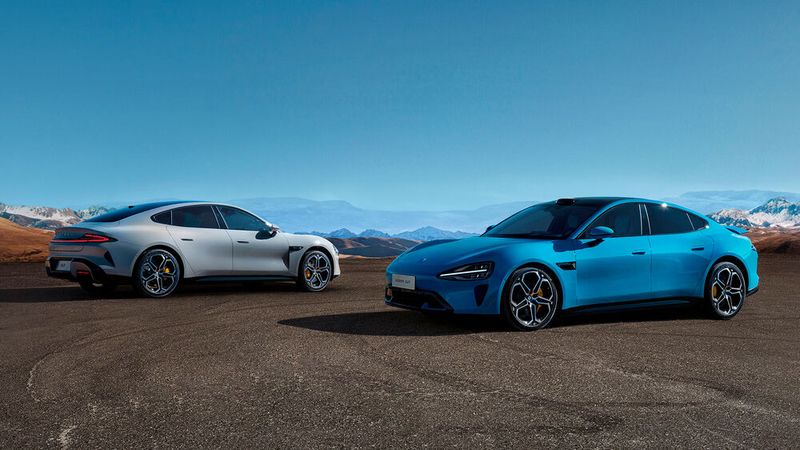
The Xiaomi SU7, among other models, is equipped with SiC chips from Infineon.
(Image: Xiaomi)
Henrik Bork, long-time China correspondent for the Süddeutsche Zeitung and the Frankfurter Rundschau, is Managing Director at Asia Waypoint, a Beijing-based consulting agency specializing in China.
China has urged its car manufacturers to use more Chinese chips. Already next year, ideally "20 to 25 percent" of all car chips should be purchased from Chinese chip producers, says a new directive from the Chinese Ministry of Industry and Information Technology MIIT. This is reported by the Japanese business newspaper Nikkei Asia, citing car managers in China.
Currently, foreign chip manufacturers such as Infineon, NXP Semiconductors, or Renesas still dominate the Chinese market for car chips by an overwhelming majority. Only about 10 percent of all car chips for cars produced in China have so far come from domestic Chinese manufacturers.
However, the Chinese government's new localization initiative already sets the goal for 2025 to more than double the share of domestic car chips. "The goal is ambitious - maybe only locally produced chips will be used for cars," the Japanese business newspaper quotes an unnamed source in China.
No legal basis
The call to use significantly more "made in China" chips has been communicated to Chinese carmakers including BYD, SAIC Motor, Dongfeng, GAC, and the FAW Group, among others. However, implementation is not legally required, Nikkei Asia writes.
Instead, Chinese car manufacturers are being offered "incentives" if they buy as much as possible on the domestic chip market. There will be a "reward or credit system" for patriotically pleasing semiconductor orders, according to the report.
China's desire to gradually climb higher in the industrial value chain, from the cheap "workbench of the world" to a high-tech nation, is not new. As early as 2015, the "Made in China 2025" plan was published, with exactly this goal for many sectors of the manufacturing industry. Among other things, China had drawn inspiration from the German "Industry 4.0" plan, which dates back to 2013.
Threatening anti-subsidy initiative
Since former US President Donald Trump tried to thwart China's industrial modernization plan with boycotts for advanced semiconductors and equipment for their foundries, the Communist leadership in Beijing has significantly accelerated its efforts to build its own semiconductor supply chains.
At least in the case of auto chips, which are largely based on more mature processes and are not as difficult to manufacture as the most advanced AI chips, the People's Republic has already made great progress in the past few years.
Also important to understand the new haste in Beijing to replace foreign manufacturers of automotive semiconductors in stages with domestic ones are the new sanction threats from the European Union. The EU Commission has started an "anti-subsidy investigation" against several Chinese manufacturers of electric cars, including the market leader BYD.
It is expected that the EU will impose tariffs on Chinese electric cars this summer to protect the European market from competition from the Far East. Washington has recently already quadrupled its protective tariffs on Chinese electric cars to more than 100 percent.
In the face of these semiconductor and trade wars, Beijing is now striving to make its supply chains increasingly independent of foreign semiconductors and other high tech. Every year, more than 30 million cars are sold in China, but so far domestic semiconductor companies supply only ten percent of all auto chips, as mentioned earlier. This is not a healthy ratio from a Chinese perspective.
The journey is the destination
As always, the Chinese government is very systematic and long-term in pursuing such industrial policy objectives. Not individual products are localized, but complete supply chains. Thus, Chinese chip manufacturers like the Semiconductor Manufacturing International Corp. (SMIC) and ChangXin Memory Technologies (CXMT) have also already begun to switch their sourcing of important materials for their own chip production from foreign to domestic suppliers.
Since last year, foreign suppliers of wafers as well as hundreds of chemicals and specialty gases for chip production are being replaced by companies producing in China wherever possible.
Where it sees a need to catch up, China continues to rely on partnerships with foreign companies. For example, Xiaomi, the mobile phone manufacturer with ambitions in the field of electric cars, has just signed a long-term supply contract for control chips fro, Infineon.
Date: 08.12.2025
Naturally, we always handle your personal data responsibly. Any personal data we receive from you is processed in accordance with applicable data protection legislation. For detailed information please see our privacy policy.
Consent to the use of data for promotional purposes
I hereby consent to Vogel Communications Group GmbH & Co. KG, Max-Planck-Str. 7-9, 97082 Würzburg including any affiliated companies according to §§ 15 et seq. AktG (hereafter: Vogel Communications Group) using my e-mail address to send editorial newsletters. A list of all affiliated companies can be found here
Newsletter content may include all products and services of any companies mentioned above, including for example specialist journals and books, events and fairs as well as event-related products and services, print and digital media offers and services such as additional (editorial) newsletters, raffles, lead campaigns, market research both online and offline, specialist webportals and e-learning offers. In case my personal telephone number has also been collected, it may be used for offers of aforementioned products, for services of the companies mentioned above, and market research purposes.
Additionally, my consent also includes the processing of my email address and telephone number for data matching for marketing purposes with select advertising partners such as LinkedIn, Google, and Meta. For this, Vogel Communications Group may transmit said data in hashed form to the advertising partners who then use said data to determine whether I am also a member of the mentioned advertising partner portals. Vogel Communications Group uses this feature for the purposes of re-targeting (up-selling, cross-selling, and customer loyalty), generating so-called look-alike audiences for acquisition of new customers, and as basis for exclusion for on-going advertising campaigns. Further information can be found in section “data matching for marketing purposes”.
In case I access protected data on Internet portals of Vogel Communications Group including any affiliated companies according to §§ 15 et seq. AktG, I need to provide further data in order to register for the access to such content. In return for this free access to editorial content, my data may be used in accordance with this consent for the purposes stated here. This does not apply to data matching for marketing purposes.
Right of revocation
I understand that I can revoke my consent at will. My revocation does not change the lawfulness of data processing that was conducted based on my consent leading up to my revocation. One option to declare my revocation is to use the contact form found at https://contact.vogel.de. In case I no longer wish to receive certain newsletters, I have subscribed to, I can also click on the unsubscribe link included at the end of a newsletter. Further information regarding my right of revocation and the implementation of it as well as the consequences of my revocation can be found in the data protection declaration, section editorial newsletter.
Beijing also allows foreign chip manufacturers and Tier-1 suppliers such as Bosch or Continental to build new factories for automotive chips and other electronic components for the automotive market in China. German suppliers to the automotive industry in particular are very active in this area in the People's Republic and are placing strong emphasis on the electrification of their product portfolios.
Partial independence
Apparently, although China is aiming for greater independence from car chips produced abroad, it does not want to exclude foreign chip manufacturers from production and lucrative business on site in China. This subtle difference could be important for the share prices of Infineon, Renesas and possibly Bosch in the future.
On the other hand, Chinese policy is not limited to localization requirements, but actively promotes investments in the establishment of domestic, Chinese-dominated supply chains. An example is the vertical integration in the industry, where local chip manufacturers, like SMEC, as well as Chinese car and battery manufacturers establish new joint ventures, e.g. for the production of the increasingly popular SiC chips in electric cars. (sb)



:quality(80)/p7i.vogel.de/wcms/a0/47/a04725ef9bd09fb6c9341a1bea1b5d93/0130443083v1.jpeg "Here, a type of plastic pallet is produced by thermoforming (vacuum forming or deep drawing) at the corresponding division of New England Plastics in the USA. This division, which specializes in so-called liners, is now part of Ringmetall ... (Image:New England Plastics)")
:quality(80)/p7i.vogel.de/wcms/e3/42/e342b3c593ea92d56604d3be969e9c9a/0130437231v1.jpeg "Daimler Truck will be building even more trucks at its Czech plant in Cheb in the future. This is because it is now being expanded for strategic cost-saving reasons ... (Image:Daimler Truck)")
:quality(80)/p7i.vogel.de/wcms/23/99/23992bf2dcdc432c9b7209c34a4a7c48/0129733089v1.jpeg "Stork relies on the modular Neoswiss turning system from Iscar to shorten the set-up times for its sliding headstock lathes and work more productively. (Image:Iscar)")
:quality(80)/p7i.vogel.de/wcms/7d/e2/7de2923434b2f1a78ba5482d8d335269/0113143253v1.jpeg "In our China Market Insider we regularly provide you with relevant information directly from China. (Image:© Eisenhans - stock.adobe.com)")
:quality(80)/p7i.vogel.de/wcms/b7/36/b736dfebc16c42d6901d0d0e1f390493/3d-druck-20factory-20--20ki-20generiert-1920x1079v1.png "(Source: AI-generated)")
:quality(80)/p7i.vogel.de/wcms/79/b2/79b21aad663f4a7bd4472afc1c1afc62/0130433994v1.jpeg "Mission Joyride: The free-flying robot (shown here in the rendering) will relieve the ISS crew of logistics tasks from 2027 with its two mechanical arms. (Image:Icarus Robotics)")
:quality(80)/p7i.vogel.de/wcms/6b/45/6b4546fa6ebf305c3660326909363f32/0130437089v1.jpeg "Industrial AI in action: Rockwell Automation presents practical solutions for self-controlling production systems at the Hannover Messe. (Image:Rainer Jensen, Deutsche Messe)")
:quality(80)/p7i.vogel.de/wcms/78/e9/78e9188c25a8a94e67c34c9bf8ffe495/visual-agile-20robots-20and-20google-20deepmind-20partner-20to-20bring-20intelligence-20to-20robotics-2500x1406v1v1.jpeg "Together, the partners are developing adaptable, intelligent robots for a wide range of applications (Image:Agile Robots SE)")
:quality(80)/p7i.vogel.de/wcms/59/a2/59a2b11f0aa1b700eff02addd5de8703/adobestock-1788280853--c2-a9-20satria-20-e2-80-93-20stock-adobe-com-5081x2860v1v1.jpeg "Quantum computers require extreme cooling to temperatures close to absolute zero in order to keep qubits stable. (Image:satria - stock.adobe.com)")
:quality(80)/p7i.vogel.de/wcms/62/5f/625f41e87ebfef156a98c8e6393e32fd/0130211654v1.jpeg "Axial flux motors have some advantages over radial flux motor—but their production is currently still expensive. (Image:RWTH Aachen University)")
:quality(80)/p7i.vogel.de/wcms/f6/ae/f6aec4f6241b36ed5e3a990ac9176b42/0130429460v1.jpeg "Verne, Pony.ai and Uber want to launch a robotaxi service in Europe. (Image:Verne)")
:quality(80)/p7i.vogel.de/wcms/d7/88/d788699f2974708a332baa4e7a62fa9e/0130438967v1.jpeg "Skoda is withdrawing from China. The brand has produced well over three million vehicles there. (Image:Skoda car)")
:quality(80)/p7i.vogel.de/wcms/b0/43/b043b86899837532aad62d63368a917a/0130371361v1.jpeg "Skoda leaves the chinese market.
(Image:Skoda)")
:quality(80)/p7i.vogel.de/wcms/c3/c4/c3c4ce270b083eeac55654148611f064/0130237945v1.jpeg "China is not giving up on hydrogen, but is intensifying its efforts. (Image:freely licensed from Pixabay)")
:quality(80)/p7i.vogel.de/wcms/ee/09/ee09acbd6dc896df25affaa9e871e6e5/0130440053v1.jpeg "IMS chip module for simple system integration into an ion mobility spectrometer. (Image:Fraunhofer IPMS)")
:quality(80)/p7i.vogel.de/wcms/10/6c/106cd22de5f68a0f74639d654827228c/0130345302v1.jpeg "Made in India: According to the India Electronics and Semiconductor Association (IESA), the country should be able to produce between 75 and 80 million chips by the beginning of 2027, once the plants currently under construction become operational. (Image:Pixabay (Montage: Sebastian Gerstl))")
:quality(80)/p7i.vogel.de/wcms/a5/ed/a5ed6fda029d362732a293d6b19d74c4/0130444216v1.jpeg "Thirteen executives from the Chinese chip industry have drawn up a plan to achieve an 80% self-sufficiency rate for semiconductors by 2030. (Image:Maxim_Kazmin - stock.adobe.com)")
:quality(80)/p7i.vogel.de/wcms/31/a6/31a646018b34d8e0a44bfc8bf17837f6/0130361632v1.jpeg "For many companies, PFAS are considered indispensable in electronics production. (Image:freely licensed)")
:fill(fff,0)/images.vogel.de/vogelonline/companyimg/76800/76895/65.jpg "FAULHABER_120mm.jpg ()")
:fill(fff,0)/p7i.vogel.de/companies/69/88/69882c428938e/tmts2026-ticec-banner-en-2000px.png "tmts2026-ticec-banner-en-2000px (https://www.tmts.tw/en)")
:quality(80)/p7i.vogel.de/wcms/90/52/9052cd4cea3f3912d5fb96634837046b/0125688237v1.jpeg "Analysts note that the power semiconductor market is beginning to shift towards China. (Image:Dall-E / AI-generated)")
:quality(80)/p7i.vogel.de/wcms/d5/e2/d5e22c63ba60d609d973da20984f6828/0126218335v1.jpeg "The long-term impact of state-led initiatives to promote high-tech industries is continually demonstrated in China. (Symbolic image) (Image:Dall-E / AI-generated)")