Many executives today are ambitious about deploying AI comprehensively in manufacturing. However, without a robust data infrastructure, (pilot) projects will fail. Understanding that data should be treated as a fundamental infrastructure and not as a side issue is crucial for a fundamental transformation today.
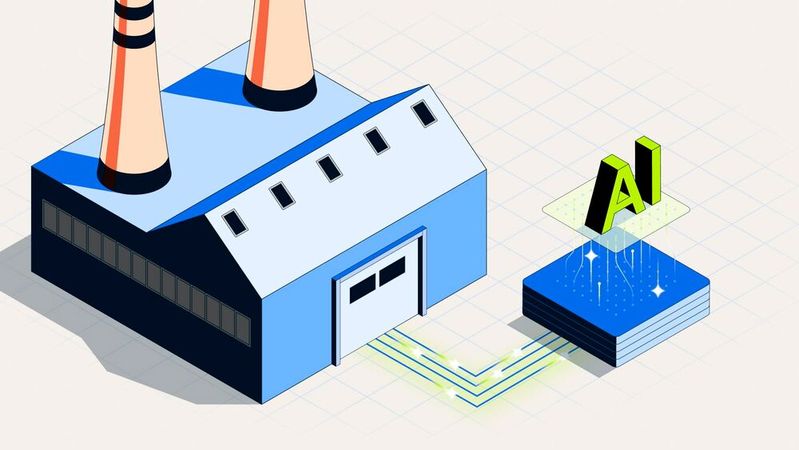
Agent-based AI requires a data foundation that also provides the necessary context—a challenge especially in manufacturing due to the physical and distributed nature of industrial data.
(Image: Fivetran)
In the industry, proofs of concept for AI initiatives are often very promising but then fail to deliver the expected return on investment. The cause typically does not lie in the AI models but rather in the data foundation: fragmented, poorly managed, and context-poor data environments, as commonly found in manufacturing.
Therefore, AI initiatives should start here with a radical realignment: data should no longer be understood as a byproduct of systems or as a compliance issue, but as the core of everything, from production planning to predictive maintenance. For this, data must be treated as its own infrastructure, maintained, standardized, and monitored for quality.
Gallery
Dozens of Different Data Streams
Especially in the manufacturing environment, this is no simple task. Dozens of different data streams are generated between industrial sensors, ERP systems, production lines, and supply chains. Merging these into a coherent picture that supports predictive or generative models is both a technical and cultural challenge.
The ability to contextualize is crucial here. For truly meaningful data products, companies need a holistic perspective. The foundation for this is consolidated datasets, consistent definitions, and clarity on who is responsible for which data.
Important: Company-Wide Definitions
The need for company-wide definitions is often overlooked but is crucial. For example, if different departments, systems, or applications use different definitions for "customer," this will lead to confusion and fail to provide reliable AI results.
The goal is not just to store more data but to create the conditions for its harmonization. This includes both technical tools and organizational maturity: governance, quality assurance, provenance tracking, access controls, encryption, and bias mitigation must be integrated into the data stack from the outset.
AI Agents Need Context
Currently, agent-based AI is associated with great promises. They can autonomously navigate digital ecosystems, query systems, and perform actions without human intervention. It is the next iteration of what was previously referred to as data federation or data virtualization. However, without a consolidated and well-managed data foundation that also provides the necessary context, there is a risk of lack of reliability and inconsistent responses.
In contrast to areas like finance or HR, manufacturing faces entirely different challenges due to the physical and distributed nature of industrial data: determining when a part needs to be produced, how to optimize uptime, or how to forecast availability requires deep integration with supply chains, operational processes, and equipment performance data. Without such a data structure, autonomous agents cannot function.
The Modern Industrial Data Stack
What should manufacturers prioritize when building their data infrastructure? Reference data, ERP systems, customer hierarchies, and supply chain relationships should come first. From here, they should quickly expand to IoT sensor streams and the ongoing collection, transmission, and analysis of production data in real time. At this point, data consolidation becomes essential.
Streaming platforms are becoming increasingly relevant. They make it possible to ingest data from various sources—be it machines, control systems, or external providers—and bring it into an analysis and AI environment almost in real time. It is crucial that these data streams are delivered in a common, open, and widely used storage format.
Data Lakes form the Foundation
High priority should be given to data lakes. They have significantly evolved in recent years and now form the foundation for reliable streaming, AI, and real-time decision-making. With robust technologies such as Apache Iceberg and Delta Lake, structured, scalable, and cost-efficient data access is made possible. Combined with unified catalogs and open
Tabular formats offer manufacturers the flexibility to run multiple workloads with a single clean and managed dataset. These advancements are gradually closing the gap between traditional data warehouses and data lakes. In the future, this distinction could even become completely obsolete.
Change in Technology And Corporate Culture
But even this is no guarantee of success for AI initiatives. The most challenging part is often not the architecture but the alignment: a traditional corporate culture—particularly in environments where IT, OT, and data teams work in silos—can doom even the most elegant solutions to failure. To change this, leadership must take the lead. An effective approach is to select a small but significant problem where data can make a measurable difference. If a positive result and a measurable ROI can be achieved here, it can be used as a case study to build internal trust and drive cultural change.
Date: 08.12.2025
Naturally, we always handle your personal data responsibly. Any personal data we receive from you is processed in accordance with applicable data protection legislation. For detailed information please see our privacy policy.
Consent to the use of data for promotional purposes
I hereby consent to Vogel Communications Group GmbH & Co. KG, Max-Planck-Str. 7-9, 97082 Würzburg including any affiliated companies according to §§ 15 et seq. AktG (hereafter: Vogel Communications Group) using my e-mail address to send editorial newsletters. A list of all affiliated companies can be found here
Newsletter content may include all products and services of any companies mentioned above, including for example specialist journals and books, events and fairs as well as event-related products and services, print and digital media offers and services such as additional (editorial) newsletters, raffles, lead campaigns, market research both online and offline, specialist webportals and e-learning offers. In case my personal telephone number has also been collected, it may be used for offers of aforementioned products, for services of the companies mentioned above, and market research purposes.
Additionally, my consent also includes the processing of my email address and telephone number for data matching for marketing purposes with select advertising partners such as LinkedIn, Google, and Meta. For this, Vogel Communications Group may transmit said data in hashed form to the advertising partners who then use said data to determine whether I am also a member of the mentioned advertising partner portals. Vogel Communications Group uses this feature for the purposes of re-targeting (up-selling, cross-selling, and customer loyalty), generating so-called look-alike audiences for acquisition of new customers, and as basis for exclusion for on-going advertising campaigns. Further information can be found in section “data matching for marketing purposes”.
In case I access protected data on Internet portals of Vogel Communications Group including any affiliated companies according to §§ 15 et seq. AktG, I need to provide further data in order to register for the access to such content. In return for this free access to editorial content, my data may be used in accordance with this consent for the purposes stated here. This does not apply to data matching for marketing purposes.
Right of revocation
I understand that I can revoke my consent at will. My revocation does not change the lawfulness of data processing that was conducted based on my consent leading up to my revocation. One option to declare my revocation is to use the contact form found at https://contact.vogel.de. In case I no longer wish to receive certain newsletters, I have subscribed to, I can also click on the unsubscribe link included at the end of a newsletter. Further information regarding my right of revocation and the implementation of it as well as the consequences of my revocation can be found in the data protection declaration, section editorial newsletter.
View Data As A Business-Critical Resource
As part of this cultural shift, it is also essential to address the question of responsibility for data. Data should not be viewed as a technical resource but as a business-critical asset. Governance mechanisms, ranging from data lineage and master data management to regulatory compliance and algorithmic transparency, form the strategic foundation for this.
Foundation for AI Success
Many manufacturing companies are still at the beginning of this journey. While some have already implemented modern data pipelines and data-centric strategies, others are still struggling with legacy systems, siloed teams, and limited pilot projects. However, the transformation is accelerating, with strong momentum around open-table formats and unified infrastructure in recent months. Companies should leverage this momentum, as technologies mature, to reassess their digital strategies and build something robust and scalable.
Ultimately, the winners in the field of manufacturing AI will not be those with the most elaborate AI models or the fanciest dashboards, but those who have taken the development of their data infrastructure seriously.
Tobias Knieper, Lead Marketing Manager, DACH bei Fivetran
Secure and Compliant Authentication in Laboratories



:quality(80)/p7i.vogel.de/wcms/c0/92/c0922365a230627bafa6a3ed7fbe15d7/0131573143v1v1.jpeg "The EU members of the European Parliament have voted by a majority in favor of the planned tariff agreement coming into effect. Trump's threats have clearly worked ... (Image: F. Schneidler)")
:quality(80)/p7i.vogel.de/wcms/81/22/8122583abe81b65e0590e99aa189b001/0131847826v1.jpeg "Rymoplast has invested in a recycling plant in Markranstädt, Saxony, near Leipzig. There, high-quality granulate is produced from plastic films. However, the thermal management of the processing systems must be optimal for this. Technotrans had the right solution ... (Image: Rymoplast)")
:quality(80)/p7i.vogel.de/wcms/13/c6/13c6acdbf4035be50a3ef493b7d96f5b/0130689539v1.jpeg "SLZ secures the components exclusively with clamping technology from Gressel. Deformations, for example during the machining of carbon, are avoided by using predefined clamping forces set on the \"grepos-5X\". (Image:Gressel)")
:quality(80)/p7i.vogel.de/wcms/27/64/2764abcce02217d49f1469141e36507d/0131762740v1.jpeg "With the latest features in Lantek's 3D CAD/CAM software, cutting complex 3D chamfers can be programmed easily and conveniently. (Image:Lantek)")
:quality(80)/p7i.vogel.de/wcms/de/49/de496edc0815d63154eccc7d1341d696/0131501872v1.jpeg "Cybersecurity: is increasingly evolving from an isolated IT discipline to an integral part of industrial value creation. (Image: Designed by Freepik)")
:quality(80)/p7i.vogel.de/wcms/2f/34/2f3405b4e958de9db82d079bd8681bde/symbolbild-wahrnehmung-kiv1.jpeg "AI models often process visual information in a fragmented manner – new training approaches address this. (Source: )")
:quality(80)/p7i.vogel.de/wcms/2a/16/2a164f7cbaf53e75573f718f69560c03/-28c-29designbyfreepik2v1.jpeg "Humanoid robots could become one of the most important tools of modern industrial and service society within the next ten years. (Image:FreePik2)")
:quality(80)/p7i.vogel.de/wcms/72/55/7255d89715c477b2efabb44061f43614/db2026fa00001-largev1.jpeg "The logistics planning of VW Mexico uses AI to forecast a supply failure. (Image:Volkswagen AG)")
:quality(80)/p7i.vogel.de/wcms/2c/65/2c65057b446b0c6fd5f59a51af9081c1/ruderer-pm-sonderfahrzeugbau-caravan-cmyk-02v1.jpeg "Modern adhesives and sealants enable stable, tight, and economical connections in special vehicle construction – from vehicle structure to interior fittings to repairs. (Source: Ruderer)")
:quality(80)/p7i.vogel.de/wcms/dc/1e/dc1e164ca1e524e7cb48de6fd6a16a1c/hytank-ifam-pi-bilder-1-ad-plasmav1.png "Non-contact atmospheric pressure plasma pretreatment of a CFRP surface. (Source: Fraunhofer IFAM)")
:quality(80)/p7i.vogel.de/wcms/8d/ef/8defbe608abb2a7d06cf2f77d3f22a4c/newsimage423082-7733x4347v1v1.jpeg "This microplastic-free hairspray ensures eco-friendly styling. (Source: Fraunhofer ISC)")
:quality(80)/p7i.vogel.de/wcms/59/d0/59d0bc5d8d39ed9b3ff7014d2eb71349/newsimage423193-1143x643v1v1.jpeg "Scanning electron microscope image of the nanostructure of an alloy composed of aluminum, molybdenum, niobium, tantalum, titanium, and zirconium. The material is particularly well-suited for catalytic processes. (Image:BAM)")
:quality(80)/p7i.vogel.de/wcms/b7/6f/b76f62200dcdbf72b3363b3ab7a7b3f5/catl-20batteriewechsel-20lkw-20e59bbee78987-95v1.webp "CATL offers battery swapping stations for heavy e-trucks. (Source: CATL)")
:quality(80)/p7i.vogel.de/wcms/46/7f/467fa27219f5a10f92c3f9bdae3ec1d1/rg-4troopv1.jpeg "The \"4 Troop,\" based on the Rafale, is intended to serve as a mobile command station. (Source: Renault)")
:quality(80)/p7i.vogel.de/wcms/c7/14/c714351f8a739cc95187aa5b05dd67e4/0131692292v1.jpeg "Automakers and suppliers are exploring the diverse use of generative AI in vehicle cockpits. (Image:Aumovio)")
:quality(80)/p7i.vogel.de/wcms/ed/e2/ede2e3f015ac5982ae76d5a171185156/0131845932v1.jpeg "The situation for Volkswagen in China is worsening, according to reports from Beijing. The reason stems from various developments. Nevertheless, it is believed that they are well-prepared ... (Image: Volkswagen)")
:quality(80)/p7i.vogel.de/wcms/3a/95/3a9516e43ea165b807f3212cf46cdfb1/0131845363v1.jpeg "Data centers: European hardware is indispensable for the AI boom. (Image:freely licensed)")
:quality(80)/p7i.vogel.de/wcms/ba/18/ba1847eab1dcf1acb8f6c2d741c9a7b0/0131777880v1.jpeg "Agentive AI: The future of AI in EDA lies not in copilots but in the orchestration of many processes. (Image: Siemens EDA)")
:quality(80)/p7i.vogel.de/wcms/65/fd/65fdfac3c428ca5902ed9be2fcc4faf0/0131845070v1.jpeg "Miniaturization: The implantable brain pressure sensor (Kitea sensor) weighs only about 0.3 grams (approx. 0.01 ounces). The safety-critical electronics are hermetically sealed in a biocompatible glass casing. (Image: Parasoft)")
:quality(80)/p7i.vogel.de/wcms/78/a0/78a04b7ad83462b9e5fcefb897e8e7a3/0131840217v1.jpeg "Elon Musk's space company SpaceX is launching a catch-up race against its two competitors in the development of generative AI tools. To achieve this, they have dug deep into their pockets and casually acquired Cursor. (Image: SpaceX)")
:fill(fff,0)/images.vogel.de/vogelonline/companyimg/76800/76895/65.jpg "FAULHABER_120mm.jpg ()")
:fill(fff,0)/p7i.vogel.de/companies/69/88/69882c428938e/tmts2026-ticec-banner-en-2000px.png "tmts2026-ticec-banner-en-2000px (https://www.tmts.tw/en)")
:fill(fff,0)/p7i.vogel.de/companies/69/de/69de1b7403b0d/simtos-logo.jpeg "simtos-logo (SIMTOS)")
:quality(80)/p7i.vogel.de/wcms/36/01/36014e2f5ff17f886e500d223400b6b9/0128634719v1.jpeg "With streaming platforms, data from all sources – from machines, control systems, or external providers – can be brought into an AI environment almost in real-time.(Image: Fivetran)")
:quality(80)/p7i.vogel.de/wcms/bc/d2/bcd231124ce6a0fd1273458db92f32f6/0128634728v1.jpeg "Based on data lakes, streaming, AI, and real-time decision-making can function reliably.(Image: Fivetran)")
:quality(80)/p7i.vogel.de/wcms/fa/dc/fadc636f3bf0843374866bf264910507/0128634713v1.jpeg "Agent-based AI requires a data foundation that also provides the necessary context – a challenge especially in manufacturing due to the physical and distributed nature of industrial data.(Image: Fivetran)")
:quality(80):fill(efefef,0)/p7i.vogel.de/wcms/67/ac/67acb931a438c/elatec-wp-gmp.png "Elatec WP GMP")
:quality(80)/p7i.vogel.de/wcms/bf/8a/bf8aae2ae7c550c255746c94a36fdd01/0128634710v1.jpeg "Agent-based AI requires a database that also provides the necessary context—a challenge especially in manufacturing due to the physical and distributed nature of industrial data. Agent-based AI requires a database that also provides the necessary context—a challenge especially in manufacturing due to the physical and distributed nature of industrial data. (Image:Fivetran)")
:quality(80)/p7i.vogel.de/wcms/01/e7/01e7291168b9766bc7cc3fe60c3dde16/0128026251v1.jpeg "One result of the study: The future of engineering lies in agentic AI, i.e., systems capable of autonomous reasoning and orchestrating workflows across various disciplines and tools. (Image: ©Boonyapawn - stock.adobe.com)")