Superlight, superflexible, superinsulating: To protect satellites from extreme temperatures, an aluminum-coated polymer foil is used. Researchers at Empa Thun have made the material even more resilient by using an ultra-thin interlayer.
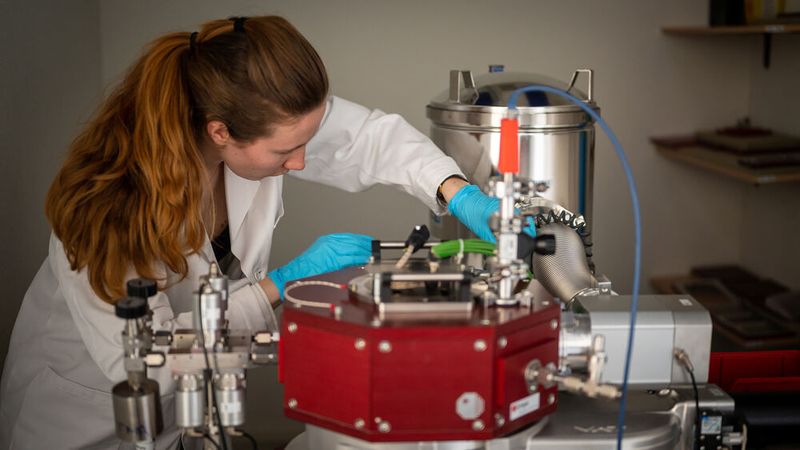
Johanna Byloff analyzes the samples at the coating machine of the Empa spin-off Swiss Cluster.
(Image: Empa)
Who doesn't know the archetypal image of a satellite: two outstretched solar "wings" and a compact body wrapped in gold or silver shimmering foil. Researchers from the "Mechanics of Materials and Nanostructures" lab at Empa in Thun are precisely focused on this foil.
The film in question is so-called "Multilayer Insulation," also known as superinsulation. It consists of multiple layers of a durable polymer coated with a thin layer of metal—typically aluminum. On Earth, the coated film can be encountered in the form of emergency blankets. Onboard spacecraft, the superinsulation protects electronics from temperature fluctuations. "For satellites in low Earth orbit, the temperature difference between the sun-facing and sun-shaded sides is around 300 °F," says Empa researcher Barbara Putz. "However, electronics function best at a room temperature of 77 °F." Since it is directly exposed to space conditions, the superinsulation itself must be highly durable.
Accelerating the Development of Flexible Electronics on Earth
Polyimide, a robust material, is typically used as the polymer base for the thin-film structure. In addition to its temperature and vacuum resistance, it is notable for its excellent adhesion to aluminum coatings. "The reason for this is a nanometer-thin intermediate layer that forms between the polymer and the aluminum during the coating process," explains Putz. The researcher now aims to examine this intermediate layer in greater detail—and apply it strategically. The layer is not only expected to enable better superinsulation for future satellites but also to accelerate the development of flexible electronics on Earth. For this research project, she received the "Ambizione Grant" from the Swiss National Science Foundation (SNSF) in 2020.
0.2 Microinches Make the Difference
To precisely understand the intermediate layer and its effects on material properties, Barbara Putz and her doctoral student Johanna Byloff chose a simple model system: a 0.002 inches-thick polyimide film coated with 6 microinches of aluminum. The researchers apply a coating of aluminum oxide, measuring just five nanometers, between the metal and the polymer. Working with such a thin intermediate layer is challenging. To ensure clean processing, the researchers use a coating machine from the Empa spin-off Swiss Cluster AG, founded in 2020 by researchers from the "Mechanics of Materials and Nanostructures" laboratory. The device allows several coating processes to be sequentially applied to the same workpiece without removing it from the vacuum chamber.
"Our material combination corresponds to the one used in space applications, for example, on the European Mercury probe BepiColombo or the sunshield of NASA's James Webb Space Telescope," says Byloff. "Only there the oxide interlayer forms naturally, while we produce it deliberately, allowing us to tailor the properties."
The 69 by 46 feet sunshield of the space telescope also highlights the demands placed on materials in space. In addition to the large temperature differences, the insulating layers are also exposed to mechanical stresses. "On the one hand, the sunshield was stowed during the telescope's launch and had to unfold at its destination without the layers tearing or separating from each other," explains Byloff. "On the other hand, particles and space debris can damage the film. It is crucial that the damage remains localized and does not spread as long cracks across the entire surface."
From Satellites to Medical Sensors
The researchers thoroughly tested their model film, subjecting it to stretching experiments, temperature shocks, and chemical and physical characterization. The result: the intermediate layer makes the material more stretchable and significantly more resistant to cracks and shear forces. Next, the researchers plan to vary the thickness of the layer and apply it to other polymer substrates. "The natural intermediate layer forms only on polyimide and only at a thickness of five nanometers, which limits its usefulness," says Barbara Putz. "We expect that our artificial intermediate layer will enable multilayer systems on other polymers, which have so far been unsuitable due to poor coating adhesion."
Date: 08.12.2025
Naturally, we always handle your personal data responsibly. Any personal data we receive from you is processed in accordance with applicable data protection legislation. For detailed information please see our privacy policy.
Consent to the use of data for promotional purposes
I hereby consent to Vogel Communications Group GmbH & Co. KG, Max-Planck-Str. 7-9, 97082 Würzburg including any affiliated companies according to §§ 15 et seq. AktG (hereafter: Vogel Communications Group) using my e-mail address to send editorial newsletters. A list of all affiliated companies can be found here
Newsletter content may include all products and services of any companies mentioned above, including for example specialist journals and books, events and fairs as well as event-related products and services, print and digital media offers and services such as additional (editorial) newsletters, raffles, lead campaigns, market research both online and offline, specialist webportals and e-learning offers. In case my personal telephone number has also been collected, it may be used for offers of aforementioned products, for services of the companies mentioned above, and market research purposes.
Additionally, my consent also includes the processing of my email address and telephone number for data matching for marketing purposes with select advertising partners such as LinkedIn, Google, and Meta. For this, Vogel Communications Group may transmit said data in hashed form to the advertising partners who then use said data to determine whether I am also a member of the mentioned advertising partner portals. Vogel Communications Group uses this feature for the purposes of re-targeting (up-selling, cross-selling, and customer loyalty), generating so-called look-alike audiences for acquisition of new customers, and as basis for exclusion for on-going advertising campaigns. Further information can be found in section “data matching for marketing purposes”.
In case I access protected data on Internet portals of Vogel Communications Group including any affiliated companies according to §§ 15 et seq. AktG, I need to provide further data in order to register for the access to such content. In return for this free access to editorial content, my data may be used in accordance with this consent for the purposes stated here. This does not apply to data matching for marketing purposes.
Right of revocation
I understand that I can revoke my consent at will. My revocation does not change the lawfulness of data processing that was conducted based on my consent leading up to my revocation. One option to declare my revocation is to use the contact form found at https://contact.vogel.de. In case I no longer wish to receive certain newsletters, I have subscribed to, I can also click on the unsubscribe link included at the end of a newsletter. Further information regarding my right of revocation and the implementation of it as well as the consequences of my revocation can be found in the data protection declaration, section editorial newsletter.
Satellite insulation is not the only field where flexible multilayer systems are in demand. Putz and Byloff also see great potential for their research in the area of flexible electronics, which likewise relies on metal-coated polymer substrates. Thin-film components for electronic devices typically consist of multiple layers of different materials. However, the mechanical properties in this area could also be improved through the targeted use of thin intermediate layers. This could enable foldable or rollable devices, smart textiles, and flexible medical sensors.
Future-Proof Authentication with Universal RFID Readers



:quality(80)/p7i.vogel.de/wcms/9e/23/9e23111e49d73012e9e3b7c69428ad5c/0134019347v1.jpeg "The Dominant VA45 high-helix tap from Bass, made of lead-free brass. The long chips, which result from the absence of lead, are clearly visible. (Image:Bass, Inc.)")
:quality(80)/p7i.vogel.de/wcms/1d/09/1d0999956ef87709b72ab1d0402ba207/csf-minis-gruppe-final-01-outputv1.jpeg "Since mid-2026, Harmonic Drive has been offering its CSF Mini gearheads in size 7 as well, in six variants designed for different installation scenarios. (Source: Harmonic Drive)")
:quality(80)/p7i.vogel.de/wcms/ab/08/ab08675922c3a7edea45128248b45b00/0133857009v1.jpeg "In the aerospace industry—one of the most demanding sectors of all—the Shanghai-based company TOPNC has already made a name for itself. (Image:TOPNC)")
:quality(80)/p7i.vogel.de/wcms/ff/48/ff48b1154746e79128935f28bd73ba0e/0113143253v1.jpeg "In our China Market Insider, we regularly provide you with relevant information straight from China. (Image:© Eisenhans - stock.adobe.com)")
:quality(80)/p7i.vogel.de/wcms/ca/24/ca24d741a2fd714fa14d2a3e9db1c904/image1v1.jpeg "With 117,500 units sold, transportation and logistics will remain the leading application area for service robotics in 2025 as well. (Image:Innok Robotics)")
:quality(80)/p7i.vogel.de/wcms/b7/95/b795d5fb82459f8a526e880f0698dffa/1-maxon-mind-covershot-landscapev1.jpeg "Claude Jaquemet demonstrates the Maxon Mind demo system. (Source: Maxon)")
:quality(80)/p7i.vogel.de/wcms/be/66/be661616d5250d4c3814a25688f3904b/0133917202v1.jpeg "Neuron AI combines 3D vision, touch, hearing, proprioception, and language—along with memory—into a Perception-Language-Action (PLA) model. Robots can grasp objects they cannot see. (Image:Neura)")
:quality(80)/p7i.vogel.de/wcms/c7/12/c712b688dba2262fa3906e3a4c1d2f7d/humanoide-robotikv1.jpeg "“Find a job that the humanoid can actually do, and understand your processes”—that’s the advice robotics expert Sebastian Prinz gives companies so they can benefit from the technology in the long term. (Source: Fraunhofer IEM / Janosch Gruschczyk)")
:quality(80)/p7i.vogel.de/wcms/51/b8/51b8e08d2105fdd9952aff385f154192/graphic-2-adma1v1.png "The new surface hardening process enhances the performance of corrosion-resistant alloys by improving their tribological and mechanical surface properties, while preserving the properties of the base material. (Source: Bodycote)")
:quality(80)/p7i.vogel.de/wcms/96/ef/96effc239916cb7e0f396ab75627b8c0/image-space-testingv1.jpeg "Two scientists in front of a vacuum chamber used for testing: As technical instruments for spaceflight become more sensitive, the test facilities are becoming a critical system. (Source: Busch Group)")
:quality(80)/p7i.vogel.de/wcms/5a/12/5a1294a38a634f839f542c0055024d7a/jie-yin-feather-star-header-1500v1.jpeg "Underwater Acrobatics: The new soft robot mimics brittle stars—using minimal propulsion technology. (Source: North Carolina State University)")
:quality(80)/p7i.vogel.de/wcms/96/89/9689197f666e4aa9bc4a1f395c25d3ef/0133739635v1.jpeg "The 2026 Nobel Prize in Medicine laureates: Karl Deisseroth, Peter Hegemann, and Georg Nagel. (Image:Nobel Prize Outreach)")
:quality(80)/p7i.vogel.de/wcms/fe/f7/fef766ae8b8310ca6dd0852208923e4e/hendrik-malinowski-coo-01v1.png "Hendrik Malinowski Takes on New Role as CCO of BUGATTI RIMAC (Source: Bugatti)")
:quality(80)/p7i.vogel.de/wcms/d9/5f/d95fd82eb5368ce77a8bc9de3a085376/yoshihiro-nakatav1.jpeg "“We are a European manufacturer”: Yoshihiro Nakata, CEO of Toyota Motor Europe, at the corporate briefing in Brussels. (Image:Toyota)")
:quality(80)/p7i.vogel.de/wcms/e3/0b/e30b87c9b7a6c41b7e7336f34f0a8214/0133970831v1.jpeg "Tesla's planned expansion of vehicle and battery production capacity in Grünheide, near Berlin, appears to be gaining momentum, according to a recent announcement by the U.S. electric car manufacturer ... (Image: AI-generated)")
:quality(80)/p7i.vogel.de/wcms/23/5f/235fa4afabc57699636224d17e106b4b/kraemer-p2p-display-technologyv1.png "The cockpit display system from Krämer Automotive Systems shows driving-related information, infotainment, and vehicle functions. (Source: Krämer Automotive)")
:quality(80)/p7i.vogel.de/wcms/8b/35/8b35660420abba32fb891a4c5cc42fbd/0134018092v1.jpeg "Long-range UVC LED with lens and reflector: Close-up of a square LED with a transparent, dome-shaped lens on a dark base plate. The hermetically sealed housing ensures greater reliability and durability under demanding environmental conditions. (Image:FBH_Schurian)")
:quality(80)/p7i.vogel.de/wcms/a4/1c/a41cd52e0a26e5173bd4e1f834d4f7f4/0134025034v1.jpeg "As chips become more complex, the demands on semiconductor testing increase. Teradyne and FormFactor plan to combine their technologies for future applications. (Image:freely licensed)")
:quality(80)/p7i.vogel.de/wcms/7b/64/7b64e9fe595b88d2b01ed79e0f2baf94/pm-weidm-ller-elatec-substation-line-switchv1.jpeg "Caption: The Substation Line managed switches can accommodate up to three HSR/PRP modules. (Image:Weidmüller)")
:quality(80)/p7i.vogel.de/wcms/b3/bf/b3bf55a31510b319bb473f73aa205477/0133987448v1.jpeg "In court, Qualcomm achieved a partial victory in its legal dispute with Arm, but was awarded only a symbolic $2 in damages—for now. (Image:Dall-E / AI-generated)")
:quality(80):fill(efefef,0)/p7i.vogel.de/wcms/67/ae/67ae0b9ac31f8/elatec-wp-universal-reader.png "Elatec WP Universal Reader")
:quality(80)/p7i.vogel.de/wcms/3b/53/3b5329e67623ac3ce5a903ca6f84f97f/eq89-flex-stopper2-596x335v1.jpeg "Superinsulation: The sunshield of the James Webb Space Telescope is made of the same material the researchers work with. (Image: NASA/Goddard/Chris Gunn)")
:quality(80)/p7i.vogel.de/wcms/f0/bf/f0bf7db87605ba6d74e26fa3e27e0e8e/0128192836v1.jpeg "Researchers use a single-phase reaction of metal ions and an organic compound to produce conductive, well-organized colloidal coordination nanolayers. (Image:Tokyo University of Science)")