Both companies and states are investing massively in semiconductor technology to stabilize supply chains and meet demand through leaps in innovation, such as AI. An analysis of market potential based on current figures.
Semiconductor production: How does the European semiconductor market compare to the rest of the world?
The international semiconductor industry moved into the spotlight of the global public during the significant disruptions in supply chains between 2021 and 2022. What industry insiders have long been aware of has now become evident: The semiconductor market is complex and indispensable for the global industry.
Analyses by IC Insights or Semiengineering.com show that in 2022 alone, more than 190 billion euros were invested in the semiconductor market. An additional 300 billion US dollars have been announced by leading semiconductor companies for the coming years. For comparison: The sum corresponds roughly to the investment amount that the global automotive industry plans to invest in research and development by 2028, particularly due to the megatrends of electrification and autonomous driving.
Taiwan undisputedly in first place in semiconductor production
The development is also gaining momentum from politics. The supply chain problems during the pandemic and beyond have made it clear that semiconductor chips are critical infrastructure. With the concrete shortage situation, politics in Europe and the USA have decided to promote local production more intensively again.
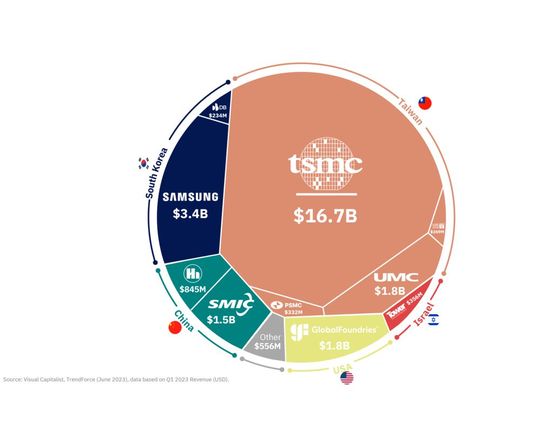
Image 1: The global top 10 semiconductor foundries. Europe ranks only under "others."
(Image: Pava Partners Semiconductor Sector Report May 2024)
Thus, billions in tax dollars flow into the settlement of FABs. How far behind Europe is in chip production is shown by the global top 10 semiconductor foundries (Image 1). Europe is listed there only under "Other." Unsurprisingly, Taiwanese semiconductor production is the undisputed leader. The graphic from the current Semicon Report highlights the immense lead that Taiwan holds.
The fact that industrial policy is now being made and more subsidies are flowing into semiconductor production is an important sign for Europe and Germany in particular. Over the last 30 years, the regions of Saxony and Saxony-Anhalt have succeeded in creating an attractive location for international players through the strategic development of production sites, expertise at universities, and research centers.
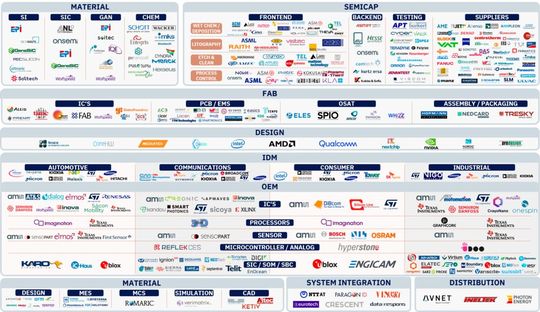
Image 2: The entire semiconductor technology ecosystem from material to software includes more than 300 companies in new industrial sectors with various subgroups. European companies come from the fields of power electronics, sensors, and mechanical engineering.
(Image: Pava Partners Semiconductor Sector Report May 2024)
An investment that pays off, as confirmed by international settlements in the region. However, the industry association ZVEI has criticized that German subsidies are too selective and do not sufficiently support the entire semiconductor ecosystem. So far, the association criticizes that important sub-sectors such as printed circuit boards and electronics manufacturing services (EMS), which make the further processing of chips possible in the first place, have been left out in the allocation of subsidies.
The "Semicon Landscape" in Image 2 shows that the entire ecosystem from material to software includes more than 300 companies in new industrial sectors with various subgroups. Particularly in mechanical engineering, relevant providers come from Europe, as well as in the development and manufacturing of chips for sensors and power electronics.
Artificial intelligence fuels chip demand
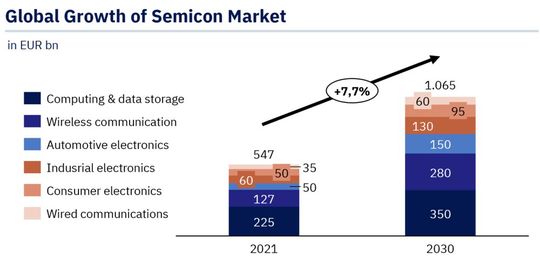
Image 3: Data storage, wireless communication, and automotive electronics are the largest drivers of the semiconductor industry, accounting for more than 70 percent of industry growth.
(Image: Pava Partners Semiconductor Sector Report May 2024)
However, the market promises significant growth in the future, as shown by a look at the key growth drivers of the semiconductor industry. Data storage, wireless communication, and automotive electronics are the largest drivers of the semiconductor industry, accounting for more than 70 percent of industry growth (Image 3).
The electrification of the automotive industry and advances in autonomous driving are driving growth, as is the expansion of the Internet of Things in industrial and consumer environments. The future topic of artificial intelligence, particularly generative artificial intelligence (GenAI), which has achieved enormous leaps of innovation in a very short time, is increasing the demand for intelligent chips to an unprecedented extent.
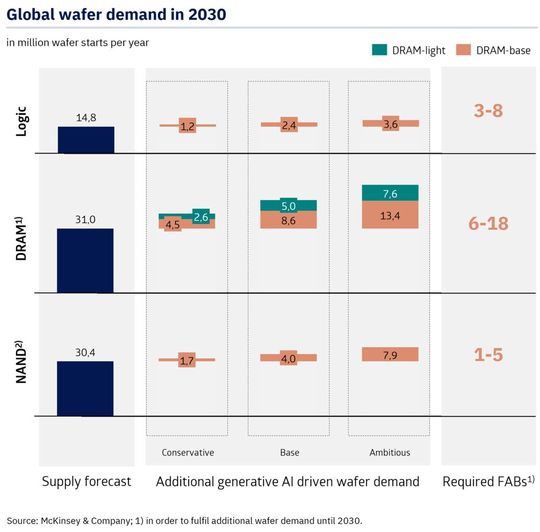
According to current analyses, the demand for logic chips for GenAI applications will rise by up to an additional 3.6 million wafers (Image 4). To meet this, a corresponding increase in production capacities is required, which is why up to eight new fabs will be needed by 2030.
Image 4: The demand for logic chips for GenAI applications will rise by up to an additional 3.6 million wafers.
(Image: Pava Partners Semiconductor Sector Report May 2024)
The graphic in Image 4 also makes it clear that NAND and DRAM chips are required in the double-digit million range in the field of memory technology. This demand primarily arises from the increasing performance requirements and the growing rack density in specialized data centers as a result of the rising number of complex GenAI applications. Manufacturers are already investing to massively ramp up production.
Date: 08.12.2025
Naturally, we always handle your personal data responsibly. Any personal data we receive from you is processed in accordance with applicable data protection legislation. For detailed information please see our privacy policy.
Consent to the use of data for promotional purposes
I hereby consent to Vogel Communications Group GmbH & Co. KG, Max-Planck-Str. 7-9, 97082 Würzburg including any affiliated companies according to §§ 15 et seq. AktG (hereafter: Vogel Communications Group) using my e-mail address to send editorial newsletters. A list of all affiliated companies can be found here
Newsletter content may include all products and services of any companies mentioned above, including for example specialist journals and books, events and fairs as well as event-related products and services, print and digital media offers and services such as additional (editorial) newsletters, raffles, lead campaigns, market research both online and offline, specialist webportals and e-learning offers. In case my personal telephone number has also been collected, it may be used for offers of aforementioned products, for services of the companies mentioned above, and market research purposes.
Additionally, my consent also includes the processing of my email address and telephone number for data matching for marketing purposes with select advertising partners such as LinkedIn, Google, and Meta. For this, Vogel Communications Group may transmit said data in hashed form to the advertising partners who then use said data to determine whether I am also a member of the mentioned advertising partner portals. Vogel Communications Group uses this feature for the purposes of re-targeting (up-selling, cross-selling, and customer loyalty), generating so-called look-alike audiences for acquisition of new customers, and as basis for exclusion for on-going advertising campaigns. Further information can be found in section “data matching for marketing purposes”.
In case I access protected data on Internet portals of Vogel Communications Group including any affiliated companies according to §§ 15 et seq. AktG, I need to provide further data in order to register for the access to such content. In return for this free access to editorial content, my data may be used in accordance with this consent for the purposes stated here. This does not apply to data matching for marketing purposes.
Right of revocation
I understand that I can revoke my consent at will. My revocation does not change the lawfulness of data processing that was conducted based on my consent leading up to my revocation. One option to declare my revocation is to use the contact form found at https://contact.vogel.de. In case I no longer wish to receive certain newsletters, I have subscribed to, I can also click on the unsubscribe link included at the end of a newsletter. Further information regarding my right of revocation and the implementation of it as well as the consequences of my revocation can be found in the data protection declaration, section editorial newsletter.
New construction and optimization: Meeting the demand
By 2025, a total of 79 new fabs are planned to meet the increasing demand. All major OEMs—from Globalfoundries to Intel and Micron, to Samsung, TSMC, and Texas Instruments—are planning to build highly efficient and powerful new factories.
Worldwide, there are currently 486 FABs; 289 of them produce 200-mm wafers and 197 of them produce 300-mm wafers. There is a high demand for new 300-mm factories, especially for industries that require new processors, larger memories, and billions of transistors. Therefore, of the new FABs, 54 factories will produce 300-mm wafers, while 25 will manufacture 200-mm wafers, specifically for silicon carbide-based semiconductors.
The expansion of new chip factories takes time, so existing facilities are being retrofitted and a higher degree of automation is being introduced. Last year, the SCIO Automation Group, an international platform for automation, acquired the German fab automation company Fabmatics.
Fabmatics, headquartered in Dresden, Germany, is a specialist in the automation of existing semiconductor FABs. Through a fully integrated and modular system based on standardized components, the company optimizes material flow through improved handling, transport, and storage processes. Process optimizations like these contribute to expanding existing production capacities and meeting current demand.
The semiconductor market: Growth market and outlook for Europe
Philipp Schlüter, Pava: What is the status of the international semiconductor market? The key figures have been compiled by the investment banking consultancy Pava.
(Image: FELIX_ADLER_LEIPZIG)
The numbers show a clear trend: the demand for chips will continue in the medium term. They are the foundation for the most important technologies of our time; accordingly, government subsidies are flowing extensively into semiconductor production. In recent years, supply chain issues have demonstrated how fragile the global ecosystem can be.
Nearshoring production to the USA and Europe will somewhat mitigate this risk, but establishing a complete, complex ecosystem in one region remains a challenge. For every job in a fab, five jobs are created at suppliers.
In the medium term, OEMs will focus on being able to meet the demand at all. Therefore, they are committed to both building new factories and optimizing existing facilities to increase capacities in the short term.
The rapid development of data centers for AI is not yet considered in most studies and planning. It is not foreseeable that the relevance of the key technology "semiconductors" will diminish. The AI chip market seems to be dominated initially by the USA and China. We hope that Europe will still leverage its historical strength in terms of Industrial IoT. European research is also leading in the field of quantum computing. May the applications also be brought to market by European companies. (kr)
*Philipp Schlüter is a partner and semiconductor expert at M&A consultancy Pava Partners, where he advises companies specifically from the semiconductor sector on sales, strategic acquisitions, financing, and succession.



:quality(80)/p7i.vogel.de/wcms/9e/23/9e23111e49d73012e9e3b7c69428ad5c/0134019347v1.jpeg "The Dominant VA45 high-helix tap from Bass, made of lead-free brass. The long chips, which result from the absence of lead, are clearly visible. (Image:Bass, Inc.)")
:quality(80)/p7i.vogel.de/wcms/1d/09/1d0999956ef87709b72ab1d0402ba207/csf-minis-gruppe-final-01-outputv1.jpeg "Since mid-2026, Harmonic Drive has been offering its CSF Mini gearheads in size 7 as well, in six variants designed for different installation scenarios. (Source: Harmonic Drive)")
:quality(80)/p7i.vogel.de/wcms/ab/08/ab08675922c3a7edea45128248b45b00/0133857009v1.jpeg "In the aerospace industry—one of the most demanding sectors of all—the Shanghai-based company TOPNC has already made a name for itself. (Image:TOPNC)")
:quality(80)/p7i.vogel.de/wcms/ff/48/ff48b1154746e79128935f28bd73ba0e/0113143253v1.jpeg "In our China Market Insider, we regularly provide you with relevant information straight from China. (Image:© Eisenhans - stock.adobe.com)")
:quality(80)/p7i.vogel.de/wcms/6e/bb/6ebb687f573be847aa611b413c6a33b1/0134094461v1.jpeg "From left: Sepp Hochreiter, founder of Nxai and AI researcher, and David Reger, founder and CEO of Neura Robotics, are excited about their collaboration on Physical AI. (Image:Neura)")
:quality(80)/p7i.vogel.de/wcms/89/01/890193a30c52ffd4811d18db82170952/0113143253v1.jpeg "In our China Market Insider, we regularly provide you with relevant information straight from China. (Image:© Eisenhans - stock.adobe.com)")
:quality(80)/p7i.vogel.de/wcms/6b/8a/6b8ac7cd85db2d1d1f6ab30957648711/schaeffler-news-taicanglighthouse6v1.jpeg "At the Lighthouse Factory, robots assemble linear and rotary actuators, among other components. (Source: Schaeffler)")
:quality(80)/p7i.vogel.de/wcms/4f/5a/4f5a2417df55dae5967e90b331e0bbc5/physical-ai-robotics-ariv1.jpeg "With new hardware and software solutions, the productive use of AI in industry is becoming increasingly prominent. (Source: Nvidia)")
:quality(80)/p7i.vogel.de/wcms/c3/68/c368b4f6821557ec497c64bc17fe9f8d/adobestock-2051843806--kaliel-stock-adobe-com-ki-generiertv1.jpeg "To truly harness the full potential of virtual product development, teams and management must radically change their mindset. (Source: © kaliel – stock.adobe.com_AI-generated)")
:quality(80)/p7i.vogel.de/wcms/a3/c1/a3c19e028b66a6fd7c373ab94981631d/paprika-gripperv1.jpeg "For the final, additively manufactured gripper base, SoftGripping chose PA 2200, a material based on polyamide 12 (PA12). It offers balanced mechanical properties and high load-bearing capacity, making it ideal for robust gripper solutions with integrated pneumatics. (Source: SoftGripping GmbH)")
:quality(80)/p7i.vogel.de/wcms/51/b8/51b8e08d2105fdd9952aff385f154192/graphic-2-adma1v1.png "The new surface hardening process enhances the performance of corrosion-resistant alloys by improving their tribological and mechanical surface properties, while preserving the properties of the base material. (Source: Bodycote)")
:quality(80)/p7i.vogel.de/wcms/96/ef/96effc239916cb7e0f396ab75627b8c0/image-space-testingv1.jpeg "Two scientists in front of a vacuum chamber used for testing: As technical instruments for spaceflight become more sensitive, the test facilities are becoming a critical system. (Source: Busch Group)")
:quality(80)/p7i.vogel.de/wcms/4c/61/4c61e3d5582715f2cadafc911480a20a/0132455124v1.jpeg "Mercedes-Benz has announced that it is moving away from its platform-based manufacturing strategy. Management expects a modular design concept to deliver greater benefits... (Image:Mercedes-Benz)")
:quality(80)/p7i.vogel.de/wcms/0d/14/0d14c9be5fc47bc256002ce3df435f21/keb-automation-drive-controller-marinev1.jpeg "Certified for ships, offshore applications, and more: the Combivert F6 Drive Controllers from KEB Automation. (Source: KEB Automation / Miss Irine)")
:quality(80)/p7i.vogel.de/wcms/ba/d3/bad3d62389a59fe3cdbac386a0dce64b/0134098250v1.jpeg "Following initial tests with its robotaxis in Europe, Pony.ai now plans to bring robot trucks to Europe as well. (Image:Pony.ai)")
:quality(80)/p7i.vogel.de/wcms/78/d1/78d124651f6149aa9f33913fc00ef98a/bertrandt-standort-tschechienv1.jpeg "Bertrandt has opened a new facility in the Czech Republic—near Škoda. (Source: Bertrandt)")
:quality(80)/p7i.vogel.de/wcms/27/47/27472d923d2d60f883a5682cb7987558/0134050215v1.jpeg "China's semiconductor industry: At the China International Industry Fair (CIIF) in Shanghai, the chip industry was given its own exhibition area for the first time in 2026. More than 300 companies showcased their technologies and solutions for industrial manufacturing at the “IC Ecosystem Show.” (Image:CIIF)")
:quality(80)/p7i.vogel.de/wcms/bc/20/bc2034a1ba033f00e539d91bcc70e403/bopla-bonext-1-rgbv1.jpeg "A translucent base allows for ambient lighting, either as a design feature or to visually indicate status. (Source: Bopla)")
:quality(80)/p7i.vogel.de/wcms/cd/23/cd239aa506b3ace30e62f44c83fa31ca/0134051508v1.jpeg "Figure 1: Schematic representation of the DAB (Dual Active Bridge) topology. (Image:Texas Instruments)")
:quality(80)/p7i.vogel.de/wcms/8b/35/8b35660420abba32fb891a4c5cc42fbd/0134018092v1.jpeg "Long-range UVC LED with lens and reflector: Close-up of a square LED with a transparent, dome-shaped lens on a dark base plate. The hermetically sealed housing ensures greater reliability and durability under demanding environmental conditions. (Image:FBH_Schurian)")
:fill(fff,0)/images.vogel.de/vogelonline/companyimg/76800/76895/65.jpg "FAULHABER_120mm.jpg ()")
:fill(fff,0)/p7i.vogel.de/companies/69/88/69882c428938e/tmts2026-ticec-banner-en-2000px.png "tmts2026-ticec-banner-en-2000px (https://www.tmts.tw/en)")
:fill(fff,0)/p7i.vogel.de/companies/69/de/69de1b7403b0d/simtos-logo.jpeg "simtos-logo (SIMTOS)")

:quality(80)/p7i.vogel.de/wcms/07/88/0788e1d750435682207672c1184b72b6/0132293079v1.jpeg "Facilities for 3-nm manufacturing processes in a cleanroom of Intel's Fab 34: Intel Foundry plans to ramp up production in Leixlip, Ireland, and is investing an additional 5 billion euros in the site's expansion. (Image: Intel)")
:quality(80)/p7i.vogel.de/wcms/04/a5/04a55af7c725abd266c1afc3a4f494a8/0131668052v1.jpeg "TSMC CEO C.C. Wei sees a chip shortage on the global market for years to come, driven by the high demands of the ongoing AI boom. However, the company intends to keep prices stable despite fully utilized capacities. (Image:TMSC)")