Originally designed for electric cars, the salt battery now powers mobile phone antennas—offering a safe, long-lasting energy solution with huge potential. Empa researchers, in collaboration with an industry partner, are advancing this innovative technology.
In the background a commercial salt cell with its electrolyte, in the foreground a laboratory cell.
(Image: Empa)
In 1997, the Mercedes-Benz A-Class tipped out of a bend during the moose test. One of the causes of the infamous incident: the A-Class was originally designed as an electric car. By switching to the combustion engine, the heavy battery was removed and the center of gravity shifted too far upwards.
The battery that should have been installed in the A-Class was a so-called salt battery. In contrast to most other batteries, in which the cathode and anode "float" in a common liquid electrolyte, the electrolyte in a salt battery is a solid, namely a ceramic ion conductor based on sodium aluminum oxide. The solid electrolyte is non-flammable and also allows the anode and cathode to be separated, which increases the service life of the battery. The cathode of a salt battery is based on a granulate of common salt and nickel powder, while the sodium metal anode is only formed during charging.
Gallery
This battery technology has not proven itself for electromobility: Today's electric cars run on lithium-ion batteries, which are lighter and can be charged more quickly. However, salt batteries are superior to their lithium-ion competitors in other areas of application. This is why salt batteries are being actively researched today - at Empa, among others.
Salt batteries offer a high level of safety
The research collaboration began in 2016 when the Ticino-based salt battery manufacturer Horien Salt Battery Solutions, formerly known as FZSoNick, approached Empa. The company wanted to improve the ceramic sodium aluminum oxide electrolyte in its battery cells as part of an Innosuisse project. This led to further projects on the cell geometry and electrochemistry of the salt battery, as it differs greatly from other battery types. "The assembly of salt battery cells for research purposes is very complex and there are hardly any studies on how they work exactly. That's what makes these projects so interesting for us: we can learn a lot and develop our understanding further together with the industrial partner," says Empa researcher Meike Heinz from the "Materials for Energy Conversion" department, which is headed by Corsin Battaglia.
However, their different cell structure also gives salt batteries some advantages over lithium-ion batteries. For example, in terms of safety: although salt batteries need an operating temperature of around 300° Celsius, they can neither burn nor explode. This is why they are also used in places where lithium-ion batteries are not even permitted, such as in mining and tunnel construction and on offshore oil and gas production platforms. Due to their high operating temperature, salt batteries are also much less sensitive to temperature than their lithium-ion counterparts. This makes them ideal emergency power storage systems for critical infrastructure, such as mobile phone antennas. Even in remote and exposed locations, the long-lasting and maintenance-free salt batteries can perform their work reliably for decades.
However, the operating temperature is also a disadvantage of this battery technology: salt batteries need "auxiliary heating" to be ready for use. But is a battery that needs electricity economical at all? "Depending on the application, it is more economical to keep a battery warm than to cool it," explains Meike Heinz. "Heat is generated during charging and discharging due to the natural cell resistance. In an optimal system, a large battery can heat itself as a result," adds Empa researcher Enea Svaluto-Ferro.
Cell chemistry for the future
As a materials researcher, Meike Heinz and her team focus on cell chemistry. Most of the raw materials for molten salt batteries are inexpensive and available in large quantities. The architecture of the cell also makes it easy to recycle. However, as the cathode material nickel is increasingly being classified as critical, Horien and Empa set about reducing the nickel content of the cells as part of the "HiPerSoNick" project funded by the Swiss Federal Office of Energy (SFOE). This was no easy task, as the composition and microstructure of the cell must be very precisely coordinated to ensure an efficient and long-lasting salt battery.
As part of the EU Solstice project, which will run until mid-2025, Horien and Empa, together with other project partners, are investigating whether the nickel in molten salt batteries could even be completely replaced by zinc. "However, the low melting point of zinc is a challenge at the current operating temperature," says Meike Heinz. Nevertheless, the researchers have already found promising approaches to stabilize the cathode microstructure.
Date: 08.12.2025
Naturally, we always handle your personal data responsibly. Any personal data we receive from you is processed in accordance with applicable data protection legislation. For detailed information please see our privacy policy.
Consent to the use of data for promotional purposes
I hereby consent to Vogel Communications Group GmbH & Co. KG, Max-Planck-Str. 7-9, 97082 Würzburg including any affiliated companies according to §§ 15 et seq. AktG (hereafter: Vogel Communications Group) using my e-mail address to send editorial newsletters. A list of all affiliated companies can be found here
Newsletter content may include all products and services of any companies mentioned above, including for example specialist journals and books, events and fairs as well as event-related products and services, print and digital media offers and services such as additional (editorial) newsletters, raffles, lead campaigns, market research both online and offline, specialist webportals and e-learning offers. In case my personal telephone number has also been collected, it may be used for offers of aforementioned products, for services of the companies mentioned above, and market research purposes.
Additionally, my consent also includes the processing of my email address and telephone number for data matching for marketing purposes with select advertising partners such as LinkedIn, Google, and Meta. For this, Vogel Communications Group may transmit said data in hashed form to the advertising partners who then use said data to determine whether I am also a member of the mentioned advertising partner portals. Vogel Communications Group uses this feature for the purposes of re-targeting (up-selling, cross-selling, and customer loyalty), generating so-called look-alike audiences for acquisition of new customers, and as basis for exclusion for on-going advertising campaigns. Further information can be found in section “data matching for marketing purposes”.
In case I access protected data on Internet portals of Vogel Communications Group including any affiliated companies according to §§ 15 et seq. AktG, I need to provide further data in order to register for the access to such content. In return for this free access to editorial content, my data may be used in accordance with this consent for the purposes stated here. This does not apply to data matching for marketing purposes.
Right of revocation
I understand that I can revoke my consent at will. My revocation does not change the lawfulness of data processing that was conducted based on my consent leading up to my revocation. One option to declare my revocation is to use the contact form found at https://contact.vogel.de. In case I no longer wish to receive certain newsletters, I have subscribed to, I can also click on the unsubscribe link included at the end of a newsletter. Further information regarding my right of revocation and the implementation of it as well as the consequences of my revocation can be found in the data protection declaration, section editorial newsletter.
Further follow-up projects are already being planned in which the Empa researchers will attempt to further improve—and scale up—nickel-free salt batteries. After all, their safety, long service life and lack of critical raw materials would make salt batteries ideal for stationary storage. If salt batteries can be produced cheaply and in large quantities, they could one day supply not only mobile phone antennas but also entire residential areas with electricity.



:quality(80)/p7i.vogel.de/wcms/a0/47/a04725ef9bd09fb6c9341a1bea1b5d93/0130443083v1.jpeg "Here, a type of plastic pallet is produced by thermoforming (vacuum forming or deep drawing) at the corresponding division of New England Plastics in the USA. This division, which specializes in so-called liners, is now part of Ringmetall ... (Image:New England Plastics)")
:quality(80)/p7i.vogel.de/wcms/e3/42/e342b3c593ea92d56604d3be969e9c9a/0130437231v1.jpeg "Daimler Truck will be building even more trucks at its Czech plant in Cheb in the future. This is because it is now being expanded for strategic cost-saving reasons ... (Image:Daimler Truck)")
:quality(80)/p7i.vogel.de/wcms/23/99/23992bf2dcdc432c9b7209c34a4a7c48/0129733089v1.jpeg "Stork relies on the modular Neoswiss turning system from Iscar to shorten the set-up times for its sliding headstock lathes and work more productively. (Image:Iscar)")
:quality(80)/p7i.vogel.de/wcms/7d/e2/7de2923434b2f1a78ba5482d8d335269/0113143253v1.jpeg "In our China Market Insider we regularly provide you with relevant information directly from China. (Image:© Eisenhans - stock.adobe.com)")
:quality(80)/p7i.vogel.de/wcms/b7/36/b736dfebc16c42d6901d0d0e1f390493/3d-druck-20factory-20--20ki-20generiert-1920x1079v1.png "(Source: AI-generated)")
:quality(80)/p7i.vogel.de/wcms/79/b2/79b21aad663f4a7bd4472afc1c1afc62/0130433994v1.jpeg "Mission Joyride: The free-flying robot (shown here in the rendering) will relieve the ISS crew of logistics tasks from 2027 with its two mechanical arms. (Image:Icarus Robotics)")
:quality(80)/p7i.vogel.de/wcms/6b/45/6b4546fa6ebf305c3660326909363f32/0130437089v1.jpeg "Industrial AI in action: Rockwell Automation presents practical solutions for self-controlling production systems at the Hannover Messe. (Image:Rainer Jensen, Deutsche Messe)")
:quality(80)/p7i.vogel.de/wcms/78/e9/78e9188c25a8a94e67c34c9bf8ffe495/visual-agile-20robots-20and-20google-20deepmind-20partner-20to-20bring-20intelligence-20to-20robotics-2500x1406v1v1.jpeg "Together, the partners are developing adaptable, intelligent robots for a wide range of applications (Image:Agile Robots SE)")
:quality(80)/p7i.vogel.de/wcms/59/a2/59a2b11f0aa1b700eff02addd5de8703/adobestock-1788280853--c2-a9-20satria-20-e2-80-93-20stock-adobe-com-5081x2860v1v1.jpeg "Quantum computers require extreme cooling to temperatures close to absolute zero in order to keep qubits stable. (Image:satria - stock.adobe.com)")
:quality(80)/p7i.vogel.de/wcms/62/5f/625f41e87ebfef156a98c8e6393e32fd/0130211654v1.jpeg "Axial flux motors have some advantages over radial flux motor—but their production is currently still expensive. (Image:RWTH Aachen University)")
:quality(80)/p7i.vogel.de/wcms/f6/ae/f6aec4f6241b36ed5e3a990ac9176b42/0130429460v1.jpeg "Verne, Pony.ai and Uber want to launch a robotaxi service in Europe. (Image:Verne)")
:quality(80)/p7i.vogel.de/wcms/d7/88/d788699f2974708a332baa4e7a62fa9e/0130438967v1.jpeg "Skoda is withdrawing from China. The brand has produced well over three million vehicles there. (Image:Skoda car)")
:quality(80)/p7i.vogel.de/wcms/b0/43/b043b86899837532aad62d63368a917a/0130371361v1.jpeg "Skoda leaves the chinese market.
(Image:Skoda)")
:quality(80)/p7i.vogel.de/wcms/c3/c4/c3c4ce270b083eeac55654148611f064/0130237945v1.jpeg "China is not giving up on hydrogen, but is intensifying its efforts. (Image:freely licensed from Pixabay)")
:quality(80)/p7i.vogel.de/wcms/ee/09/ee09acbd6dc896df25affaa9e871e6e5/0130440053v1.jpeg "IMS chip module for simple system integration into an ion mobility spectrometer. (Image:Fraunhofer IPMS)")
:quality(80)/p7i.vogel.de/wcms/10/6c/106cd22de5f68a0f74639d654827228c/0130345302v1.jpeg "Made in India: According to the India Electronics and Semiconductor Association (IESA), the country should be able to produce between 75 and 80 million chips by the beginning of 2027, once the plants currently under construction become operational. (Image:Pixabay (Montage: Sebastian Gerstl))")
:quality(80)/p7i.vogel.de/wcms/a5/ed/a5ed6fda029d362732a293d6b19d74c4/0130444216v1.jpeg "Thirteen executives from the Chinese chip industry have drawn up a plan to achieve an 80% self-sufficiency rate for semiconductors by 2030. (Image:Maxim_Kazmin - stock.adobe.com)")
:quality(80)/p7i.vogel.de/wcms/31/a6/31a646018b34d8e0a44bfc8bf17837f6/0130361632v1.jpeg "For many companies, PFAS are considered indispensable in electronics production. (Image:freely licensed)")
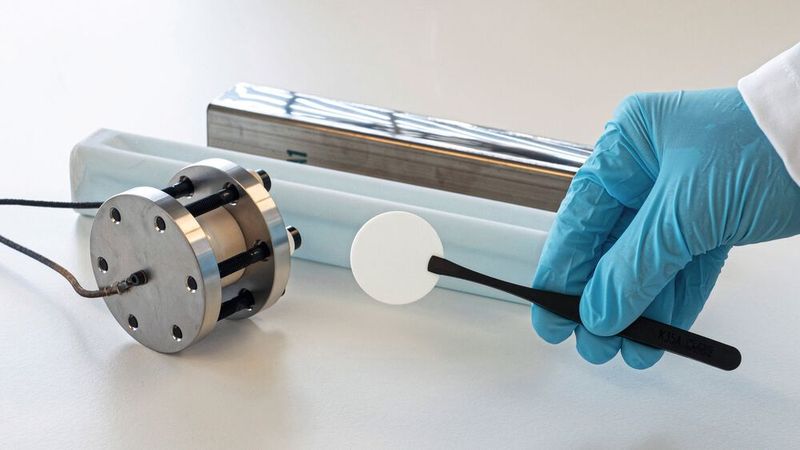
:quality(80)/p7i.vogel.de/wcms/ef/2f/ef2f51741b304df7cec4868e18d6bdb8/0121583464v1.jpeg "In the background a commercial salt cell with its electrolyte, in the foreground a laboratory cell.(Image: Empa)")
:quality(80)/p7i.vogel.de/wcms/6e/d7/6ed7cacdd962575cc2e8e202b7a2119b/0121583467v1.jpeg "Empa researchers Enea Svaluto and Meike Heinz in the new battery laboratory on the Empa campus in Dübendorf.(Image: Empa)")
:quality(80)/p7i.vogel.de/wcms/a1/89/a189c8d9401aef40480fb000e999df0b/0121583461v1.jpeg "Empa researcher Meike Heinz holds a slice of the ceramic electrolyte for the salt battery.(Image: Empa)")
:quality(80)/p7i.vogel.de/wcms/85/e8/85e89606edeeec55feac9ab5617e2440/newsimage418885-3500x1969v1v1.jpeg "Flexible: The solid electrolyte based on silicone is expandable and thus compensates for the cavities that form in solid-state batteries during charging and discharging. (Image:Empa)")
:quality(80)/p7i.vogel.de/wcms/54/55/5455b914580a27cb39bcd5c088184e15/0124774343v1.jpeg "The right mix is crucial. The BAM team is developing special solid electrolytes based on sodium superionic conductors. (Image:Federal Institute for Materials Research and Testing)")