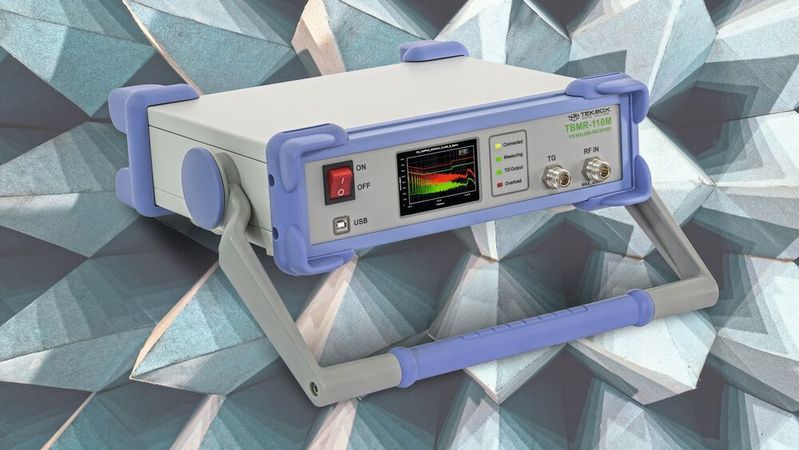
In the automotive industry, it is necessary for developers to test and validate the EMC performance of various components. Otherwise, there may be interference between electronic devices. The necessary measurements can be explained using the example of the TBMR-110M.
RF Power Electronics: The RF EMI analyzer can be used to examine components for use in vehicles.
(Image: Meilhaus)
*Shashank Vodapally is an RF specialist at Meilhaus Electronic.
In the rapidly evolving automotive industry, where advanced electronics and wireless techniques are increasingly integrated into vehicles, it is crucial to test electromagnetic compatibility (EMC). A key tool in this process is the RF EMI analyzer (Radio Frequency Electromagnetic Interference), which plays a critical role in ensuring the reliable and interference-free operation of electronic systems in automobiles.
Automobile manufacturers and suppliers use RF EMI analyzers for pre-compliance testing of their products. This allows developers to ensure they meet the necessary EMC requirements before undergoing formal certification. This proactive approach helps identify and resolve EMI issues early in the development process, reducing the risk of costly delays or non-compliance in final certification.
Test and validate EMC performance of components
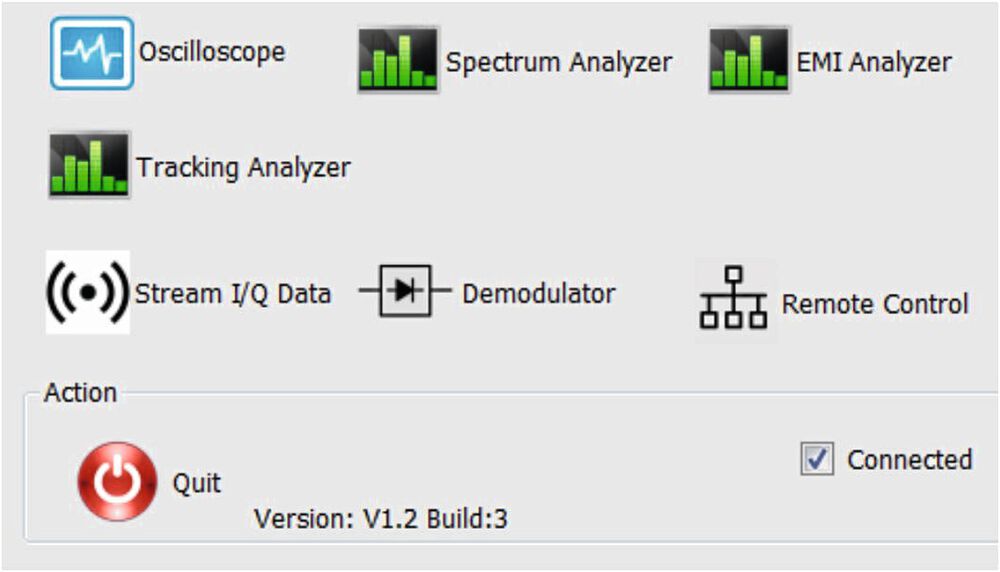
Image 1: The graphical user interface of the TBMR-110M.
(Image:Meilhaus)
In automotive manufacturing, these analyzers are particularly valuable for testing and validating the EMC performance of various components, from engine control units (ECUs) to infotainment systems operating at a frequency of 110 MHz. RF analyzers measure conducted electromagnetic emissions generated by electronic components and systems in motor vehicles that could potentially interfere with the operation of other onboard systems. These measurements are typically carried out according to standards such as CISPR 25 or OEM-specific requirements to ensure compliance with regulatory guidelines.
For such applications, the company Tekbox has introduced the high-speed EMI analyzer TBMR-110M, which allows developers to perform all necessary measurements. In addition to EMI functions, the device features a built-in tracking generator, an oscilloscope function, a demodulator, and an IQ stream generator. The following text explains the functionality of the TBMT-110M.
RF signal processing and spectrum analysis
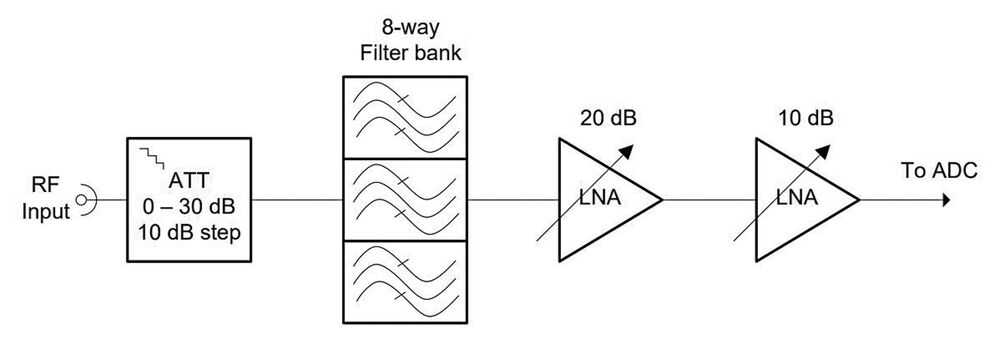
Image 2: The block diagram of the RF section.
(Image:Meilhaus)
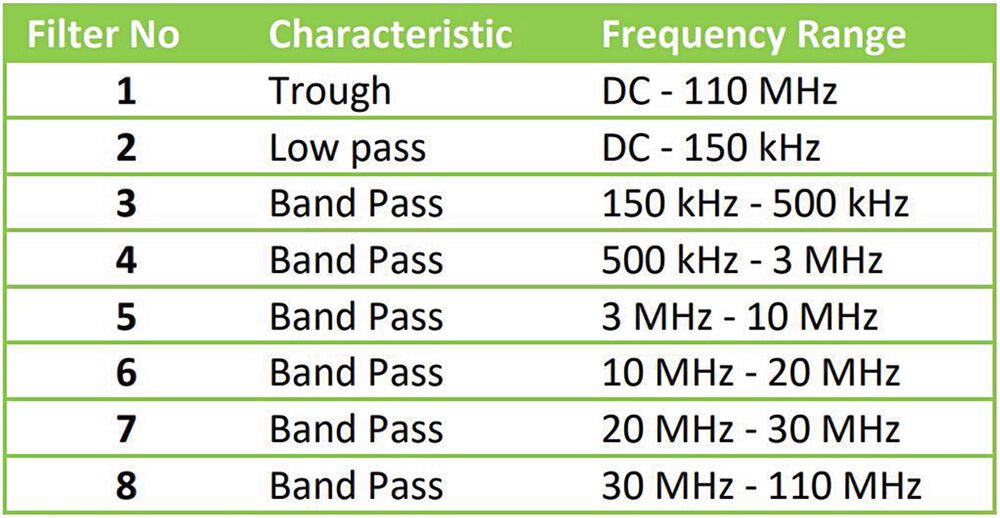
Image 3: Listing of the preselector filter features.
(Image:Meilhaus)
The RF input is connected to a switchable attenuator with an attenuation range from 0 dB to 30 dB in 10 dB steps and an input protection circuit. This is followed by an 8-channel preselector. The output of the preselector feeds two sequential LNAs (Low Noise Amplifiers). The first stage has a gain of 20 dB and the second stage has a gain of 10 dB. This allows for gain adjustment from 0 to 30 dB in 10 dB steps.
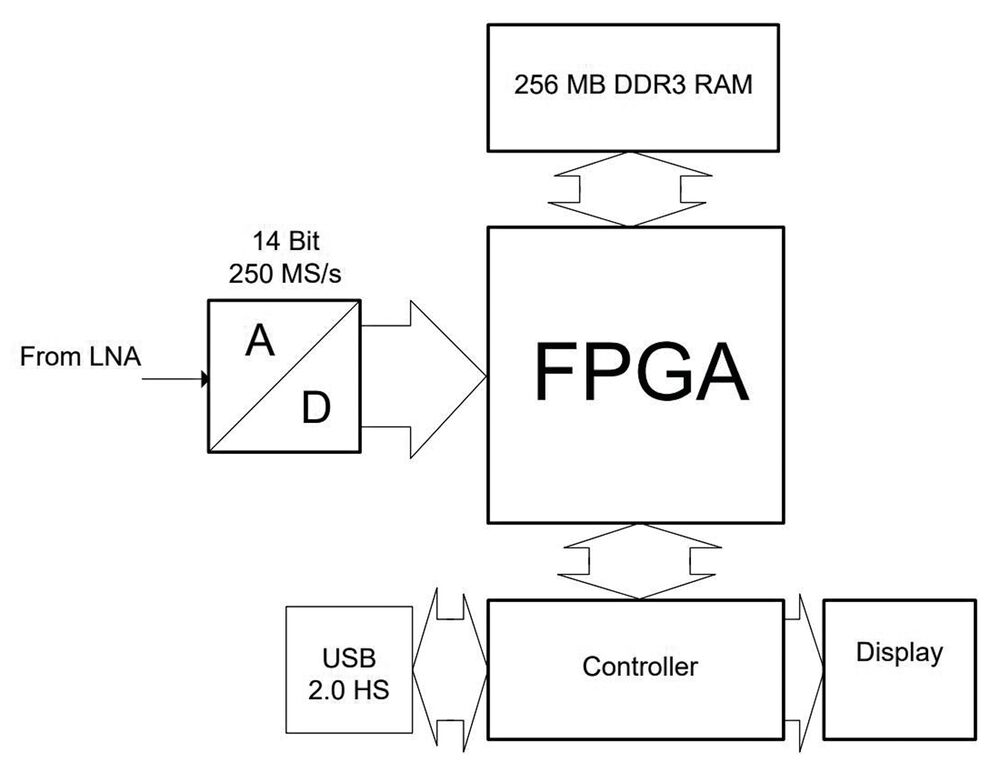
Image 4: The block diagram of the digital part of the analyzer with the FPGA.
(Image:Meilhaus)
The RF signal is sampled, converted to digital via an A/D converter, and processed in an FPGA block with custom logic before the data is stored in a fast synchronous RAM with 256 MB. The microcontroller reads the contents of the RAM and transfers them to the computer via the USB interface, where the spectrum is processed and displayed.
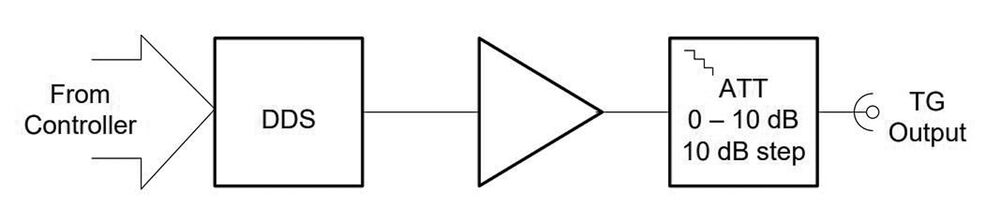
Image 5: The block diagram of the tracking generator.
(Image:Meilhaus)
The tracking generator consists of a 250 MHz DDS (Direct Digital Synthesis), followed by an amplifier and a switchable 10-dB attenuator. It can generate single-tone (CW) signals from very low frequencies up to 100 MHz with a maximum output power of 0 dBm. The analyzer includes a digital receiver with a cascaded switchable and tunable digital filter bank. The maximum RBW (Resolution Bandwidth) is limited to 3.5 MHz. Demodulation, short-term FFT (STFFT), and parallel filter calculation are carried out computationally using powerful multithreading and SIMD (Single Input Multiple Data) technology. EMI (Electromagnetic Interference) test setups include transducers such as measuring antennas, RF current monitoring probes, or LISN (Line Impedance Stabilization Network), just to name the most commonly used. All transducers have characteristics that must be considered for accurate measurement results. This comprehensive setup ensures precise control and analysis capabilities for a wide range of EMI testing applications in various fields, particularly useful in settings where stringent electromagnetic compliance is required.
Antenna factors for electric and magnetic field strengths
Measuring antennas are characterized by their antenna factor AF in [dB/m] and are supplied with an antenna factor table. By adding the electrical antenna factor to the voltage at the antenna output in [dBµV], the corresponding electric field strength in [dBµV/m] is obtained. Electric field strength E [dBµV/m] = VANT [dBµV] + AFE [dB/m]. If antennas are designed to measure magnetic fields, they are characterized by the magnetic antenna factor in [dB/Ωm]. Magnetic field strength H [dBµA/m] = VANT [dBµV] + AFH [dB/Ωm]. The antenna factors are always frequency-dependent and vary slightly depending on the measurement distance between the antenna and the test object.
Date: 08.12.2025
Naturally, we always handle your personal data responsibly. Any personal data we receive from you is processed in accordance with applicable data protection legislation. For detailed information please see our privacy policy.
Consent to the use of data for promotional purposes
I hereby consent to Vogel Communications Group GmbH & Co. KG, Max-Planck-Str. 7-9, 97082 Würzburg including any affiliated companies according to §§ 15 et seq. AktG (hereafter: Vogel Communications Group) using my e-mail address to send editorial newsletters. A list of all affiliated companies can be found here
Newsletter content may include all products and services of any companies mentioned above, including for example specialist journals and books, events and fairs as well as event-related products and services, print and digital media offers and services such as additional (editorial) newsletters, raffles, lead campaigns, market research both online and offline, specialist webportals and e-learning offers. In case my personal telephone number has also been collected, it may be used for offers of aforementioned products, for services of the companies mentioned above, and market research purposes.
Additionally, my consent also includes the processing of my email address and telephone number for data matching for marketing purposes with select advertising partners such as LinkedIn, Google, and Meta. For this, Vogel Communications Group may transmit said data in hashed form to the advertising partners who then use said data to determine whether I am also a member of the mentioned advertising partner portals. Vogel Communications Group uses this feature for the purposes of re-targeting (up-selling, cross-selling, and customer loyalty), generating so-called look-alike audiences for acquisition of new customers, and as basis for exclusion for on-going advertising campaigns. Further information can be found in section “data matching for marketing purposes”.
In case I access protected data on Internet portals of Vogel Communications Group including any affiliated companies according to §§ 15 et seq. AktG, I need to provide further data in order to register for the access to such content. In return for this free access to editorial content, my data may be used in accordance with this consent for the purposes stated here. This does not apply to data matching for marketing purposes.
Right of revocation
I understand that I can revoke my consent at will. My revocation does not change the lawfulness of data processing that was conducted based on my consent leading up to my revocation. One option to declare my revocation is to use the contact form found at https://contact.vogel.de. In case I no longer wish to receive certain newsletters, I have subscribed to, I can also click on the unsubscribe link included at the end of a newsletter. Further information regarding my right of revocation and the implementation of it as well as the consequences of my revocation can be found in the data protection declaration, section editorial newsletter.
Power impedance network and measurement correction
The Line Impedance Stabilization Network (LISN) is a crucial device in Electromagnetic Compatibility (EMC) testing, used to measure unwanted emissions from power lines. The performance of an LISN is characterized by key factors such as impedance, phase, isolation, and the voltage division ratio. This ratio is especially important for correcting measurement values, as it defines the relationship between the voltage at the LISN's RF port and the voltage at the EUT (Equipment Under Test) port. The testing setup often includes additional components beyond the LISN, such as cables, attenuators, filters, limiters, amplifiers, and other converters. Each of these elements has specific logarithmic parameters, like gain or attenuation, which must be accounted for in the analysis of raw data. Depending on their role, these parameters are either added to or subtracted from the raw data to accurately determine the actual levels of interference. Precise calculation and adjustment of these parameters are essential to ensure reliable and accurate EMC test results.
The following formula is implemented in the TBMR-110M software and in EMCview: Diagram amplitude = Raw amplitude [dBµV] - Cable file - LISN file + Antenna file - Amplifier file.
Each file can characterize various components. The software identifies the files by their extensions:
Cable files: *.cac
LISN files: *.lsc
Antenna files: *.ant
Amplifier files: *.amp
Each component can be defined in any of the files as long as the parameter has the appropriate sign. For example, the attenuation value of an attenuator must be negative in cable, LISN, or amplifier files, but positive in antenna files. RF current probes are defined in LISN files with positive transimpedance values. (heh)



:quality(80)/p7i.vogel.de/wcms/9f/7b/9f7be35880605811e045acd3af8b571b/0129558586v1.jpeg "An example of the V210 processing machine, which, according to Voortman, supplements the laser cutting of the V353 with drilling, thread cutting and milling. (Image:Voortman)")
:quality(80)/p7i.vogel.de/wcms/b0/41/b041264d931df4347bc760fff1c7cb7b/0129439236v1.jpeg "The circular milling system proves to be a problem solver in the numerous standard variants, as well as in special shapes for some other milling processes. (Image:Horn/Sauermann)")
:quality(80)/p7i.vogel.de/wcms/33/ab/33abf15b4b5625a8904cb57c51597709/0129982307v1.jpeg "This is a new development from Fraunhofer IFAM and partners: an automated adhesive splitting system for the reliable and more productive bonding of composite parts. Here, a frame for an airplane window is measured in real time and a precise amount of adhesive is applied. (Image:Fraunhofer IFAM)")
:quality(80)/p7i.vogel.de/wcms/df/26/df26e72a2f7c890171a1059b48eef68e/0129962397v1.jpeg "The Swedish cutting tool manufacturer Sandvik Coromant now has two additional geometries for its Corodrill DE10 replaceable head drilling system, which it says will further expand the already wide range of applications - for example for cast materials ... (Image:Sandvik Coromant)")
:quality(80)/p7i.vogel.de/wcms/92/5e/925ee98ea36ad9bd574fa1cea11d0e53/0129964352v1.jpeg "The production of hardware components for humanoid robots offers great market potential. (Image:Fraunhofer IPA)")
:quality(80)/p7i.vogel.de/wcms/08/72/0872dd2dd119a54824c41e0e580e45a8/0129576591v1.jpeg "The Rose enclosure systems can be customized on request. (Image:Rose Systemtechnik GmbH)")
:quality(80)/p7i.vogel.de/wcms/73/17/7317794432521bf911711b91287cfc28/0129961259v1.jpeg "ABB Robotics and Nvidia are enabling the widespread use of physical AI in the world of robotics. This means that systems can be created virtually and with high precision and optimized much more cost-effectively. In the large image the virtual system, next to it the real robot cell ... (Image:ABB)")
:quality(80)/p7i.vogel.de/wcms/09/a2/09a2e832b1c0271d299fc130201e5717/adobestock-1767409934-4191x2360v1.jpeg "(Source: © ImageFlow - stock.adobe.com)")
:quality(80)/p7i.vogel.de/wcms/68/89/688937087188b77da95b2079399ca862/0130009534v1.jpeg "Here you can see the Dualis layout configurator in use at Montratec. (Picture: ©Gorodenkoff - stock.adobe.com)")
:quality(80)/p7i.vogel.de/wcms/9e/98/9e984afbf9c6f2bcc8963bd13465b180/26-02-pi-fraunhofer-iws-41300-ultragrain-project-closing-pic-02-1562x878v1v1.png "The process of laser wire build-up welding (DED-LB) with pulse laser-induced plasma, which contributed to the success of the Ultra Grain project, is shown at high speed. (Image:Fraunhofer IWS)")
:quality(80)/p7i.vogel.de/wcms/28/00/28008d9477bb07daa3b28ce4ac0ae907/newsimage418436-1536x864v1v1.jpeg "Researchers have produced elastic ear cartilage from human cells in the laboratory, which remains dimensionally stable in animal models. (Image:ETH Zurich)")
:quality(80)/p7i.vogel.de/wcms/1e/7d/1e7d6a316cdd7a7ba5e84d7c9a3efb80/newsimage418837-3000x1687v1v1.jpeg "Driverless shuttles can strengthen public transport, especially in rural areas. (Image:ZF Friedrichshafen)")
:quality(80)/p7i.vogel.de/wcms/c5/d2/c5d2655e427c7cbfe2f537dccfbd06e3/0129971639v1.jpeg "Volkswagen Group Charging, Elli, has connected its first electricity storage system to the grid. (Image:Elli)")
:quality(80)/p7i.vogel.de/wcms/b4/fc/b4fc9420fca6915b291eca0ae2532688/0129978040v1.jpeg "MAN has completed winter tests with nine buses. (Image:Bulent Camci)")
:quality(80)/p7i.vogel.de/wcms/a7/22/a722a06c823b5d7405eb9fb15a0b4e7d/0129931201v1.jpeg "The company offers access to its charging network, which now has more than 1,000,000 charging points across Europe, via the Elli app. (Image:Elli | Volkswagen)")
:quality(80)/p7i.vogel.de/wcms/89/5d/895dfb4fb9a90c33ddd287c7d09c9ffd/0129938355v1.jpeg "Ganfeng Lithium has developed semi-solid batteries for eVTOLs together with Geely subsidiary Aerofugia. (Image:Aerofugia)")
:quality(80)/p7i.vogel.de/wcms/c2/a8/c2a8a93f306c1475489dff074ad59731/0129967672v1.jpeg "Figure 1: Imec's logic technology roadmap showing the extension of the nanosheet era from 2nm to the A10 node with the outer-wall forksheet, before the transition to CFET for A7 and beyond. (Image:imec)")
:quality(80)/p7i.vogel.de/wcms/07/79/0779a3ba2b38d583fc9b515900be2add/0129957428v1.jpeg "If the Chinese government has its way, domestic data centers full of Nvidia hardware will be a thing of the past. (Image:Nvidia)")
:quality(80)/p7i.vogel.de/wcms/aa/4c/aa4cd2c6c10199015d47caf72eca2115/0129962687v1.jpeg "Bosch Rexroth and AMD are working together on Software-Defined Automation: ctrlX OS now also supports AMD Embedded x86 CPUs and adaptive SoCs, promising even greater hardware design flexibility, seamless scalability and a secure, modular operating system foundation. (Image:Bosch Rexroth AG)")
:quality(80)/p7i.vogel.de/wcms/7b/10/7b108d8ec7bf09cb1a20998364483525/0129923685v1.jpeg "The concept of the blade battery. (Image:BYD Europe B.V.)")
:fill(fff,0)/p7i.vogel.de/companies/68/a4/68a47beec75ce/logo-cmyk-de.jpeg "logo-cmyk-de (https://www.datatec.eu/)")
:fill(fff,0)/p7i.vogel.de/companies/67/eb/67eba621ef6ea/logo2.png "logo2 (Wuxi InfiMotion)")
:quality(80)/p7i.vogel.de/wcms/d6/94/d694db1af2cad4cfd03e1ae617b2967b/0127938873v1.jpeg "Fieldbus integration in embedded systems is considered a supreme discipline—EMI robustness, real-time capable protocols, and certification processes challenge developers on all levels. (Image:AI-generated)")
:quality(80)/p7i.vogel.de/wcms/a6/40/a640b5cc3091a7f4403988f2ff272855/0127037035v1.jpeg "Cross-section: The sectional view shows what the substrates look like inside. Fill materials, such as in Rogers RO4730G3, are adjusted so that they do not alter the properties of the antennas. (Image:Rogers Corporation)")