Circuit boards are also, in a sense, passive components. Individual traces have a measurable resistance, inductance, and also capacitance. This depends heavily on the material used.
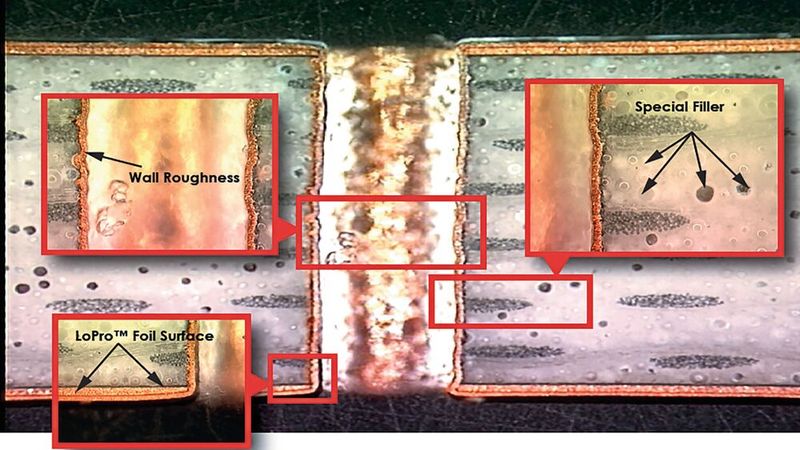
Cross-section: The sectional view shows what the substrates look like inside. Fill materials, such as in Rogers RO4730G3, are adjusted so that they do not alter the properties of the antennas.
(Image: Rogers Corporation)
A double-sided Eurocard (160 mm × 100 mm) with a core thickness of 400 µm and a relative permittivity εr = 4.6 results in a parasitic capacitance of approximately 1.62 nF. This value can be calculated using the formula for plate capacitors:
with C = capacitance [F], ε0 = electric field constant (approximately 8.854⋅10⁻¹² As/Vm), εr = relative permittivity of the material, A = plate area [m2], d = distance between the plates [m].
The Dielectric
Let’s take a closer look at the dielectric. It is a factor in the calculation of capacitance. Particularly important here is the dielectric constant (also called relative permittivity, εr). It is a material property that describes the attenuation of an electric field within a substance. It is measured relative to the attenuation in a vacuum (ε0).
This constant indicates how well a material can store electrical energy in a field. Formally, it is the ratio of the permittivity of the material (εr) to the electric field constant (ε0). The higher the dielectric constant, the more the electric field is reduced in the material and the more charge a capacitor can store at a given voltage. Typical values range from about 2 to 4 for plastics, around 80 for water, and up to several thousand for special ceramics used in the production of capacitors.
The Problem
When calculating the impedance of microstrip lines, the influence of the dielectric is particularly evident. A trace with a width of 3 mm on a 1.6 mm thick FR4 substrate over a ground plane achieves an impedance of approximately 49.5 Ω with a dielectric constant of εr = 4.4. Incidentally, FR4 stands for Flame Retardant 4. If instead a material like Rogers RO4730G3 is used, the impedance increases to about 58.6 Ω due to the lower dielectric constant of εr = 3.0. The advantage of such substrates lies not only in the higher impedance value but especially in their very low loss characteristics, stability, and homogeneity: unlike FR4, it is a hydrocarbon-based laminate filled with ceramic and hollow micro-particles, offering very stable electrical properties across a wide frequency range. Rogers RO4730G3 and the expected RO4725G3 material in Q1 2026, with an even lower dielectric constant of εr = 2.55, are specifically designed for high-frequency radio technology.
FR4 does not exhibit this property. Upon closer inspection, it becomes clear that it is composed of a fiberglass weave and epoxy resin. The fiberglass weave has a dielectric constant of approximately 5.8 to 6.7, while the epoxy resin ranges from about 3.0 to 3.4. This value is also highly temperature-dependent. FR4 is therefore a bulk average of these two components. The effective value depends on the resin-to-glass ratio. With a high resin content, εr decreases closer to 3.5 to 4.0. With a high glass content, εr increases toward 4.7 to 5.0.
For example, if a fine antenna or trace structure is located directly above a fiberglass area, it experiences a significantly higher effective dielectric constant locally than over an area predominantly consisting of resin. For the electromagnetic wave, this means that the propagation speed and thus the phase position differ in these zones. The antenna therefore does not "see" a uniform dielectric but rather a fine, fabric-induced structure with varying electrical properties and, in the worst case, a preferential alignment, also referred to as anisotropy. This inhomogeneity results in the effective electrical length not exactly matching the geometric design.
In practical operation, this manifests as shifts in the resonance frequency, altered impedance matching, and sometimes additional losses. The higher the frequency and the smaller the structures, the more pronounced these differences become. Therefore, FR4 is considered problematic in high-frequency technology and especially in antenna design, while homogeneous and lower-loss substrates such as PTFE, ceramic, or specialized RF laminate materials are typically used for precise applications.
Date: 08.12.2025
Naturally, we always handle your personal data responsibly. Any personal data we receive from you is processed in accordance with applicable data protection legislation. For detailed information please see our privacy policy.
Consent to the use of data for promotional purposes
I hereby consent to Vogel Communications Group GmbH & Co. KG, Max-Planck-Str. 7-9, 97082 Würzburg including any affiliated companies according to §§ 15 et seq. AktG (hereafter: Vogel Communications Group) using my e-mail address to send editorial newsletters. A list of all affiliated companies can be found here
Newsletter content may include all products and services of any companies mentioned above, including for example specialist journals and books, events and fairs as well as event-related products and services, print and digital media offers and services such as additional (editorial) newsletters, raffles, lead campaigns, market research both online and offline, specialist webportals and e-learning offers. In case my personal telephone number has also been collected, it may be used for offers of aforementioned products, for services of the companies mentioned above, and market research purposes.
Additionally, my consent also includes the processing of my email address and telephone number for data matching for marketing purposes with select advertising partners such as LinkedIn, Google, and Meta. For this, Vogel Communications Group may transmit said data in hashed form to the advertising partners who then use said data to determine whether I am also a member of the mentioned advertising partner portals. Vogel Communications Group uses this feature for the purposes of re-targeting (up-selling, cross-selling, and customer loyalty), generating so-called look-alike audiences for acquisition of new customers, and as basis for exclusion for on-going advertising campaigns. Further information can be found in section “data matching for marketing purposes”.
In case I access protected data on Internet portals of Vogel Communications Group including any affiliated companies according to §§ 15 et seq. AktG, I need to provide further data in order to register for the access to such content. In return for this free access to editorial content, my data may be used in accordance with this consent for the purposes stated here. This does not apply to data matching for marketing purposes.
Right of revocation
I understand that I can revoke my consent at will. My revocation does not change the lawfulness of data processing that was conducted based on my consent leading up to my revocation. One option to declare my revocation is to use the contact form found at https://contact.vogel.de. In case I no longer wish to receive certain newsletters, I have subscribed to, I can also click on the unsubscribe link included at the end of a newsletter. Further information regarding my right of revocation and the implementation of it as well as the consequences of my revocation can be found in the data protection declaration, section editorial newsletter.
Additionally, the impedance of a trace on FR4 does not behave consistently due to several factors. Impedance is primarily determined by the thickness of the substrate, trace width, and dielectric constant. If these parameters vary significantly from production batch to production batch, the impedance will shift.
Environmental influences, such as relatively high moisture absorption of the epoxy resin and the temperature dependency of the dielectric constant, also play a role.
Additionally, depending on whether the trace runs directly over a fiberglass strand or a pure resin area, tiny impedance jumps occur along the line, which can manifest at high frequencies in the form of reflections, increased attenuation, and, in some cases, unwanted crosstalk. While these effects are hardly relevant for low-frequency applications, they can significantly degrade signal quality in the GHz range and noticeably complicate the development of antennas or high-speed traces.
Dielectric Losses
As already mentioned, the behavior of the dielectric at high frequencies is particularly critical. While ideal materials would exhibit a constant dielectric constant across the entire frequency range, common substrates like FR4 show significant frequency dependency.
The cause lies in the molecular relaxation processes of the material. Polar molecules and molecular groups in the dielectric try to align themselves with the changing electric field. At low frequencies, these polarization mechanisms can fully follow the field changes. However, as the frequency increases, the time between field changes becomes shorter. Then, the inertia of the molecules prevents them from keeping up with the rapid changes. This delayed response of the molecular dipoles results in two effects. Firstly, the effective dielectric constant decreases with increasing frequency because fewer polarization mechanisms contribute to field shielding. Secondly, dielectric losses occur, as the energy used for the incomplete alignment of dipoles is converted into heat. These losses are characterized by the loss factor tan δ (tangent of the loss angle).
In practice, it becomes apparent that signal transmission is increasingly impaired as frequency rises. The frequency-dependent dielectric constant causes impedance fluctuations and phase shifts. The dielectric losses increase signal attenuation. Additionally, frequency dispersion affects different spectral components of a signal unequally.
High-quality RF laminates like Rogers RO4730G3 offer nearly constant electrical properties and low losses over a wide frequency range due to their homogeneous structure and optimized molecular composition. (mr)



:quality(80)/p7i.vogel.de/wcms/eb/2b/eb2bd1b8487afe577b37363cd02f16ff/0113143253v1.jpeg "In our China Market Insider, we regularly provide you with relevant information straight from China. (Image:© Eisenhans - stock.adobe.com)")
:quality(80)/p7i.vogel.de/wcms/d1/ef/d1ef6b6f7d4543f7999980bacccaf22b/0133499261v1.jpeg "As the growing imbalance in trade relations with China continues to widen, the EU Chamber of Commerce foresees a day when trade with China will have to be seriously reevaluated ... (Image: AI-generated)")
:quality(80)/p7i.vogel.de/wcms/fe/1f/fe1fa5ee713f94deaba963dc24c3abc5/0133299273v1.jpeg "The Flexistar enables highly flexible production of laser-welded tubes thanks to its tool-free clamping system. (Image:Because Technology, LLC)")
:quality(80)/p7i.vogel.de/wcms/1b/5a/1b5ac72f83db4dbee3ff91e51bc398f4/0133496095v1.jpeg "BASF announces that it will take the next step toward producing the polyurethane precursor MDI in India ... (Image:BASF)")
:quality(80)/p7i.vogel.de/wcms/60/ef/60ef4f07e4829b2c2929befc0f353c58/0133511729v1.jpeg "Humanoid robots can match human performance in certain tasks. (Image:Gemini / AI-generated)")
:quality(80)/p7i.vogel.de/wcms/2e/99/2e99726b522e4b35b690e25eb6a42643/0133463991v1.jpeg "Robotics: In AMR applications, connection technology must reliably transmit power, signals, and data despite vibration and shock loads—in very confined spaces and in a way that allows for regular maintenance. (Image:Hyperever)")
:quality(80)/p7i.vogel.de/wcms/d0/18/d01801e3d5dbd7bc9d0b4f60408b630c/0133468429v1.jpeg "Quality requirements for film packaging are on the rise. At the same time, many companies are turning to recyclable film materials, which, however, have their own challenges. Fraunhofer researchers have therefore developed a fast system that detects problems in real time. (Image:Fraunhofer IKTS)")
:quality(80)/p7i.vogel.de/wcms/b1/06/b106cf44923ce39565c3264982fd20eb/0133414574v1.jpeg "Robots Build Robots: At the new Ubtech factory, automated systems even handle parts of the material supply and logistics for the production of humanoid robots. (Image:Ubtech)")
:quality(80)/p7i.vogel.de/wcms/c0/52/c052f405eb55fc3d08c4837e77206fc0/adobestock-2021845957--aucartstudio-stock-adobe-com-ki-generiertv1.jpeg "An innovation from China to combat extreme summer heat: A novel coating lowers temperatures. (Source: © AucArtStudio – stock.adobe.com_AI-generated)")
:quality(80)/p7i.vogel.de/wcms/66/a7/66a7b78159caeacce57136529688799f/0133503398v1.jpeg "Sunlight Makes Stone! These stone blocks weren't made the traditional way. Instead, they were additively manufactured from sand using a laser. In the future, however, the laser is set to be replaced by concentrated sunlight—if the startup Addisol is successful... (Image:Addisol / F. Fiedler)")
:quality(80)/p7i.vogel.de/wcms/72/b9/72b995c2c8d812c5e2115cbef31e035a/0133462727v1.jpeg "Eggl manufactures center hoods that are precisely tailored to each cooking island—whether standard size or custom shape. They are made entirely of stainless steel and are individually customized in terms of size and filter arrangement. (Image:SPI)")
:quality(80)/p7i.vogel.de/wcms/13/5d/135dfae6229ceaf5c55467a43e8f7257/adobestock-1879961393--ardi-stock-adobe-com-ki-generiertv1.jpeg "Annoying chatterboxes or awkward silences in response to questions—a moderator should specifically prepare for difficult situations in order to navigate them effectively. (Image:ardi - stock.adobe.com_AI-generated)")
:quality(80)/p7i.vogel.de/wcms/aa/a2/aaa2c6dd2daa24b485cddbf9297590c0/0133467318v1.jpeg "Battery Monitoring: Battery monitoring using electrochemical impedance spectroscopy offers several advantages. (Image:TI)")
:quality(80)/p7i.vogel.de/wcms/39/b2/39b21bf03be1683831862239a369987c/0133469638v1.jpeg "Data from autonomous vehicles and robots operating autonomously is in high demand, and Ruqi wants to capitalize on this. (Image:Ruqi Mobility)")
:quality(80)/p7i.vogel.de/wcms/8a/bb/8abbb6217220595edc1549ac9b84f307/0133429906v1.jpeg "The IAA in Hanover showcased the ambitions of Chinese commercial vehicle manufacturers in Europe. (Image:Wehner - VCG)")
:quality(80)/p7i.vogel.de/wcms/0c/53/0c5313ef91c14b6df0d0996efc33c8ad/jpg03568-bearbeitetv1.jpeg "The category winners of the 2027 German Car of the Year award. (Source: GCOTY)")
:quality(80)/p7i.vogel.de/wcms/17/2b/172bd132f9febdfcbcedba292ad0504d/aufmacherv1.jpeg "Micro-Epsilon offers a wide range of IO-Link-compatible sensors. (Source: Micro-Epsilon Messtechnik GmbH & Co. KG)")
:quality(80)/p7i.vogel.de/wcms/ca/b4/cab46fd26d19d6a2febca032048200b6/0133471827v1.jpeg "Photonics SDK for C and Python: Computational operations are now abstracted as standard mathematical functions. (Image:Q.ANT)")
:quality(80)/p7i.vogel.de/wcms/92/b2/92b2ed5299cde450c0764f4f64468395/0133505895v1.jpeg "The \"Iris 100\" test system for high-precision volume production of microLEDs uses a spectrometer and a high-resolution camera. (Image:Teradyne)")
:quality(80)/p7i.vogel.de/wcms/f3/d8/f3d870d8f31a5a5110449c929ea3e641/0133470449v1.jpeg "The new Nexora sensor family from Teledyne e2v: These CMOS image sensors combine BSI technology with a global shutter and are available in 12- and 16-megapixel versions. (Image:Teledyne)")
:fill(fff,0)/images.vogel.de/vogelonline/companyimg/76800/76895/65.jpg "FAULHABER_120mm.jpg ()")
:quality(80)/p7i.vogel.de/wcms/61/7a/617ae764407c0819b0b649af5fbbdf55/0128163548v1.jpeg "At the end of their lifecycle, Soluboard PCBs can be dissolved in hot water, causing their copper traces and integrated circuit chips to detach and subsequently be recycled. (Image:University of Glasgow James Watt School of Engineering)")
:quality(80)/p7i.vogel.de/wcms/e2/99/e2993175de251193db39b12705ea6172/0127461340v1.jpeg "The biodegradable mouse works like any other computer mouse. The 3D-printed casing was made by the researchers using a mix of biodegradable plastic and wood fibers. (Image:Empa)")