In the maritime industry, there are currently many developments aimed at making shipping globally sustainable. Phoenix Contact is also aligning itself with the vision of the All Electric Society and is adapting its product and service portfolio to meet future requirements.
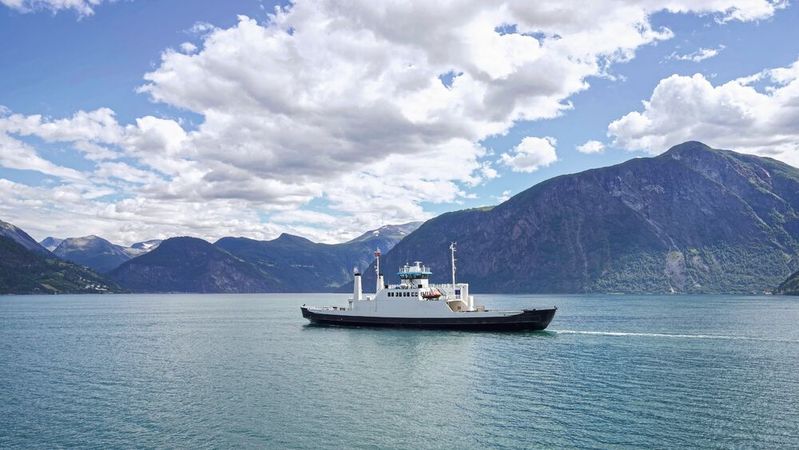
Hydrogen fuel cells can be used in various applications and ships, depending on their power class.
(Image: Haavard Dyroe@shutterstock.com)
Niklas Lecker, Global Industry Management Marine, Phoenix Contact Electronics GmbH, Bad Pyrmont
The International Maritime Organization (IMO) is a specialized agency of the UN that promotes the safety of ships and seafarers at sea as well as reducing and ideally preventing the environmental impacts of shipping. To achieve these goals, the IMO develops international conventions for ship operations and increasing environmental compatibility. Specifically, concerning the long-term temperature goal of the Paris Climate Agreement, the specialized agency has developed a strategy to reduce greenhouse gas emissions and has set the global goal of making shipping climate-neutral by the year 2050.
Transition to alternative fuels
In light of this, the maritime industry currently hosts numerous solution-oriented projects focused on new technologies and various optimization possibilities for ship operations. In addition to hydrodynamic improvements to ships, adjusted speeds, optimized routes, and the reduction of all on-board energy consumption through more efficient systems, the supplementary use of wind power for main propulsion is also explored. However, the switch from environmentally harmful fuels—such as heavy oil or diesel—to alternative fuels represents the most effective measure for reducing emissions. This is because fuel on board is not only needed for the ship's main propulsion but also covers the entire energy demand, such as electricity and heat. Aside from alternative propulsion solutions, a search for more sustainable energy supply on ships is also underway.
As a flexible onboard energy supply solution, the hydrogen fuel cell is emerging prominently. For its operation, hydrogen and oxygen are required, which must be continuously supplied. Through an electrochemical process in a galvanic cell, electrical power and water are produced. Known as cold combustion, this process has lower energy losses compared to traditional combustion engines, leading to high efficiency. When green hydrogen is used, the emission of pollutants is virtually zero. Additionally, unlike conventional combustion processes, the electrochemical process causes minimal wear and noise emissions, which significantly reduces the need for spare parts on long journeys.
Flexible placement on board
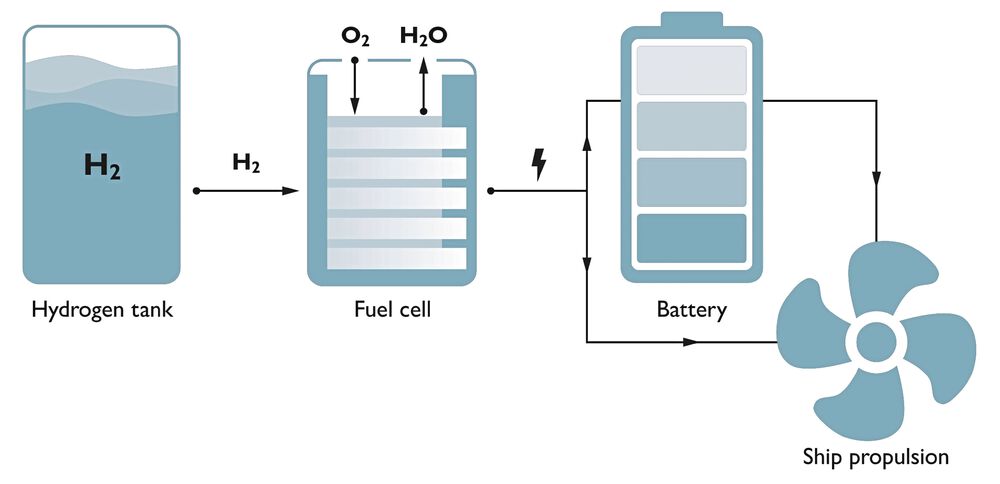
The flexibility of hydrogen fuel cells allows for the powering of batteries or even propulsion systems.
(Image:Phoenix Contact GmbH & Co. KG)
The combination of low noise emissions and the potential for a compact, modular, and scalable construction of hydrogen fuel cell systems allows for their flexible placement on board. This ensures efficient use of the limited space available on a ship. The high flexibility is also evident on both the input and output sides of the electrochemical process:
On the input side, hydrogen can be generated from various energy sources—such as methanol or natural gas—using a device known as a reformer. This eliminates dependence on pure hydrogen.
On the output side, the electricity generated can either charge a battery or directly supply various consumption systems. In larger ships, it is also possible for the fuel cell to function as a supportive unit of the main propulsion system or, in smaller ships, even serve as the main propulsion.
Hydrogen fuel cells thus offer significant added value for global shipping. To ensure the safe operation of the fuel cells, the internal processes must be reliably monitored and controlled. Specifically, this involves monitoring data on various pressures, concentrations, fill levels, and temperatures. Based on this data, the control of drives and inlet and outlet valves is conducted. Additionally, certain power supplies and communication paths between the different trades within the fuel cell must be overseen.
Free programming of automation solutions
For such tasks, the PLCnext Technology ecosystem is suitable, which stands for open and free programming of automation solutions. For robust use on ships, the portfolio includes, among other things, controls approved for maritime applications from the PLCnext Control product family, as well as modular I/O modules from the Axioline F (AXL F) series. This combination ensures reliable and efficient management of complex systems and processes on maritime vessels.
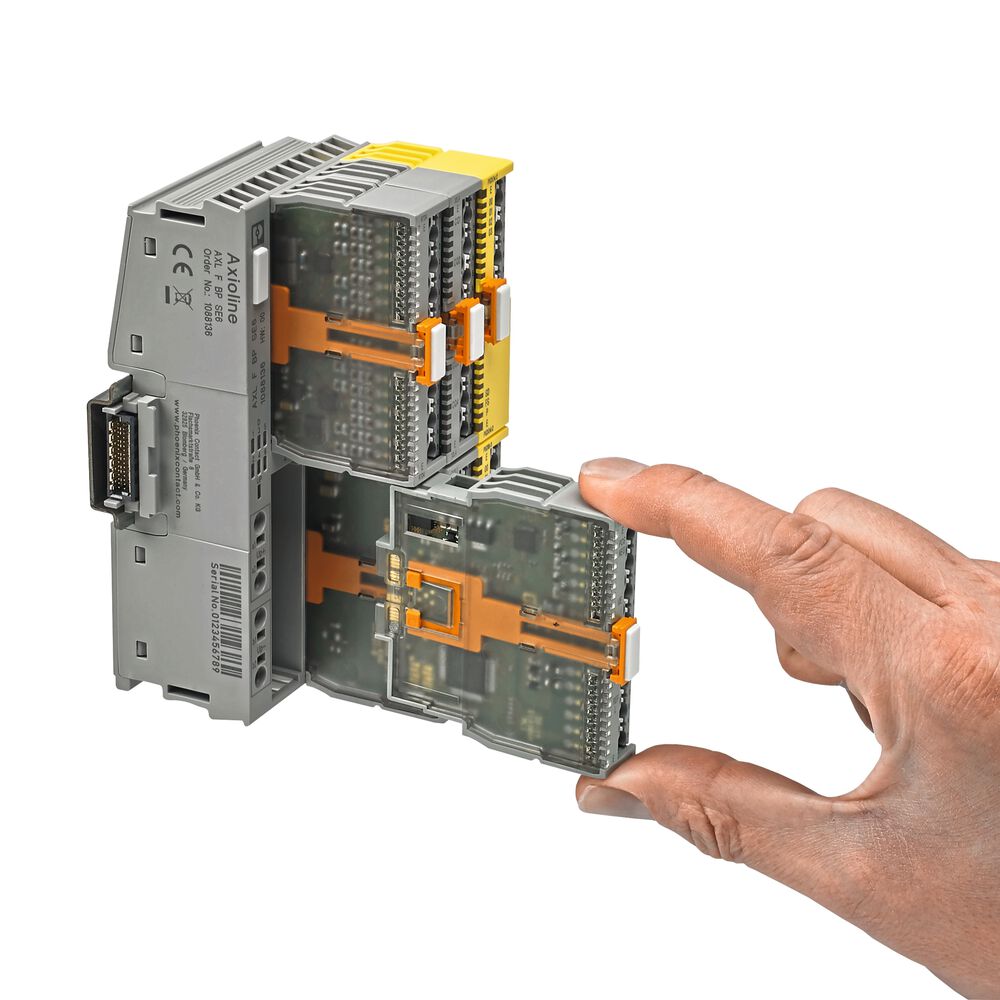
The I/O modules of the AXL SE series are inserted and locked into the module carriers (here six slots) as needed.
(Image:Phoenix Contact GmbH & Co. KG)
For applications with limited space, selected components from the I/O product family, Axioline Smart Elements (AXL SE) can be used. The AXL SE series is based on two module carriers with four or six slots, which can be equipped with various I/O modules as needed. This opens up high flexibility while optimally utilizing the available space. The various performance classes of the industrial controls running on the Linux operating system, in combination with the two modular I/O systems, allow for a hardware setup based on a modular principle. The Axioline family includes digital and analog input and output modules as well as various function, communication, and safety modules.
Date: 08.12.2025
Naturally, we always handle your personal data responsibly. Any personal data we receive from you is processed in accordance with applicable data protection legislation. For detailed information please see our privacy policy.
Consent to the use of data for promotional purposes
I hereby consent to Vogel Communications Group GmbH & Co. KG, Max-Planck-Str. 7-9, 97082 Würzburg including any affiliated companies according to §§ 15 et seq. AktG (hereafter: Vogel Communications Group) using my e-mail address to send editorial newsletters. A list of all affiliated companies can be found here
Newsletter content may include all products and services of any companies mentioned above, including for example specialist journals and books, events and fairs as well as event-related products and services, print and digital media offers and services such as additional (editorial) newsletters, raffles, lead campaigns, market research both online and offline, specialist webportals and e-learning offers. In case my personal telephone number has also been collected, it may be used for offers of aforementioned products, for services of the companies mentioned above, and market research purposes.
Additionally, my consent also includes the processing of my email address and telephone number for data matching for marketing purposes with select advertising partners such as LinkedIn, Google, and Meta. For this, Vogel Communications Group may transmit said data in hashed form to the advertising partners who then use said data to determine whether I am also a member of the mentioned advertising partner portals. Vogel Communications Group uses this feature for the purposes of re-targeting (up-selling, cross-selling, and customer loyalty), generating so-called look-alike audiences for acquisition of new customers, and as basis for exclusion for on-going advertising campaigns. Further information can be found in section “data matching for marketing purposes”.
In case I access protected data on Internet portals of Vogel Communications Group including any affiliated companies according to §§ 15 et seq. AktG, I need to provide further data in order to register for the access to such content. In return for this free access to editorial content, my data may be used in accordance with this consent for the purposes stated here. This does not apply to data matching for marketing purposes.
Right of revocation
I understand that I can revoke my consent at will. My revocation does not change the lawfulness of data processing that was conducted based on my consent leading up to my revocation. One option to declare my revocation is to use the contact form found at https://contact.vogel.de. In case I no longer wish to receive certain newsletters, I have subscribed to, I can also click on the unsubscribe link included at the end of a newsletter. Further information regarding my right of revocation and the implementation of it as well as the consequences of my revocation can be found in the data protection declaration, section editorial newsletter.
Diverse services in the area of Safety and Cyber Security
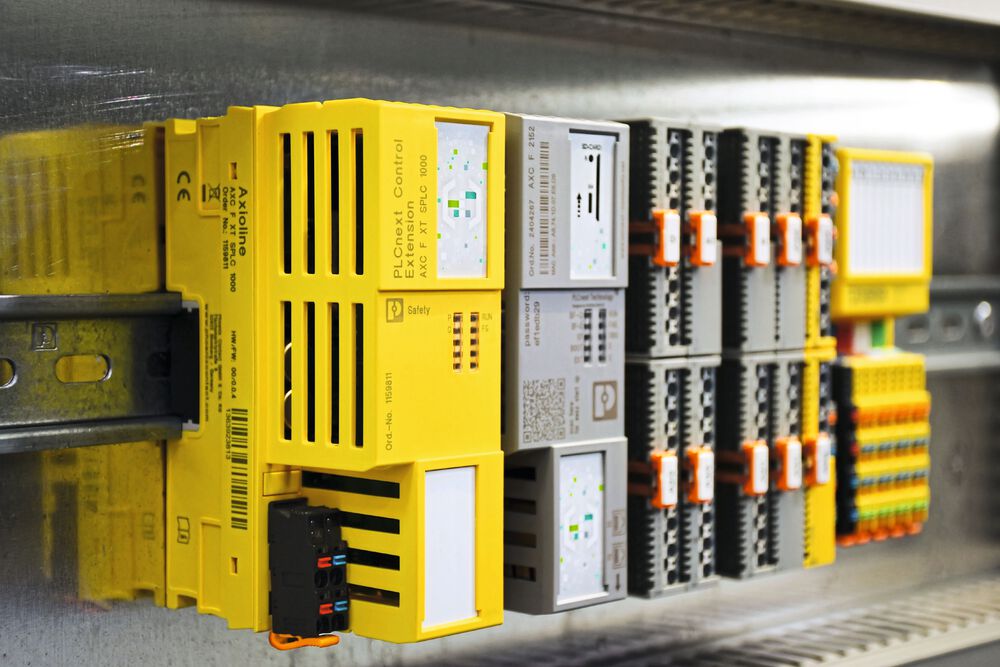
Depending on the requirements, the AXC F XT SPLC 1000 small safety controller and the modular I/O components (AXL SE & AXL F) can be combined.
(Image:Phoenix Contact GmbH & Co. KG)
For processing both standard and critical signals—such as external emergency stop signals or gas detection data—as well as for potentially issuing error messages or executing emergency shutdowns, a safety controller and appropriate programming are required. The AXL F XT SPLC 1000 small safety controller is designed for such applications. This full-fledged safety-oriented PLC is connected on the left side to a standard PLCnext Control, thereby extending its capabilities to include safe applications up to SIL 3. This integration facilitates the management of safety-critical tasks within automated systems, enhancing overall system reliability and safety compliance.
As with the standard control, the programming of the safety controller is carried out in the software environment PLCnext Engineer. Developers can thus work in a familiar environment. If the user lacks expertise in safety programming, Phoenix Contact provides support. Based on the specifications provided, the company's certified safety specialists can undertake the safety programming as a service. This ensures that even those without deep programming knowledge can implement and maintain safety critical systems effectively.
A similar offering is available in the area of Cyber Security. Although the PLCnext Control series controllers already have security features and hardening measures implemented, and have been certified by TÜV Süd according to IEC 62443-4-2, the connection to ship control systems or networking with other systems requires appropriate security measures. Here, the experts at Phoenix Contact, also certified according to IEC 62443, assist users in developing security concepts, ensuring that applications are comprehensively protected. This assistance helps to address specific security challenges and ensures that the systems adhere to high standards of cyber security, safeguarding against potential cyber threats.
All hardware and software for the control cabinet
Since its founding in 1923, Phoenix Contact's product portfolio has expanded from terminal blocks to over 100,000 products for electrical engineering and automation. The hardware and software can equip complete control cabinets. This is evident in the division of a control cabinet into six functional areas:
Connecting
Supply and protect
Adjust signals
Control
Functional safety
Switch loads
communicate securely
Terminal blocks, connectors, and cables ensure connections within the control cabinet, while power supplies, batteries, uninterruptible power supplies (UPS), and protection devices are responsible for reliable power supply and protection. With isolators and transducers, signals from explosive areas, among others, can be adapted so that they can be processed by controllers and I/O components, and actuators can be driven or loads switched. In this context, safety components play a central role in ensuring security. Additionally, data is securely transmitted over switches and routers. Finally, the comprehensive portfolio is complemented by certified services—such as in the areas of safety and security—enhancing overall system reliability and compliance.
The product portfolio of the PLCnext Control, Axioline F, and Axioline SE series represents the answer to challenges in the areas of functional safety, cyber security, flexibility, and compactness. Together with the services offered, Phoenix Contact thus becomes the ideal partner for automating maritime fuel cell solutions.



:quality(80)/p7i.vogel.de/wcms/dd/08/dd086510d9ae7b50181f6070e4463b44/0129363730v1.jpeg "Typical application for ionizing devices: Wrapping films. (Picture: ©Adobe Stock/SMC)")
:quality(80)/p7i.vogel.de/wcms/35/57/3557c819943c53acec41a0ccba87da4f/0130049064v1.jpeg "Researchers at the Fraunhofer IWU in Chemnitz have long known that many typical sheet metal parts can be manufactured more cost-effectively using hollow embossing rollers. Now there is news to report ... (Image:Fraunhofer IWU)")
:quality(80)/p7i.vogel.de/wcms/59/02/590246e3b3f415c65edbee377c14ca77/26-06-pi-fraunhofer-iws-41450-direktplattieren-pic-01-7771x4369v1v1.jpeg "The Fraunhofer IWS has developed the new \"direct laser cladding\" process, which creates a functional layer directly on the base body by applying a strip-shaped metal to rotationally symmetrical components in a spiral and bonding it locally by laser. (Image:Christoph Wilsnack/Fraunhofer IWS)")
:quality(80)/p7i.vogel.de/wcms/73/60/73608418789b1d9c393f5e2fa974eda2/0130209906v1.jpeg "The robots of the X6 generation from b+m enable very high painting quality and are also particularly compact and easy to maintain. (Image:Beckhoff)")
:quality(80)/p7i.vogel.de/wcms/78/e9/78e9188c25a8a94e67c34c9bf8ffe495/visual-agile-20robots-20and-20google-20deepmind-20partner-20to-20bring-20intelligence-20to-20robotics-2500x1406v1v1.jpeg "Together, the partners are developing adaptable, intelligent robots for a wide range of applications (Image:Agile Robots SE)")
:quality(80)/p7i.vogel.de/wcms/e7/66/e7669ecf0260ae8fc54c214e34e4902a/0130316817v1.jpeg "Siemens and Palo Alto Networks offer tested cybersecurity solution for industrial 5G. (Image:Siemens)")
:quality(80)/p7i.vogel.de/wcms/9f/55/9f55324832c4f426958031375124d9de/siemens-20ubtech-20hmnd-1920x1079v1v1.png "Ready for the factory floor: While Ubtech is planning mass production, Siemens is already testing humanoids in real factory applications in Erlangen. (Image:Siemens)")
:quality(80)/p7i.vogel.de/wcms/11/36/113695ed260e29c8c2d9d39dc5f9d869/0130213768v1.jpeg "AI can work cheaply in China and deliver the results rapidly all over the world. (Image:Dall-E / AI-generated)")
:quality(80)/p7i.vogel.de/wcms/62/5f/625f41e87ebfef156a98c8e6393e32fd/0130211654v1.jpeg "Axial flux motors have some advantages over radial flux motor—but their production is currently still expensive. (Image:RWTH Aachen University)")
:quality(80)/p7i.vogel.de/wcms/77/9b/779b0685d010dfe45c9c2cb1cfecd467/0128886425v1.jpeg "The BlueEye is the first \"real\" hyperspectral camera for the UV range and covers the wavelength range from 220 to 380nm. (Image:Inno-spec GmbH)")
:quality(80)/p7i.vogel.de/wcms/e4/51/e451d52ce0182fb0aaa46a5774f832ef/26-04-pi-fraunhofer-iws-21160-bioslide-pic-01-4128x2321v1v1.jpeg "With the BioSlide research project, the Fraunhofer IWS is investigating how sliding systems can be designed to be more sustainable and energy-efficient. New materials can be tested in a particularly application-oriented manner on this plain bearing test stand. (Image:Fraunhofer IWS)")
![Thanks to advanced 3D printing technology, a more efficient use of resources should contribute to lower-emission aviation—this is the goal of ['skai]-lab. (Image:Oleksandr Pashchenko - stock.adobe.com / AI-generated)](https://cdn1.vogel.de/nghHNSbySccfOjG3n1qCA-FVOjQ=/288x162/smart/filters:format(jpg):quality(80)/p7i.vogel.de/wcms/62/64/626424c97a16e69f871bf216c9629c2a/adobestock-1927043193--c2-a9-20oleksandr-20pashchenko-20-e2-80-93-20stock-adobe-com-ki-generiertv1v1.jpeg "Thanks to advanced 3D printing technology, a more efficient use of resources should contribute to lower-emission aviation—this is the goal of ['skai]-lab. (Image:Oleksandr Pashchenko - stock.adobe.com / AI-generated)")
:quality(80)/p7i.vogel.de/wcms/c3/c4/c3c4ce270b083eeac55654148611f064/0130237945v1.jpeg "China is not giving up on hydrogen, but is intensifying its efforts. (Image:freely licensed from Pixabay)")
:quality(80)/p7i.vogel.de/wcms/4e/c0/4ec0bd19390b169edfa23677373dcdf1/0130260089v1.jpeg "Renewable fuels can supply European road traffic, according to a study. (Image:Aral)")
:quality(80)/p7i.vogel.de/wcms/6f/c9/6fc9050301d745cad25585c6780f8f51/0130197341v1.jpeg "Production facilities are a worthwhile target and are therefore at risk. (Image:ABB Robotics)")
:quality(80)/p7i.vogel.de/wcms/b6/62/b662adc2cec8227d8172509bbfb6ee42/25c0207-107-4961x2789v1v1.jpeg "The GLB is the second model based on Mercedes' new MMA platform. Apparently, Geely's platform is better and cheaper, which is why the two companies are negotiating a partnership. (Image:Mercedes-Benz)")
:quality(80)/p7i.vogel.de/wcms/4d/dd/4dddf438e91f394c04a095dbfd109d1c/0130236430v1.jpeg "Measurement modules: The 720301 module in combination with the SL2000 enables RMS and power calculations, among other things. (Image:Yokogawa)")
:quality(80)/p7i.vogel.de/wcms/61/fc/61fcf95f5cca15494ad18343901ae585/0130317237v1.jpeg "With the AGI CPU, Arm says it is taking a \"historic step\": With the processor aimed at AI in data centers, the company is presenting itself for the first time as a provider of its own chips, not just as a pure IP licensor. (Image:Arm)")
:quality(80)/p7i.vogel.de/wcms/82/90/8290dfe3595b6c6b33726ae8b76172c7/0130319587v1.jpeg "The concept image illustrates how the pattern of tiny protrusions and depressions created on the substrate (MgO, bottom) controls the arrangement of atoms in the superconducting material (YBCO, top). At the interface between the two layers, an electronic structure enables superconductivity to occur at higher temperatures than previously possible. (Image:Chalmers University of Technology / Riccardo Arpaia)")
:fill(fff,0)/images.vogel.de/vogelonline/companyimg/76800/76895/65.jpg "FAULHABER_120mm.jpg ()")
:fill(fff,0)/p7i.vogel.de/companies/67/eb/67eba621ef6ea/logo2.png "logo2 (Wuxi InfiMotion)")
:quality(80)/p7i.vogel.de/wcms/49/d9/49d9da94bd1a3b8da34b924d40761d62/0125207134v1.jpeg "A cruise ship with an electric drive sails low-emission into the sunset. A symbol of change in maritime mobility. (Image:Dall-E / AI-generated)")
:quality(80)/p7i.vogel.de/wcms/12/25/1225e2b88b8def71d401a6f800bef1ef/0125235197v1.jpeg "Toyota is committed to the next phase of the research vessel Energy Observer. (Image:Toyota)")