In the context of the circular economy, solutions that are the most ecologically sensible alternative not despite but because of the use of plastic are the focus.
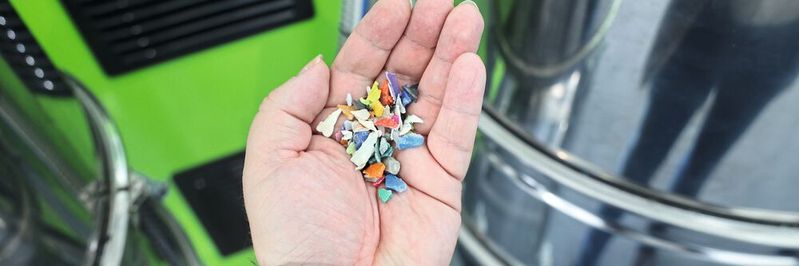
Post-consumer recyclates are often inhomogeneous and additionally contaminated with foreign objects such as stones or metal and glass shards. They pose high demands on processing processes and require sophisticated technology.
(Image: Richard Pergler)
Our daily lives are characterized by plastics, which as versatile materials enable our entire modern existence. From simple toothbrushes to medical devices and implants, electronic equipment, and packaging, plastics define our standard of living. Many products would simply be unfeasible without plastic, and our lives would be unimaginable without this versatile material.
In recent years, plastics have primarily come into public focus as an environmental issue due to pollution in oceans and landscapes, broadly earning plastic a reputation as a particularly harmful material to the environment. However, upon closer examination, plastic products can be the solution with the least environmental impact in many applications. This depends on how we handle the material, from its creation to its recycling.
The success of the circular economy depends on the consumer
Whether a product is ecologically favorable or not largely depends on us as consumers. A product, no matter how sustainably produced, can be extremely harmful to the environment if it is unnecessary. Therefore, the entire life cycle is relevant to the degree of sustainability. If consumers choose products that are durable, repair-friendly, and extensively used and can perhaps be fully recycled, the environmental impact can be manageable even if they are made from plastics of fossil origin.
A key factor is the sustainable design of production, which involves many variables. Whether a product has a good ecological balance is determined at the design stage. For instance, during product development, the construction can be optimized to reduce material usage—and if done cleverly, without compromising the product's functionality in the slightest.
"With 'Design for Recycling,' we set the course early on for optimal recycling and the longest possible lifespan," emphasizes Alexander Tränkle, an industrial designer at the Vorarlberg-based packaging and recycling specialist Alpla, known for its solutions in the beverage bottle sector. In collaboration with the reusable packaging specialist zerooo, the company now offers a 300 ml PET reusable bottle available in clear, milky-white, and brown variants for cosmetic products—such as a shatterproof alternative for care products in the shower. Additional formats are planned. Starting in September, the first manufacturers in Germany will present cosmetics and care products in the PET container of the zerooo reuse system—Austria will follow in October. "In terms of shape, color, and material, every detail matters," Tränkle adds. "The reuse system extends the lifecycle of the plastic bottle, saves materials and reduces the CO2 footprint."
Consistently save material
The skill of the designer is crucial here—they need to have extensive knowledge about the product and its use. Through simulations, for example in topology optimization, experts can precisely identify the areas that will need to bear forces during use. Consequently, designers can configure the workpiece construction such that the material is concentrated in the flow of force. At the other areas, material can be saved without compromising the functionality of the product.
In this field, it becomes very clear that ecological business practices can also be economically attractive—if one relies on the knowledge and skills of experts. Because material that is saved does not have to be paid for. And material costs account for an average of about 60 percent of the costs of a typical injection molded part.
An important focus is the tools. "In the molds, contour-close cooling can be created using generative technologies, and very efficient temperature control can be achieved with the intelligent combination of heat-conductive materials," explains Willibald Windhager, Sustainability Manager at the tool-making company Haidlmair in Nussbach, Upper Austria. "But also, optimized build sizes or compact design, an injection process tailored to the tool and product, and the use of technologies that enable significant energy savings in production, open up potential for CO2 reduction."
Utilize bioplastics and recyclates
Material selection is another key factor in sustainably produced parts. In addition to plastics of fossil origin, there is increasing use of bio-based materials made from plant materials such as cornstarch or sugarcane. These can significantly reduce the CO2 footprint of a product at the outset. However, a biological origin does not always mean that the products are also biodegradable. There is a lot of pioneering work currently being done in the field of bio-based plastics, but much research and development is still needed.
Date: 08.12.2025
Naturally, we always handle your personal data responsibly. Any personal data we receive from you is processed in accordance with applicable data protection legislation. For detailed information please see our privacy policy.
Consent to the use of data for promotional purposes
I hereby consent to Vogel Communications Group GmbH & Co. KG, Max-Planck-Str. 7-9, 97082 Würzburg including any affiliated companies according to §§ 15 et seq. AktG (hereafter: Vogel Communications Group) using my e-mail address to send editorial newsletters. A list of all affiliated companies can be found here
Newsletter content may include all products and services of any companies mentioned above, including for example specialist journals and books, events and fairs as well as event-related products and services, print and digital media offers and services such as additional (editorial) newsletters, raffles, lead campaigns, market research both online and offline, specialist webportals and e-learning offers. In case my personal telephone number has also been collected, it may be used for offers of aforementioned products, for services of the companies mentioned above, and market research purposes.
Additionally, my consent also includes the processing of my email address and telephone number for data matching for marketing purposes with select advertising partners such as LinkedIn, Google, and Meta. For this, Vogel Communications Group may transmit said data in hashed form to the advertising partners who then use said data to determine whether I am also a member of the mentioned advertising partner portals. Vogel Communications Group uses this feature for the purposes of re-targeting (up-selling, cross-selling, and customer loyalty), generating so-called look-alike audiences for acquisition of new customers, and as basis for exclusion for on-going advertising campaigns. Further information can be found in section “data matching for marketing purposes”.
In case I access protected data on Internet portals of Vogel Communications Group including any affiliated companies according to §§ 15 et seq. AktG, I need to provide further data in order to register for the access to such content. In return for this free access to editorial content, my data may be used in accordance with this consent for the purposes stated here. This does not apply to data matching for marketing purposes.
Right of revocation
I understand that I can revoke my consent at will. My revocation does not change the lawfulness of data processing that was conducted based on my consent leading up to my revocation. One option to declare my revocation is to use the contact form found at https://contact.vogel.de. In case I no longer wish to receive certain newsletters, I have subscribed to, I can also click on the unsubscribe link included at the end of a newsletter. Further information regarding my right of revocation and the implementation of it as well as the consequences of my revocation can be found in the data protection declaration, section editorial newsletter.
The industry has already made significant progress in using recycled materials in a traditional circular economy today. Recycling plastics reduces dependence on primary raw materials and concurrently decreases the amount of plastic waste. A distinction is made between post-industry and post-consumer recyclates.
Homogeneous materials are more efficient
The industry has now gained substantial experience with post-industry recyclate from numerous projects. Depending on their origin, post-industry recyclates are very homogeneous and thus easily manageable in processing procedures. The resulting products can also be quite complex. Furthermore, the surface appearance does not have to resemble recycled material; nowadays, even very sophisticated finishes are possible. This enables the use of recycled materials for visible parts in the automotive industry, among others. Specifically, in combination with in-mold decoration or in-mold labeling techniques, interesting concepts can be implemented that elegantly combine ecology, mechanical stability, and a premium aesthetic.
Post-consumer recyclate, such as that sourced from the "yellow bin," remains a real challenge in processing. The quality of the material heavily depends on the sorting and cleaning of the wastes. With these materials, the achievable part quality is still significantly below that of post-industry recyclate—often the material is too inhomogeneous. Another hurdle for injection molding machines and tools is the presence of foreign bodies like remnants of glass, wood, or metal still in the material. As a result, producing sophisticated, high-quality parts is generally not feasible—but the material can still be used in less demanding applications such as flower pots or planting containers.
Pay attention to recyclability
Filled plastics that contain plant components such as fibers or shell fragments can further reduce the use of fossil materials. Those with experience using such materials, and who appropriately design their tools and adjust the processing parameters of the injection molding machine, have a wide field of suitable products to explore. Another advantage is that depending on the combination, such materials can be separated and recycled at the end of a product's life cycle.
Choosing the right manufacturing process is crucial for the production of an ecologically favorable plastic product. Traditional compact injection molding creates solid material parts. Techniques such as Gas Injection Molding (GIM) or Water Injection Technology (WIT) allow for the production of components with defined cavities. In these processes, the injection molder injects a temporary filler (water or an inert gas, typically nitrogen) into a partially filled mold, acting as a core. Once the melt solidifies, the water or gas can escape. This allows for more economical and lighter design variations than are possible with standard injection molding.
Energy-efficient production thanks to electrification
Another option is the sandwich construction method, where you can encase a recyclate core with a layer of another type of plastic. This technique can even be used to manufacture food-safe containers with a recyclate core, for instance, to achieve the necessary stability. Additionally, with a dense outer layer, the recyclate will never come into contact with the food, ensuring safety and compliance with health regulations.
Additional methods include injection foaming and injection compression molding. These techniques allow for achieving high strength with relatively low material usage. Furthermore, plastic manufacturers can conceal any material- or process-induced surface defects afterward using In-Mold Decoration (IMD) or In-Mold Labeling (IML). This allows for the creation of components with combinations of properties that were not previously possible, enhancing both functionality and aesthetic appeal.
The energy consumption during manufacturing contributes significantly to the CO2 footprint of a product. Opting for a fully electric injection molding machine and modern temperature control systems over the energy-intensive hydraulic injection molding machines can lead to far more energy-efficient production with a smaller CO2 footprint. An injection molding tool is cyclically heated and cooled on the injection molding machine during the production process. A genuine cooling calculation during the design of the tool and its implementation in the construction can help optimize this process, saving energy and, consequently, money. This not only benefits the environment but also the companies themselves.
"We demonstrate every day through our work that the highest level of economy and quality can optimally align with sustainable and environmentally friendly production," emphasizes Windhager. "We see ourselves as pioneers for sustainable production solutions—and we want to encourage the industry to also make greater efforts in this area. Because: It is definitely worth it!" (rp)



:quality(80)/p7i.vogel.de/wcms/60/eb/60ebe43de41f833157b476b2e1641811/0130090160v1.jpeg "The Surface Control Automotive measuring system from Micro-Epsilon automatically detects dents, scratches and other surface defects on body shells. (Image:Micro-Epsilon)")
:quality(80)/p7i.vogel.de/wcms/26/8a/268aba929d72bd089234bd512aab9b08/0130487474v1.jpeg "The works meeting at Volkswagen is over! Here is a brief overview of the most important aspects ... (Image:VW)")
:quality(80)/p7i.vogel.de/wcms/50/63/5063e5b91e7897c13b882440c7f106d4/0128575929v1.jpeg "How is Edge AI changing the industry? Local data processing meets distributed intelligence to promote sustainability and efficiency. (Picture: ©tippapatt - stock.adobe.com)")
:quality(80)/p7i.vogel.de/wcms/a0/47/a04725ef9bd09fb6c9341a1bea1b5d93/0130443083v1.jpeg "Here, a type of plastic pallet is produced by thermoforming (vacuum forming or deep drawing) at the corresponding division of New England Plastics in the USA. This division, which specializes in so-called liners, is now part of Ringmetall ... (Image:New England Plastics)")
:quality(80)/p7i.vogel.de/wcms/29/d8/29d83fa92093c7f247429e060be46c7b/0130378625v1.jpeg "Secures and monitors circuits directly in the field: Turck's IP67 TBIF fuse with IO-Link (Image:Turck GmbH)")
:quality(80)/p7i.vogel.de/wcms/d3/3d/d33d26b35aa1e64f5c41d19d22c5c5dc/0130496518v1.jpeg "(Image:Speedbot)")
:quality(80)/p7i.vogel.de/wcms/f0/ca/f0caaaa9fc2347a5221760a94f92e831/0129880873v1.jpeg "Human-machine collaboration takes on a new quality. This is because the automation task is formulated in natural language and the AI takes over its implementation directly in the project. This allows users to implement Codesys projects more quickly. (Image:Codesys)")
:quality(80)/p7i.vogel.de/wcms/b7/36/b736dfebc16c42d6901d0d0e1f390493/3d-druck-20factory-20--20ki-20generiert-1920x1079v1.png "(Source: AI-generated)")
:quality(80)/p7i.vogel.de/wcms/79/b2/79b21aad663f4a7bd4472afc1c1afc62/0130433994v1.jpeg "Mission Joyride: The free-flying robot (shown here in the rendering) will relieve the ISS crew of logistics tasks from 2027 with its two mechanical arms. (Image:Icarus Robotics)")
:quality(80)/p7i.vogel.de/wcms/59/a2/59a2b11f0aa1b700eff02addd5de8703/adobestock-1788280853--c2-a9-20satria-20-e2-80-93-20stock-adobe-com-5081x2860v1v1.jpeg "Quantum computers require extreme cooling to temperatures close to absolute zero in order to keep qubits stable. (Image:satria - stock.adobe.com)")
:quality(80)/p7i.vogel.de/wcms/49/38/493876a248943456b7e4a6db6edfc454/0130230765v1.jpeg "Safe and reliable in aircraft construction: light-curing adhesive bond combined with universal fastening elements. (Source: Delo)")
:quality(80)/p7i.vogel.de/wcms/26/e1/26e1c8d1f56a588b078196508a069155/0130500702v1.jpeg "Hyundai plans a large truck for North America (Image:Hyundai)")
:quality(80)/p7i.vogel.de/wcms/61/eb/61eb2c9fe2ec3295593bd63ebc610f59/0130504331v1.jpeg "Headquarters of the Chinese truck start-up Zeron. (Image:Jiangsu 01 Automobile Technology/Screen shot)")
:quality(80)/p7i.vogel.de/wcms/c2/57/c257d627beec10e94252cde72830adf6/0130472803v1.jpeg "With the Twingo E-Tech, Renault is now launching a purely electrically powered new edition of the Twingo small car (Image:Renault)")
:quality(80)/p7i.vogel.de/wcms/c1/43/c143c24b62e51b848b2586b52bcd20e2/0130468443v1.jpeg "Jörg Burzer, Head of Development at Mercedes Benz Group AG (Image:Mercedes)")
:quality(80)/p7i.vogel.de/wcms/89/f2/89f2b2de703956abfb30ea456d77a463/0130471595v1.jpeg "The joint venture between TDK and Nippon Chemical Industrial focuses on the development of ceramic materials for electronic components. (Image:TDK Corporation)")
:quality(80)/p7i.vogel.de/wcms/e4/a0/e4a0da27805e96aa8976f04add4b3bec/0130458429v1.jpeg "Fit for extreme conditions: This illustration shows a photonic chip whose components have been bonded with high stability using the new connection technology. (Image:NIST)")
:quality(80)/p7i.vogel.de/wcms/9b/84/9b845ee38e4fb3c8ea07d1735d9e36fd/0130451629v1.jpeg "The windshield as a projection screen: a high-precision and low-latency system architecture is required for implementation. This requires the seamless integration of different technologies. (Image:Harman)")
:quality(80)/p7i.vogel.de/wcms/86/e0/86e09ea9c278d112c55b995b843abfee/0130494578v1.jpeg "PV system on the roof of the Elbfabrik, a Fraunhofer IFF research factory. A sensor system can detect faults in large-scale PV systems at an early stage. (Image:Fraunhofer IFF/Anne Bornkessel)")
:fill(fff,0)/images.vogel.de/vogelonline/companyimg/76800/76895/65.jpg "FAULHABER_120mm.jpg ()")
:fill(fff,0)/p7i.vogel.de/companies/69/88/69882c428938e/tmts2026-ticec-banner-en-2000px.png "tmts2026-ticec-banner-en-2000px (https://www.tmts.tw/en)")
:quality(80)/p7i.vogel.de/wcms/4d/f0/4df0e6b3ac4022b620f0978909828559/fcs-spritzgiessmaschine-vollelektrisch-1-6000x3373v1v1.jpeg "FCS presents itself at K with powerful injection molding solutions under the motto \"Intelligent Manufacturing and Sustainable Practice,\" showcasing a wide range of sustainable shaping solutions. (Image:FCS)")
:quality(80)/p7i.vogel.de/wcms/47/fd/47fddb0017e2d592721014bb5053912c/jenny-20lin-2048x1151v1v1.jpeg "Jenny Lin: \"We have built a good reputation in demanding industries such as automotive components, electronic parts, logistics products, and packaging applications.\" (Image:CLF)")