Superconducting digital components could advance artificial intelligence (AI) and machine learning (ML) as they promise 100 times higher energy efficiency and 1000 times higher computing density. What is the state of the art and the scaling roadmap?
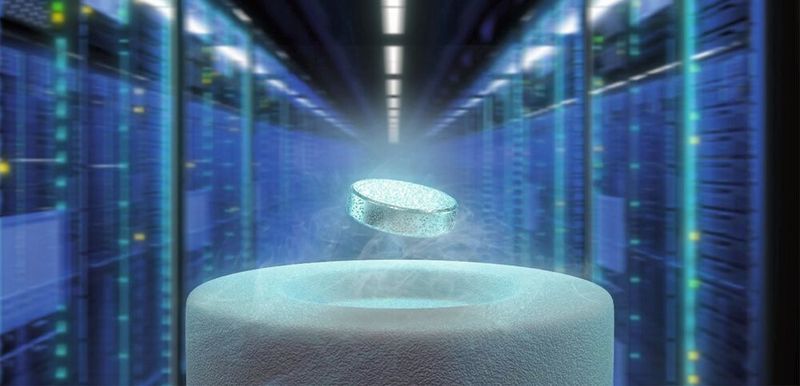
Floating magnet: The expected increase in power demand for cloud-based computing represents a major strain on the environment, costs, and available computing resources. Superconducting electronics hold immense potentials here.
(Image: imec)
Experts from the Semiconductor Industry Association have predicted that by the year 2040 nearly 50% of the globally generated electrical energy will be used for data processing [1]. This forecast was made before the explosion of AI-based language models, so the actual proportion is likely to be even higher. The predicted computing power will be far beyond the capabilities of even the most advanced CMOS computing and storage systems.
Take the progress of AI as an example. The total AI computing time, expressed in petaFLOP/s-days, has increased by a factor of 1800 over the past two years [2]. Smaller structure widths and architectural improvements only accounted for a factor of six growth. The lion's share was due to the expansion of data centers and the associated higher energy consumption. From a cost and environmental point of view, this is unsustainable.
At least unless new computing systems are developed that offer significantly higher energy efficiency and computing density. This is exactly what superconducting digital technology brings, as the electrical resistance is almost zero at low temperatures. Initial calculations predict a hundred times higher energy efficiency and a thousand times higher computing density compared to modern CMOS processors [3].
Driving the development of deep learning and quantum computers
The superconducting digital technology is not intended to replace conventional technologies, but to complement CMOS in selected application areas and drive innovation in new areas, such as AI and ML techniques.
Through superconductivity, energy-efficient, compact servers are possible that bridge the gap between edge and cloud. The potential of such server technology is enormous. It opens doors for online training of AI models based on real data that are part of an actively changing environment, such as in autopilots.
Real-time interaction with simultaneous cloud communication will benefit many application areas, e.g. smart grids, smart cities, mobile health systems, connected manufacturing and smart agriculture.
In addition, elements of superconductivity could benefit quantum technology. Scalable measurement systems need to be developed to read out and control the growing number of qubits, perform error corrections, and process data. Here, superconductivity can provide a solution that cannot be achieved with other technologies.
Co-development of systems and technologies
The leap in energy efficiency and computing density will result from the introduction of superconducting materials and new components, thereby changing the technological basis of classical digital technologies. However, the advances achieved through material and device innovations can easily be undone by bottlenecks at the module or system level.
To ensure that these effectively reflect on the entire system, innovations in the whole system structure—from the core components of the devices to the algorithms—are developed together from the beginning. This requires a continuous, iterative loop between top-down system-driven decisions and the maturation of technology and bottom-up integration. Such a systems-level approach takes into account the fact that solutions are determined by application requirements, implementation constraints, and workloads.
One might wonder, for example, whether the energy and cost efficiency of low-temperature technology would not be easily negated by the necessary cooling effort. To this end, the electricity costs of both a conventional AI system and a superconducting AI system were modeled and compared for different orders of magnitude (i.e., the number of petaFLOPS). At larger scales, i.e., between ten and hundreds of petaFLOPS, the cooling effort decreases significantly and the superconducting system becomes more energy-efficient than its classical cousin.
In other words: the larger the scale of operation, the higher the profits. Cooling can be done by commercial cryocoolers, which have the size of three conventional server cabinets.
A data center as small as a shoebox
Design tools were used to optimize the functional partitioning of a superconducting system for AI processing. A look at one of the boards shows many similarities with a classic 3D system-on-chip that is created by heterogeneous integration of CMOS technologies. The board is equipped in a similar way with computing chips, a CPU with embedded SRAM-like cache memories, DRAM memory stacks, and switches that are connected via silicon interposer or bridge techniques.
Date: 08.12.2025
Naturally, we always handle your personal data responsibly. Any personal data we receive from you is processed in accordance with applicable data protection legislation. For detailed information please see our privacy policy.
Consent to the use of data for promotional purposes
I hereby consent to Vogel Communications Group GmbH & Co. KG, Max-Planck-Str. 7-9, 97082 Würzburg including any affiliated companies according to §§ 15 et seq. AktG (hereafter: Vogel Communications Group) using my e-mail address to send editorial newsletters. A list of all affiliated companies can be found here
Newsletter content may include all products and services of any companies mentioned above, including for example specialist journals and books, events and fairs as well as event-related products and services, print and digital media offers and services such as additional (editorial) newsletters, raffles, lead campaigns, market research both online and offline, specialist webportals and e-learning offers. In case my personal telephone number has also been collected, it may be used for offers of aforementioned products, for services of the companies mentioned above, and market research purposes.
Additionally, my consent also includes the processing of my email address and telephone number for data matching for marketing purposes with select advertising partners such as LinkedIn, Google, and Meta. For this, Vogel Communications Group may transmit said data in hashed form to the advertising partners who then use said data to determine whether I am also a member of the mentioned advertising partner portals. Vogel Communications Group uses this feature for the purposes of re-targeting (up-selling, cross-selling, and customer loyalty), generating so-called look-alike audiences for acquisition of new customers, and as basis for exclusion for on-going advertising campaigns. Further information can be found in section “data matching for marketing purposes”.
In case I access protected data on Internet portals of Vogel Communications Group including any affiliated companies according to §§ 15 et seq. AktG, I need to provide further data in order to register for the access to such content. In return for this free access to editorial content, my data may be used in accordance with this consent for the purposes stated here. This does not apply to data matching for marketing purposes.
Right of revocation
I understand that I can revoke my consent at will. My revocation does not change the lawfulness of data processing that was conducted based on my consent leading up to my revocation. One option to declare my revocation is to use the contact form found at https://contact.vogel.de. In case I no longer wish to receive certain newsletters, I have subscribed to, I can also click on the unsubscribe link included at the end of a newsletter. Further information regarding my right of revocation and the implementation of it as well as the consequences of my revocation can be found in the data protection declaration, section editorial newsletter.
But there are also some striking differences. With classic CMOS technology, it is very difficult to stack computer chips on top of each other, as a lot of power loss is generated per chip. In the case of superconductivity, the low power loss can be well compensated by the cooling system. Logic chips can be stacked directly using 3D integration, which leads to shorter and faster connections between chips and to area advantages.
Several boards can be stacked one on top of the other with a small distance between them. An estimate of the performance and space requirements of a stack of 100 boards shows that the system can deliver 20 AI exaFLOPS (BF16 dense or 16-bit floating point format dense—which corresponds to 80 exaFLOPS FP8 with sparsity, as is often used in GPU servers), exceeding the most modern supercomputer in today's data centers. Moreover, the system only consumes 1 kW at cryogenic cold and 500 kW at room temperature, an energy efficiency of more than 100 TOPS (Tera operations per second) per watt, all on the base area of a shoebox.
Superconductivity: basics, building blocks and state of the art
To better understand why superconducting digital technology is so energy efficient and how it can be used to build digital electronics, let's look at the physics behind it.
In classic logic and memory systems, the digital information is derived from the voltage levels of the analog signals in the form of ones and zeros. With superconducting elements, the zero resistance rules out a voltage drop. The data encoding here is based on the Meissner-Ochsenfeld effect (magnetic fields are displaced from a superconducting material when it is brought below its critical temperature).
If a ring made of a superconducting material is brought into a magnetic field, the magnetic flux is only an integer multiple. This so-called magnetic flux quantum can be used as a basis for the encoding of information. Unlike the voltage ranges used in classical computing, this quantum bit is fundamentally exact. This effect forms the basis for a superconducting memory.
Once generated, a quantum bit exists forever. To perform digital operations, a switch is needed that can change the state of the ring. This is where the Josephson effect comes into play (a tunnel current between two superconductors).
This effect is exploited in the Josephson contact, where a thin layer of non-superconducting material is embedded between two superconducting layers. Until a critical current is reached, Cooper pairs tunnel through the barrier and a supercurrent flows.
If the critical current is exceeded, a tiny voltage pulse is produced over the junction, releasing 2x10-20 J in a picosecond. This effect is used for data encoding, for example by defining a digital one for a positive pulse when the superconducting phase switches from low to high, and a digital zero for a negative pulse when it returns from high to low. During operation, only the "small" switching processes contribute to the power loss of the system.
Zero resistance, Meissner-Ochsenfeld effect, and Josephson effect
These three physical phenomena—zero resistance, Meissner-Ochsenfeld effect, and Josephson effect—form the basis for the construction of superconducting digital electronics: superconducting logic chips, Josephson SRAMs, resistance-free wires, switches, supplemented by tunable metal-insulator-metal capacitors (MIMCAPs) for power supply and cryo-DRAM [4, 5].
And although the materials and functional principles fundamentally differ from CMOS technology, the logical operations and data coding have many similarities. In the design phase, conventional EDA tools can be used, superconducting CPUs can be synthesized with conventional code, and multi-chip modules (MCM) can be built.
Superconducting electronics is not a new computational paradigm. It is a classic technique that has been around for a long time. Over the years, a variety of powerful, energy-efficient 8- and 16-bit CPUs and MCMs have been developed.
Scaling superconducting technology: key criteria and first stages
The fabrication processes and materials used to manufacture superconducting CPUs do not offer the ability to scale to the computing density required for the revolution of the AI and ML roadmaps. Imec aims to scale from today's 0.25 µm lithography node to a 28 nm node.
When scaling superconducting interconnects to 50 nm, the product of clock rate and device density is comparable to what a 7 nm CMOS logic technology node offers. In terms of interconnect performance, expressed in Gbit/line, the 28 nm superconducting technology is expected to outperform the 7 nm CMOS technology by two to three orders of magnitude while being about 50 times more energy efficient.
Two important factors contribute to scaling. First, the processing is shifted to a 300-mm chip cleanroom to take advantage of the processes and equipment that have enabled the continuous scaling of CMOS technology. This gives the researchers access to unique processes such as 193 nm immersion lithography for structure production and advanced integration methods such as the semi-Damascene process for the construction of the connection layers.
Secondly, niobium, the superconducting material currently used, is replaced by NbTiN, a superconducting compound with significantly better scaling potential. This alloy is used for the construction of the connections and for the production of new types of Josephson contacts and MIM capacitors. Unlike niobium, NbTiN can withstand the temperatures used in standard CMOS processes, and it interacts much less with the surrounding layers.
Superconducting logic components
The research focuses on developing modules for MIM capacitors, Josephson contacts, and connections and validating them at cryogenic temperatures. Recently, the scientists demonstrated short loops with metal lines and vias made of NbTiN, which were manufactured in the 300-mm cleanroom through direct etching of metals and a semi-Damascene approach. The manufactured lines are only 50 nm wide, chemically stable, have a critical current density of 100 mA/µm² and a critical temperature of 14 K.
The ability to achieve the critical dimension of 50 nm through optimal process control forms a solid basis for the production of superconducting connections on a two-metal level. The feasibility of such a two-metal scheme was also demonstrated. The module is designed to allow multi-level expansion due to the planar single layers from which the metal and via layers are built, allowing multiple metal layers to be stacked on top of each other. The results on the conductor tracks and vias were presented at the IEEE International Interconnect Technology Conference (IITC) [6] in 2023.
The two-metal level results form the basis for the possibility of embedding superconducting digital logic components, such as tunable HZO capacitors with NbTiN electrodes and Josephson contacts with αSi barrier and NbTiN electrodes. Progress has been made in the development of superconducting HZO capacitors with NbTiN electrodes, using a manufacturing concept similar to that of standard room temperature HZO capacitors with TiN electrodes.
With the αSi Josephson contacts, the integration of the new NbTiN electrodes resulted in an improvement compared to previously reported αSi junctions with Nb electrodes. The use of clean rooms allows for high-quality interfaces and sufficient control of uniformity within the component, which are crucial for proper functionality. Cross-sections of the connections, HZO capacitors, and Josephson junctions can be seen in image 3a and 3b.
In addition to shrinking the Josephson contacts and the size of the connections over three successive generations, the roadmap also extends to 3D integration and cooling technologies. For the first generation, the roadmap envisages stacking about 100 boards to achieve a performance of 20 exaFLOPS BF16 dense (80 exaFLOPS FP8 with sparsity). Gradually, more and more logic chips are stacked and the number of boards is reduced. This will further increase performance while reducing complexity and costs.
Conclusion: Superconducting digital systems are likely to turn AI and ML roadmaps upside down. They promise a big leap in energy efficiency and computing density, deeply rooted in the physical fundamentals of superconducting technology. A joint optimization of system and technology is necessary to ensure that the gains apply to the entire system structure.
On the technology side, a roadmap based on shrinking Josephson contacts and connections, increasing clock frequency, and stacking circuit boards and individual logic chips, will enable the shrinking of data servers to the size of a shoe box. Initial milestones have been reached in the miniaturization of NbTiN-based conductors, HZO capacitors, and αSi Josephson contacts. For all three process modules, the use of materials and integration schemes compatible with CMOS manufacturing is key to success. (kr)
*Quentin and Anna Herr are scientific directors at imec in Leuven, Belgium.
This research work was also reported in IEEE Spectrum
References
[1] Semiconductor Industry Association. “Rebooting the IT Revolution: A Call to Action.” Retrieved March 14 (2015): 2019.
[2] https://openai.com/research/ai-and-compute
[3] ‘Superconducting digital technology: enabling sustainable hardware for deep learning and quantum computing’, Anna Herr, presented at the 2022 imec technology forum (ITF) USA
[4] ‘Scaling NbTiN-based ac-powered Josephson digital to 400M devices/cm2’, A. Herr et al., arXiv preprint arXiv:2303.16792 (2023).
[5] ‘Superconducting pulse conserving logic and Josephson-SRAM’, Q. Herr et al., Appl. Phys. Lett. 122, 182604 (2023)
[6] ‘Towards enabling two metal level semi-damascene interconnects for superconducting digital logic: fabrication, characterization and electrical measurements of superconducting NbxTi(1-x)N’, A. Ponkhrel et al., 2023 IITC



:quality(80)/p7i.vogel.de/wcms/40/c5/40c5051cebdb10fdee9a283303434d9d/0129881741v1.jpeg "3D-printed tools and other components contribute to energy-saving, precise processes. (Image:Gerhard Schubert GmbH)")
:quality(80)/p7i.vogel.de/wcms/e5/fa/e5fa9fa2e3b44ee1894fdf95bbe828fe/0129904146v1.jpeg "Airports and other critical infrastructure in Europe are to be better protected against drones. (Picture: ©assetseller - stock.adobe.com)")
:quality(80)/p7i.vogel.de/wcms/ae/bd/aebda515c684825e97579175874ea6bd/0129920231v1.jpeg "Hensoldt, a sensor specialist for critical defense applications among other things, now has a strategic milestone ahead of it. The company is planning to acquire Nedinsco, an optronics company from Venlo in the Netherlands. Here's what's to come ... (Image:Hensoldt)")
:quality(80)/p7i.vogel.de/wcms/c3/6f/c36f031df46d22615d941d077d32313c/0129800025v1.jpeg "The laser-assisted process is intended to make wafer cutting significantly more productive. (Image:Trumpf)")
:quality(80)/p7i.vogel.de/wcms/e8/dc/e8dc27a8d9fba8fbd081987400bf6848/0127426198v1.jpeg "3D FEM models are detailed, large and computationally intensive. Thanks to ROM and the support of Cadfem, Wago has succeeded in setting up an e-shop for thermal simulation. (Image:WAGO)")
:quality(80)/p7i.vogel.de/wcms/9c/ac/9cac6246660e746c5a3989399ac4d250/0128561645v1.jpeg "Artificial intelligence can drive efficiency in smart factories through centralized data management and predictive maintenance. (Picture: ©Fardived - stock.adobe.com)")
:quality(80)/p7i.vogel.de/wcms/6b/e2/6be235b5ad8a442ccd9d164b0b300d8b/0129763992v1.jpeg "As early as 2020, the Zimmer Group announced that it would convert its production to be sustainably CO2-neutral. (Image:Zimmer Group)")
:quality(80)/p7i.vogel.de/wcms/d4/ba/d4bab9481e66f8570f40eb8ef2a90198/0129795613v1.jpeg "A camera inspection during removal ensures that the components are placed correctly in the KLTs. (Image:Yaskawa Europe)")
:quality(80)/p7i.vogel.de/wcms/76/81/7681b6450512b2cce1e453cd3d732543/0129479309v1.jpeg "Symbolic image: Model-based design combines virtual system models with real machines and systems in order to simulate, validate and coordinate functions, control and software early on in the development process. (Image:Dall-E / AI-generated)")
:quality(80)/p7i.vogel.de/wcms/5c/0f/5c0fee074c4b6c8e8c0993f3217c2f5a/0129773718v1.jpeg "The General Fusion demonstration reactor. (Image:General Fusion)")
:quality(80)/p7i.vogel.de/wcms/b5/5e/b55ed9355e0395ec0caf111d6af6b494/adobestock-495980372--c2-a9-20natali-mis-20-e2-80-93-20stock-adobe-com-6720x3778v1v1.jpeg "Which engineering skills will be in vogue in 2026? (Image:natali_mis - stock.adobe.com)")
:quality(80)/p7i.vogel.de/wcms/bf/a5/bfa5d882e93f159ce93e933742272b00/nord-vibn-cmyk-2196x1235v1v1.jpeg "With digital twins for virtual commissioning, Nord supports customers in ensuring that systems are available more quickly, even with complex drive systems. (Image:Nord Drivesystems)")
:quality(80)/p7i.vogel.de/wcms/e4/01/e40186c9a7d04cbecb20fab20ff79094/0129886097v1.jpeg "Skoda has inaugurated a new battery plant in Mlada Boleslav to meet rising demand, but also to reduce battery costs by 30 percent. (Image:Skoda)")
:quality(80)/p7i.vogel.de/wcms/74/7b/747b6bc4d758c5dd4b5c24a763ae493d/0129897614v1.jpeg "Huawei Intelligent Automotive Solutions has presented a lidar with a resolution of 896 lines. (Image:HIMA via ChinaEVHome)")
:quality(80)/p7i.vogel.de/wcms/ba/b7/bab7bfd052f35da3c39388508faa350e/0129851977v1.jpeg "The third generation of the Mazda CX-5 scores above all with its inner values. (Image:Mauritz - VCG)")
:quality(80)/p7i.vogel.de/wcms/81/24/8124e33f53ec73fa99374f407cc11b61/0129727992-541x304v1v1.jpeg "The development of control elements and HMI systems for commercial vehicles can lead to interactions. (Image:Preh / AI-generated)")
:quality(80)/p7i.vogel.de/wcms/8b/46/8b46730ba87a86f16d696f043cf0e3d1/0129887022v1.jpeg "Linyi Yunchuan's S2000 platform has risen to a height of two kilometers and fed the energy generated into the grid. (Image:Linyi Yunchuan)")
:quality(80)/p7i.vogel.de/wcms/92/f8/92f8bf81914500bcda78f63dab8da720/0129926751v1.jpeg "Only recently, the US government allowed high-end chips for AI such as Nvidia's H200 series (pictured) to be exported to China under certain conditions. But now the tax is being pulled back all the harder: An eDraft envisages tighter controls on the export of hardware for AI technologies worldwide. Even allies would be affected. (Image:Nvidia)")
:quality(80)/p7i.vogel.de/wcms/84/cc/84cc506003388ecffaab464677c7afa6/0129843694v1.jpeg "Launched last year, ASML's TWINSCAN XT:260 is an i-line scanner with a throughput of 270 wafers per hour. With a focus on the increased demands of AI chips, ASML wants to shift its focus away from pure front-end tools for chip production in the next ten to fifteen years with packaging and bonding technologies. (Image:ASML)")
:quality(80)/p7i.vogel.de/wcms/8f/48/8f48b0ed0d6c5c4f299b1310a7b577e9/0129830738v1.jpeg "Data centers in orbit are indeed dreams of the future, while data centers under water are already being tested. (Image:Dall-E / AI-generated)")
:fill(fff,0)/p7i.vogel.de/companies/67/eb/67eba621ef6ea/logo2.png "logo2 (Wuxi InfiMotion)")
:quality(80)/p7i.vogel.de/wcms/ed/66/ed66270712a6e1bb222632417aa4f3e2/0119346387v1.jpeg "Floating magnet: The expected increase in power demand for cloud-based computing represents a major strain on the environment, costs, and available computing resources. Superconducting electronics hold immense potentials here.(Image: imec)")
:quality(80)/p7i.vogel.de/wcms/4f/fc/4ffc9264d970d10bc08359dabaadb478/0119346390v1.jpeg "Image 1: Schematic cross-section of a board intended for superconducting AI processing. Superconducting components are heterogeneously integrated using advanced 3D and silicon interposer technology.(Image: imec)")
:quality(80)/p7i.vogel.de/wcms/90/c3/90c3ea974f99cd6c1dd3acd18be6cc30/0119346393v1.jpeg "Image 2: A comparison of 7 nm CMOS and 28 nm superconducting digital technology for commercial AI/HPC (High-Performance Computing) in terms of performance and area.(Image: imec)")
:quality(80)/p7i.vogel.de/wcms/1f/3b/1f3ba336fd2dbbdc655000ac9e0c5fc3/0119346396v1.jpeg "Image 3a: TEM images of (left) structured Metal-1 (M1) and Metal-2 (M2) NbTiN interconnect lines and via; (right) HZO capacitor with NbTiN electrodes.(Image: imec)")
:quality(80)/p7i.vogel.de/wcms/b5/32/b532d819a7aec29f1cd85ad30f4cf516/0128508030v1.jpeg "A new manufacturing technique, in which multiple active components are stacked on the back of a computer chip, could significantly increase the energy efficiency of microelectronics. (Image:Dall-E / AI-generated)")
:quality(80)/p7i.vogel.de/wcms/2e/be/2ebe7a3fd5bc91773110a9b66e3e95cf/86592347v1.jpeg "Quantum computers exploit quantum mechanical effects such as superposition and entanglement to deliver enormous computing power. (Image:public domain)")