Niles-Simmons and Mapal are bringing their jointly developed process for the complete machining of stator housings for electric motors into series production. Suppliers and OEMs can now efficiently manufacture components for electric and hybrid vehicles from major manufacturers.
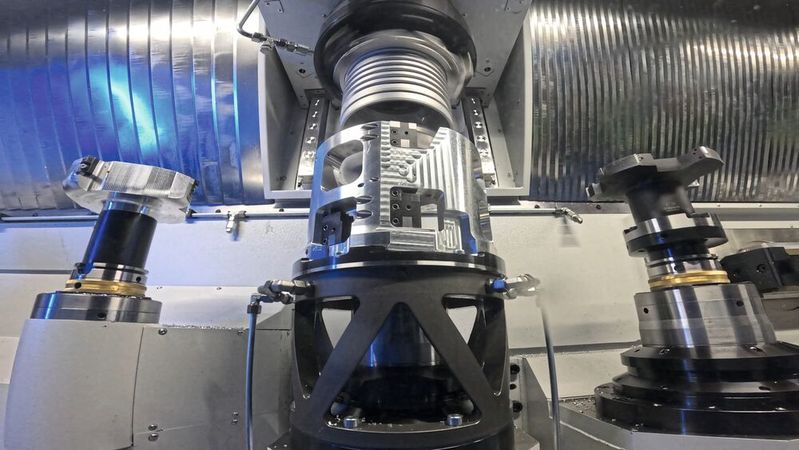
For the second processing step, the thin-walled component is moved into the gap between the inner and outer tool.
(Image: Mapal)
In a development project, the two manufacturers have demonstrated that it is possible to produce stator housings very economically and with high precision on a pick-up turning machine. The thin-walled aluminum components are required for the drive in electric vehicles. They have ribs on the outside for the cooling circuit and are installed in the larger motor housings.
While Niles-Simmons had been working with a converted modular lathe during the development phase, a machine designed specifically for stator production was now launched on the market. The development was based on the vertical machining center of the Rasoma brand, which, like Niles-Simmons, is a brand of the NSH Group (Niles-Simmons-Hegenscheidt GmbH). Both brands are jointly organized in the NSH Group subsidiary NSH Technology and have jointly driven the development. The designation Rasoma DZS 400-2 indicates that it works with two workpiece spindles.
For use in series production, the machine was equipped with a pick-up area for the raw parts and a drop-down area for the finished parts on the sides. The components are fed in and out via conveyor belts. For manual assembly, a buffer of ten to 20 components can be used via the automation system. This makes it possible to operate several systems while the employee can pursue other processes during production.
We have thus implemented the simplest automation as standard, for which no robots or barriers are required on the machine. The operator can place the parts directly onto a pallet conveyor.
Thomas Lötzsch, Sales Manager at NSH Technology
Fully automated workpiece loading and unloading of several machines with a central conveyor system is possible as an option. The machine can be easily integrated into an existing production environment, which is also helped by its relatively compact footprint of 7.50 meters × 2.60 meters (~25 feet x 8.5 feet). The basis for the design of the Rasoma DZS 400-2 was developed in collaboration with LTH Castings, a partner with many years of experience in the field of casting and a specialist in the machining of complex, high-quality and thin-walled components made of die-cast aluminum. The design thus took direct account of practical experience and user requirements.
Complete Machining in Two Set-Ups
Between pick-up and drop-down, the components are completely processed on the vertical machine in two set-ups. A clamping device first picks up the workpiece from above and moves it to various processing stations in the machine one after the other. At a reclamping station in the work area, the part is rotated by 180 degrees and picked up by the second workpiece spindle for finishing. During the second clamping, machining of the next component begins in parallel at the first fixture.
The processing steps follow one another like a miniature transfer line. The process begins with roughing the various internal diameters of the component. The tool stands still and the workpiece rotates.
Machining with a four-edged ISO boring tool on an HSK-A 100 spindle requires only a quarter of the main time compared to conventional turning with one cutting edge.
André Ranke, Regional Sales Manager at Mapal
The next machining step, in which the rotating stator housing is machined internally and externally simultaneously with four cutting edges each, is also extremely efficient. The inner tool also rotates. The cutting speed on the inner cutting edges is determined by the difference between the tool speed and the workpiece speed. The bell-shaped outer tool is stationary. For machining, the component is moved into the gap between the inner and outer tool. This patented process reduces the forces acting on the clamping device. In order to machine thin-walled components precisely, a complex workpiece clamping device with vibration damping can be dispensed with.
When designing the tool, particular attention was paid to the large chip volume and the high forces involved, as the inner and outer diameters are typically machined simultaneously.
Michael Kucher, Component Manager E-Mobility at Mapal
During finishing, only the fine boring tool is driven while the component is stationary. This prevents imbalances from occurring in the material due to non-rotationally symmetrical workpiece shapes and having a negative effect. The workpiece is then reclamped in the machine and the outer area that was previously clamped in the flange area is machined. The reclamping station can also be used for another purpose: The workpiece is placed here to relax the material before fine boring. The machine also has two tool turrets for driven tools, which carry out further machining operations as required by the component.
The bottom line is that the Rasoma DZS 400-2 combines the best of both worlds, namely the speed of turning for pre-machining the inner and outer contour with the precision of fine boring for finishing the inner contour.
Daniel Pilz, Project Leader at NSH Technology
The machine tool manufacturer and Mapal have contributed their respective core competencies to this complete solution. With the serialization of machine, tool technology and process, the good results of the prototype were improved even further. The process stability achieved even exceeded expectations, which is why the targeted cutting speed of 700 meters per minute (~2,300 feet per minute) could be increased even further.
Date: 08.12.2025
Naturally, we always handle your personal data responsibly. Any personal data we receive from you is processed in accordance with applicable data protection legislation. For detailed information please see our privacy policy.
Consent to the use of data for promotional purposes
I hereby consent to Vogel Communications Group GmbH & Co. KG, Max-Planck-Str. 7-9, 97082 Würzburg including any affiliated companies according to §§ 15 et seq. AktG (hereafter: Vogel Communications Group) using my e-mail address to send editorial newsletters. A list of all affiliated companies can be found here
Newsletter content may include all products and services of any companies mentioned above, including for example specialist journals and books, events and fairs as well as event-related products and services, print and digital media offers and services such as additional (editorial) newsletters, raffles, lead campaigns, market research both online and offline, specialist webportals and e-learning offers. In case my personal telephone number has also been collected, it may be used for offers of aforementioned products, for services of the companies mentioned above, and market research purposes.
Additionally, my consent also includes the processing of my email address and telephone number for data matching for marketing purposes with select advertising partners such as LinkedIn, Google, and Meta. For this, Vogel Communications Group may transmit said data in hashed form to the advertising partners who then use said data to determine whether I am also a member of the mentioned advertising partner portals. Vogel Communications Group uses this feature for the purposes of re-targeting (up-selling, cross-selling, and customer loyalty), generating so-called look-alike audiences for acquisition of new customers, and as basis for exclusion for on-going advertising campaigns. Further information can be found in section “data matching for marketing purposes”.
In case I access protected data on Internet portals of Vogel Communications Group including any affiliated companies according to §§ 15 et seq. AktG, I need to provide further data in order to register for the access to such content. In return for this free access to editorial content, my data may be used in accordance with this consent for the purposes stated here. This does not apply to data matching for marketing purposes.
Right of revocation
I understand that I can revoke my consent at will. My revocation does not change the lawfulness of data processing that was conducted based on my consent leading up to my revocation. One option to declare my revocation is to use the contact form found at https://contact.vogel.de. In case I no longer wish to receive certain newsletters, I have subscribed to, I can also click on the unsubscribe link included at the end of a newsletter. Further information regarding my right of revocation and the implementation of it as well as the consequences of my revocation can be found in the data protection declaration, section editorial newsletter.
The experience that Niles-Simmons brings with it from its wide range of technologies has a positive effect on the overall stability of the tool technology and machine in this aluminum machining process.
Michael Kucher, Component Manager E-Mobility at Mapal
The Rasoma DZS 400-2 achieves a significantly shorter chip-to-chip time than a milling machining center. This is due to the fact that all tools are already in the working area and are only brought into working position by swiveling the turret disk. This eliminates all tool changes, which significantly reduces non-productive times. With the technology described, a cycle time reduction of 50 percent compared to standard turning was already expected in the studies. The increase in cutting speeds to 1,000 meters per minute (~3,300 feet per minute) using the most suitable cutting materials and the optimization of non-productive times resulted in a further 20 percent time saving.
The process is so stable that random sampling is sufficient for quality assurance. Whereas initially all manufactured components were measured, the recommendation is now only one part per shift. Daniel Pilz proves that this is more than sufficient with figures: "The Rasoma DZS 400-2 with the special tools from Mapal achieves a process capability index of over 1.67 for critical features such as cylinder shape, diameter and concentricities and therefore meets the industrial specifications." Customers who are already using the machine achieve an annual output of up to 180,000 produced components in three-shift operation.
Successful in Large-Scale Production
One of the first users of the series process for stator production on the Rasoma DZS 400-2 is LTH Castings in Slovenia. The long-established foundry company has more than 100 casting cells and processes the raw parts on more than 250 CNC machining centers. Around 3,800 employees work at a total of six locations.
With our all-in-one solutions from design to series production, we are an important strategic partner to the automotive industry. Our range of parts includes components for transmissions, motors for battery electric and hybrid vehicles, steering and braking systems.
Dr. Primož Ogrinec, CTO at LTH Castings
The Rasoma DZS 400-2 machines are loaded and unloaded by robots in the ultra-modern production facility.
Like most automotive suppliers, LTH Castings manufactures components for various vehicle models. The flexibility of the Rasoma DZS 400-2 is helpful in the production of stator housings, where only clamping devices and tools need to be converted. "With a single system and using the new process, an optimum solution was developed for the specific manufacturer in terms of both quantity and quality and made ready for series production," explains André Ranke. The production of stator housings is now possible up to a diameter of 500 millimetres and a component length of 500 millimetres (~20 inches).
The Rasoma DZS 400-2 can be used to produce all the housings we have seen so far, and we have already seen a great many.
Thomas Lötzsch, Sales Manager at NSH Technology
The project team was in for a surprise when an undercut on the inside of the component was required for the housing design of a major car manufacturer. The sample component from Mapal, which was specially designed and manufactured for the process design, did not present this challenge. However, Mapal and the specialists from the NSH Group very quickly came up with a joint solution: instead of the tried and tested fine boring tool, a high-precision actuating tool with four slides from Mapal's product portfolio was used to produce the required internal contour. On the machine side, an interface coordinated with Mapal was designed in just a few days, which was ready for series production during the current order. Thanks to the now very closely networked development design, the two companies are able to react quickly to newly developed contours.
New Benchmark for Low Cost per Part
The Rasoma DZS 400-2 with tool technology from Mapal has established itself for series production and solves quality problems that occur on conventional turning-milling machines and horizontal transfer lines. Thomas Lötzsch is aware of cases in which the required shape and position tolerances were not reliably achieved and rejects were produced instead - up to 50 percent. Where the quality was right, the cycle times left a lot to be desired and resulted in higher workpiece costs. There was no established process for manufacturing the components.
Because there is a tough price war among automotive suppliers, the development of the Rasoma DZS 400-2 focused on the lowest possible unit costs right from the start. This goal was achieved through the combination of high machine availability, short cycle times, quality of the machined components and reliable production processes. According to current calculations, this means that a particularly economical cost per part can be achieved for machining, including tool costs.



:quality(80)/p7i.vogel.de/wcms/9d/2b/9d2b802f800e5caf17b2831e74228cd3/screenshot-202026-03-03-20103822-609x343v1v1.png "Visual comparison: on the left, a clean, burr-free cut edge; on the right, typical burr formation with oxidation discoloration. This illustrates how strongly parameter control and gas management influence the quality of the result. (CO₂ laser, oxygen cutting gas, sheet thickness approx. 15 mm). (Image:Picture: Rime)")
:quality(80)/p7i.vogel.de/wcms/dd/08/dd086510d9ae7b50181f6070e4463b44/0129363730v1.jpeg "Typical application for ionizing devices: Wrapping films. (Picture: ©Adobe Stock/SMC)")
:quality(80)/p7i.vogel.de/wcms/35/57/3557c819943c53acec41a0ccba87da4f/0130049064v1.jpeg "Researchers at the Fraunhofer IWU in Chemnitz have long known that many typical sheet metal parts can be manufactured more cost-effectively using hollow embossing rollers. Now there is news to report ... (Image:Fraunhofer IWU)")
:quality(80)/p7i.vogel.de/wcms/59/02/590246e3b3f415c65edbee377c14ca77/26-06-pi-fraunhofer-iws-41450-direktplattieren-pic-01-7771x4369v1v1.jpeg "The Fraunhofer IWS has developed the new \"direct laser cladding\" process, which creates a functional layer directly on the base body by applying a strip-shaped metal to rotationally symmetrical components in a spiral and bonding it locally by laser. (Image:Christoph Wilsnack/Fraunhofer IWS)")
:quality(80)/p7i.vogel.de/wcms/78/e9/78e9188c25a8a94e67c34c9bf8ffe495/visual-agile-20robots-20and-20google-20deepmind-20partner-20to-20bring-20intelligence-20to-20robotics-2500x1406v1v1.jpeg "Together, the partners are developing adaptable, intelligent robots for a wide range of applications (Image:Agile Robots SE)")
:quality(80)/p7i.vogel.de/wcms/e7/66/e7669ecf0260ae8fc54c214e34e4902a/0130316817v1.jpeg "Siemens and Palo Alto Networks offer tested cybersecurity solution for industrial 5G. (Image:Siemens)")
:quality(80)/p7i.vogel.de/wcms/9f/55/9f55324832c4f426958031375124d9de/siemens-20ubtech-20hmnd-1920x1079v1v1.png "Ready for the factory floor: While Ubtech is planning mass production, Siemens is already testing humanoids in real factory applications in Erlangen. (Image:Siemens)")
:quality(80)/p7i.vogel.de/wcms/11/36/113695ed260e29c8c2d9d39dc5f9d869/0130213768v1.jpeg "AI can work cheaply in China and deliver the results rapidly all over the world. (Image:Dall-E / AI-generated)")
:quality(80)/p7i.vogel.de/wcms/62/5f/625f41e87ebfef156a98c8e6393e32fd/0130211654v1.jpeg "Axial flux motors have some advantages over radial flux motor—but their production is currently still expensive. (Image:RWTH Aachen University)")
:quality(80)/p7i.vogel.de/wcms/77/9b/779b0685d010dfe45c9c2cb1cfecd467/0128886425v1.jpeg "The BlueEye is the first \"real\" hyperspectral camera for the UV range and covers the wavelength range from 220 to 380nm. (Image:Inno-spec GmbH)")
:quality(80)/p7i.vogel.de/wcms/e4/51/e451d52ce0182fb0aaa46a5774f832ef/26-04-pi-fraunhofer-iws-21160-bioslide-pic-01-4128x2321v1v1.jpeg "With the BioSlide research project, the Fraunhofer IWS is investigating how sliding systems can be designed to be more sustainable and energy-efficient. New materials can be tested in a particularly application-oriented manner on this plain bearing test stand. (Image:Fraunhofer IWS)")
![Thanks to advanced 3D printing technology, a more efficient use of resources should contribute to lower-emission aviation—this is the goal of ['skai]-lab. (Image:Oleksandr Pashchenko - stock.adobe.com / AI-generated)](https://cdn1.vogel.de/nghHNSbySccfOjG3n1qCA-FVOjQ=/288x162/smart/filters:format(jpg):quality(80)/p7i.vogel.de/wcms/62/64/626424c97a16e69f871bf216c9629c2a/adobestock-1927043193--c2-a9-20oleksandr-20pashchenko-20-e2-80-93-20stock-adobe-com-ki-generiertv1v1.jpeg "Thanks to advanced 3D printing technology, a more efficient use of resources should contribute to lower-emission aviation—this is the goal of ['skai]-lab. (Image:Oleksandr Pashchenko - stock.adobe.com / AI-generated)")
:quality(80)/p7i.vogel.de/wcms/f6/ae/f6aec4f6241b36ed5e3a990ac9176b42/0130429460v1.jpeg "Verne, Pony.ai and Uber want to launch a robotaxi service in Europe. (Image:Verne)")
:quality(80)/p7i.vogel.de/wcms/d7/88/d788699f2974708a332baa4e7a62fa9e/0130438967v1.jpeg "Skoda is withdrawing from China. The brand has produced well over three million vehicles there. (Image:Skoda car)")
:quality(80)/p7i.vogel.de/wcms/b0/43/b043b86899837532aad62d63368a917a/0130371361v1.jpeg "Skoda leaves the chinese market.
(Image:Skoda)")
:quality(80)/p7i.vogel.de/wcms/c3/c4/c3c4ce270b083eeac55654148611f064/0130237945v1.jpeg "China is not giving up on hydrogen, but is intensifying its efforts. (Image:freely licensed from Pixabay)")
:quality(80)/p7i.vogel.de/wcms/4d/dd/4dddf438e91f394c04a095dbfd109d1c/0130236430v1.jpeg "Measurement modules: The 720301 module in combination with the SL2000 enables RMS and power calculations, among other things. (Image:Yokogawa)")
:quality(80)/p7i.vogel.de/wcms/61/fc/61fcf95f5cca15494ad18343901ae585/0130317237v1.jpeg "With the AGI CPU, Arm says it is taking a \"historic step\": With the processor aimed at AI in data centers, the company is presenting itself for the first time as a provider of its own chips, not just as a pure IP licensor. (Image:Arm)")
:quality(80)/p7i.vogel.de/wcms/82/90/8290dfe3595b6c6b33726ae8b76172c7/0130319587v1.jpeg "The concept image illustrates how the pattern of tiny protrusions and depressions created on the substrate (MgO, bottom) controls the arrangement of atoms in the superconducting material (YBCO, top). At the interface between the two layers, an electronic structure enables superconductivity to occur at higher temperatures than previously possible. (Image:Chalmers University of Technology / Riccardo Arpaia)")
:fill(fff,0)/images.vogel.de/vogelonline/companyimg/76800/76895/65.jpg "FAULHABER_120mm.jpg ()")
:quality(80)/p7i.vogel.de/wcms/15/ea/15ead2b98eddb28628465f377faff8a8/0127912148v1.jpeg "Development partners and users of the series process, the LTH Castings team: from left (Blaž Peternel (technologist), Janez Jelovčan (Head of Machining Technology Škofja Loka), Nejc Kapus (Plant Manager Škofja Loka), Tatjana Cankar Mencinger (Project Leader), Tilen Štremfelj (Head of Project Management), Dr. Primož Ogrinec (CTO).(Image: LTH Castings)")
:quality(80)/p7i.vogel.de/wcms/a6/09/a6091b0ac4c5221413a2fea818de3b8a/0127912118v1.jpeg "Have made the new technology ready for series production (from left): Daniel Pilz (Project Leader NSH Technology) with the sample component from Mapal, André Ranke (Area Sales Manager Mapal) with a fine boring tool and Thomas Lötzsch (Sales Manager at NSH Technology) with a customer component.(Image: Mapal)")
:quality(80)/p7i.vogel.de/wcms/23/37/2337cd5c234058fa8bfceb946ed3ba68/0127912126v1.jpeg "The first machining step is roughing the various internal diameters of the component. The tool is stationary and only the workpiece rotates.(Image: Mapal)")
:quality(80)/p7i.vogel.de/wcms/bb/20/bb20556079f8db5cbba0cb7a9ea93d23/0127912135v1.jpeg "The cutting speed at the inner cutting edges is determined by the difference between the tool speed and the workpiece speed. The bell-shaped outer tool is stationary.(Image: Mapal)")
:quality(80)/p7i.vogel.de/wcms/8b/c7/8bc7380a7e8dc5dcb9d7337383e93e46/0127912129v1.jpeg "For the second machining step, the thin-walled component is moved into the gap between the inner and outer tool. (Image:Mapal)")
:quality(80)/p7i.vogel.de/wcms/80/e0/80e0f72546bc65aedffc632541f4e7b7/0125884949v1.jpeg "The third generation of the solid carbide milling cutter OptiMill-Uni-HPC was specifically developed for modern, automated manufacturing processes. The focus is on maximum process reliability. (Image:Mapal)")