Japanese researchers have developed a method in which a cost-effective single-photon source is directly integrated into the optical fiber. This is intended to enhance communication security and eliminate the need for expensive cryogenic systems.
Researchers from Japan are working on integrating a single-photon source directly into the optical fiber. This makes it possible to use standard optical fibers.
With the increasing computational power of quantum computers, classical cryptographic methods are coming under pressure. In particular, asymmetric algorithms such as RSA or ECC could be broken through quantum algorithms (e.g., Shor's algorithm). To ensure long-term data security, researchers are working on quantum communication systems that rely on physically secure information transmission.
A central element of such systems is the single-photon source, which provides defined photon packets for quantum key distribution (QKD) methods. Crucial for practical use is low-loss coupling of photons into standard optical fibers, as any optical attenuation reduces the range and efficiency of the quantum connection.
So far, single-photon sources have mostly been implemented outside the optical fiber, for example, with quantum dots or rare earth ions in solid-state matrices. However, this construction resulted in high coupling losses, as only a small fraction of the emitted photons entered the fiber's input mode. For a practical quantum network architecture, high coupling and channeling efficiencies are therefore essential.
Fiber-Coupled Single-Photon Source
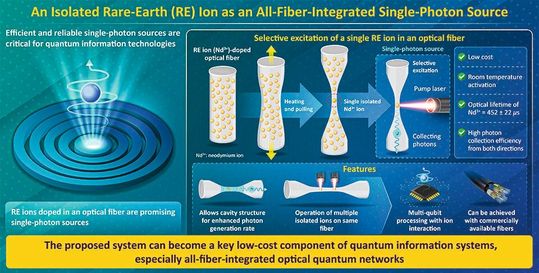
The proposed method uses a single rare earth ion in a tapered optical fiber to generate single photons directly and guide them within the fiber. This is an important, cost-effective component for future quantum communication.
(Image: Dr. Kaoru Sanaka from Tokyo University of Science, Japan.)
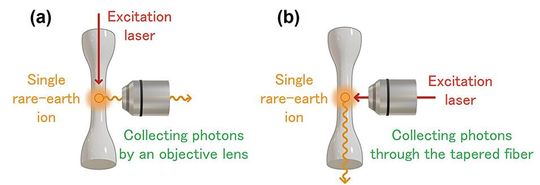
In a study, a research team led by Associate Professor Kaoru Sanaka from the Tokyo University of Science (TUS) in Japan has now found a solution: they developed a highly efficient fiber-coupled single-photon source where the photons are generated directly within the fiber. Prof. Sanaka explains: "In our approach, a single isolated RE ion, enclosed in a tapered optical fiber, is selectively excited by a laser to generate single photons."
Researchers propose a system for generating single photons at room temperature. For this, they selectively excite an isolated Nd³⁺ ion in an optical tapered fiber.
(Image: Dr. Kaoru Sanaka from Tokyo University of Science, Japan.)
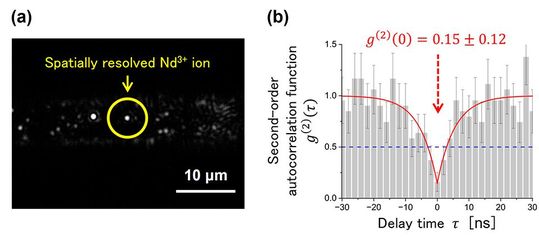
Scientists have succeeded in generating photons at room temperature using a single neodymium ion (Nd³⁺). This could potentially impact quantum communication technology. Image (a) shows the spatially resolved single Nd³⁺. Image (b) shows the autocorrelation measurement function of Nd³⁺ achieved through selective excitation.
(Image: Dr. Kaoru Sanaka from Tokyo University of Science, Japan.)
The team also included doctoral student Kaito Shimizu, Assistant Professor Tomo Osada from TUS, and Associate Professor Mark Sadgrove. Their results were published in the journal Optics Express.
The researchers used a silicon fiber doped with neodymium ions (Nd³⁺), which is versatile in telecommunications due to its emission properties in the near-infrared around 41.70 microinches. Through a thermal tapering process, the fiber was thinned to selectively excite the Nd³⁺ ions.
This led to a novel method in which "single Nd³⁺ ions were selectively excited with a pump laser at room temperature to generate single photons directly in the guided mode of the fiber," explains Prof. Sanaka further.
This innovative approach enables cost-effective and straightforward integration into existing systems through the use of commercially available optical fibers. Additionally, the need for expensive cryosystems is eliminated, as the system operates at room temperature. Prof. Sanaka emphasizes: "Our method allows for the highly efficient transmission of single photons from the source to the target." These features make it a promising candidate for the next generation of quantum-based networks.
From the perspective of high-frequency and photonics development, this approach offers several advantages:
Integrability: Utilizing standard optical fibers simplifies HF layout and system integration.
Scalability: Multi-channel structures with multiple ions within a fiber are conceivable, enabling photonic multi-qubit systems.
Signal Integrity: Direct waveguide coupling minimizes reflection and loss points, which is relevant for precise synchronization and timing systems in the GHz range.
The method could be used not only for quantum communication systems but also for quantum computing applications. By operating multiple isolated ions within a fiber, enhanced multi-qubit processors can be developed.
Future Research Beyond Quantum Communication
Future research should focus on further optimizing the photon wavelength to enable practical applications in spectroscopy and imaging analysis. In the long term, this technology could be used not only for quantum communication networks but also for spectrally selective measurement techniques, optical clock distribution systems, and photonic computing architectures. Overall, this development in single-photon sources marks a significant advancement for practical quantum technologies and paves the way for secure, eavesdropping-proof communication networks. (heh)
Date: 08.12.2025
Naturally, we always handle your personal data responsibly. Any personal data we receive from you is processed in accordance with applicable data protection legislation. For detailed information please see our privacy policy.
Consent to the use of data for promotional purposes
I hereby consent to Vogel Communications Group GmbH & Co. KG, Max-Planck-Str. 7-9, 97082 Würzburg including any affiliated companies according to §§ 15 et seq. AktG (hereafter: Vogel Communications Group) using my e-mail address to send editorial newsletters. A list of all affiliated companies can be found here
Newsletter content may include all products and services of any companies mentioned above, including for example specialist journals and books, events and fairs as well as event-related products and services, print and digital media offers and services such as additional (editorial) newsletters, raffles, lead campaigns, market research both online and offline, specialist webportals and e-learning offers. In case my personal telephone number has also been collected, it may be used for offers of aforementioned products, for services of the companies mentioned above, and market research purposes.
Additionally, my consent also includes the processing of my email address and telephone number for data matching for marketing purposes with select advertising partners such as LinkedIn, Google, and Meta. For this, Vogel Communications Group may transmit said data in hashed form to the advertising partners who then use said data to determine whether I am also a member of the mentioned advertising partner portals. Vogel Communications Group uses this feature for the purposes of re-targeting (up-selling, cross-selling, and customer loyalty), generating so-called look-alike audiences for acquisition of new customers, and as basis for exclusion for on-going advertising campaigns. Further information can be found in section “data matching for marketing purposes”.
In case I access protected data on Internet portals of Vogel Communications Group including any affiliated companies according to §§ 15 et seq. AktG, I need to provide further data in order to register for the access to such content. In return for this free access to editorial content, my data may be used in accordance with this consent for the purposes stated here. This does not apply to data matching for marketing purposes.
Right of revocation
I understand that I can revoke my consent at will. My revocation does not change the lawfulness of data processing that was conducted based on my consent leading up to my revocation. One option to declare my revocation is to use the contact form found at https://contact.vogel.de. In case I no longer wish to receive certain newsletters, I have subscribed to, I can also click on the unsubscribe link included at the end of a newsletter. Further information regarding my right of revocation and the implementation of it as well as the consequences of my revocation can be found in the data protection declaration, section editorial newsletter.



:quality(80)/p7i.vogel.de/wcms/62/14/6214b7c2c247ff6610c33ec375ff629a/0132992790v1.jpeg "Oliver Sax is a member of the board of Ceratizit and responsible for the areas of machining and rods. He heads the specialist for machining tools and carbide solutions, which is part of the Plansee Group. Sax is responsible for the strategic direction of the global market leader, focusing particularly on the expansion of the circular economy and technological independence in the supply of the critical raw material tungsten. The company boasts over 100 years of expertise in material development. (Image:Ceratizit Deutschland GmbH)")
:quality(80)/p7i.vogel.de/wcms/35/ca/35cac9f68609eccae3173dad1863df49/0132991739v1.jpeg "Carbide prices are skyrocketing, as Vomat observes. This makes these materials strategic resources that should be kept in the most closed material cycle possible. Vomat fine filtration technology can help with this ... (Image:Vomat)")
:quality(80)/p7i.vogel.de/wcms/cf/fc/cffc25779317b5b1e42cba9cfcd52bbc/0132927530v1.jpeg "The analysts were wrong again, as Japan was able to increase its export volume far more than predicted. Here are some numbers and facts about Nippon's economic situation... (Image:AI-generated)")
:quality(80)/p7i.vogel.de/wcms/6f/12/6f122ac26fd08f621f7b14f421fc435c/0132930817v1.jpeg "The Federal Statistical Office has taken a closer look at the first half of 2026 in terms of trade. Among other findings, it revealed that China is once again Germany's top trading partner... (Image:AI-generated)")
:quality(80)/p7i.vogel.de/wcms/95/fa/95fa92bf59ac4f0a72d6962b7c319ffb/0132527275v1.jpeg "Tom Terlouw from the Paul Scherrer Institute PSI and his team investigated around 13,000 scenarios for the climate-friendly production of ammonia, the basic component of fertilizers. (Image:Mahir Dzambegovic/Paul Scherrer Institute)")
:quality(80)/p7i.vogel.de/wcms/ea/49/ea49db542d261ce93bd6282699523c32/0131824146v1.jpeg "Ultrasonic sensors of the UB*-F42 series with IO-Link in various designs (Image:Pepperl+Fuchs)")
:quality(80)/p7i.vogel.de/wcms/e5/a7/e5a74207af0c3ad3948ff7c4019101bc/lapp-sps25-impr2-067v1.jpeg "Building on the insights from Etherline Guard for data cables, Lapp is developing a system that will, for the first time, record the wear of power-carrying cables during operation. (Source: Lapp)")
:quality(80)/p7i.vogel.de/wcms/37/96/37968ffa64fab850183b13fe38f7d304/0132983547v1.jpeg "They orchestrated the purchase of Adlatus by Neura (from left to right): Adlatus CEO Stefan Erhardt, Neura Robotics CEO David Reger, and Andreas Lindemann, Managing Director of Neura Mobile Robots GmbH. (Image: Neura Robotics)")
:quality(80)/p7i.vogel.de/wcms/07/98/0798729516175be8b01888121fb1c47e/20260806-h250-c-1v1.jpeg "Regional machinery manufacturers today often find themselves between global key customers, international competition, and an internal transformation process. This can quickly lead to a critical situation, as demonstrated by the practical case of Modul MT Verzahntechnik GmbH from Chemnitz (Germany). (Image: MODUL MT)")
:quality(80)/p7i.vogel.de/wcms/cb/0b/cb0b1aae460fa33151607c1171ee2576/mit-st-tzstruktur1v1.jpeg "The new process allows the same support structures to be reused over multiple printing operations. (Source: MIT)")
:quality(80)/p7i.vogel.de/wcms/95/7b/957b5deb968697d4fc72dbc82799b13e/0132976937v1.jpeg "In the telescopic PV pool cover from Skyvolution, energy chains from Igus safely guide the solar cables through the moving roof elements, even in the tightest installation spaces. (Image:Igus)")
:quality(80)/p7i.vogel.de/wcms/7d/17/7d174cbff42173176bae8b12dcec0c18/0132966756v1.jpeg "Thermal management: Custom and mechanically perfectly adapted heat sink solutions for the application provide users with efficient thermal management for many applications. (Image:© Fischer Elektronik)")
:quality(80)/p7i.vogel.de/wcms/81/31/81317bbc8be30332955ca435d55956e2/0133006538v1.jpeg "With the Nebula NEXT 01 JET Edition, Dreame presented an electrically powered hypercar with an additional rocket drive. According to Chinese media reports, the company has now largely scaled back its plans for commercial vehicle production. (Image:freely licensed)")
:quality(80)/p7i.vogel.de/wcms/e3/fb/e3fb490c8bcc4cc2e7976fe93ef3bad6/continental-zevra-tire--4v1.jpeg "The \"ZEvRA\" concept tire consists of approximately 43 percent recycled materials. (Source: Continental)")
:quality(80)/p7i.vogel.de/wcms/77/e0/77e08f061ae9c307f0e3450eda337427/0132990135v1.jpeg "Charging infrastructure in focus: Hubject and Localiser have entered into a cooperation. (Image:Hubject)")
:quality(80)/p7i.vogel.de/wcms/f7/9e/f79eb21ac246cb5ae9f4413400c8f8f7/0129006331v1.jpeg "The range of electric cars has grown significantly compared to 2024. At the same time, prices have dropped sharply. (Image:Hyundai)")
:quality(80)/p7i.vogel.de/wcms/2a/2f/2a2fc1bb2a6941d1e5c795c047c969ce/0132945015v1.jpeg "Developers at the lab workplace: For WBG-based power converters and highly dynamic loads, precise efficiency and loss analysis require the time-synchronized acquisition of electrical, transient, and thermal parameters. (Image:Yokogawa)")
:quality(80)/p7i.vogel.de/wcms/61/54/6154ff60caffd4552fcdeb45e4dc72b2/0132962188v1.jpeg "Using optical coherence tomography (OCT), high-resolution cross-sectional images of the retina and cornea with a resolution of a few micrometers can be created. However, the demands on the necessary computing power of industrial PCs are high. (Image:freely licensed)")
:quality(80)/p7i.vogel.de/wcms/d6/61/d661801f679db7b71de6cbf76c38de64/0132929603v1.jpeg "Thermal management in the data center: Air cooling is no longer sufficient for AI applications, but liquid cooling is not universally applicable. (Image:Dall-E / AI-generated)")
:quality(80)/p7i.vogel.de/wcms/dc/17/dc178c6f831bb1d99ecca0a342f6bcee/0132945424v1.jpeg "The BrainBoard 1500 brings the AI accelerator AKD1500 to a development board. (Image:Brainchip)")
:fill(fff,0)/p7i.vogel.de/companies/69/de/69de1b7403b0d/simtos-logo.jpeg "simtos-logo (SIMTOS)")
:quality(80):fill(efefef,0)/p7i.vogel.de/wcms/67/ad/67adf92d254d2/elatec-wp-smart-factory.png "Elatec WP Smart Factory")
:quality(80)/p7i.vogel.de/wcms/6f/8f/6f8ff5bf9b81829ef22736bc790cecca/0129224894v1.jpeg "View of the quantum optics laboratory at the University of Stuttgart: here, researchers are experimenting with new photon sources for quantum computing and quantum networks. (Image:Barz Group, University of Stuttgart)")
:quality(80)/p7i.vogel.de/wcms/f1/48/f1485734942e3ac8426660bfba8d17a5/0131601392v1.jpeg "Integrated optical circuit with fiber optic connections (top and bottom), developed at the Fraunhofer IOF in Jena. (Image:Fraunhofer IOF)")