In the Chinese city of Shenzhen, more cars are manufactured than anywhere else in China. Other Chinese cities are falling behind.
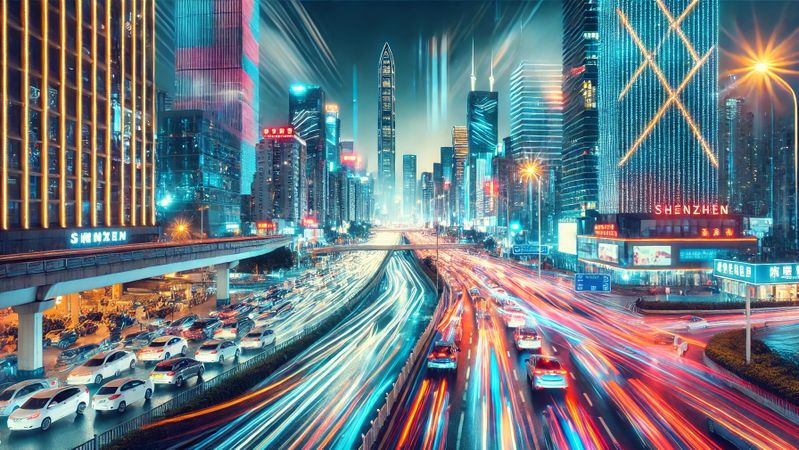
A dynamic night scene of Szenzen: The Shenzhen city government announced that preliminary statistics indicate more than 2.8 million cars were built there in 2024. BYD has its headquarters in Shenzhen and builds around a fifth of its cars there.
(Image: AI-generated)
Shenzhen is the Detroit of modern times. The city can now officially call itself "China's number one car city", writes the specialist portal Gasgoo with reference to the figures for 2024. Nowhere else in the People's Republic are as many e-cars and hybrids, or cars in general, built as in Shenzhen.
During the glorious days of the Ford Model T in Detroit, there was no other place on Earth with such concentrated mass production of combustion-engine vehicles. Similarly, today there is no place in the world where more electric cars and hybrids are produced than in Shenzhen.
During a visit a few weeks ago, it was clear that a significant leap in mobility transformation had taken place in the southern Chinese city: electric cars and hybrids increasingly dominate traffic, and there seemed to be more charging stations than gas stations.
What seemed like a superficial impression during the visit, at best an observation, has been substantiated with official statistics at the turn of the year. Since 2024, Shenzhen has led the nation not only in the registration and use of "New Energy Vehicles" (NEVs)—including pure electric cars, hybrids, and fuel cell vehicles—but also in their production.
The Shenzhen city government announced that preliminary statistics indicate more than 2.8 million cars were built there in 2024. This was one million more than in 2023. Even then, Shenzhen had held the title of "China's NEV City Number 1" for the second year in a row. Following last year's massive growth, the city has also become the national leader in overall vehicle production, whether combustion engine vehicles or NEVs.
Much like Detroit once was, Shenzhen is becoming a symbol of an entire country's modern economic power in the era of e-mobility. And similar to Ford in the past, it is now BYD—headquartered in Shenzhen—that has outpaced all other manufacturers worldwide with modern production processes and affordable cars for the mass market.
In November, BYD rolled its ten-millionth NEV off the assembly line. The world's largest producer of electric and hybrid vehicles also operates at other locations across China, including Changsha, Xi'an, Hefei, Fuzhou, Jinan, Zhengzhou, and Xiangyang. However, Shenzhen is now home to the so-called "Super Factory," the largest production line, which has been primarily responsible for the sharp increase in car production in Shenzhen last year. Around one-fifth of all BYD vehicles are manufactured in the city.
Shenzhen Has Attracted Suppliers
Shenzhen has also actively promoted the establishment of an entire supply chain comprising 2,400 companies. These firms are involved in the research, development, and production of connected and automated electric vehicles and hybrids, as well as many of their key components.
The electronics giant Huawei manufactures its "Harmony Cockpit" in Shenzhen. Companies such as DeepRoute AI, Robosense, ZYT, Inovance Technology, and many other new suppliers are also based here. In fact, the city of Shenzhen has essentially transformed into a single "Science and Technology Cluster" for e-mobility and connected driving.
More Charging Stations Than Gas Stations
The city administration continues to do everything possible to promote the growth of this cluster. It is also actively paving the way for the NEV market locally. In fact, recent statistics show that since 2024, Shenzhen has had more charging stations than gas stations for the first time. Over 400,000 charging points are available in the city, more than anywhere else in China.
Since 2017, all buses in Shenzhen have been electric, and since 2018, all taxis as well. The sale of electric and hybrid vehicles to private customers is supported, among other things, by the easier availability of license plates.
However, artificial incentives are becoming less necessary. Thanks to the central government in Beijing ensuring low electricity prices nationwide, electric driving in China is significantly cheaper than using fossil fuels. For instance, someone in Shenzhen who commutes 30 kilometers (approx. 19 miles) daily to work with an electric car pays about ten euros per month for it.
Date: 08.12.2025
Naturally, we always handle your personal data responsibly. Any personal data we receive from you is processed in accordance with applicable data protection legislation. For detailed information please see our privacy policy.
Consent to the use of data for promotional purposes
I hereby consent to Vogel Communications Group GmbH & Co. KG, Max-Planck-Str. 7-9, 97082 Würzburg including any affiliated companies according to §§ 15 et seq. AktG (hereafter: Vogel Communications Group) using my e-mail address to send editorial newsletters. A list of all affiliated companies can be found here
Newsletter content may include all products and services of any companies mentioned above, including for example specialist journals and books, events and fairs as well as event-related products and services, print and digital media offers and services such as additional (editorial) newsletters, raffles, lead campaigns, market research both online and offline, specialist webportals and e-learning offers. In case my personal telephone number has also been collected, it may be used for offers of aforementioned products, for services of the companies mentioned above, and market research purposes.
Additionally, my consent also includes the processing of my email address and telephone number for data matching for marketing purposes with select advertising partners such as LinkedIn, Google, and Meta. For this, Vogel Communications Group may transmit said data in hashed form to the advertising partners who then use said data to determine whether I am also a member of the mentioned advertising partner portals. Vogel Communications Group uses this feature for the purposes of re-targeting (up-selling, cross-selling, and customer loyalty), generating so-called look-alike audiences for acquisition of new customers, and as basis for exclusion for on-going advertising campaigns. Further information can be found in section “data matching for marketing purposes”.
In case I access protected data on Internet portals of Vogel Communications Group including any affiliated companies according to §§ 15 et seq. AktG, I need to provide further data in order to register for the access to such content. In return for this free access to editorial content, my data may be used in accordance with this consent for the purposes stated here. This does not apply to data matching for marketing purposes.
Right of revocation
I understand that I can revoke my consent at will. My revocation does not change the lawfulness of data processing that was conducted based on my consent leading up to my revocation. One option to declare my revocation is to use the contact form found at https://contact.vogel.de. In case I no longer wish to receive certain newsletters, I have subscribed to, I can also click on the unsubscribe link included at the end of a newsletter. Further information regarding my right of revocation and the implementation of it as well as the consequences of my revocation can be found in the data protection declaration, section editorial newsletter.
Three Out of Four Cars in Shenzhen Are NEVs
As a result, more and more people in Shenzhen are switching to electric or hybrid vehicles. In the first ten months of the past year, the market penetration of NEVs in new car sales in the city reached 75 percent.
The star of China's former major "car cities," such as Changchun with FAW-Volkswagen or Shanghai with SAIC-Volkswagen, is slowly but surely fading. These cities are trying, albeit belatedly, to catch up with the trends. In contrast, Shenzhen has already emerged as the Detroit of the modern era and is currently working to expand its lead.
*Henrik Bork is General Manager and Founder of AsiaWaypoint, Beijing, P.R. China



:quality(80)/p7i.vogel.de/wcms/f9/7d/f97deef8fde21c8630d76411b18a20a7/0129803665v1.jpeg "Skoda has invested well over 220 million US dollars in the high-tech battery plant that has now opened in Mlada Boleslav. It has now started its work, which is highly automated ... (Image:Skoda)")
:quality(80)/p7i.vogel.de/wcms/f5/61/f561ad7c72ed41fd7a67ad9c481cb15d/0129799343v1.jpeg "Engine-generator units (MGU) from Steyr Motors are at work in the Leopard 2 main battle tank and the Leguan bridge vehicle (pictured). An extended contract is now to secure at least 500 more systems of this type for the Bundeswehr ... (Image:German Armed Forces)")
:quality(80)/p7i.vogel.de/wcms/6c/b5/6cb5ce2155433f6e73b16399adc4c561/0113143253v1.jpeg "In our China Market Insider we regularly provide you with relevant information directly from China. (Image:© Eisenhans - stock.adobe.com)")
:quality(80)/p7i.vogel.de/wcms/7f/fd/7ffd32863352c40f562f4245e4766e61/0129745849v1.jpeg "After US President Donald Trump once again resorted to his favorite weapon, tariffs, concerns rose in the EU that the so-called tariff deal could become invalid. But it looks as if the sea remains relatively calm ... (Image:F. Schneidler)")
:quality(80)/p7i.vogel.de/wcms/9c/ac/9cac6246660e746c5a3989399ac4d250/0128561645v1.jpeg "Artificial intelligence can drive efficiency in smart factories through centralized data management and predictive maintenance. (Picture: ©Fardived - stock.adobe.com)")
:quality(80)/p7i.vogel.de/wcms/6b/e2/6be235b5ad8a442ccd9d164b0b300d8b/0129763992v1.jpeg "As early as 2020, the Zimmer Group announced that it would convert its production to be sustainably CO2-neutral. (Image:Zimmer Group)")
:quality(80)/p7i.vogel.de/wcms/d4/ba/d4bab9481e66f8570f40eb8ef2a90198/0129795613v1.jpeg "A camera inspection during removal ensures that the components are placed correctly in the KLTs. (Image:Yaskawa Europe)")
:quality(80)/p7i.vogel.de/wcms/cb/56/cb56e42b01638b618e8d1b9b38f32faa/0129810132v1.jpeg "From summer 2026, \"AEON\" will support people at the BMW plant in Leipzig. (Image:diephotodesigner.de/BMW)")
:quality(80)/p7i.vogel.de/wcms/b5/5e/b55ed9355e0395ec0caf111d6af6b494/adobestock-495980372--c2-a9-20natali-mis-20-e2-80-93-20stock-adobe-com-6720x3778v1v1.jpeg "Which engineering skills will be in vogue in 2026? (Image:natali_mis - stock.adobe.com)")
:quality(80)/p7i.vogel.de/wcms/bf/a5/bfa5d882e93f159ce93e933742272b00/nord-vibn-cmyk-2196x1235v1v1.jpeg "With digital twins for virtual commissioning, Nord supports customers in ensuring that systems are available more quickly, even with complex drive systems. (Image:Nord Drivesystems)")
:quality(80)/p7i.vogel.de/wcms/f5/7e/f57ef535ee35e7b3b7ff15a8a63cef10/eds-keyvisual-8000x4496v1.jpeg "(Source: European Defence Supply)")
:quality(80)/p7i.vogel.de/wcms/af/a3/afa312176d956068af20491957eef642/newsimage418262-3100x1745v1v1.jpeg "The autonomous shuttle of the Aula AI project during a demonstration of sensor data with artificial fog. (Image:University of Magdeburg)")
:quality(80)/p7i.vogel.de/wcms/cb/23/cb23acd8e9de969d52522692b62b1892/0129680605v1.jpeg "The Z22198 is an extremely compact, three-axis IEPE acceleration sensor for measuring oscillations (vibrations) and shocks in demanding applications. With an edge length of just 0.24 inches and a weight of 0.03 ounces, it is ideal for lightweight structures and confined spaces. (Image:Copyright 2020 ScROGERS,All Rights Reserved)")
:quality(80)/p7i.vogel.de/wcms/c4/40/c44043c61f9dd99b80ccca398c284018/0129795093v1.jpeg "Subaru manufactures the E-Outback at its Yajima plant, marking the first time it has produced an electric vehicle in-house. (Image:Subaru)")
:quality(80)/p7i.vogel.de/wcms/fe/18/fe1824e572677900655c854f6c92c391/0129811281v1.jpeg "BMW and CATL deepen their partnership and work together on the battery pass. (Image:BMW)")
:quality(80)/p7i.vogel.de/wcms/15/54/15546b27b3a679871325ef6d92509a95/0129750872v1.jpeg "Webasto plans to open its third plant for sunroofs in India. (Image:Webasto)")
:quality(80)/p7i.vogel.de/wcms/70/14/70142aa050f8d3f7784c5ddbb2aba5f1/0129778339v1.jpeg "The software investments in production have saved time in Lacon production. (Image:Lacon)")
:quality(80)/p7i.vogel.de/wcms/5c/0f/5c0fee074c4b6c8e8c0993f3217c2f5a/0129773718v1.jpeg "The General Fusion demonstration reactor. (Image:General Fusion)")
:quality(80)/p7i.vogel.de/wcms/7f/c1/7fc1c83b8509df676d27518b82aaef02/0129764984v1.jpeg "China Resources Microelectronics (CR Micro) has announced its intention to increase the prices of its own products. (Image:China Resources Microelectronics)")
:quality(80)/p7i.vogel.de/wcms/eb/4e/eb4e449562174ec95a5b3d30fb0137a2/0129648135v1.jpeg "The III-V germanium PV module with an efficiency of 34.2% is currently the most efficient solar module in the world. (Image:Jacob Forster)")
:fill(fff,0)/images.vogel.de/vogelonline/companyimg/76800/76895/65.jpg "FAULHABER_120mm.jpg ()")
:fill(fff,0)/p7i.vogel.de/companies/68/a4/68a47beec75ce/logo-cmyk-de.jpeg "logo-cmyk-de (https://www.datatec.eu/)")
:fill(fff,0)/p7i.vogel.de/companies/67/eb/67eba621ef6ea/logo2.png "logo2 (Wuxi InfiMotion)")
:quality(80)/p7i.vogel.de/wcms/cd/26/cd26d90038914506ce7506b783b5fdab/byd-20sealion-207-2001-7008x3940v1v1.jpeg "China's automotive industry is not only growing but is increasingly becoming a global leader in innovation, especially in e-mobility. (Image: BYD) (Image:)")
:quality(80)/p7i.vogel.de/wcms/0e/e2/0ee29098cc5c35211cdf0e7869f3ddc2/0122293897v1.jpeg "With the GOVY AirJet, GAC aims to meet various mobility needs, ranging from short commuting distances in the city to medium-distance intercity travel. (Image:GAC)")
:quality(80)/p7i.vogel.de/wcms/33/be/33be0659e7949b9459d12230d26bbc14/byd-haendlertagung-de-5-20-281-29-3240x1822v1v1.jpeg "The photo was taken at the BYD dealer conference in Germany. Globally, the manufacturer has significantly expanded its sales network and thereby been able to substantially increase its sales. (Image:BYD)")
:quality(80)/p7i.vogel.de/wcms/84/29/84292c48b041e6085d9825dd999dfdc5/0114716946v1.jpeg "The MG 4 is one of the most successful models from China in Europe. (Image:MG Motor)")