The EU imposed punitive tariffs on Chinese electric cars. However, the manufacturers are responding cleverly: they are focusing on hybrids, expanding dealership networks, and significantly undercutting European competitors.
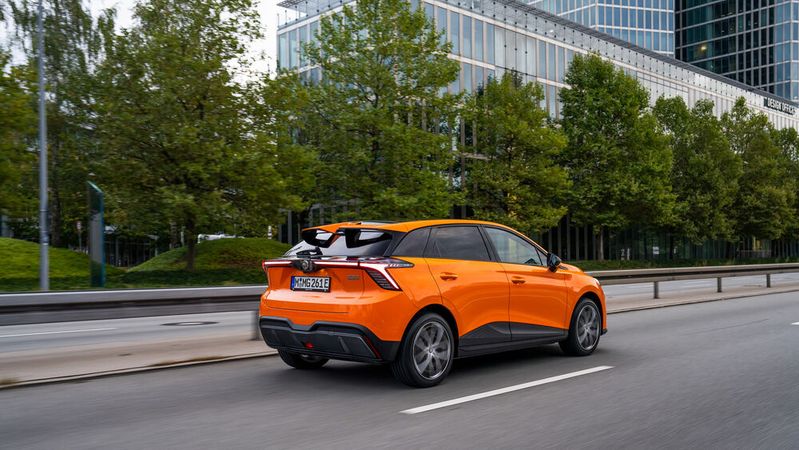
The MG 4 is one of the most successful models from China in Europe.
(Image: MG Motor)
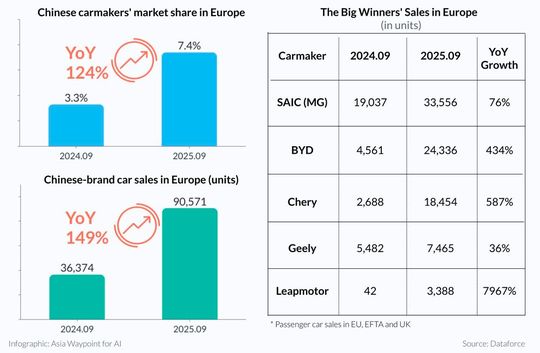
Chinese automakers have doubled their market share in Europe within a year. Figures for September 2025 document rapid growth for cars from China, according to a newly released report by Dataforce. Brands like BYD, Saic, and Chery are becoming more popular in Europe, and some of them have, for the first time, surpassed Korean automakers like Kia.
The doubling of sales occurred in the period from September 2024 to September 2025 and includes all types of drive systems. In this statistic, "Europe" refers to the European Union plus Iceland, Liechtenstein, Norway, Switzerland, and the United Kingdom (EU + EFTA + UK).
Overall Market Share Still in Single Digits
Both the market shares and the absolute sales figures of Chinese car brands in the market as defined are still low. However, they show that the very early protective tariffs imposed by the European Commission in Brussels on imports of Chinese electric cars cannot prevent the export success of the Chinese.
In September of this year, Chinese manufacturers were able to sell around 90,000 cars in Europe. Given that over 1.2 million units were sold in total, this corresponds to a market share of around seven percent, according to Dataforce. A year earlier, in September 2024, this share stood at around three percent.
Sales of Chinese Hybrids Quintupled
Sales figures and market shares of Chinese automakers in Europe (EU + EFTA + UK).
(Image: Vogel Communications Group)
Particularly impressive was the increase in cars with hybrid drives of all types. In September, the market share of Chinese manufacturers in this segment grew to 15 percent. A year earlier, it was just under three percent—meaning it has more than quintupled within a year.
Partly to circumvent the EU tariffs on all-electric vehicles and partly because they correctly identified market demand in Europe, Chinese manufacturers have significantly expanded the share of plug-in hybrids in their product portfolios for Europe.
After A Difficult Start: BYD Catches Up
The biggest winner in the mentioned period is BYD. Since October 2024, the EU has been trying to shield the EU market from the success of the Shenzhen-based company with an additional 17 percent tariff on pure electric vehicles (BEVs) from BYD. In addition to the previously introduced ten percent tariff on all car sales from China, BYD now has to pay a total of 27 percent tariff when importing electric cars into the EU.
BYD then adjusted its strategy by shipping its affordable yet impressively equipped plug-in hybrid "Seal U DM-i" to Europe. It promoted this SUV with attractive introductory offers, leveraging the rapidly growing network of its dealers.
This car model from BYD features a small petrol engine that helps to ease the range anxiety of European customers, but its electric drive alone achieves mileage that is fully sufficient for the everyday needs of many customers. European automakers have little to compete with it in terms of price and features.
$17,400 Cheaper than A Tiguan
A Seal U DM-i can be found in Europe starting at around $40,600. Those looking for something comparable will come across the VW Tiguan eHybrid, which charges slightly faster and has a somewhat higher range but is only available starting at $58,000, even though VW does not have to pay any tariffs for it. The Tiguan still sells better than the Seal U DM-i.
How long this will remain the case is an interesting question. "Since the EU imposed additional tariffs on battery-electric vehicles imported from China in November 2024, Chinese automakers have been adjusting their product mix, reducing BEV deliveries, and expanding the range of plug-in hybrids," reports the Chinese auto portal Gasgoo.
Overall, BYD was able to increase its car sales across all drivetrains by around 300 percent during the specified period. In the first nine months of this year, the Chinese manufacturer sold 120,000 cars in Europe. Although this figure was still less than MG, the formerly British car brand now owned by China, which sold 225,000 units, MG grew by about 29 percent over the same period.
Date: 08.12.2025
Naturally, we always handle your personal data responsibly. Any personal data we receive from you is processed in accordance with applicable data protection legislation. For detailed information please see our privacy policy.
Consent to the use of data for promotional purposes
I hereby consent to Vogel Communications Group GmbH & Co. KG, Max-Planck-Str. 7-9, 97082 Würzburg including any affiliated companies according to §§ 15 et seq. AktG (hereafter: Vogel Communications Group) using my e-mail address to send editorial newsletters. A list of all affiliated companies can be found here
Newsletter content may include all products and services of any companies mentioned above, including for example specialist journals and books, events and fairs as well as event-related products and services, print and digital media offers and services such as additional (editorial) newsletters, raffles, lead campaigns, market research both online and offline, specialist webportals and e-learning offers. In case my personal telephone number has also been collected, it may be used for offers of aforementioned products, for services of the companies mentioned above, and market research purposes.
Additionally, my consent also includes the processing of my email address and telephone number for data matching for marketing purposes with select advertising partners such as LinkedIn, Google, and Meta. For this, Vogel Communications Group may transmit said data in hashed form to the advertising partners who then use said data to determine whether I am also a member of the mentioned advertising partner portals. Vogel Communications Group uses this feature for the purposes of re-targeting (up-selling, cross-selling, and customer loyalty), generating so-called look-alike audiences for acquisition of new customers, and as basis for exclusion for on-going advertising campaigns. Further information can be found in section “data matching for marketing purposes”.
In case I access protected data on Internet portals of Vogel Communications Group including any affiliated companies according to §§ 15 et seq. AktG, I need to provide further data in order to register for the access to such content. In return for this free access to editorial content, my data may be used in accordance with this consent for the purposes stated here. This does not apply to data matching for marketing purposes.
Right of revocation
I understand that I can revoke my consent at will. My revocation does not change the lawfulness of data processing that was conducted based on my consent leading up to my revocation. One option to declare my revocation is to use the contact form found at https://contact.vogel.de. In case I no longer wish to receive certain newsletters, I have subscribed to, I can also click on the unsubscribe link included at the end of a newsletter. Further information regarding my right of revocation and the implementation of it as well as the consequences of my revocation can be found in the data protection declaration, section editorial newsletter.
Sales Network is Rapidly Expanding
What happens when BYD seriously focuses on a market and expands its dealership network can currently be observed in the United Kingdom. In less than two and a half years, the Chinese company has established a network of 100 franchise dealers there.
They offer dealers attractive packages, and many customers are impressed by the product, British media report. A "wow effect" ("shock and awe") is currently being observed in the dealerships, Bloomberg quotes an analyst from Bernstein.
BYD Surpasses Kia
The brands BYD, Chery, and MG (owned by Saic) claim the majority of the market share, a good seven percent, captured by Chinese manufacturers. In individual rankings, BYD was able to surpass the Korean brand Kia for the first time.
Some analysts tried hard to find a flaw and suggested that part of the statistical gains might come from fleet sales and dealer-registered demo vehicles. That may be true. On the other hand, for example, the sales figures of Volvo (owned by Geely) are not included in the Dataforce numbers.
All in all, the trend is clear: Despite EU tariffs, which amount to up to 45 percent for some manufacturers, BYD and other Chinese brands are steadily capturing more of the European car market. For plug-in hybrids, the total share was already around 20 percent in September. And they are just getting started.



:quality(80)/p7i.vogel.de/wcms/51/1b/511b420dbcc296aec09e3bffb051b8a8/0133581587v1.jpeg "The cables connect numerous machine components—often in confined spaces. (Image:Helu)")
:quality(80)/p7i.vogel.de/wcms/b5/67/b5676f3bfb36251ed31f9a0cccf650b6/0133167827v1.jpeg "Thanks to JumboFlex Generation 2, employees can effortlessly move wheelchairs weighing as much as 40 kilograms. (Image:Lard)")
:quality(80)/p7i.vogel.de/wcms/5e/c6/5ec615b7a51440f668259f2af9158cb9/0132654694v1.jpeg "Strategic Partnerships in Industry: As buyers and restructuring partners, Chinese investors are increasingly helping to preserve jobs in Germany. (Image: ©Anatolii Rymarchuk - stock.adobe.com)")
:quality(80)/p7i.vogel.de/wcms/eb/2b/eb2bd1b8487afe577b37363cd02f16ff/0113143253v1.jpeg "In our China Market Insider, we regularly provide you with relevant information straight from China. (Image:© Eisenhans - stock.adobe.com)")
:quality(80)/p7i.vogel.de/wcms/aa/3e/aa3e2603a812f8e7d33c00ba8ae28c9f/0133507886v1.jpeg "With the Iggy Rob, igus is bringing a humanoid robot into factories for a price of 47,999 euros ($54,718). (Image: igus)")
:quality(80)/p7i.vogel.de/wcms/92/64/92645c64ffbb6980976d39102388d120/0113143253v1.jpeg "In our China Market Insider, we regularly provide you with relevant information straight from China. (Image:© Eisenhans - stock.adobe.com)")
:quality(80)/p7i.vogel.de/wcms/c7/05/c70542511e0824ee491f7b55e21fa429/0133598424v1.jpeg "In logistics, AI is often implemented only on a case-by-case basis; data is stored in separate systems, and inventory levels, status values, and priorities are not defined consistently. (Image: ©m-project - stock.adobe.com)")
:quality(80)/p7i.vogel.de/wcms/3a/9c/3a9c1fd546e1f041b86bb1d03cf39101/0133610524v1.jpeg "The Mason W-01 combines industrial-grade humanoid hardware, Physical AI-based perception, and autonomous task planning. (Image:Nova X Robotics)")
:quality(80)/p7i.vogel.de/wcms/e7/94/e794290f265afbd0ffc7a06c4fe9d425/adobestock-1887113836--hypnotics-14-stock-adobe-com-ki-generiertv1.jpeg "In both autonomous driving and industrial production, there is growing skepticism as to whether full autonomy is always desirable. (Source: © Hypnotics 14 – stock.adobe.com / AI-generated)")
:quality(80)/p7i.vogel.de/wcms/a8/71/a8712e5c6ef536228444ab5275cedfe2/adobestock-340905887--gorodenkoff-stock-adobe-comv1.jpeg "A new position paper outlines the conditions that the business community, academia, and policymakers must jointly establish in order to ensure the long-term viability of industry in Germany and Europe. (Source: © Gorodenkoff – stock.adobe.com)")
:quality(80)/p7i.vogel.de/wcms/7d/eb/7deb25ca674fa4c781a9d1fab083f7cf/parker-entwicklungszentrum-hresv1.jpeg "The centerpiece of the Parker Center for Drive and Control Technology in Offenbach is the exhibition area. (Source: Parker Hannifin)")
:quality(80)/p7i.vogel.de/wcms/3d/ff/3dff5e51c24b30c8dc37c1d024887157/0133602931v1.jpeg "Just a few years ago, SpaceX specialists were working on the world’s largest rocket—the Starship. Now, Elon Musk’s company has reached a milestone during a test flight: Earth’s orbit! But there was also a downside... (Image: SpaceX)")
:quality(80)/p7i.vogel.de/wcms/78/ab/78abbfbab0565fabb19efe637aea30e8/nio-power-swap-station-4-china-guangzhou-2024-1400x933-jpgv1.webp "Nio and Geely are collaborating on battery replacement for electric cars. (Source: Nio)")
:quality(80)/p7i.vogel.de/wcms/2e/58/2e58c664e733dd182666606f850c5da4/0133400664v1.jpeg "The IM6 is sort of the crossover version of the IM5. (Image:MG Motor)")
:quality(80)/p7i.vogel.de/wcms/40/5f/405f41f4075e8798878011f0932a8195/0133509065v1.jpeg "Caruso has integrated Hyundai into its platform. (Image:Hyundai)")
:quality(80)/p7i.vogel.de/wcms/06/98/06989beb3f95b8fb06d71190c86cffde/tabletv1.jpeg "The cockpit view during a test drive in the simulator. (Source: Uccello et al., IEEE OJITS 2026)")
:quality(80)/p7i.vogel.de/wcms/40/34/4034915f85470ad8264659267e4f02d0/0133655653v1.jpeg "Cariad, Volkswagen's software subsidiary, continues to struggle. Now, another round of layoffs has been announced, which will result in the loss of many jobs ... (Image:Cariad)")
:quality(80)/p7i.vogel.de/wcms/e4/2a/e42af12e2a0816bb3d25fac9932903e9/0133646920v1.jpeg "TSMC's U.S. headquarters in Arizona: According to various media reports, the world's largest contract semiconductor manufacturer may be planning to build up to six additional fabs in the state of Texas. (Image:TSMC)")
:quality(80)/p7i.vogel.de/wcms/de/8c/de8c694e560ce8e8d7d43fa5b91917b3/0133668420v1.jpeg "Open-source AI tools: DeepSeek and Huawei are making programming tools for Ascend processors available, with the aim of simplifying development, chip communication, and AI computations on Huawei's hardware—and thereby intensifying competition with Nvidia. (Image:Dall-E / AI-generated)")
:quality(80)/p7i.vogel.de/wcms/86/25/8625a62499a6e70e629a2ddde2f01dcb/0133671173v1.jpeg "\"OpenAI\" has repeatedly experienced problems in which AI models have accessed the internet without authorization in order to carry out their tasks. The company has now fired three people whom it no longer trusts ... (Image:AI-generated)")
:quality(80)/p7i.vogel.de/wcms/23/b9/23b94097ac96587a0369e214e69ec055/byd-20atto-202-6m21331-5000x2811v1v1.jpeg "The Chinese state has indirectly supported companies like BYD. In the country's new Five-Year Plan, the importance of the automotive industry decreases. (Image:BYD)")
:quality(80):fill(efefef,0)/p7i.vogel.de/wcms/67/ad/67adf4a647532/elatec-wp-machine-authentication.png "Elatec WP Machine Authentication")
:quality(80)/p7i.vogel.de/wcms/28/93/2893fa639d50c6f0a4e5010b26c50383/denza-b5cv1.jpeg "The automotive group BYD is aggressively pushing its brands onto global markets. (Image:BYD)")
:quality(80)/p7i.vogel.de/wcms/0d/4a/0d4a1d7129c5838744eecb4765db6698/0126570766v1.jpeg "China currently accounts for two-thirds of global EV sales. Europe follows with 17 percent, and the USA with seven percent. (Image:AI-generated)")