New Transistor Architecture: Monolithic CFETs Could Revolutionize Semiconductor Manufacturing. Imec has now experimentally proven that scaling for A7, A5, and A3 logic nodes is possible.
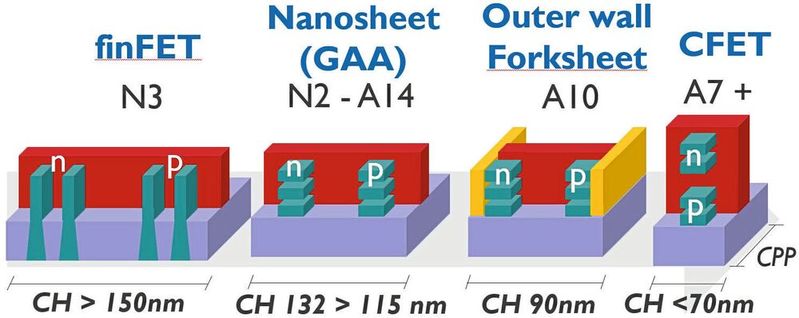
Figure 1: Imec's logic technology roadmap showing the extension of the nanosheet era from 2nm to the A10 node with the outer-wall forksheet, before the transition to CFET for A7 and beyond.
(Image: imec)
In recent years, significant advances have been made in developing process flows for monolithic CFET device architectures (mCFET). However, the semiconductor industry may only be ready to adopt this disruptive transistor architecture if it can be implemented across several successive technology nodes.
Imec conducted a DTCO (Design-Technology Co-Optimization) study to identify the performance-enhancing factors necessary to support aggressive area scaling of mCFET device architectures for A7, A5, and A3 logic nodes.
For the A3 node, hybrid channel alignments for n- and pMOS transistors are required. The research institute has experimentally demonstrated the key process module that enables the integration of heterogeneous channels in an mCFET: the embedded middle dielectric isolation.
CFET: Significantly Reduce the Size of Logic Cells
Complementary FET (CFET) device architectures are expected to replace gate-all-around (GAA) nanosheet transistors in the roadmap for logic technologies. In a CFET device, n- and pMOS transistors are stacked on top of each other, eliminating the n-p separation from the considerations regarding standard cell height for the first time. Thus, CFET device architectures have the potential to significantly reduce the size of logic standard cells, provided they can be combined with advanced technologies for contacting and powering the transistors.
Of all possible integration processes, monolithic CFET is considered the least disruptive - it offers the fastest way to introduce CFET in industrially relevant dimensions. In monolithic integration, the vertical device structure with common top and bottom gates is structured and processed in a single sequence of process steps.
The vertical stacking of layers poses various challenges, which is why CFET-specific modules are required to enable vertical isolation in critical areas of the stack cross-section. An example of this is the MDI (Middle Dielectric Isolation) module, which provides isolation between the top and bottom gates [1]. This allows different threshold voltages to be defined for the upper and lower components.
Recently, significant progress has been made in demonstrating the critical building blocks for a 300 mm mCFET integration flow. At VLSI 2024, the Belgian researchers reported an mCFET device with MDI module compatible with an inner spacer - a nanosheet-specific feature that isolates the gate from the source/drain (S/D) [2]. At IEDM 2024, the Belgian scientists experimentally demonstrated a functional mCFET with direct backside contact to the S/D of the bottom pMOS device [3].
Imec expects to introduce the mCFET device architecture in the A7 node of the logic technology roadmap when mCFET takes over the successor role of the Outer Wall Forksheet (46285001). The latter is expected to extend the nanosheet-based logic roadmap to the A10 node in anticipation of mCFET being ready for volume production.
Extending mCFET to Other Nodes: A Topic for the Industry
At the circuit level, imec proposed the double-row CFET architecture as the best way to integrate mCFETs into a standard A7 cell [4]. A double-row CFET standard cell contains two rows of stacked devices with a common vertical signal between them and "USS" voltage walls at the cell boundary. At IEDM 2024, a DTCO study demonstrated how this double-row CFET architecture offers the best trade-off between manufacturability and area efficiency for the A7 technology node.
However, the industry has always been reluctant to switch to a new component architecture, as this entails huge investments in tools and additional risks. For a successful transition, it is important that the new architecture can be used across different nodes.
The researchers therefore continued their DTCO study to investigate the scalability of the double-row mCFET in subsequent technology nodes.
To evaluate the PPA (power performance area) metrics at the circuit level, the behavior of a 15-stage ring oscillator (i.e. an RO with 15 mCFET-based inverters) was simulated. The RO was implemented using smaller and smaller standard cell layouts corresponding to the specifications of nodes A7, A5 and A3.
To support scalability, the performance of the RO must be maintained across all nodes while adhering to a limited power density budget. An important metric for performance evaluation is the frequency of the RO, expressed as a ratio of effective driver current to effective capacity.
As the standard cell dimensions decrease, the layer widths of the individual CFET channels also decrease, reducing the effective drive current and increasing the parasitic capacitance. Therefore, power amplifiers are required to balance these parameters and maintain iso-power across all nodes while limiting the increase in power density. The DTCO study presented at IEDM 2025 shows which amplifiers are required for each node to achieve the ambitious area scaling targets [5].
Date: 08.12.2025
Naturally, we always handle your personal data responsibly. Any personal data we receive from you is processed in accordance with applicable data protection legislation. For detailed information please see our privacy policy.
Consent to the use of data for promotional purposes
I hereby consent to Vogel Communications Group GmbH & Co. KG, Max-Planck-Str. 7-9, 97082 Würzburg including any affiliated companies according to §§ 15 et seq. AktG (hereafter: Vogel Communications Group) using my e-mail address to send editorial newsletters. A list of all affiliated companies can be found here
Newsletter content may include all products and services of any companies mentioned above, including for example specialist journals and books, events and fairs as well as event-related products and services, print and digital media offers and services such as additional (editorial) newsletters, raffles, lead campaigns, market research both online and offline, specialist webportals and e-learning offers. In case my personal telephone number has also been collected, it may be used for offers of aforementioned products, for services of the companies mentioned above, and market research purposes.
Additionally, my consent also includes the processing of my email address and telephone number for data matching for marketing purposes with select advertising partners such as LinkedIn, Google, and Meta. For this, Vogel Communications Group may transmit said data in hashed form to the advertising partners who then use said data to determine whether I am also a member of the mentioned advertising partner portals. Vogel Communications Group uses this feature for the purposes of re-targeting (up-selling, cross-selling, and customer loyalty), generating so-called look-alike audiences for acquisition of new customers, and as basis for exclusion for on-going advertising campaigns. Further information can be found in section “data matching for marketing purposes”.
In case I access protected data on Internet portals of Vogel Communications Group including any affiliated companies according to §§ 15 et seq. AktG, I need to provide further data in order to register for the access to such content. In return for this free access to editorial content, my data may be used in accordance with this consent for the purposes stated here. This does not apply to data matching for marketing purposes.
Right of revocation
I understand that I can revoke my consent at will. My revocation does not change the lawfulness of data processing that was conducted based on my consent leading up to my revocation. One option to declare my revocation is to use the contact form found at https://contact.vogel.de. In case I no longer wish to receive certain newsletters, I have subscribed to, I can also click on the unsubscribe link included at the end of a newsletter. Further information regarding my right of revocation and the implementation of it as well as the consequences of my revocation can be found in the data protection declaration, section editorial newsletter.
For the A7 node, RO performance comparable to an N2 nanosheet node can be achieved by further minimizing the parasitic capacitance of the gate. This can be achieved by reducing the gate area and the conductor area facing the gate. Optionally, moving the power wall of the double-row CFET to the center of the line (MOL) - resulting in an M0 power rail - can provide an additional advantage.
Scaling to the A5 node requires the introduction of an outer-wall forksheet architecture. So far, the forksheet architecture has been proposed as an extension of nanosheet devices [6], but its architecture is fully compatible with CFET designs. The wall-load approach - characteristic of the outer-wall forksheet variant - is interesting as it increases the channel voltage and thus increases the drive current of the CFET device.
The lower gate extension - enabled by the common n-n or p-p wall of the forksheet - reduces the parasitic gate capacitance. Even more benefits are achieved by implementing an omega-shaped gate that more effectively encloses the channel.
The A3 node requires an additional power booster in addition to the omega gate outer wall forksheet and the M0 busbar. The effective driver current can be further improved by introducing hybrid channel alignments. Tuning the channel alignment affects the mobility of the carriers, with the optimal alignment being different for n-type and p-type devices.
It should be noted that the optimal choice also depends on whether (and to what extent) a preload is introduced into the channel. The imec team has evaluated various channel orientations, with the optimum combination increasing the driver current by up to 20%. The associated increase in power density can be compensated for by equalizing the channel width.
Embedded MDI Module for Hybrid Channel Alignments in an A3 mCFET Process Flow
At IEDM 2025, the Belgians experimentally presented the key module that enables the integration of channels with different orientations for the upper nMOS and lower pMOS devices in an mCFET process flow: the embedded MDI module [7].
The production process for manufacturing the eMDI begins with a carrier and a donor wafer, on which the CFET-specific stacks of Si and sacrificial SiGe layers for the lower and upper channels are epitaxially deposited. These epitaxial stacks are then bonded together again using wafer fusion bonding.
The SiCN bonding dielectric becomes the embedded MDI single film of the mCFET device architecture and insulates the bottom and top parts. After these steps, processing of the mCFET is completed using the conventional mCFET workflow, including nanosheet patterning, Si fin exposure, gate and inner spacer formation, bottom and top S/D epitaxy, and replacement metal gates.
Imec has successfully integrated this eMDI module into a complete mCFET flow and demonstrated functional top devices with different channel orientations: Si top nFETs in (100) orientation, Si top pFETs in (100) and (110) orientation. The top devices were manufactured with front-side connectivity.
The integration process was then extended to include a direct rear contact to the mCFET base component. The CFET team demonstrated functional mCFET devices with an integrated eMDI module, a (100) Si top nFET connected from the front and a (110) Si pFET with direct backside contact.
eMDI: Heterogeneous Channels, Simplified MDI Process Flow, Simpler Si/SiGe Epi Growth, More Stacked Si Channels
The eMDI module offers several advantages over an earlier version of the MDI module, which imec refers to as replacement MDI or rMDI [1]. With rMDI, the active Si/SiGe epi stack is converted into a high Si/SiGe1/SiGe2 multilayer stack. Later in the process, the sacrificial SiGe1 layers are replaced by the gate working metals and the high SiGe2 layers are converted into the MDI dielectric.
The main difference between the two approaches lies in the initial design of the substrate. In the case of eMDI, mCFET processing starts with an advanced bonded substrate in which the MDI module is already embedded. The use of separate wafers for growing the active n- and pMOS epi stacks before the first bonding enables the integration of heterogeneous channels optimized for maximum n- and pMOS performance. These can be channels with different orientations - as shown in this study - but also channels with different voltages and even different materials for n and p.
Other advantages include reduced process complexity and simpler epi steps: eMDI avoids the deposition of the complex Si/SiGe1/SiGe2 multilayer stack and the replacement of the dummy SiGe2 layers with a dielectric. By growing the epi-stacks on two separate wafers, more Si channels can also be integrated before relaxation of the layers occurs during epi-growth - increasing design flexibility. The novel MDI module can be integrated into any mCFET baseline with minor changes to the mCFET flow.
Various Channel Materials, Embedded Dielectric Insulation Module on the Underside
Imec is currently optimizing the critical modules of the eMDI-based mCFET flow with different channel orientations. Future work will extend the proposed scheme to integrate different channel materials for n and p, i.e. Ge for pMOS and Si for nMOS.
In addition, imec's CFET team intends to use a similar "embedded" approach to integrate Bottom Dielectric Isolation (BDI), a process module required to isolate the S/D epitaxy from the substrate.
The use of an eBDI approach based on layer transfer by wafer bonding should facilitate the integration of the backside interconnect compared to today's replacement BDI (rBDI). In addition, the eBDI approach offers more freedom in the choice of BDI material. One option is to use a highly thermally conductive material, which could address concerns about the thermal reliability of mCFETs.
Conclusion: Imec has used a DTCO study to identify the performance-enhancing factors required to support intensive miniaturization of mCFET device architectures across multiple technology nodes. While minimizing parasitic gate capacitance is critical for the A7 node, the outer-wall forksheet with omega-shaped gate and an M0 busbar are introduced for the A5 and A3 nodes.
For A3, the additional introduction of heterogeneous channels optimized separately for p and nMOS will be critical to maintain performance and power density at maximum scaled standard cell dimensions. An eMDI module is the key technology for integrating heterogeneous channels into an mCFET flow. This has been experimentally demonstrated on mCFET devices with different channel orientations for nMOS and pMOS top devices.
This work was made possible in part by the NanoIC pilot line. The acquisition and operation are jointly funded by the Chips Joint Undertaking through the European Union's "Digital Europe" (101183266) and "Horizon Europe" (101183277) programs and by the participating countries Belgium (Flanders), France, Germany, Finland, Ireland and Romania. (kr)
Literature
[1] ‘Towards a process flow for monolithic CFET transistor architectures,’ imec reading room;
[2] ‘Monolithic complementary field effect transistors (CFET) demonstrated using middle dielectric isolation and stacked contacts,’ S. Demuynck et al., VLSI 2024;
[3] ‘Monolithic-CFET with direct backside contact to source/drain and backside dielectric isolation,’ A. Vandooren et al., IEDM 2024;
[4] ‘Imec proposes double-row CFET for the A7 technology node,’ imec press release;
[5] ‘Multi-node scaling potential of monolithic CFET,’ S. Yang et al., IEDM 2025;
[6] ‘Outer wall forksheet to bridge nanosheet and CFET device architectures in the logic technology roadmap,’ imec reading room;
[7] ‘Hybrid channel monolithic-CFET with Si (110) pMOS and (100) nMOS,’ A. Vandooren et al., IEDM 2025.
*Sheng Yang received her Master's degree in Photonics Engineering from Ghent University in 2016 and her PhD in Photonics Engineering from the same university in 2023. She has been working as a researcher at imec since 2021, focusing on Design and Technology Co-Optimization (DTCO).
*Anne Vandooren received her Master's degree in Electrical Engineering from the Université Catholique de Louvain (UCL) in Belgium in 1996 and her PhD in Electrical Engineering from the University of California, Davis in 2000. From 2000 to 2007, she was a senior researcher at Motorola/Freescale, working on the integration of FDSOI and FinFET technologies. She joined imec in 2007 as a Principal Member of Technical Staff. In this role, she focuses on the development of novel CFET architectures, including monolithic and sequential approaches as well as backside interconnects.
*Geert Hellings received his PhD in Electrical Engineering from KU Leuven in Belgium in 2012. He joined imec in 2006 and worked on III-nitride based detectors, high mobility transistors, ESD and reliability before moving to the Design Technology Co-Optimization program in 2020. In 2022, he became Program Director for the integrated DTCO program. Currently, his research focuses on compute density scaling for CFET technologies and beyond within imec's Cross-Technology Co-Optimization program.
*Naoto Horiguchi is Director of CMOS Device Technology at imec. He graduated from the University of Tokyo in Japan with a degree in Applied Physics in 1992. He has worked at Fujitsu and the University of California at Santa Barbara, where he was involved in the development of semiconductor nanostructure devices and advanced CMOS technology. He joined imec in 2006, where he has been involved in the research and development of advanced CMOS devices together with worldwide industry partners, universities and research institutes. He is currently focusing on scaling down CMOS devices to the 1nm technology node and beyond.



:quality(80)/p7i.vogel.de/wcms/9f/7b/9f7be35880605811e045acd3af8b571b/0129558586v1.jpeg "An example of the V210 processing machine, which, according to Voortman, supplements the laser cutting of the V353 with drilling, thread cutting and milling. (Image:Voortman)")
:quality(80)/p7i.vogel.de/wcms/b0/41/b041264d931df4347bc760fff1c7cb7b/0129439236v1.jpeg "The circular milling system proves to be a problem solver in the numerous standard variants, as well as in special shapes for some other milling processes. (Image:Horn/Sauermann)")
:quality(80)/p7i.vogel.de/wcms/33/ab/33abf15b4b5625a8904cb57c51597709/0129982307v1.jpeg "This is a new development from Fraunhofer IFAM and partners: an automated adhesive splitting system for the reliable and more productive bonding of composite parts. Here, a frame for an airplane window is measured in real time and a precise amount of adhesive is applied. (Image:Fraunhofer IFAM)")
:quality(80)/p7i.vogel.de/wcms/df/26/df26e72a2f7c890171a1059b48eef68e/0129962397v1.jpeg "The Swedish cutting tool manufacturer Sandvik Coromant now has two additional geometries for its Corodrill DE10 replaceable head drilling system, which it says will further expand the already wide range of applications - for example for cast materials ... (Image:Sandvik Coromant)")
:quality(80)/p7i.vogel.de/wcms/92/5e/925ee98ea36ad9bd574fa1cea11d0e53/0129964352v1.jpeg "The production of hardware components for humanoid robots offers great market potential. (Image:Fraunhofer IPA)")
:quality(80)/p7i.vogel.de/wcms/08/72/0872dd2dd119a54824c41e0e580e45a8/0129576591v1.jpeg "The Rose enclosure systems can be customized on request. (Image:Rose Systemtechnik GmbH)")
:quality(80)/p7i.vogel.de/wcms/73/17/7317794432521bf911711b91287cfc28/0129961259v1.jpeg "ABB Robotics and Nvidia are enabling the widespread use of physical AI in the world of robotics. This means that systems can be created virtually and with high precision and optimized much more cost-effectively. In the large image the virtual system, next to it the real robot cell ... (Image:ABB)")
:quality(80)/p7i.vogel.de/wcms/09/a2/09a2e832b1c0271d299fc130201e5717/adobestock-1767409934-4191x2360v1.jpeg "(Source: © ImageFlow - stock.adobe.com)")
:quality(80)/p7i.vogel.de/wcms/68/89/688937087188b77da95b2079399ca862/0130009534v1.jpeg "Here you can see the Dualis layout configurator in use at Montratec. (Picture: ©Gorodenkoff - stock.adobe.com)")
:quality(80)/p7i.vogel.de/wcms/9e/98/9e984afbf9c6f2bcc8963bd13465b180/26-02-pi-fraunhofer-iws-41300-ultragrain-project-closing-pic-02-1562x878v1v1.png "The process of laser wire build-up welding (DED-LB) with pulse laser-induced plasma, which contributed to the success of the Ultra Grain project, is shown at high speed. (Image:Fraunhofer IWS)")
:quality(80)/p7i.vogel.de/wcms/28/00/28008d9477bb07daa3b28ce4ac0ae907/newsimage418436-1536x864v1v1.jpeg "Researchers have produced elastic ear cartilage from human cells in the laboratory, which remains dimensionally stable in animal models. (Image:ETH Zurich)")
:quality(80)/p7i.vogel.de/wcms/1e/7d/1e7d6a316cdd7a7ba5e84d7c9a3efb80/newsimage418837-3000x1687v1v1.jpeg "Driverless shuttles can strengthen public transport, especially in rural areas. (Image:ZF Friedrichshafen)")
:quality(80)/p7i.vogel.de/wcms/c5/d2/c5d2655e427c7cbfe2f537dccfbd06e3/0129971639v1.jpeg "Volkswagen Group Charging, Elli, has connected its first electricity storage system to the grid. (Image:Elli)")
:quality(80)/p7i.vogel.de/wcms/b4/fc/b4fc9420fca6915b291eca0ae2532688/0129978040v1.jpeg "MAN has completed winter tests with nine buses. (Image:Bulent Camci)")
:quality(80)/p7i.vogel.de/wcms/a7/22/a722a06c823b5d7405eb9fb15a0b4e7d/0129931201v1.jpeg "The company offers access to its charging network, which now has more than 1,000,000 charging points across Europe, via the Elli app. (Image:Elli | Volkswagen)")
:quality(80)/p7i.vogel.de/wcms/89/5d/895dfb4fb9a90c33ddd287c7d09c9ffd/0129938355v1.jpeg "Ganfeng Lithium has developed semi-solid batteries for eVTOLs together with Geely subsidiary Aerofugia. (Image:Aerofugia)")
:quality(80)/p7i.vogel.de/wcms/c2/a8/c2a8a93f306c1475489dff074ad59731/0129967672v1.jpeg "Figure 1: Imec's logic technology roadmap showing the extension of the nanosheet era from 2nm to the A10 node with the outer-wall forksheet, before the transition to CFET for A7 and beyond. (Image:imec)")
:quality(80)/p7i.vogel.de/wcms/07/79/0779a3ba2b38d583fc9b515900be2add/0129957428v1.jpeg "If the Chinese government has its way, domestic data centers full of Nvidia hardware will be a thing of the past. (Image:Nvidia)")
:quality(80)/p7i.vogel.de/wcms/aa/4c/aa4cd2c6c10199015d47caf72eca2115/0129962687v1.jpeg "Bosch Rexroth and AMD are working together on Software-Defined Automation: ctrlX OS now also supports AMD Embedded x86 CPUs and adaptive SoCs, promising even greater hardware design flexibility, seamless scalability and a secure, modular operating system foundation. (Image:Bosch Rexroth AG)")
:quality(80)/p7i.vogel.de/wcms/7b/10/7b108d8ec7bf09cb1a20998364483525/0129923685v1.jpeg "The concept of the blade battery. (Image:BYD Europe B.V.)")
:fill(fff,0)/images.vogel.de/vogelonline/companyimg/76800/76895/65.jpg "FAULHABER_120mm.jpg ()")
:quality(80)/p7i.vogel.de/wcms/13/bf/13bf2ec8e1ab68e47a12f010e8414134/0129967578v1.jpeg "Figure 1: Imec's logic technology roadmap showing the extension of the nanosheet era from 2nm to the A10 node with the outer-wall forksheet, before the transition to CFET for A7 and beyond.(Image: imec)")
:quality(80)/p7i.vogel.de/wcms/54/35/5435d7d912643cf23cc3b9b69d375248/0129967581v1.jpeg "Figure 2: Conceptual representation of a (a) single-row and (b) double-row CFET.(Image: imec)")
:quality(80)/p7i.vogel.de/wcms/ec/20/ec20b6ec1fea2e1083b7a4687eb1e93f/0129967587v1.jpeg "Figure 4: Performance of the RO (ring oscillator) when scaled from A7 to A3 and the effects of performance boosters (as presented at IEDM 2025).(Image: imec)")
:quality(80)/p7i.vogel.de/wcms/de/a9/dea9cafd09c155c57d8ca671ae8bafe5/0129967593v1.jpeg "Figure 6: SiCN-MDI layer transfer with hybrid nanosheet channels with 100) orientation in the upper silicon crystal and in the lower silicon crystal with (110) orientation: (a) TEM and (b) high-resolution TEM cross-sections and (c) Fast Fourier transform to confirm the two different crystal orientations (presented at IEDM 2025).(Image: imec)")
:quality(80)/p7i.vogel.de/wcms/6a/a9/6aa953a0070b54ba5e1cb9657f08b8e3/0124434645v1.jpeg "Extended roadmap: Just two years after the recently announced A16 process, TSMC wants to introduce the A14 manufacturing process in 2028 - and still do without high-NA-EUV lithography. (Image:TSMC)")
:quality(80)/p7i.vogel.de/wcms/29/7a/297ad27ffd22f0ddd850b699fc3adec8/0124512500v1.jpeg "Bernd Waidhas, Principal Engineer - Silicon Packaging Architecture at Intel Germany, explained the importance of advanced packaging for the future of chiplets at the 'Chip Development' symposium. (Image:Manuel Christa)")