Updating machine safety was the goal of Wassermann Technologie. The company has revised its storage and loading system for clamping pallets, which allows for automated loading and unloading of machine tools. The safety technology can now be installed via plug-and-play.
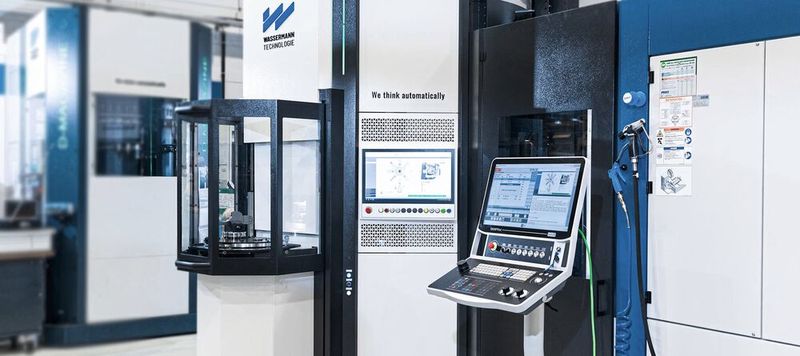
The Work-S terminals from Wassermann Technologie have been equipped with compact safety interlocks and an EtherCAT-capable Safety Fieldbox.
(Image: Wassermann Technologie GmbH)
Wassermann Technologie, based in Eichenzell near Fulda/Germany, offers a solution for retrofitting older machine tools with automated loading and unloading capabilities. Their Work-S series provides advanced storage and loading systems designed for clamping pallets, which seamlessly dock with the machine tool, enhancing efficiency and productivity.
Modular system automation of machine tools
About 25 years ago, Wassermann, then known as HPI, started developing tool changers and has since been supplying reputable OEMs such as DMG Mori, Index-Werke, and many more with tool magazines and entire tool change systems. The automation of machine tools has since become a distinct business area. Leading manufacturers of machine tools have included the terminals—as they are called at Wassermann—in their range, offering factory automation. Wassermann designs each terminal based on a modular system.
The user of a Work-S-Terminal can clamp the workpiece, weighing up to 800 kilograms, or several smaller workpieces, onto a clamping pallet at an integrated setup station. From there, the pallet is transported to the machining center, and all required job data (pallet, tools, clamping devices, NC program, etc.) are transferred via a data bus, and the pallet is processed accordingly. The connection of the terminal to common control systems such as Procam or Soflex ensures a continuous flow of information.
Once the processing is complete, the pallet can be automatically unloaded or temporarily stored in a one or up to six-level pallet storage. This enables the machine operator to run complete unmanned and weekend shifts. This applies not only to batch production but also to batch size one per workpiece.
Designers revise safety interlock
In the latest generation of Work-S stations, Wassermann's designers have revised the machine safety, starting with the level of safety switching devices. Michael Jestädt, Deputy Head of Design and Electrical at Wassermann Technologie, says, "The setup station is secured with a swiveling double door because a wide opening angle is needed for loading. Due to design and space constraints, the safety interlock was mounted at the bottom of the protective door, some distance from the door handles. This strains the structure, can lead to warping, and is also not ideal visually. Therefore, we looked for a better solution."
The safety interlock of the AZM40 series from Schmersal can be installed at the height of the door handles and in close proximity to them, without the handling of the pallets or the centering of the workpieces being affected by interference contours. Jestädt explains, "Now, the force when opening the protective door is applied exactly where the lock with the interlock is located."
Plug-and-play for safety bus technology
On this occasion, Wassermann also opted for an optimization at the level of safety-oriented signals. The Work-S systems are controlled via a Beckhoff Twincat3, and Schmersal offers an up-to-date version of the Safety Fieldbox for this purpose—with interfaces for Ethernet/IP and Ethercat. This opened the door for Wassermann to safety bus technology and to the flexible installation of safety switching devices according to the plug-and-play concept.
The Safety Fieldbox allows the on-site connection of up to eight safety switching devices. In addition to safety interlocks, sensors, and light curtains, operating panels and emergency stop buttons, for example, can also be easily integrated into the safety circuit simply by connecting the eight-pin M12 connector. An integrated digital input allows for the evaluation of diagnostic signals. Thus, non-safety-oriented signals are also collected and transmitted.
Quickly installed for flexible use
This type of connection brings practical benefits: The user saves costs because not every single device needs to be equipped with a bus interface. They gain flexibility because they can integrate various types of safety switching devices, and they also save time because the installation is simple. "The first time you might still have questions, but by the third time, all the safety components are installed very quickly," describes Jestädt. Additionally, with the Ethercat variant for the Beckhoff control, there is the advantage that remote maintenance can be easily implemented.
Safety Fieldbox for two machine tools
In a current project, Wassermann built a Work-S-300-4 terminal that allows the automated loading and unloading of two side-by-side machine tools. The same Safety Fieldbox is used as in the terminals for a single machine.
Date: 08.12.2025
Naturally, we always handle your personal data responsibly. Any personal data we receive from you is processed in accordance with applicable data protection legislation. For detailed information please see our privacy policy.
Consent to the use of data for promotional purposes
I hereby consent to Vogel Communications Group GmbH & Co. KG, Max-Planck-Str. 7-9, 97082 Würzburg including any affiliated companies according to §§ 15 et seq. AktG (hereafter: Vogel Communications Group) using my e-mail address to send editorial newsletters. A list of all affiliated companies can be found here
Newsletter content may include all products and services of any companies mentioned above, including for example specialist journals and books, events and fairs as well as event-related products and services, print and digital media offers and services such as additional (editorial) newsletters, raffles, lead campaigns, market research both online and offline, specialist webportals and e-learning offers. In case my personal telephone number has also been collected, it may be used for offers of aforementioned products, for services of the companies mentioned above, and market research purposes.
Additionally, my consent also includes the processing of my email address and telephone number for data matching for marketing purposes with select advertising partners such as LinkedIn, Google, and Meta. For this, Vogel Communications Group may transmit said data in hashed form to the advertising partners who then use said data to determine whether I am also a member of the mentioned advertising partner portals. Vogel Communications Group uses this feature for the purposes of re-targeting (up-selling, cross-selling, and customer loyalty), generating so-called look-alike audiences for acquisition of new customers, and as basis for exclusion for on-going advertising campaigns. Further information can be found in section “data matching for marketing purposes”.
In case I access protected data on Internet portals of Vogel Communications Group including any affiliated companies according to §§ 15 et seq. AktG, I need to provide further data in order to register for the access to such content. In return for this free access to editorial content, my data may be used in accordance with this consent for the purposes stated here. This does not apply to data matching for marketing purposes.
Right of revocation
I understand that I can revoke my consent at will. My revocation does not change the lawfulness of data processing that was conducted based on my consent leading up to my revocation. One option to declare my revocation is to use the contact form found at https://contact.vogel.de. In case I no longer wish to receive certain newsletters, I have subscribed to, I can also click on the unsubscribe link included at the end of a newsletter. Further information regarding my right of revocation and the implementation of it as well as the consequences of my revocation can be found in the data protection declaration, section editorial newsletter.
As part of the revision of the Work-S series, Wassermann also made a change at the safety level. Contrary sliding vertical doors are installed at the physical interface of the terminal to the machine or machines. They are usually open and are only closed during maintenance work on the terminal or the machine. Three safety sensors from the RSS36 series by Schmersal monitor the position of the protective doors and are also connected to the Safety Fieldbox.
Currently, Wassermann Technologie GmbH is working on additional terminal variants. A linear, rather than carousel-type, loading and unloading system has already been implemented, which can supply up to six machines via a robot. In addition to the workpiece change terminals, Wassermann also plans automated change systems for up to about 700 tools, which are also suitable for retrofitting on existing machines.



:quality(80)/p7i.vogel.de/wcms/a0/47/a04725ef9bd09fb6c9341a1bea1b5d93/0130443083v1.jpeg "Here, a type of plastic pallet is produced by thermoforming (vacuum forming or deep drawing) at the corresponding division of New England Plastics in the USA. This division, which specializes in so-called liners, is now part of Ringmetall ... (Image:New England Plastics)")
:quality(80)/p7i.vogel.de/wcms/23/99/23992bf2dcdc432c9b7209c34a4a7c48/0129733089v1.jpeg "Stork relies on the modular Neoswiss turning system from Iscar to shorten the set-up times for its sliding headstock lathes and work more productively. (Image:Iscar)")
:quality(80)/p7i.vogel.de/wcms/7d/e2/7de2923434b2f1a78ba5482d8d335269/0113143253v1.jpeg "In our China Market Insider we regularly provide you with relevant information directly from China. (Image:© Eisenhans - stock.adobe.com)")
:quality(80)/p7i.vogel.de/wcms/9d/2b/9d2b802f800e5caf17b2831e74228cd3/screenshot-202026-03-03-20103822-609x343v1v1.png "Visual comparison: on the left, a clean, burr-free cut edge; on the right, typical burr formation with oxidation discoloration. This illustrates how strongly parameter control and gas management influence the quality of the result. (CO₂ laser, oxygen cutting gas, sheet thickness approx. 15 mm). (Image:Picture: Rime)")
:quality(80)/p7i.vogel.de/wcms/b7/36/b736dfebc16c42d6901d0d0e1f390493/3d-druck-20factory-20--20ki-20generiert-1920x1079v1.png "(Source: AI-generated)")
:quality(80)/p7i.vogel.de/wcms/79/b2/79b21aad663f4a7bd4472afc1c1afc62/0130433994v1.jpeg "Mission Joyride: The free-flying robot (shown here in the rendering) will relieve the ISS crew of logistics tasks from 2027 with its two mechanical arms. (Image:Icarus Robotics)")
:quality(80)/p7i.vogel.de/wcms/6b/45/6b4546fa6ebf305c3660326909363f32/0130437089v1.jpeg "Industrial AI in action: Rockwell Automation presents practical solutions for self-controlling production systems at the Hannover Messe. (Image:Rainer Jensen, Deutsche Messe)")
:quality(80)/p7i.vogel.de/wcms/78/e9/78e9188c25a8a94e67c34c9bf8ffe495/visual-agile-20robots-20and-20google-20deepmind-20partner-20to-20bring-20intelligence-20to-20robotics-2500x1406v1v1.jpeg "Together, the partners are developing adaptable, intelligent robots for a wide range of applications (Image:Agile Robots SE)")
:quality(80)/p7i.vogel.de/wcms/59/a2/59a2b11f0aa1b700eff02addd5de8703/adobestock-1788280853--c2-a9-20satria-20-e2-80-93-20stock-adobe-com-5081x2860v1v1.jpeg "Quantum computers require extreme cooling to temperatures close to absolute zero in order to keep qubits stable. (Image:satria - stock.adobe.com)")
:quality(80)/p7i.vogel.de/wcms/49/38/493876a248943456b7e4a6db6edfc454/0130230765v1.jpeg "Safe and reliable in aircraft construction: light-curing adhesive bond combined with universal fastening elements. (Source: Delo)")
:quality(80)/p7i.vogel.de/wcms/b5/c7/b5c749d16c8a2e789c1469c2c8c1c387/0130452780v1.jpeg "Volvo Trucks completes road tests with its new hydrogen-powered trucks. (Image:Volvo Trucks)")
:quality(80)/p7i.vogel.de/wcms/ba/69/ba6975f417a85147084f38dc2cd209e2/0130451386v1.jpeg "Together with Nvidia, Hyundai wants to develop an architecture that will be used for level 4 robotaxis (image) as well as for level 2 customer vehicles. (Image:Hyundai)")
:quality(80)/p7i.vogel.de/wcms/93/4d/934de334b47abaa526c78cba1417d7af/0130343495v1.jpeg "The new SU7 is available in three price categories, \"Standard\", \"Pro\" and \"Max\" (Image:Xiaomi)")
:quality(80)/p7i.vogel.de/wcms/df/a0/dfa048434bb94f1b7d030e346b25b3ae/0130373541v1.jpeg "From August, BMW will be producing the i3 at its main plant in Munich - which the car manufacturer has extensively rebuilt for this purpose. (Image:Rainer Haeckl)")
:quality(80)/p7i.vogel.de/wcms/ee/09/ee09acbd6dc896df25affaa9e871e6e5/0130440053v1.jpeg "IMS chip module for simple system integration into an ion mobility spectrometer. (Image:Fraunhofer IPMS)")
:quality(80)/p7i.vogel.de/wcms/10/6c/106cd22de5f68a0f74639d654827228c/0130345302v1.jpeg "Made in India: According to the India Electronics and Semiconductor Association (IESA), the country should be able to produce between 75 and 80 million chips by the beginning of 2027, once the plants currently under construction become operational. (Image:Pixabay (Montage: Sebastian Gerstl))")
:quality(80)/p7i.vogel.de/wcms/a5/ed/a5ed6fda029d362732a293d6b19d74c4/0130444216v1.jpeg "Thirteen executives from the Chinese chip industry have drawn up a plan to achieve an 80% self-sufficiency rate for semiconductors by 2030. (Image:Maxim_Kazmin - stock.adobe.com)")
:quality(80)/p7i.vogel.de/wcms/31/a6/31a646018b34d8e0a44bfc8bf17837f6/0130361632v1.jpeg "For many companies, PFAS are considered indispensable in electronics production. (Image:freely licensed)")
:fill(fff,0)/images.vogel.de/vogelonline/companyimg/76800/76895/65.jpg "FAULHABER_120mm.jpg ()")
:fill(fff,0)/p7i.vogel.de/companies/69/88/69882c428938e/tmts2026-ticec-banner-en-2000px.png "tmts2026-ticec-banner-en-2000px (https://www.tmts.tw/en)")
:quality(80)/p7i.vogel.de/wcms/a5/fc/a5fcb8d00a3e77a059396c893a43eeb5/0119510941v1.jpeg "The safety interlock AZM40 can be mounted at the height of the door handles.(Image: Schmersal)")
:quality(80)/p7i.vogel.de/wcms/98/48/9848f9f9edad59683123308be1ef7bcf/0119489475v1.jpeg "Three safety sensors from the RSS36 series monitor the position of the side protective door(s) on the terminals.(Image: Schmersal)")
:quality(80)/p7i.vogel.de/wcms/33/30/3330eaa16dda1464f8099ae65bf12079/0119489481v1.jpeg "The Safety Fieldbox allows for the integration of various safety switching devices into the safety circuit via plug-and-play.(Image: Schmersal)")
:quality(80)/p7i.vogel.de/wcms/61/b4/61b4d40f67501b5e0e3ad2525d076494/0119489469v1.jpeg "Michael Jestädt, Deputy Head of Design & Electrical at Wassermann Technologie (left), and Schmersal sales representative Andreas Rönnig.(Image: Schmersal)")
:quality(80)/p7i.vogel.de/wcms/28/75/28751a17e2bcca46e53a1e7b8a84c433/schmersal-tiepner-029-6749x3796v1v1.jpeg "Tiepner's compact system produces ID cards made of laminated plastic, which are used as customer cards, ID cards or cheque cards, among other things. Left in the picture: Christian Höltge, Managing Director of Tiepner GmbH. (Image:Tiepner GmbH)")
:quality(80)/p7i.vogel.de/wcms/8b/c7/8bc7380a7e8dc5dcb9d7337383e93e46/0127912129v1.jpeg "For the second machining step, the thin-walled component is moved into the gap between the inner and outer tool. (Image:Mapal)")