Digital modeling and simulation of batteries in the development of battery management systems enable faster development cycles, lower costs, and the realization of safe, efficient electric vehicles.
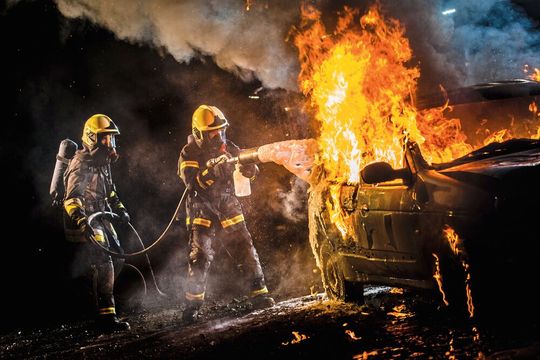
Thermal runaway is the dreaded exothermic reaction where the battery becomes nearly impossible to extinguish. BMS prevent this reaction.
(Image: MathWorks)
In electric vehicles (EV), safety is the top priority. Due to the high energy density of lithium-ion batteries, which are typically used in electric vehicles, there is a risk of failure if the operating conditions differ from those for which the battery is designed. A battery management system (BMS) is therefore essential to avoid critical incidents. These include thermal runaway—an uncontrolled exothermic reaction that can lead to the destruction of the battery.
The main functions of a BMS include
the monitoring of current, voltage, and temperature,
the prevention of overcharging and overdischarging,
the charge balancing between battery cells,
the estimation of the state of charge (SOC) and state of health (SOH) of the battery, as well as
the control of the battery pack's temperature.
These functions are of crucial importance as they affect the performance, safety, battery lifespan, and user experience of the electric vehicle. By preventing overcharging and discharging beyond the voltage limits, the BMS prevents premature aging of the battery. This ensures the vehicle remains efficient throughout its operational life.
Advantages of Simulation in BMS Development
The developers simulate the battery system model, the environment, and the BMS algorithms on a desktop computer using behavioral models. They use these desktop simulations to explore new design ideas and test different system architectures before deciding on a hardware prototype. Additionally, the developers use the desktop simulation to verify functional aspects of the BMS design.
For example, they can test different balancing configurations to evaluate their suitability as well as their advantages and disadvantages. Such a simulation also proves to be a valuable tool for requirements testing. For instance, developers can verify the correct behavior of a contactor in the event of an insulation fault. Analyzing system behavior in fault scenarios is another illustrative example of how simulations can effectively replace hardware tests.
Once the design of the BMS has been validated using the desktop simulation, C or HDL code is automatically generated for rapid prototyping (RP) or hardware-in-the-loop (HIL) tests to further validate the BMS algorithms executed as code in real-time. With RP, code is generated from the BMS algorithm model and executed on a real-time computer that simulates the functions of the final production microcontroller.
Thanks to automatic code generation, algorithm changes made in the model can be verified on real-time hardware within a few hours instead of several days. In HIL testing, the code is generated from the battery system models and not from the BMS algorithm models. This creates a virtual real-time environment that represents the battery pack, active and passive circuit elements, loads, the charger, and other system components. This virtual environment allows developers to validate the functionality of the BMS controller in real-time before developing a hardware prototype.
Simulation can significantly shorten the time from design to code generation and allows technical applications to be tested faster and more efficiently. For example, experts at Altigreen Propulsion Labs used a simulation-based approach to model and iteratively test various methods for SOC estimation, such as Kalman filtering and Coulomb counting. According to Prathamesh Patki, Principal Engineer and Control Systems Head at Altigreen, the MathWorks Embedded Coder halved the development time. "Whatever we design, we can get it running on the real hardware in the shortest possible time."
Use Cases for Modeling and Simulation in BMS Development
Cell characterization refers to the adaptation of a battery model to experimental data. Precise cell characterization is important because the BMS algorithm uses the battery model to set control parameters, such as Kalman filter values for SOC estimation or power limits depending on SOC and temperature, to avoid under- or over-voltage conditions. Later in the BMS development phase, the same battery model is used for closed-loop desktop and real-time simulations at the system level. Tools like Simscape Battery offer various approaches to battery modeling, including equivalent circuit, electrochemical modeling, and reduced-order modeling using neural networks.
Charging speed is also an important performance indicator in the development and deployment of electric vehicles. The high energy amounts during fast charging strain the battery materials and shorten their lifespan. Therefore, it is important to optimize the performance profile during fast charging to ensure a maximum charging rate and minimal stress on the battery. Simulation and optimization are combined for this purpose. This minimizes the charging time while keeping stress factors within an acceptable range.
Date: 08.12.2025
Naturally, we always handle your personal data responsibly. Any personal data we receive from you is processed in accordance with applicable data protection legislation. For detailed information please see our privacy policy.
Consent to the use of data for promotional purposes
I hereby consent to Vogel Communications Group GmbH & Co. KG, Max-Planck-Str. 7-9, 97082 Würzburg including any affiliated companies according to §§ 15 et seq. AktG (hereafter: Vogel Communications Group) using my e-mail address to send editorial newsletters. A list of all affiliated companies can be found here
Newsletter content may include all products and services of any companies mentioned above, including for example specialist journals and books, events and fairs as well as event-related products and services, print and digital media offers and services such as additional (editorial) newsletters, raffles, lead campaigns, market research both online and offline, specialist webportals and e-learning offers. In case my personal telephone number has also been collected, it may be used for offers of aforementioned products, for services of the companies mentioned above, and market research purposes.
Additionally, my consent also includes the processing of my email address and telephone number for data matching for marketing purposes with select advertising partners such as LinkedIn, Google, and Meta. For this, Vogel Communications Group may transmit said data in hashed form to the advertising partners who then use said data to determine whether I am also a member of the mentioned advertising partner portals. Vogel Communications Group uses this feature for the purposes of re-targeting (up-selling, cross-selling, and customer loyalty), generating so-called look-alike audiences for acquisition of new customers, and as basis for exclusion for on-going advertising campaigns. Further information can be found in section “data matching for marketing purposes”.
In case I access protected data on Internet portals of Vogel Communications Group including any affiliated companies according to §§ 15 et seq. AktG, I need to provide further data in order to register for the access to such content. In return for this free access to editorial content, my data may be used in accordance with this consent for the purposes stated here. This does not apply to data matching for marketing purposes.
Right of revocation
I understand that I can revoke my consent at will. My revocation does not change the lawfulness of data processing that was conducted based on my consent leading up to my revocation. One option to declare my revocation is to use the contact form found at https://contact.vogel.de. In case I no longer wish to receive certain newsletters, I have subscribed to, I can also click on the unsubscribe link included at the end of a newsletter. Further information regarding my right of revocation and the implementation of it as well as the consequences of my revocation can be found in the data protection declaration, section editorial newsletter.
The generation of production code complements BMS design workflows that comply with the formal certification standards of the automotive industry. For example, when LG Chem (now LG Energy Solution) developed the BMS for the plug-in hybrid Volvo XC90, AUTOSAR was a required standard. LG Chem chose to model and simulate the BMS algorithms and behaviors as an integral part of its design workflow.
The number of software issues identified in each software version reduced from around 22 to less than 9, significantly below the project's target value. The AUTOSAR-developed BMS for Volvo by LG Chem subsequently received ISO 26262 certification for functional safety according to Automotive Safety Integrity Level C (ASIL C).
Modeling and simulation in BMS design enable faster development cycles, lower costs, and the realization of safer, more efficient electric vehicles. By testing BMS algorithms under all possible operating and fault conditions, developers can rely on the BMS software to handle these situations in the real system. This reduces the need for costly testing. The approach ensures that the final product not only meets industry standards but also exceeds consumer expectations. (st)



:quality(80)/p7i.vogel.de/wcms/2c/d6/2cd65bff6624dbdc007f2315307612fe/0130800023v1.jpeg "An international consortium led by Tata Steel Nederland has made significant progress in the development of new zinc-coated ultra-strong steels. (Image:Tata Steel)")
:quality(80)/p7i.vogel.de/wcms/f0/e0/f0e05856a96a9afa991a8dd9f4aceb04/0131242862v1.jpeg "Humanoid robots are the focus of the \"TUM RoboGym (powered by Neura)\". (Image:Neura Robotics)")
:quality(80)/p7i.vogel.de/wcms/c3/be/c3be858b644b6f52c83ea025a6f596ad/0130477152v1.jpeg "With the \"DUO\" version of the \"POWER-Skate XL\", loads can be moved in all directions. (Image:HTS)")
:quality(80)/p7i.vogel.de/wcms/92/87/9287ce9327245bdcd01af627044b34c8/0131221372v1.jpeg "Here, Binder provides information on a standardized portfolio and, above all, on improvements for the assembly of M12 connectors, which are now easier to handle and even safer ... (Image:Binder)")
:quality(80)/p7i.vogel.de/wcms/fc/5c/fc5c314369136a0f2b4819ca4011ce80/0131048280v1.jpeg "It all depends on the overall IO-Link package. If the interaction between sensors, powerful masters and a manufacturer-independent configuration tool is right, a significant increase in machine performance is possible. (Image:Baumer)")
:quality(80)/p7i.vogel.de/wcms/69/a2/69a26de87302feccb0ad51bc5eefae4d/0131155056v1.jpeg "Quantum Mate with integrated cobot takes over manual, repetitive tasks in an automated, reliable and efficient process. (Image:Galdabini)")
:quality(80)/p7i.vogel.de/wcms/72/54/7254c0031573057a049e5879cba0de85/0130912407v1.jpeg "The serial interface still has its legitimacy in the age of Industry 4.0: it is still used, for example, to connect peripheral devices such as scanners. (Picture: ©Guy - stock.adobe.com)")
:quality(80)/p7i.vogel.de/wcms/c1/70/c170fd5c52c08ceb4bc2b58eb94ea95f/newsimage421365-2048x1151v1v1.jpeg "Diving robot from TU Bergakademie Freiberg before its first dive at the Malter dam (Image:Andreas Hiekel/TUBAF)")
:quality(80)/p7i.vogel.de/wcms/30/76/3076278d4a7b51a5c566581a20135afc/54963580015-cdcb4657c5-k-2047x1151v1v1.jpeg "The Nancy Grace Roman space telescope was completed in the largest clean room at NASA's Goddard Space Flight Center. It is due to be launched into space in September 2026. (Image:NASA/Jolearra Tshiteya / CC BY 4.0)")
:quality(80)/p7i.vogel.de/wcms/3a/08/3a08d5a0623b4d32294e8108d639f237/nivalon-20medical-20-1626x914v1v1.png "EvoFlex implant from Nivalon Medical consists of a bone-like ZTA ceramic that is precisely adapted to the anatomy of each patient. (Image:Nivalon)")
:quality(80)/p7i.vogel.de/wcms/55/93/55936485100842cd9e83fa3ec053e9c1/2-995x560v1v1.png "The research team at the Technical University of Munich measures and controls the tendon forces on the robot. The aim of the research project is to develop new control concepts. (Image:TU Munich)")
:quality(80)/p7i.vogel.de/wcms/c2/df/c2df275b52afda5130ec90662fc767af/adobestock-1858604981--c2-a9-20vladyslav-20andrukhiv-20-e2-80-93-20stock-adobe-com-ki-generiertv1.jpeg "Artificial sun on earth: Start-ups in China are working to accelerate the development of the virtually inexhaustible energy source of nuclear fusion with AI. (Source: © Vladyslav Andrukhiv - stock.adobe.com/AI-generated)")
:quality(80)/p7i.vogel.de/wcms/2c/1f/2c1fb590b96de7ca3ca029564b063865/0131218954v1.jpeg "Xpeng brings the X9 to Germany. (Picture:Xpeng)")
:quality(80)/p7i.vogel.de/wcms/94/6b/946b136b4478d8b80e3d9e62041e7274/0131259520v1.jpeg "The Craft test bench in Berlin is used to develop future propulsion systems for sustainable aviation. The aim is to minimize noise while maintaining the efficiency of aircraft engines. (Image:DLR)")
:quality(80)/p7i.vogel.de/wcms/5a/14/5a14b26a5d4495d3a192e90e5c216251/ai-catl-sodium-batteries-vs-lithium-revolution-1800x1012v1v1.jpeg "The supplier CATL is bringing its first sodium-ion batteries into series production. Although not in the automotive industry, this step is set to follow soon. (Image:CATL)")
:quality(80)/p7i.vogel.de/wcms/68/43/68433001d98374eb72f51b4a7db590fe/0131229290v1.jpeg "Charging infrastructure provider Evoltra will operate as Citywatt Development in the future. (Image:Citywatt)")
:quality(80)/p7i.vogel.de/wcms/98/11/981107e7d149b2ff970c574cdd73f158/0131183152v1.jpeg "An optical phased array (OPA) counteracts strong optical crosstalk. For this purpose, the antenna geometry is arranged asymmetrically. (Image:Amy Pan / MIT)")
:quality(80)/p7i.vogel.de/wcms/a3/2e/a32e8b8bb38bd5c1cfd27b043baf72b7/0131203375v1.jpeg "Alliance for the AI age: Sony and TSMC join forces to produce next-generation smart image sensors (Image:Brunox983/Pixabay)")
:quality(80)/p7i.vogel.de/wcms/f9/5d/f95d24afa8d7ffb2c27916d0f329c670/0131192604v1.jpeg "Symbolic image: Kontron has a positive outlook for 2026, but must restructure. (Image:AI-generated)")
:quality(80)/p7i.vogel.de/wcms/c7/6b/c76b7659a76e1dd6e9b007340a12c70b/0131171547v1.jpeg "Circular economy in practice: in future, automated systems will save intact battery cells for reuse. (Image:Rainer Betz/Fraunhofer IPA)")
:fill(fff,0)/p7i.vogel.de/companies/69/de/69de1b7403b0d/simtos-logo.jpeg "simtos-logo (SIMTOS)")
:quality(80):fill(efefef,0)/p7i.vogel.de/wcms/67/ad/67adf4a647532/elatec-wp-machine-authentication.png "Elatec WP Machine Authentication")
:quality(80)/p7i.vogel.de/wcms/ae/ef/aeefd454917c2812921ef0ec7a698c0b/0129906834v1.jpeg "NXP has developed a method of bringing laboratory-quality battery cell diagnostics directly into electric vehicles. (Image:NXP)")
:quality(80)/p7i.vogel.de/wcms/87/f6/87f6edf2c7f287df294328c0b002617d/0129467191v1.jpeg "Jörg Grotendorst has been advising the management of HTEC in Belgrade, Serbia, since April 2025. (Image:HTEC)")