Even under the most adverse conditions such as extreme cold, intense heat, or high mechanical stress, cables must reliably transport energy, data, and signals. Specially developed plastics ensure this by making the cables robust and durable. In Bhopal, India, Lapp now produces specially formulated plastic compounds.
The properties of cables, such as flame resistance, tensile strength, or heat resistance, are largely determined by the chemical composition of the plastic sheath. Therefore, many applications require custom-made compounds precisely tailored to specific requirements.
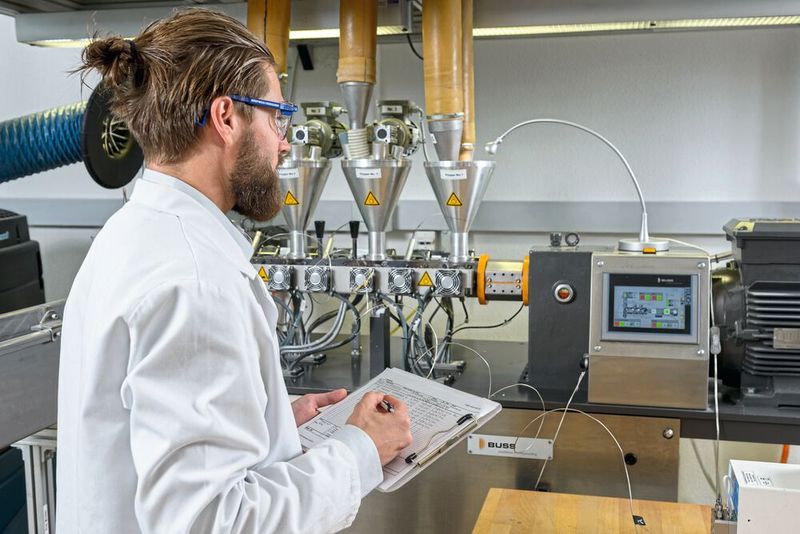
(Image: Lapp)
The development and production of plastic mixtures, known as compounds, are complex processes that require specialized expertise. In modern cable production, not only the construction, shielding, or stranding of the wires play a crucial role—but also the choice of the appropriate coating is of great importance. Properties such as flame resistance, tensile strength, or heat resistance are significantly determined by the chemical composition of the plastic sheath. Many applications therefore require custom-made compounds precisely tailored to specific requirements.
Complex Development Process
It is not about simply mixing materials, but rather a complex and precisely coordinated development process. "A compound is a very complex product," explains Pascal Wolfer, a PhD material scientist at Swiss Lapp Engineering AG, who is responsible for compound development along with two other colleagues. "They contain up to 20 individual components. For a custom requirement, we usually test between six and ten formulations per development loop." When a customer approaches Lapp with a requirement, a team of experts develops various formulations based on the application's specifications.
The iterative process includes several steps, from the analysis of specifications to the formulation development, sample extrusion, and subsequent production of a cable prototype. The development loop is typically repeated several times until all requirements for the compound are met. "We need around two to six months per loop," Wolfer explains. He is also part of the expert team comprising colleagues from Germany, Switzerland, India, and Korea, who are intensely focused on the topic of compound development and production. The goal: to increase Lapp's competitiveness.
Cost Reduction And More Independence
"Increasing competitiveness works easiest the deeper you delve into your own value chain," explains Matthias Lapp, CEO of the Lapp Group. The solution: an in-house compounding facility in India. "For a solution provider like us, taking the step to engage in compound manufacturing is logical. This way, we are not dependent on suppliers and can also position ourselves as market leaders," Lapp explains the strategic decision. And it works: With the help of their own production facility, the costs for compounds can be reduced by five to twenty percent compared to purchasing from external suppliers. This, in turn, pays off for the customers.
We can now precisely determine how the plastics should be composed and decide on the exact mixtures for our products ourselves.
Matthias Lapp, CEO of the Lapp Group
Good Reasons for India
But why India as a location for compound manufacturing? There are several reasons for this: Around 50 percent of the products currently produced in the connection specialist's factories in Bhopal and Bangalore are tailored to the Indian market and meet local standards, especially regarding price structure and technical features. "The regulations for cables and plastics are very high in India, so it is primarily about solutions for very specific requirements, for example, for Indian rail transport," explains Matthias Lapp.
For this, plastics are needed that meet certain requirements, but the number of suppliers in this area is low. They would have to be transported by the manufacturers to India and through the tariffs of the individual Asian countries. The consequence: dependencies on suppliers and long transport routes with significant CO2 emissions. "Therefore, we decided to establish our own compounding facility, with which we can develop and manufacture materials in India and for India," says Matthias Lapp, adding, "And this has yet another crucial advantage: We can now precisely determine how the plastics should be composed and decide on the tailor-made mixtures for our products ourselves." The raw materials for the compounds are preferably purchased in India. The formulations are commissioned by the Indian subsidiary from the Swiss colleagues at Lapp Engineering AG. Once the experts in Switzerland have successfully completed the iterative process, production to measure begins at the Indian plant.
A decisive factor here was our patient approach to the country and its culture. India works differently from Germany and Europe. We recognized and embraced the pace at which business develops here. This has definitely contributed to our success.
Matthias Lapp, CEO of the Lapp Group
Further Expand Strong Position in India
But that is not the only reason for the choice of location. The leading provider of integrated solutions and brand products in the field of cable and connection technology has been present in the Indian market since 1998. While other companies focused exclusively on China for years, Lapp established close relationships early on with what has become the most populous country in the world—and this decision proved to be spot on. India not only has one of the largest and fastest-growing populations in the world, but its economy has also experienced steady growth over the past decades. Accordingly, the country boasts a large number of well-educated specialists and talents, increasingly better infrastructure, and a growing middle class.
Date: 08.12.2025
Naturally, we always handle your personal data responsibly. Any personal data we receive from you is processed in accordance with applicable data protection legislation. For detailed information please see our privacy policy.
Consent to the use of data for promotional purposes
I hereby consent to Vogel Communications Group GmbH & Co. KG, Max-Planck-Str. 7-9, 97082 Würzburg including any affiliated companies according to §§ 15 et seq. AktG (hereafter: Vogel Communications Group) using my e-mail address to send editorial newsletters. A list of all affiliated companies can be found here
Newsletter content may include all products and services of any companies mentioned above, including for example specialist journals and books, events and fairs as well as event-related products and services, print and digital media offers and services such as additional (editorial) newsletters, raffles, lead campaigns, market research both online and offline, specialist webportals and e-learning offers. In case my personal telephone number has also been collected, it may be used for offers of aforementioned products, for services of the companies mentioned above, and market research purposes.
Additionally, my consent also includes the processing of my email address and telephone number for data matching for marketing purposes with select advertising partners such as LinkedIn, Google, and Meta. For this, Vogel Communications Group may transmit said data in hashed form to the advertising partners who then use said data to determine whether I am also a member of the mentioned advertising partner portals. Vogel Communications Group uses this feature for the purposes of re-targeting (up-selling, cross-selling, and customer loyalty), generating so-called look-alike audiences for acquisition of new customers, and as basis for exclusion for on-going advertising campaigns. Further information can be found in section “data matching for marketing purposes”.
In case I access protected data on Internet portals of Vogel Communications Group including any affiliated companies according to §§ 15 et seq. AktG, I need to provide further data in order to register for the access to such content. In return for this free access to editorial content, my data may be used in accordance with this consent for the purposes stated here. This does not apply to data matching for marketing purposes.
Right of revocation
I understand that I can revoke my consent at will. My revocation does not change the lawfulness of data processing that was conducted based on my consent leading up to my revocation. One option to declare my revocation is to use the contact form found at https://contact.vogel.de. In case I no longer wish to receive certain newsletters, I have subscribed to, I can also click on the unsubscribe link included at the end of a newsletter. Further information regarding my right of revocation and the implementation of it as well as the consequences of my revocation can be found in the data protection declaration, section editorial newsletter.
While new market entrants in India still struggle with entry barriers, the connection specialist is already established here and has literally grown with the Indian development. "Key to this was our patient approach to the country and its culture," says Matthias Lapp. "India operates differently from Germany and Europe. We acknowledged the pace at which business develops here and embraced it. This has definitely contributed to our success." The company intends to further expand its strong position in India and is investing massively in the region and the Indian market as part of its corporate strategy.
Accordingly, the new production facility in Bhopal covers a total of 36,000 square meters. Equipped with the latest technologies, including an automated dosing system, large-scale production can take place here. "We are proud of our team in India and their commitment to innovations at Lapp," praised Matthias Lapp during the inauguration of the plant in the spring of 2024, commending the collective effort of the employees of the national subsidiary.
Focus on PVC And Special Compounds
The facility focuses on the plastic polyvinyl chloride, or PVC, which is particularly often used for cable insulation and sheathing. PVC is an excellent insulator for electrical cables, protecting against short circuits and electric shocks. Additionally, it can withstand high temperatures and is resistant to many chemicals, oils, and solvents. As a naturally flame-retardant plastic, the especially durable PVC reduces the risk of cable fires. For customers in mechanical engineering and industry, it is therefore often the first choice. Accordingly, two of the three production lines in the newly opened plant are designed for this popular plastic.
Additionally, at the site, the Indian colleagues produce specialty compounds for custom solutions on a third production line. Innovative blends with unique properties are created for various applications, allowing Lapp to stay one step ahead of the competition and swiftly meet new market demands or standards. This is particularly important for customers who need to meet high legal or regulatory requirements from industries with stringent safety and quality standards, such as aerospace or medical technology. For the company itself, this means primarily being able to offer consistently high product quality and ensuring efficient use of raw materials—without relying on the quality of an external supplier. Approximately 13,000 tons of plastic per year are currently produced in-house. The capacity is expected to progressively increase in the coming years.
All of this works particularly well through the great collaboration between Lapp's national companies and the colleagues dedicated to this project.
Pascal Wolfer, PhD in materials science from the Swiss company Lapp Engineering AG
Intensively Coordinated Collaboration
Pascal Wolfer has developed a great passion for the development and production of compounds at the connection specialist. He says, "All of this works primarily through the excellent collaboration between Lapp's national subsidiaries and the colleagues dedicated to this project." The collaboration is intensively coordinated and ranges from formulation development to the analysis of compounding equipment and the refinement of manufacturing processes. For this purpose, he has already visited the production facility in India several times, while an Indian colleague has, in turn, supported the Swiss development team on site.



:quality(80)/p7i.vogel.de/wcms/a0/47/a04725ef9bd09fb6c9341a1bea1b5d93/0130443083v1.jpeg "Here, a type of plastic pallet is produced by thermoforming (vacuum forming or deep drawing) at the corresponding division of New England Plastics in the USA. This division, which specializes in so-called liners, is now part of Ringmetall ... (Image:New England Plastics)")
:quality(80)/p7i.vogel.de/wcms/23/99/23992bf2dcdc432c9b7209c34a4a7c48/0129733089v1.jpeg "Stork relies on the modular Neoswiss turning system from Iscar to shorten the set-up times for its sliding headstock lathes and work more productively. (Image:Iscar)")
:quality(80)/p7i.vogel.de/wcms/7d/e2/7de2923434b2f1a78ba5482d8d335269/0113143253v1.jpeg "In our China Market Insider we regularly provide you with relevant information directly from China. (Image:© Eisenhans - stock.adobe.com)")
:quality(80)/p7i.vogel.de/wcms/9d/2b/9d2b802f800e5caf17b2831e74228cd3/screenshot-202026-03-03-20103822-609x343v1v1.png "Visual comparison: on the left, a clean, burr-free cut edge; on the right, typical burr formation with oxidation discoloration. This illustrates how strongly parameter control and gas management influence the quality of the result. (CO₂ laser, oxygen cutting gas, sheet thickness approx. 15 mm). (Image:Picture: Rime)")
:quality(80)/p7i.vogel.de/wcms/b7/36/b736dfebc16c42d6901d0d0e1f390493/3d-druck-20factory-20--20ki-20generiert-1920x1079v1.png "(Source: AI-generated)")
:quality(80)/p7i.vogel.de/wcms/79/b2/79b21aad663f4a7bd4472afc1c1afc62/0130433994v1.jpeg "Mission Joyride: The free-flying robot (shown here in the rendering) will relieve the ISS crew of logistics tasks from 2027 with its two mechanical arms. (Image:Icarus Robotics)")
:quality(80)/p7i.vogel.de/wcms/6b/45/6b4546fa6ebf305c3660326909363f32/0130437089v1.jpeg "Industrial AI in action: Rockwell Automation presents practical solutions for self-controlling production systems at the Hannover Messe. (Image:Rainer Jensen, Deutsche Messe)")
:quality(80)/p7i.vogel.de/wcms/78/e9/78e9188c25a8a94e67c34c9bf8ffe495/visual-agile-20robots-20and-20google-20deepmind-20partner-20to-20bring-20intelligence-20to-20robotics-2500x1406v1v1.jpeg "Together, the partners are developing adaptable, intelligent robots for a wide range of applications (Image:Agile Robots SE)")
:quality(80)/p7i.vogel.de/wcms/59/a2/59a2b11f0aa1b700eff02addd5de8703/adobestock-1788280853--c2-a9-20satria-20-e2-80-93-20stock-adobe-com-5081x2860v1v1.jpeg "Quantum computers require extreme cooling to temperatures close to absolute zero in order to keep qubits stable. (Image:satria - stock.adobe.com)")
:quality(80)/p7i.vogel.de/wcms/49/38/493876a248943456b7e4a6db6edfc454/0130230765v1.jpeg "Safe and reliable in aircraft construction: light-curing adhesive bond combined with universal fastening elements. (Source: Delo)")
:quality(80)/p7i.vogel.de/wcms/b5/c7/b5c749d16c8a2e789c1469c2c8c1c387/0130452780v1.jpeg "Volvo Trucks completes road tests with its new hydrogen-powered trucks. (Image:Volvo Trucks)")
:quality(80)/p7i.vogel.de/wcms/ba/69/ba6975f417a85147084f38dc2cd209e2/0130451386v1.jpeg "Together with Nvidia, Hyundai wants to develop an architecture that will be used for level 4 robotaxis (image) as well as for level 2 customer vehicles. (Image:Hyundai)")
:quality(80)/p7i.vogel.de/wcms/93/4d/934de334b47abaa526c78cba1417d7af/0130343495v1.jpeg "The new SU7 is available in three price categories, \"Standard\", \"Pro\" and \"Max\" (Image:Xiaomi)")
:quality(80)/p7i.vogel.de/wcms/df/a0/dfa048434bb94f1b7d030e346b25b3ae/0130373541v1.jpeg "From August, BMW will be producing the i3 at its main plant in Munich - which the car manufacturer has extensively rebuilt for this purpose. (Image:Rainer Haeckl)")
:quality(80)/p7i.vogel.de/wcms/ee/09/ee09acbd6dc896df25affaa9e871e6e5/0130440053v1.jpeg "IMS chip module for simple system integration into an ion mobility spectrometer. (Image:Fraunhofer IPMS)")
:quality(80)/p7i.vogel.de/wcms/10/6c/106cd22de5f68a0f74639d654827228c/0130345302v1.jpeg "Made in India: According to the India Electronics and Semiconductor Association (IESA), the country should be able to produce between 75 and 80 million chips by the beginning of 2027, once the plants currently under construction become operational. (Image:Pixabay (Montage: Sebastian Gerstl))")
:quality(80)/p7i.vogel.de/wcms/a5/ed/a5ed6fda029d362732a293d6b19d74c4/0130444216v1.jpeg "Thirteen executives from the Chinese chip industry have drawn up a plan to achieve an 80% self-sufficiency rate for semiconductors by 2030. (Image:Maxim_Kazmin - stock.adobe.com)")
:quality(80)/p7i.vogel.de/wcms/31/a6/31a646018b34d8e0a44bfc8bf17837f6/0130361632v1.jpeg "For many companies, PFAS are considered indispensable in electronics production. (Image:freely licensed)")
:fill(fff,0)/images.vogel.de/vogelonline/companyimg/76800/76895/65.jpg "FAULHABER_120mm.jpg ()")
:quality(80)/p7i.vogel.de/wcms/1a/53/1a53cc38b34b9a32444c7ede044e76a4/0124368441v1.jpeg "With Modbus Cloud Connect from Grandcentrix, all devices running Modbus RTU can connect with the cloud via cellular-based IoT. (Image:Grandcentrix)")
:quality(80)/p7i.vogel.de/wcms/4c/35/4c35476c967e66d3b5fe191c74cb7ee8/0124241260v1.jpeg "The image shows the Lapp Helix charging cable (left) and the Mobility Dock (right) at a Lapp trade show booth. (Image:Lapp)")
:quality(80)/p7i.vogel.de/wcms/4e/85/4e858d1ecec06dab411fa4e31501d5a8/0127057552v1.jpeg "Lapp offers Single Pair Ethernet cables for fixed and flexible applications, as well as long distances, along with specially designed cables for Ethernet-APL. (Image:LAPP)")