Can used EV batteries be efficiently and safely reused? Upcycling has faced technical and economic challenges, but researchers now offer a ready-to-use solution with AI and high-speed measurement technology.
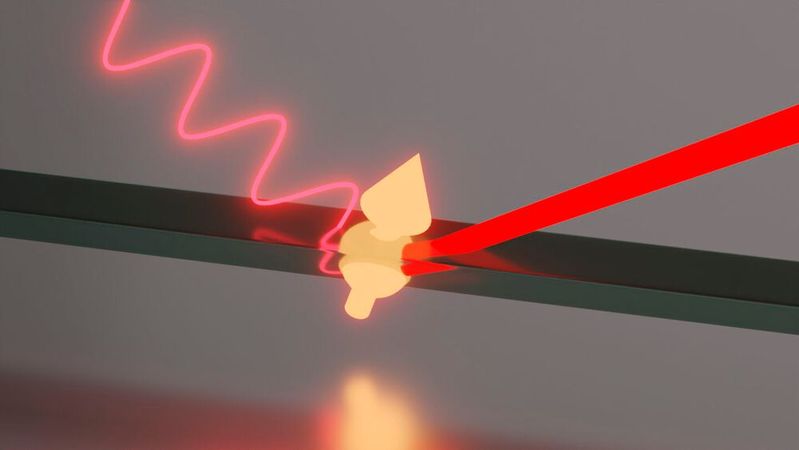
Spin-based quantum magnetic field sensor in a measuring process. The sensor is optically excited to start the magnetic field measurement. The information from the measured signal is encoded by the emission, forwarded and visualized in the form of magnetic field mappings.
(Image: Friedrich-Alexander-University Erlangen-Nuremberg/Prof. Roland Nagy)
To enhance the sustainability of electromobility and optimize resource use, upcycling lithium-ion batteries is gaining importance. Rather than immediately recycling used EV batteries, repurposing them in new applications can extend material cycles and conserve resources. However, technical and economic challenges have hindered widespread adoption. The "QuaLiProM" research project, funded by the German Federal Ministry of Education and Research (BMBF), aims to overcome these barriers. An interdisciplinary team is developing a fast, non-destructive, and reliable method to assess the residual capacity and lifespan of used lithium-ion batteries, enabling their safe and economically viable second use.
How healthy is a battery?
Lithium-ion batteries age both during storage and in operation. This becomes noticeable through a loss of capacity and an increase in internal resistance. As a result, energy and performance decrease continuously. The state of health of a battery is usually defined by the State-of-Health (SoH), which describes the age-related change in the state of a cell in relation to its original state. Determining the SoH is a key factor in assessing the performance and service life of batteries.
The SoH of batteries can be determined using various experimental methods. Electrochemical measurements such as capacity tests, electrochemical impedance spectroscopy or service life tests can be used to determine the available residual capacity or the internal resistance of aged cells, for example. However, these are not very meaningful without reference to the initial values of the cells in new condition. Furthermore, electrochemical characterization requires electrical contacting of the cells and is therefore not suitable for rapid diagnostics. In addition, this type of testing only provides information on the global condition of the cell, while defects or charge hotspots cannot be clearly identified
Quantum magnetometry is considered promising
In contrast to the experimental methods previously used for quality control or residual value analysis of lithium-ion cells, quantum magnetometry enables the health status of battery cells to be determined quickly, cost-effectively and precisely. In the field of battery research, it has already been demonstrated that this method can be used to precisely determine the condition-dependent magnetization of a battery cell. In particular, it has been shown that defects, impurities and the state of charge can be detected using quantum sensors. Based on these promising results, a high-speed measurement method based on quantum magnetometry and artificial intelligence is being used as part of the "QuaLiProM project". This will allow battery cells to be classified according to their state of health in industrial applications.
Precisely determine battery condition with rapid test methodology
To develop the rapid test methodology, lithium-ion cells are subjected to forced degradation in the "QuaLiProM project" using cyclic ageing tests. The analysis of the electrochemical measurement data forms the initial data basis for identifying dominant ageing mechanisms. The data is recorded and evaluated. This allows precise conclusions to be drawn about the condition and remaining performance of the cells.
The battery cells that have been transferred to defined ageing states using the ageing tests are then examined using quantum magnetics. The quantum sensor measures the magnetic field of the cells with high precision by observing the spin of a special defect in a diamond, which emits different numbers of light particles depending on the magnetic field. In this way, magnetic field mappings are generated that provide valuable information about possible anomalies in the battery cells. This non-destructive method does not require time-consuming charging and discharging cycles and is therefore suitable for use in cell production as well as in the recycling or upcycling process. The upcoming transfer of the methodology from the laboratory level to the industrial scale is one of the main objectives of the project.
Promoting the sustainable and resource-efficient use of battery cells
For the AI-based analysis of the magnetic field mappings, innovative deep learning methods are used to identify characteristic features, so-called healthy features, which show a clear correlation to the ageing state of the cells. These features are used to classify cells according to their state of health, e.g. healthy, degraded or defective. In this way, degraded but still functional cells that are no longer suitable for use in electric vehicles due to insufficient capacity can be identified. By developing suitable upcycling strategies and researching new second-life applications in less demanding areas, the project aims to promote the sustainable and resource-efficient use of battery cells and accelerate their transfer to industry.
Date: 08.12.2025
Naturally, we always handle your personal data responsibly. Any personal data we receive from you is processed in accordance with applicable data protection legislation. For detailed information please see our privacy policy.
Consent to the use of data for promotional purposes
I hereby consent to Vogel Communications Group GmbH & Co. KG, Max-Planck-Str. 7-9, 97082 Würzburg including any affiliated companies according to §§ 15 et seq. AktG (hereafter: Vogel Communications Group) using my e-mail address to send editorial newsletters. A list of all affiliated companies can be found here
Newsletter content may include all products and services of any companies mentioned above, including for example specialist journals and books, events and fairs as well as event-related products and services, print and digital media offers and services such as additional (editorial) newsletters, raffles, lead campaigns, market research both online and offline, specialist webportals and e-learning offers. In case my personal telephone number has also been collected, it may be used for offers of aforementioned products, for services of the companies mentioned above, and market research purposes.
Additionally, my consent also includes the processing of my email address and telephone number for data matching for marketing purposes with select advertising partners such as LinkedIn, Google, and Meta. For this, Vogel Communications Group may transmit said data in hashed form to the advertising partners who then use said data to determine whether I am also a member of the mentioned advertising partner portals. Vogel Communications Group uses this feature for the purposes of re-targeting (up-selling, cross-selling, and customer loyalty), generating so-called look-alike audiences for acquisition of new customers, and as basis for exclusion for on-going advertising campaigns. Further information can be found in section “data matching for marketing purposes”.
In case I access protected data on Internet portals of Vogel Communications Group including any affiliated companies according to §§ 15 et seq. AktG, I need to provide further data in order to register for the access to such content. In return for this free access to editorial content, my data may be used in accordance with this consent for the purposes stated here. This does not apply to data matching for marketing purposes.
Right of revocation
I understand that I can revoke my consent at will. My revocation does not change the lawfulness of data processing that was conducted based on my consent leading up to my revocation. One option to declare my revocation is to use the contact form found at https://contact.vogel.de. In case I no longer wish to receive certain newsletters, I have subscribed to, I can also click on the unsubscribe link included at the end of a newsletter. Further information regarding my right of revocation and the implementation of it as well as the consequences of my revocation can be found in the data protection declaration, section editorial newsletter.



:quality(80)/p7i.vogel.de/wcms/a0/47/a04725ef9bd09fb6c9341a1bea1b5d93/0130443083v1.jpeg "Here, a type of plastic pallet is produced by thermoforming (vacuum forming or deep drawing) at the corresponding division of New England Plastics in the USA. This division, which specializes in so-called liners, is now part of Ringmetall ... (Image:New England Plastics)")
:quality(80)/p7i.vogel.de/wcms/e3/42/e342b3c593ea92d56604d3be969e9c9a/0130437231v1.jpeg "Daimler Truck will be building even more trucks at its Czech plant in Cheb in the future. This is because it is now being expanded for strategic cost-saving reasons ... (Image:Daimler Truck)")
:quality(80)/p7i.vogel.de/wcms/23/99/23992bf2dcdc432c9b7209c34a4a7c48/0129733089v1.jpeg "Stork relies on the modular Neoswiss turning system from Iscar to shorten the set-up times for its sliding headstock lathes and work more productively. (Image:Iscar)")
:quality(80)/p7i.vogel.de/wcms/7d/e2/7de2923434b2f1a78ba5482d8d335269/0113143253v1.jpeg "In our China Market Insider we regularly provide you with relevant information directly from China. (Image:© Eisenhans - stock.adobe.com)")
:quality(80)/p7i.vogel.de/wcms/b7/36/b736dfebc16c42d6901d0d0e1f390493/3d-druck-20factory-20--20ki-20generiert-1920x1079v1.png "(Source: AI-generated)")
:quality(80)/p7i.vogel.de/wcms/79/b2/79b21aad663f4a7bd4472afc1c1afc62/0130433994v1.jpeg "Mission Joyride: The free-flying robot (shown here in the rendering) will relieve the ISS crew of logistics tasks from 2027 with its two mechanical arms. (Image:Icarus Robotics)")
:quality(80)/p7i.vogel.de/wcms/6b/45/6b4546fa6ebf305c3660326909363f32/0130437089v1.jpeg "Industrial AI in action: Rockwell Automation presents practical solutions for self-controlling production systems at the Hannover Messe. (Image:Rainer Jensen, Deutsche Messe)")
:quality(80)/p7i.vogel.de/wcms/78/e9/78e9188c25a8a94e67c34c9bf8ffe495/visual-agile-20robots-20and-20google-20deepmind-20partner-20to-20bring-20intelligence-20to-20robotics-2500x1406v1v1.jpeg "Together, the partners are developing adaptable, intelligent robots for a wide range of applications (Image:Agile Robots SE)")
:quality(80)/p7i.vogel.de/wcms/59/a2/59a2b11f0aa1b700eff02addd5de8703/adobestock-1788280853--c2-a9-20satria-20-e2-80-93-20stock-adobe-com-5081x2860v1v1.jpeg "Quantum computers require extreme cooling to temperatures close to absolute zero in order to keep qubits stable. (Image:satria - stock.adobe.com)")
:quality(80)/p7i.vogel.de/wcms/62/5f/625f41e87ebfef156a98c8e6393e32fd/0130211654v1.jpeg "Axial flux motors have some advantages over radial flux motor—but their production is currently still expensive. (Image:RWTH Aachen University)")
:quality(80)/p7i.vogel.de/wcms/f6/ae/f6aec4f6241b36ed5e3a990ac9176b42/0130429460v1.jpeg "Verne, Pony.ai and Uber want to launch a robotaxi service in Europe. (Image:Verne)")
:quality(80)/p7i.vogel.de/wcms/d7/88/d788699f2974708a332baa4e7a62fa9e/0130438967v1.jpeg "Skoda is withdrawing from China. The brand has produced well over three million vehicles there. (Image:Skoda car)")
:quality(80)/p7i.vogel.de/wcms/b0/43/b043b86899837532aad62d63368a917a/0130371361v1.jpeg "Skoda leaves the chinese market.
(Image:Skoda)")
:quality(80)/p7i.vogel.de/wcms/c3/c4/c3c4ce270b083eeac55654148611f064/0130237945v1.jpeg "China is not giving up on hydrogen, but is intensifying its efforts. (Image:freely licensed from Pixabay)")
:quality(80)/p7i.vogel.de/wcms/ee/09/ee09acbd6dc896df25affaa9e871e6e5/0130440053v1.jpeg "IMS chip module for simple system integration into an ion mobility spectrometer. (Image:Fraunhofer IPMS)")
:quality(80)/p7i.vogel.de/wcms/10/6c/106cd22de5f68a0f74639d654827228c/0130345302v1.jpeg "Made in India: According to the India Electronics and Semiconductor Association (IESA), the country should be able to produce between 75 and 80 million chips by the beginning of 2027, once the plants currently under construction become operational. (Image:Pixabay (Montage: Sebastian Gerstl))")
:quality(80)/p7i.vogel.de/wcms/a5/ed/a5ed6fda029d362732a293d6b19d74c4/0130444216v1.jpeg "Thirteen executives from the Chinese chip industry have drawn up a plan to achieve an 80% self-sufficiency rate for semiconductors by 2030. (Image:Maxim_Kazmin - stock.adobe.com)")
:quality(80)/p7i.vogel.de/wcms/31/a6/31a646018b34d8e0a44bfc8bf17837f6/0130361632v1.jpeg "For many companies, PFAS are considered indispensable in electronics production. (Image:freely licensed)")
:quality(80)/p7i.vogel.de/wcms/ae/ef/aeefd454917c2812921ef0ec7a698c0b/0129906834v1.jpeg "NXP has developed a method of bringing laboratory-quality battery cell diagnostics directly into electric vehicles. (Image:NXP)")
:quality(80)/p7i.vogel.de/wcms/92/cd/92cd963448d0c3cf682952926f66f139/0125949058v1.jpeg "Laboratory setup for computer-assisted real-time impedance measurement on a lithium-ion battery cell for condition analysis. (Image:Fraunhofer IFAM)")