No standard was robust enough for the cryopump systems in the Iter fusion reactor. In cooperation with RI Research and Iter, Konstandin has developed a control cabinet for this purpose. A valve control system with a tolerance of less than one millimeter of play ensures maximum accuracy.
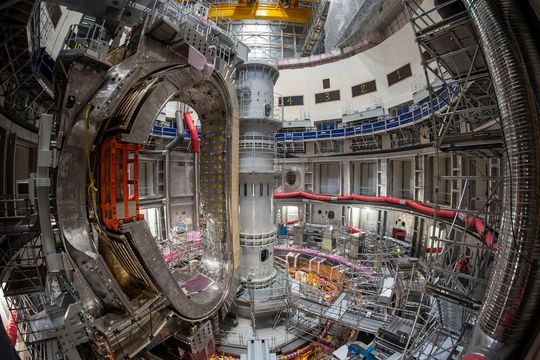
The magnet of the torus-shaped tokamak reactor will generate magnetic pulses lasting up to 500 seconds and heat the enclosed plasma to a temperature of 270 million °F.
(Image: Iter)
The world's largest fusion reactor is being built in the south of France as part of the international Iter research project. The aim is to generate clean energy by fusing hydrogen nuclei to produce electricity with zero emissions in the long term. 35 nations are involved in the project. The vacuum required for nuclear fusion, the pressure of which is almost equivalent to the emptiness of space, cannot be generated using mechanical pumps alone. Therefore, several cryopump systems with special control technology are also used. However, conventional control systems could not withstand the extreme conditions of the Tokamak reactor. The solution was developed by the company Konstandin from Karlsbad-Ittersbach (Germany), which had already supplied eight large pneumatic cylinders for the cryogenic pumps. In cooperation with RI Research Instruments GmbH and the Iter organization, a globally unique pump control cabinet was created, which precisely controls the large inlet valves with a diameter of almost 39 in with a valve clearance of less than 0.04 in and meets the high requirements for resistance to magnetic fields, radiation, heat and vibration.
"There are no standard solutions at Iter, every component has to be developed in-house," explains Mathias Kraft, Head of Design and Technology at Konstandin. This sentence sums up the requirements for the new project in a nutshell. For the control of the cryogenic pumps, a design was required that not only works reliably, but also functions under environmental conditions that are unique in the world. Iter stands for International Thermonuclear Experimental Reactor and is regarded as the most ambitious energy project of our time. In the future, the tokamak reactor will generate temperatures that are higher than those inside the sun. A highly efficient vacuum system is essential to keep these temperatures under control. Six cryogenic pumps are used to extract the gases produced during the fusion process. However, no suitable control system was available for these pumps. Operation requires precise control of the inlet valve, which is almost a meter in diameter and can only move by fractions of a millimeter (0.04 in) in order to precisely regulate the flow of gases. Konstandin had already supplied RI Research Instruments GmbH with eight large pneumatic cylinders for the cryogenic pumps in 2021. Building on these many years of positive experience, RI Research Instruments GmbH commissioned the company to develop the complete control cabinet at the end of 2023. The requirements came directly from Iter and posed a real challenge due to the safety standards for nuclear applications. The cabinet had to be mounted in port cells directly on the reactor, where it had to withstand magnetic fields, high temperatures of up to sixty degrees, vibrations and ionizing radiation. The cells act as an interface between the reactor core and the outside world. In close cooperation between RI Research Instruments GmbH, Iter and Konstandin, a control system was developed which implements the valve movement pneumatically and therefore particularly safely. The control system enables the required rapid opening and closing of the valve and guarantees positioning accuracy with a margin of less than one millimeter (<0.04 in).
Pneumatic Control Cabinet Ensures Fail-safe, Precise Control
The control cabinet works as a pneumatic control unit and requires virtually no electronic components, which means that it functions reliably and failsafe even in an environment with strong radiation. It is controlled by an externally positioned PLC-based control unit outside the radiation zone. Pipes feed the control air to larger valves, which drive the piston of the inlet valve and displace 21 gallons of compressed air in just a few seconds. The system enables fast opening and closing, precise intermediate positions and emergency stops. Different speeds can be achieved using special valve circuits, while leak compensation automatically compensates for pressure losses. The double safety valves ensure safe relief in the event of overpressure and even the smallest pressure differences are detected and compensated for. The system is fully piped for long-term safety. Hose connections that would not be permitted in this environment have been avoided. Stainless steel pipes withstand vibrations and temperature fluctuations and guarantee complete tightness. With the compact housing size of 24 × 24 in, the arrangement had to be planned precisely so that every screw connection remains functional and every line accessible. Strict material specifications prohibited fluorine-containing substances and standard seals; special materials for valves, sensors and screw fittings were tested, approved or specially manufactured. Konstandin coordinated the entire process closely with the suppliers and documented every detail in a qualified manner.
Date: 08.12.2025
Naturally, we always handle your personal data responsibly. Any personal data we receive from you is processed in accordance with applicable data protection legislation. For detailed information please see our privacy policy.
Consent to the use of data for promotional purposes
I hereby consent to Vogel Communications Group GmbH & Co. KG, Max-Planck-Str. 7-9, 97082 Würzburg including any affiliated companies according to §§ 15 et seq. AktG (hereafter: Vogel Communications Group) using my e-mail address to send editorial newsletters. A list of all affiliated companies can be found here
Newsletter content may include all products and services of any companies mentioned above, including for example specialist journals and books, events and fairs as well as event-related products and services, print and digital media offers and services such as additional (editorial) newsletters, raffles, lead campaigns, market research both online and offline, specialist webportals and e-learning offers. In case my personal telephone number has also been collected, it may be used for offers of aforementioned products, for services of the companies mentioned above, and market research purposes.
Additionally, my consent also includes the processing of my email address and telephone number for data matching for marketing purposes with select advertising partners such as LinkedIn, Google, and Meta. For this, Vogel Communications Group may transmit said data in hashed form to the advertising partners who then use said data to determine whether I am also a member of the mentioned advertising partner portals. Vogel Communications Group uses this feature for the purposes of re-targeting (up-selling, cross-selling, and customer loyalty), generating so-called look-alike audiences for acquisition of new customers, and as basis for exclusion for on-going advertising campaigns. Further information can be found in section “data matching for marketing purposes”.
In case I access protected data on Internet portals of Vogel Communications Group including any affiliated companies according to §§ 15 et seq. AktG, I need to provide further data in order to register for the access to such content. In return for this free access to editorial content, my data may be used in accordance with this consent for the purposes stated here. This does not apply to data matching for marketing purposes.
Right of revocation
I understand that I can revoke my consent at will. My revocation does not change the lawfulness of data processing that was conducted based on my consent leading up to my revocation. One option to declare my revocation is to use the contact form found at https://contact.vogel.de. In case I no longer wish to receive certain newsletters, I have subscribed to, I can also click on the unsubscribe link included at the end of a newsletter. Further information regarding my right of revocation and the implementation of it as well as the consequences of my revocation can be found in the data protection declaration, section editorial newsletter.
Control Cabinet: All Test Requirements Successfully Mastered in the Iter Test Facility
"The Iter project placed extraordinary demands on us that went far beyond traditional plant construction. All steps, components and connections had to be tested, documented and approved. Particular emphasis was placed on vibration resistance, temperature resistance, seismic stability and electromagnetic immunity," explains Kraft. Magnetic fields of up to half a Tesla can occur in the port cells, which severely restricted the choice of materials. Installation in the cramped port cells was challenging. In several development loops, the team optimized the cabinet design so that all components could be accommodated and at the same time were robust, easy to maintain and functionally reliable. Availability problems with individual components required the selection and testing of alternative components that met the same safety and material standards. Another focus was the fluorine-free nature of the materials, as conventional seals and hoses could become unstable when exposed to radiation. Special metal seals ensure a reliable seal. During the development phase, new component variants were flexibly integrated, allowing the control system to be further optimized. The real conditions of the tokamak were simulated in the cryogenic test facility and the control cabinet was tested. It worked precisely, reacted stably to pressure changes and passed all load tests without leaks or malfunctions. The specifications for the construction and testing of the control cabinet prototype were developed by Mr. Colbalt Atlantis, design engineer at Iter. The reliability and robustness of the system was fully confirmed. "The operation of the inlet valves was precise, the safety systems responded as planned and the control system is now considered qualified," says Guim Pallas, ACS (Actuator Control System) Responsible at Fusion for Energy, the European agency for the Iter project. This result can therefore also be seen as proof of the ability of German engineering to develop perfect solutions even under extreme conditions.
Control Cabinet Ensures Precise Cryogenic Pump Control And Stable Operation in the Iter-Tokamak
The delivery of the control cabinets in 2025 marks another milestone in the construction of the Iter reactor. The tested systems are ready for integration into the tokamak reactor, which should be completed by 2029. A key factor in the success of the project was the cooperation between the project partners. Konstandin, RI Research Instruments GmbH, Fusion for Energy and Iter have jointly created a system that sets standards worldwide. For the operators, the control cabinet means above all safety and reliability. The cryogenic pumps are precisely controlled, every movement of the inlet valve can be precisely monitored and pressure differences immediately compensated for. The experience gained from the Iter project is already being incorporated into new developments. "We have already received other orders for the development of special cylinders from Iter within the project. In future, other customers from sectors such as energy technology and aerospace will also benefit from the expertise gained here when developing new applications," says Kraft.
Iter—Glossary
Iter ("International Thermonuclear Experimental Reactor") is an experimental nuclear fusion reactor in Saint-Paul-lès-Durance in the south of France. The aim of the international project is to develop electricity generation from fusion energy. Following initial plans at the Geneva Summit Conference in 1985, the European Union, Japan, the Soviet Union and the USA agreed in 1988 to jointly design a large fusion plant. China and Korea joined in 2003, India in 2005, and after a selection process, the French research center Cadarache was chosen as the site. In 2006, the seven member states signed the ITER agreement and the organization was officially founded in 2007. When construction began in 2010, around 500 people were working on the project; today there are several thousand worldwide working together on the Iter Tokamak—currently the most advanced fusion energy experiment.



:quality(80)/p7i.vogel.de/wcms/1f/0f/1f0ffad77fb6daee3075c1d1534136c9/0130115952v1.jpeg "With the Trulaser Tube 7000, Trumpf has the latest generation of machines for laser tube processing to offer in time for Tube 2026. It is regarded as the most flexible and productive machine from Trumpf for this task ... (Image:Trump)")
:quality(80)/p7i.vogel.de/wcms/31/1f/311fb5b8aa1683b31cca284c8d33f443/0130073373v1.jpeg "Ceratizit has forged a very stable supply chain through a sophisticated and comprehensive recycling concept as well as through its holdings in tungsten mines. Here are some details ... (Image:Ceratite)")
:quality(80)/p7i.vogel.de/wcms/4c/49/4c49ab206af08de47d42c35bacc89c1d/0129539746v1.jpeg "With CPQ software, sales staff can create quotes for complex heavy-duty vehicles in minutes. (Image:TII Scheuerle)")
:quality(80)/p7i.vogel.de/wcms/bc/29/bc29ee18ce776b1915e10e07c1525f3a/0129766196v1.jpeg "The control cabinet is integrated into the rear of the press frame and offers accessibility with a small overhang thanks to the variable door opening. (Image:Tox)")
:quality(80)/p7i.vogel.de/wcms/53/4f/534fe0f168f6ee070ded4a48faca4cef/business-wire-main-image-1103x620v1.jpeg "The new UR AI Trainer, developed by Universal Robots and Scale AI, is the first direct lab-to-factory solution for AI model training.
(Source: Universal Robots)")
:quality(80)/p7i.vogel.de/wcms/48/8a/488afa7c9416394023a5ea1095f4ee4b/rfc4800-1-787x443v1v1.jpeg "Precise, intelligent and robust sensors will play a key role in an increasingly automated and data-driven world. (Image:Novotechnology)")
:quality(80)/p7i.vogel.de/wcms/b5/34/b534e64b2db218cdb5ad938898cbed56/0130044810v1.jpeg "The magnet of the torus-shaped tokamak reactor will generate magnetic pulses lasting up to 500 seconds and heat the enclosed plasma to a temperature of 150 million degrees. (Image:Iter)")
:quality(80)/p7i.vogel.de/wcms/97/28/9728e560d751dd54acd8b88a82ff7330/0129610882v1.jpeg "Temperature measuring devices are essential for monitoring industrial processes and thus ensuring high product quality. (Image:Micro-Epsilon)")
:quality(80)/p7i.vogel.de/wcms/08/70/087062e2e1a9b9add5777410dd746ee9/adobestock-1923991605-5607x3156v1v1.jpeg "A new type of tactile sensor, inspired by human skin, even recognizes grains of sand. (Image:Curioso.Photography - stock.adobe.com)")
:quality(80)/p7i.vogel.de/wcms/7f/08/7f087d7013424d123ab7275cd2e3fe55/adobestock-809456218--c2-a9-20degimages-20-e2-80-93-20stock-adobe-com-ki-generiert-4179x2351v1v1.jpeg "The digital upgrading of existing machines conserves resources, saves energy and reduces the need for new production. (Image:Degimages - stock.adobe.com/AI-generated)")
:quality(80)/p7i.vogel.de/wcms/dd/ce/ddcef80b290218276bf857cdb64a45e1/finkel-stephan-4162x2341v1.jpeg "Stephan Finkel, Partner and Industry Lead Defence & Security at 3DSE (Source: 3DSE)")
:quality(80)/p7i.vogel.de/wcms/34/e2/34e2a9e46e59eb28f09f9a5fdf41ff9a/0130091813v1.jpeg "Electrical drive trains require a multidimensional concept of performance characterization. Rohde & Schwarz has developed the MXO 3 oscilloscope series for this purpose. (Image:Rohde & Schwarz)")
:quality(80)/p7i.vogel.de/wcms/c9/2a/c92af18e41b077a518994a2ba60eb09f/0130037726v1.jpeg "The Renault subsidiary has presented a new brand strategy (Image:Alpine)")
:quality(80)/p7i.vogel.de/wcms/d8/fc/d8fc13ba0ae6e2180b3954cb1f1bd34c/0130060162v1.jpeg "Volkswagen has started series production of the ID Unyx 08. The model was developed in collaboration with Xpeng. (Image:Volkswagen)")
:quality(80)/p7i.vogel.de/wcms/f5/80/f5809e877017e40b413b48fcd8452246/cefmof-hydrogen-station-29-2048x1366-2048x1152v1v1.jpeg "The hydrogen filling station in Jyväskylä. The electrolyzer is installed in the fenced area at the top right. (Image:Cefmof Hydrogen)")
:quality(80)/p7i.vogel.de/wcms/60/16/6016b08dd6801f6c28c46087ecc51a2a/0130108881v1.jpeg "Jensen Huang, CEO of Nvidia (left) and Tae-won Chey, Chairman of SK Group (right) together at the Nvidia event GTC 2026. (Image:SK Group)")
:quality(80)/p7i.vogel.de/wcms/3d/f2/3df286b8c62e72218e4ea42dcd959ee1/0130050208v1.jpeg "The Heracles chip from Intel calculates fully encrypted data without decrypting it. According to the company, the chip is 1,074 to 1,547 times faster than an Intel Xeon with 24 cores in FHE (Fully Homomorphic Encryption) computing operations. (Image:Intel)")
:quality(80)/p7i.vogel.de/wcms/f6/a5/f6a587801c676040f1e6413a7d305e33/0130062380v1.jpeg "Nvidia is investing 4 billion US dollars in silicon photonics. The aim is to avoid an impending bottleneck in the AI infrastructure. (Image:freely licensed)")
:quality(80)/p7i.vogel.de/wcms/02/36/02364f083b3023cee3b3f0893ea3f859/0129857003v1.jpeg "AI will continue to drive growth in the semiconductor market in 2026. (Image:Dall-E / AI-generated)")
:fill(fff,0)/images.vogel.de/vogelonline/companyimg/76800/76895/65.jpg "FAULHABER_120mm.jpg ()")
:fill(fff,0)/p7i.vogel.de/companies/67/eb/67eba621ef6ea/logo2.png "logo2 (Wuxi InfiMotion)")
:quality(80)/p7i.vogel.de/wcms/c1/4c/c14cf64710e6487535d3356b958c2292/0130044650v1.jpeg "The control system ensures that the valve opens and closes quickly with a positioning accuracy of less than one millimeter.(Image: Konstandin)")
:quality(80)/p7i.vogel.de/wcms/44/cb/44cb021ed7349dbcdb793cc4694f00a9/0130044648v1.jpeg "The magnet of the torus-shaped tokamak reactor will generate magnetic pulses lasting up to 500 seconds and heat the enclosed plasma to a temperature of 150 million degrees.(Image: Iter)")
:quality(80)/p7i.vogel.de/wcms/a2/02/a202f2c497797e932a594c55b3662585/0130069511v1.jpeg "The heart of the Iter fusion reactor has been completed - the central solenoid magnet. The 18 meter high cylinder of the plasma container generates a 13 Tesla strong magnetic field.(Image: Iter)")
:quality(80)/p7i.vogel.de/wcms/c5/03/c503ae00ded76ec4862342da56ea18e8/0130069504v1.jpeg "Guim Pallas, F4E ACS Responsible, works as Project Manager for the fusion reactor at the European agency Fusion For Energy (F4E) in Barcelona.(Image: Iter)")
:quality(80):fill(efefef,0)/p7i.vogel.de/wcms/69/1f/691f21f5d458e/aai-agritechnica-whitepaper-coverbild.png "AAI_Agritechnica Whitepaper_Coverbild")
:quality(80)/p7i.vogel.de/wcms/32/99/3299b7c4a33725dee4d85a34b48a4a95/0126221749v1.jpeg "Most fusion facilities on Earth are of the Tokamak type, including the experimental reactor BEST in Hefei. (Image: ©abufahim - stock.adobe.com / AI-generated)")
:quality(80)/p7i.vogel.de/wcms/24/3a/243ad5b4b71541260b51b5d58bd0167c/0125026342v1.jpeg "Nuclear fusion in the stellarator: A look inside the vacuum vessel of Wendelstein 7-X in Greifswald. (Image:MPI for Plasma Physics, Jan Hosan.)")