At the Wendelstein 7-X nuclear fusion experimental facility, scientists achieved a world record in a key parameter of fusion physics—the triple product. This could be the next step on the path to a fusion power plant.
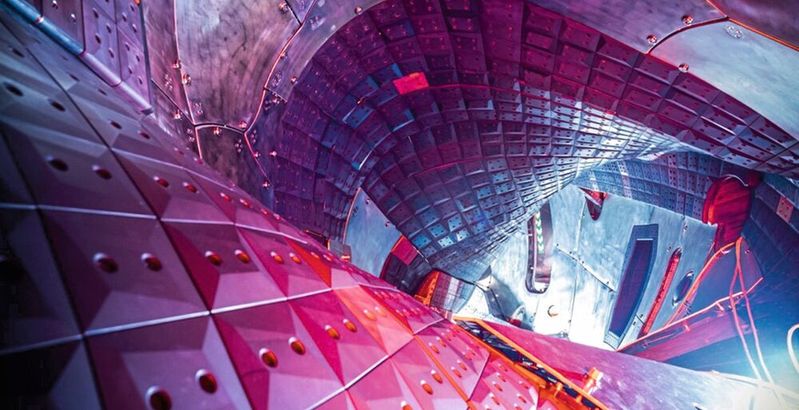
Nuclear fusion in the stellarator: A look inside the vacuum vessel of Wendelstein 7-X in Greifswald.
(Image: MPI for Plasma Physics, Jan Hosan.)
Nuclear fusion power plants promise a solution to all energy and environmental problems. Scientists have long focused on magnetic fusion, which must slowly transition into applied research. According to forecasts, magnetic fusion is expected to be the dominant technology by 2050. The two concepts, Stellarator and Tokamak, are being advanced at the European level. On the path to a fusion power plant, Stellarator-type facilities are one of the most promising options.
Now, the W7-X team from the Max Planck Institute for Plasma Physics (IPP) at the Wendelstein 7-X experimental power plant in Greifswald (Germany) announced a record: On May 22, 2025, scientists achieved a new peak value for the central key figure in fusion physics—the triple product—in the experimental campaign OP 2.3 with a plasma duration exceeding 43 seconds. This defines when more energy comes "out" of the fusion reactor than was "put in," meaning the fusion occurs. Thus, Wendelstein 7-X surpasses the best values of Tokamak-type fusion facilities at longer plasma durations.
Gallery
The highest values for the triple product were achieved by the Japanese tokamak JT60U (decommissioned in 2008) and the European tokamak facility JET in the UK (decommissioned in 2023). With short plasma durations of a few seconds, they remain the clear front-runners.
World's Best Triple Product for Long Plasma Durations
In terms of longer plasma durations, which are important for a future power plant, Wendelstein 7-X is now ahead, even though JET had three times the plasma volume. Size significantly facilitates achieving high temperatures in fusion facilities.
The world record for the triple product for long pulses was achieved through a new pellet injector, which shoots frozen hydrogen pellets into the plasma, enabling long plasma durations through "fuel replenishment." This highly complex and globally unique injector was developed by the Oak Ridge National Laboratory of the US Department of Energy (DOE) in Tennessee.
"The new record is a great achievement of the international team. It impressively demonstrates the potential of Wendelstein 7-X. Being able to raise the triple product to Tokamak levels during long plasma durations marks another important milestone on the path to a power-plant-suitable Stellarator," says Prof. Dr. Thomas Klinger, head of the operation of Wendelstein 7-X and the Stellarator Dynamics and Transport division at IPP.
This is How the Triple Product Experiments Were Conducted
In the record experiment for the triple product, about 90 frozen millimeter-sized hydrogen pellets were injected in rapid sequence over 43 seconds, while strong microwaves simultaneously heated the plasma. Heating and the pellet injector had to be precisely coordinated to achieve the optimal combination of heating power and fuel filling.
For this, the pellet injector was operated for the first time to work with different predefined pulse rates. This scheme is directly relevant for a future fusion reactor. It can potentially also be extended to longer plasma durations of several minutes.
The use of pellets was made possible thanks to the groundwork of several European laboratories, including simulation calculations by the Spanish fusion research laboratory CIEMAT and observations with ultra-fast cameras by the HUN-REN Centre for Energy Research Budapest. The microwave heating system (more precisely: electron cyclotron resonance) was developed in collaboration with the Karlsruhe Institute of Technology (KIT) and a team from the University of Stuttgart. It is considered the most promising method to bring the plasma to fusion-relevant temperatures.
During the record experiment, the plasma temperature was driven to over 36 million °F, peaking at even 54 million °F. The measurements for calculating the triple product were provided in part by the Princeton Plasma Physics Laboratory of the DOE, which operates an X-ray spectrometer to determine the plasma ion temperature at W7-X. The necessary measurement values for plasma electron density were obtained from the IPP's globally unique interferometer. The energy confinement time required for calculating the triple product was also determined with IPP measuring instruments.
Prof. Dr. Robert Wolf, head of the Stellarator Heating and Optimization Division at IPP, summarizes: "The records of this experimental campaign are more than just measurements. They represent an important advancement in the validation of the stellarator concept—enabled by excellent international collaboration."
Date: 08.12.2025
Naturally, we always handle your personal data responsibly. Any personal data we receive from you is processed in accordance with applicable data protection legislation. For detailed information please see our privacy policy.
Consent to the use of data for promotional purposes
I hereby consent to Vogel Communications Group GmbH & Co. KG, Max-Planck-Str. 7-9, 97082 Würzburg including any affiliated companies according to §§ 15 et seq. AktG (hereafter: Vogel Communications Group) using my e-mail address to send editorial newsletters. A list of all affiliated companies can be found here
Newsletter content may include all products and services of any companies mentioned above, including for example specialist journals and books, events and fairs as well as event-related products and services, print and digital media offers and services such as additional (editorial) newsletters, raffles, lead campaigns, market research both online and offline, specialist webportals and e-learning offers. In case my personal telephone number has also been collected, it may be used for offers of aforementioned products, for services of the companies mentioned above, and market research purposes.
Additionally, my consent also includes the processing of my email address and telephone number for data matching for marketing purposes with select advertising partners such as LinkedIn, Google, and Meta. For this, Vogel Communications Group may transmit said data in hashed form to the advertising partners who then use said data to determine whether I am also a member of the mentioned advertising partner portals. Vogel Communications Group uses this feature for the purposes of re-targeting (up-selling, cross-selling, and customer loyalty), generating so-called look-alike audiences for acquisition of new customers, and as basis for exclusion for on-going advertising campaigns. Further information can be found in section “data matching for marketing purposes”.
In case I access protected data on Internet portals of Vogel Communications Group including any affiliated companies according to §§ 15 et seq. AktG, I need to provide further data in order to register for the access to such content. In return for this free access to editorial content, my data may be used in accordance with this consent for the purposes stated here. This does not apply to data matching for marketing purposes.
Right of revocation
I understand that I can revoke my consent at will. My revocation does not change the lawfulness of data processing that was conducted based on my consent leading up to my revocation. One option to declare my revocation is to use the contact form found at https://contact.vogel.de. In case I no longer wish to receive certain newsletters, I have subscribed to, I can also click on the unsubscribe link included at the end of a newsletter. Further information regarding my right of revocation and the implementation of it as well as the consequences of my revocation can be found in the data protection declaration, section editorial newsletter.
Background: What is the Triple Product?
The triple product is the key measurement in a fusion power plant. Only above a certain threshold, as defined by the Lawson criterion, can a plasma in a facility generate more fusion power than the thermal power that needs to be invested. The energy balance then becomes positive, meaning more fusion energy is generated than heating energy is required to bring the plasma to temperature. Once the threshold is exceeded, the fusion reaction can sustain itself without further heating.
For a power plant, this threshold is:
n∙T∙ τ = 3 ∙ 1021 m-3 keV s
The triple product results from the particle density of the plasma n, its temperature T (more precisely: the temperature of the ions, between which fusion reactions occur), and the energy confinement time 𝜏, which is the duration over which the thermal energy escapes from the plasma if not reheated. The confinement time is thus a measure of thermal insulation.
This is how the pellet injector works
Since September 2024, the new continuous-operation pellet injector has been successfully in use in Greifswald, Germany. The device continuously generates a strand of hydrogen ice (0.12 inches in diameter), from which 0.13 inches long cylindrical pieces (pellets) are cut at intervals of fractions of a second, to be shot into the plasma at high pressure like in a blowpipe. The pellets reach speeds of 670 to 1,790 mph. (kr)



:quality(80)/p7i.vogel.de/wcms/e2/e3/e2e3515560bd53a10df7ca488953a4f1/0131008675v1.jpeg "A recent study by McKinsey & Company concludes that quantum computing is no longer an ivory tower topic. That's why we should now be looking to get our foot in the door of this space of the future ... (Image:J. Hu)")
:quality(80)/p7i.vogel.de/wcms/94/da/94da20e82c7a07da3070351800d94f1e/cjw-8143-2976x1673v1.jpeg "SIMTOS outlines the future of the industrial ecosystem, raising expectations for 2028. (Source: SIMTOS Secretariat)")
:quality(80)/p7i.vogel.de/wcms/2b/6b/2b6bed25a3db53f8b2071f088ff0d4ee/0130948787v1.jpeg "Gehring Diato: DH cutting bar and tool, designed for demanding honing processes with
high dimensional and shape accuracy. (Image:Gehring Diato)")
:quality(80)/p7i.vogel.de/wcms/e3/fd/e3fd82975e807cbd7f9920b032b6ca55/0130948768v1.jpeg "Behind these walls of the Chinese Ministry of Commerce in Beijing, people are currently making rather angry faces. The reason for this is that new EU plans to strengthen and protect European industry are causing the Chinese to be furious ... (Image:Xi Quang)")
:quality(80)/p7i.vogel.de/wcms/68/3a/683a8779cab6e9ca59b86ffad8dfe34b/0130967161v1.jpeg "The foil cut patterns can be used to imitate roof tiles, for example, without significantly impairing the efficiency of the PV module. (Image:Fraunhofer ISE / Marco Ernst)")
:quality(80)/p7i.vogel.de/wcms/37/6a/376a76c71cf2d1fd2381244437df705a/0130186001v1.jpeg "(Picture:Oriental Motor)")
:quality(80)/p7i.vogel.de/wcms/ee/77/ee77aa8edc722523035b17ad48e22dfe/adobestock-1916882160-3840x2158v1.jpeg "(Source: © InfiniteFlow - stock.adobe.com)")
:quality(80)/p7i.vogel.de/wcms/bf/8a/bf8aae2ae7c550c255746c94a36fdd01/0128634710v1.jpeg "Agent-based AI requires a database that also provides the necessary context—a challenge especially in manufacturing due to the physical and distributed nature of industrial data. Agent-based AI requires a database that also provides the necessary context—a challenge especially in manufacturing due to the physical and distributed nature of industrial data. (Image:Fivetran)")
:quality(80)/p7i.vogel.de/wcms/ab/e9/abe94c44bb91910105d3dd8cfb63cf32/pm0626-1-2675x1504v1v1.jpeg "With Iglidur i190PF, Igus has developed a highly stable filament for the 3D printing of wear-resistant and PTFE-free special parts. (Image:Igus)")
:quality(80)/p7i.vogel.de/wcms/60/0b/600bdeecdea7647f21ea0d8f7da6ea9c/rodriguez-kunstinstallation-rgb-1594x897v1v1.jpeg "For the large-format installation by Conrad Shawcross, Rodriguez supplied a total of 44 tailor-made slewing rings in various sizes. (Image:R.A. Rodriguez UK (Ltd.))")
:quality(80)/p7i.vogel.de/wcms/95/06/9506b79e955c5de09a6d5094c6d74263/bvof-2026-0311-0059-20wind-20tunnel-20marathon-20project-8256x4642v1v1.jpeg "Synopsys and Heriot-Watt University transfer technologies from aerospace to competitive sports. (Image:Synopsys)")
:quality(80)/p7i.vogel.de/wcms/42/f0/42f05894fe2f2c56ed34ab84fa3e7e4f/pm1826-1-3500x1968v1v1.jpeg "With the material Iglidur A351, Igus has developed a new bisphenol-free and FDA-compliant material that is approved for contact with food and is particularly resistant to cleaning chemicals and high temperatures of up to 356°F. (Image:Igus)")
:quality(80)/p7i.vogel.de/wcms/63/bf/63bf7e4c7609a792683899c0557c8bda/0130967702v1.jpeg "Joint solution: E.on, Neot and Mitsui offer fast charging stations for e-trucks and suitable charging tariffs as part of Charging-as-a-Service. (Image:E.On)")
:quality(80)/p7i.vogel.de/wcms/30/94/30948d92b22dcfafe14039227711ba6a/0130900098v1.jpeg "On March 31, BYD put the first major Sky Rail line outside of China into operation with Line 17 on the outskirts of the metropolis of Sao Paulo. (Image:BYD)")
:quality(80)/p7i.vogel.de/wcms/3a/ed/3aed943c2c83093b13abcaf7a26112da/580727-xpeng-20p7-r5a9710-9202e9-original-1741189346-3600x2024v1v1.jpeg "\"Car manufacturing is not a good business model,\" says He Xiaopeng, founder and CEO of Chinese e-car manufacturer Xpeng. (Image:Xpeng)")
:quality(80)/p7i.vogel.de/wcms/91/2d/912dcf5c26a17269b4b62a8e763aae6e/org-blobs-user-response-file-output-88ae6378-4502-412a-90e7-bcc41cb8c93a-file-1777456340520-jpgv1.jpeg "A recent study by the European Patent Office and the IEA shows how hard the global battle for raw material sovereignty is being fought. The EU Battery Regulation plays a central role in the circular economy. (Picture:AI-generated)")
:quality(80)/p7i.vogel.de/wcms/b0/e6/b0e67b23c1d0a1053e14fe469ffa6bb2/0131012487v1.jpeg "Chip production system from Applied Materials. Like its US competitors LAM Research and KLA, the American supplier of semiconductor production equipment was also banned from supplying equipment to China's second-largest foundry Hua Hong after SMIC. (Image:Applied Materials)")
:quality(80)/p7i.vogel.de/wcms/f2/5c/f25c5b1cd326464357b7a8bf46726424/0130871769v1.jpeg "Figure 1: Circuit diagram of the front-end interface. (Image:TI)")
:quality(80)/p7i.vogel.de/wcms/43/a8/43a8f8408f937d3853e0ccc4e98bf2d5/0130943371v1.jpeg "The Samsung Group United Union has announced an 18-day general strike at Samsung Electronics. (Image:Samsung)")
:fill(fff,0)/p7i.vogel.de/companies/69/88/69882c428938e/tmts2026-ticec-banner-en-2000px.png "tmts2026-ticec-banner-en-2000px (https://www.tmts.tw/en)")
:quality(80)/p7i.vogel.de/wcms/9a/fd/9afd1e4af0cf51d9ba2fa3323cc204f0/0125025849v1.jpeg "Image 2: The pellet injector in the experiment hall of Wendelstein 7-X.(Image: MPI for Plasma Physics, Beate Kemnitz.)")
:quality(80)/p7i.vogel.de/wcms/af/51/af515d01c3cf2b11225c45917a9e89c6/0125025846v1.jpeg "Image 1: In a fusion power plant, a plasma with a high triple product (y-axis, logarithmic scale) must be generated for long durations (x-axis). Previous fusion experiments achieved high values for plasma durations of a few seconds. Wendelstein 7-X reached the world record for plasma durations over more than 30 seconds with a simultaneously large fusion product on May 22, 2025. In this experimental campaign OP2.3, further top values were achieved for plasma durations between 30 and 40 seconds.(Image: MPI for Plasma Physics, Dinklage et al. (to be published) / X. Litaudon et al. 2024 Nucl. Fusion 64 015001)")
:quality(80)/p7i.vogel.de/wcms/cf/76/cf764bde4f49f87684c9a570d2c9b08b/0125025852v1.jpeg "Image 3: View into the experiment hall of Wendelstein 7-X.(Image: MPI for Plasma Physics, Jan Hosan.)")
:quality(80)/p7i.vogel.de/wcms/b5/58/b558e66eb3959b4d5524d0df7d48e1ab/0125025843v1.jpeg "Nuclear fusion in the stellarator: A look inside the vacuum vessel of Wendelstein 7-X in Greifswald.(Image: MPI for Plasma Physics, Jan Hosan.)")
:quality(80)/p7i.vogel.de/wcms/aa/b9/aab99ca04cc76d2ae1046df29d57beef/0122144242v1.jpeg "Research on the safe handling of tritium in future fusion power plants at KIT. (Image:KIT)")
:quality(80)/p7i.vogel.de/wcms/5c/0f/5c0fee074c4b6c8e8c0993f3217c2f5a/0129773718v1.jpeg "The General Fusion demonstration reactor. (Image:General Fusion)")
:quality(80)/p7i.vogel.de/wcms/32/99/3299b7c4a33725dee4d85a34b48a4a95/0126221749v1.jpeg "Most fusion facilities on Earth are of the Tokamak type, including the experimental reactor BEST in Hefei. (Image: ©abufahim - stock.adobe.com / AI-generated)")