With the second generation of its photonic processor, Q.ANT is launching the NPU 2.0. Energy consumption is said to be 30 times lower than CMOS processors, and performance is 50 times higher.
Nonlinear mathematical operations with light offer new AI and scientific applications, including physical AI, robotics, or computer vision.
(Image: Q.ANT)
The rapid development of artificial intelligence is hitting a fundamental limit: energy consumption. Modern AI applications like ChatGPT already require over 564 megawatt-hours daily. This corresponds to 100 times the annual consumption of a German household. GPU-based data centers now consume up to 40% of their energy solely for cooling the overheated hardware. While computing power is increasing exponentially, energy demand is growing even faster. This development is unsustainable and puts the entire AI revolution at risk.
Against this background, the Stuttgart-based company Q.ANT presents an exciting approach: the second generation of its photonic Native Processing Unit (NPU 2.0). This technology promises to fundamentally solve the energy problem of AI by computing with light instead of electrons.
Light Instead of Silicon: A Physical Paradigm Shift
The basic principle of photonic data processing breaks the physical laws of conventional semiconductor technology. While CMOS processors perform complex mathematical operations through millions of transistor circuits, photonic processors utilize the properties of light for native analog computations. Light not only moves faster than electrons but also generates almost no heat and requires significantly less energy for signal transmission.
"For years, AI development has been advancing rapidly, while we have struggled to keep up with its energy supply. Energy is the new challenge in performance enhancement," explains Dr. Michael Förtsch, CEO of Q.ANT. With the NPU 2.0, the company demonstrates up to 30 times lower energy consumption with 50 times higher performance for complex AI and HPC workloads compared to traditional silicon processors.
Enhanced Nonlinear Processing Opens Up New Application Fields
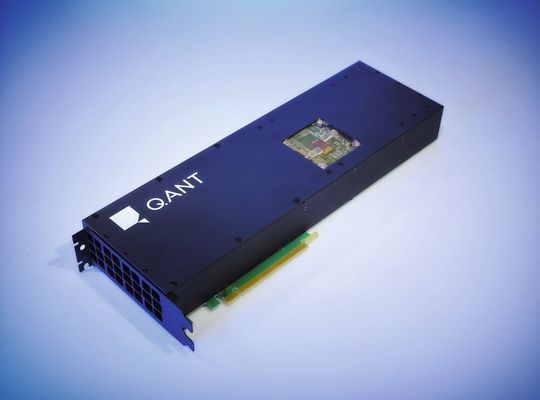
The NPU 2 from Q.ANT offers an improved nonlinear processing core, reducing the number of parameters and training depth.
(Image: Q.ANT)
The second generation of the Q.ANT NPU offers significant improvements over the first version. The enhanced nonlinear processing core was specifically optimized for neural network models, reducing the required number of parameters and training depth. At the same time, accuracy increases in image learning, classification, and physics simulation.
These properties open up entirely new application fields that are not achievable with digital circuits. These include physical AI, robotics, next-generation computer vision, industrial intelligence, physics-based simulation, as well as data analysis and automatic pattern recognition. Particularly in manufacturing, logistics, and inspection, photonic processors can execute nonlinear neural networks far more efficiently than conventional systems.
Immediate Integration into Existing Infrastructures
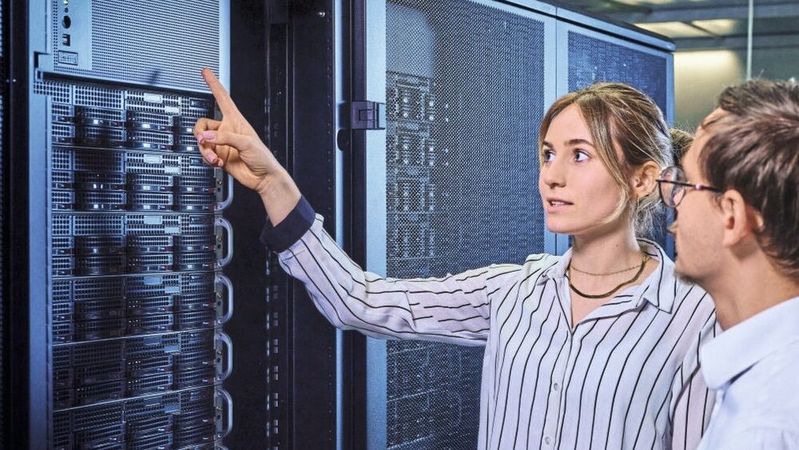
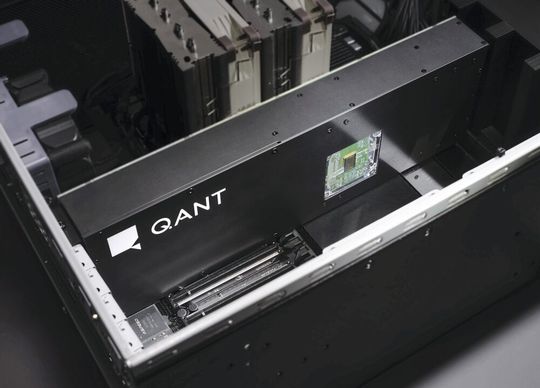
Additionally, the NPU 2 is available as a turnkey 19-inch server. It contains multiple NPUs of generation 2 and can be seamlessly integrated with CPUs and GPUs in existing HPC and data center environments via PCIe and C/C++/Python APIs.
(Image: Q.ANT)
A key advantage of the Q.ANT solution is its seamless integration into existing data center environments. The Native Processing Server (NPS) is delivered as a turnkey 19-inch rack-mountable server and contains multiple second-generation NPUs. It can easily be integrated with CPUs and GPUs in existing HPC infrastructures via PCIe and C/C++/Python APIs.
This compatibility allows companies to leverage the advantages of photonic processing without needing to overhaul their entire IT infrastructure. The Q.PAL library (Q.ANT Photonic Algorithm Library) provides developers with efficient nonlinear algorithms and functions for complex workloads.
The advances in photonic data processing are remarkable. While digital data processing required decades for its development, Q.ANT achieved the leap from simple digit recognition to image classification and image learning within just one year. "What took ten years in digital data processing, we achieved with photonics in just one year," emphasizes Dr. Förtsch.
This speed demonstrates the enormous potential of the technology and suggests that photonic computing scales faster than conventional CMOS technology. At Supercomputing 2025 in St. Louis, Q.ANT is showcasing live how the NPU 2 learns images within seconds using a nonlinear neural network.
Economic And Ecological Impacts
The drastic reduction in energy consumption not only makes AI applications more sustainable but also more economical. Computer vision systems, previously considered too computationally intensive, suddenly become profitable with photonic processors. In manufacturing, error detection systems, object tracking, and inventory optimization can be implemented with fewer parameters, significantly reducing energy costs.
Date: 08.12.2025
Naturally, we always handle your personal data responsibly. Any personal data we receive from you is processed in accordance with applicable data protection legislation. For detailed information please see our privacy policy.
Consent to the use of data for promotional purposes
I hereby consent to Vogel Communications Group GmbH & Co. KG, Max-Planck-Str. 7-9, 97082 Würzburg including any affiliated companies according to §§ 15 et seq. AktG (hereafter: Vogel Communications Group) using my e-mail address to send editorial newsletters. A list of all affiliated companies can be found here
Newsletter content may include all products and services of any companies mentioned above, including for example specialist journals and books, events and fairs as well as event-related products and services, print and digital media offers and services such as additional (editorial) newsletters, raffles, lead campaigns, market research both online and offline, specialist webportals and e-learning offers. In case my personal telephone number has also been collected, it may be used for offers of aforementioned products, for services of the companies mentioned above, and market research purposes.
Additionally, my consent also includes the processing of my email address and telephone number for data matching for marketing purposes with select advertising partners such as LinkedIn, Google, and Meta. For this, Vogel Communications Group may transmit said data in hashed form to the advertising partners who then use said data to determine whether I am also a member of the mentioned advertising partner portals. Vogel Communications Group uses this feature for the purposes of re-targeting (up-selling, cross-selling, and customer loyalty), generating so-called look-alike audiences for acquisition of new customers, and as basis for exclusion for on-going advertising campaigns. Further information can be found in section “data matching for marketing purposes”.
In case I access protected data on Internet portals of Vogel Communications Group including any affiliated companies according to §§ 15 et seq. AktG, I need to provide further data in order to register for the access to such content. In return for this free access to editorial content, my data may be used in accordance with this consent for the purposes stated here. This does not apply to data matching for marketing purposes.
Right of revocation
I understand that I can revoke my consent at will. My revocation does not change the lawfulness of data processing that was conducted based on my consent leading up to my revocation. One option to declare my revocation is to use the contact form found at https://contact.vogel.de. In case I no longer wish to receive certain newsletters, I have subscribed to, I can also click on the unsubscribe link included at the end of a newsletter. Further information regarding my right of revocation and the implementation of it as well as the consequences of my revocation can be found in the data protection declaration, section editorial newsletter.
At the same time, photonic processors open up new possibilities for hybrid AI models that combine statistical logic with physical modeling. This enables advancements in areas such as drug research, material design, and adaptive optimization, where both nonlinear complexity and extreme energy efficiency are crucial.
The Q.ANT servers with the latest processor generation NPU 2 are now available for order and can be delivered in the first half of 2026. The turnkey servers can be used in any data center and mark the beginning of a new era of sustainable, high-performance computing. (heh)
Future-Proof Authentication with Universal RFID Readers



:quality(80)/p7i.vogel.de/wcms/40/c5/40c5051cebdb10fdee9a283303434d9d/0129881741v1.jpeg "3D-printed tools and other components contribute to energy-saving, precise processes. (Image:Gerhard Schubert GmbH)")
:quality(80)/p7i.vogel.de/wcms/e5/fa/e5fa9fa2e3b44ee1894fdf95bbe828fe/0129904146v1.jpeg "Airports and other critical infrastructure in Europe are to be better protected against drones. (Picture: ©assetseller - stock.adobe.com)")
:quality(80)/p7i.vogel.de/wcms/ae/bd/aebda515c684825e97579175874ea6bd/0129920231v1.jpeg "Hensoldt, a sensor specialist for critical defense applications among other things, now has a strategic milestone ahead of it. The company is planning to acquire Nedinsco, an optronics company from Venlo in the Netherlands. Here's what's to come ... (Image:Hensoldt)")
:quality(80)/p7i.vogel.de/wcms/c3/6f/c36f031df46d22615d941d077d32313c/0129800025v1.jpeg "The laser-assisted process is intended to make wafer cutting significantly more productive. (Image:Trumpf)")
:quality(80)/p7i.vogel.de/wcms/e8/dc/e8dc27a8d9fba8fbd081987400bf6848/0127426198v1.jpeg "3D FEM models are detailed, large and computationally intensive. Thanks to ROM and the support of Cadfem, Wago has succeeded in setting up an e-shop for thermal simulation. (Image:WAGO)")
:quality(80)/p7i.vogel.de/wcms/9c/ac/9cac6246660e746c5a3989399ac4d250/0128561645v1.jpeg "Artificial intelligence can drive efficiency in smart factories through centralized data management and predictive maintenance. (Picture: ©Fardived - stock.adobe.com)")
:quality(80)/p7i.vogel.de/wcms/6b/e2/6be235b5ad8a442ccd9d164b0b300d8b/0129763992v1.jpeg "As early as 2020, the Zimmer Group announced that it would convert its production to be sustainably CO2-neutral. (Image:Zimmer Group)")
:quality(80)/p7i.vogel.de/wcms/d4/ba/d4bab9481e66f8570f40eb8ef2a90198/0129795613v1.jpeg "A camera inspection during removal ensures that the components are placed correctly in the KLTs. (Image:Yaskawa Europe)")
:quality(80)/p7i.vogel.de/wcms/76/81/7681b6450512b2cce1e453cd3d732543/0129479309v1.jpeg "Symbolic image: Model-based design combines virtual system models with real machines and systems in order to simulate, validate and coordinate functions, control and software early on in the development process. (Image:Dall-E / AI-generated)")
:quality(80)/p7i.vogel.de/wcms/5c/0f/5c0fee074c4b6c8e8c0993f3217c2f5a/0129773718v1.jpeg "The General Fusion demonstration reactor. (Image:General Fusion)")
:quality(80)/p7i.vogel.de/wcms/b5/5e/b55ed9355e0395ec0caf111d6af6b494/adobestock-495980372--c2-a9-20natali-mis-20-e2-80-93-20stock-adobe-com-6720x3778v1v1.jpeg "Which engineering skills will be in vogue in 2026? (Image:natali_mis - stock.adobe.com)")
:quality(80)/p7i.vogel.de/wcms/bf/a5/bfa5d882e93f159ce93e933742272b00/nord-vibn-cmyk-2196x1235v1v1.jpeg "With digital twins for virtual commissioning, Nord supports customers in ensuring that systems are available more quickly, even with complex drive systems. (Image:Nord Drivesystems)")
:quality(80)/p7i.vogel.de/wcms/e4/01/e40186c9a7d04cbecb20fab20ff79094/0129886097v1.jpeg "Skoda has inaugurated a new battery plant in Mlada Boleslav to meet rising demand, but also to reduce battery costs by 30 percent. (Image:Skoda)")
:quality(80)/p7i.vogel.de/wcms/74/7b/747b6bc4d758c5dd4b5c24a763ae493d/0129897614v1.jpeg "Huawei Intelligent Automotive Solutions has presented a lidar with a resolution of 896 lines. (Image:HIMA via ChinaEVHome)")
:quality(80)/p7i.vogel.de/wcms/ba/b7/bab7bfd052f35da3c39388508faa350e/0129851977v1.jpeg "The third generation of the Mazda CX-5 scores above all with its inner values. (Image:Mauritz - VCG)")
:quality(80)/p7i.vogel.de/wcms/81/24/8124e33f53ec73fa99374f407cc11b61/0129727992-541x304v1v1.jpeg "The development of control elements and HMI systems for commercial vehicles can lead to interactions. (Image:Preh / AI-generated)")
:quality(80)/p7i.vogel.de/wcms/8b/46/8b46730ba87a86f16d696f043cf0e3d1/0129887022v1.jpeg "Linyi Yunchuan's S2000 platform has risen to a height of two kilometers and fed the energy generated into the grid. (Image:Linyi Yunchuan)")
:quality(80)/p7i.vogel.de/wcms/92/f8/92f8bf81914500bcda78f63dab8da720/0129926751v1.jpeg "Only recently, the US government allowed high-end chips for AI such as Nvidia's H200 series (pictured) to be exported to China under certain conditions. But now the tax is being pulled back all the harder: An eDraft envisages tighter controls on the export of hardware for AI technologies worldwide. Even allies would be affected. (Image:Nvidia)")
:quality(80)/p7i.vogel.de/wcms/84/cc/84cc506003388ecffaab464677c7afa6/0129843694v1.jpeg "Launched last year, ASML's TWINSCAN XT:260 is an i-line scanner with a throughput of 270 wafers per hour. With a focus on the increased demands of AI chips, ASML wants to shift its focus away from pure front-end tools for chip production in the next ten to fifteen years with packaging and bonding technologies. (Image:ASML)")
:quality(80)/p7i.vogel.de/wcms/8f/48/8f48b0ed0d6c5c4f299b1310a7b577e9/0129830738v1.jpeg "Data centers in orbit are indeed dreams of the future, while data centers under water are already being tested. (Image:Dall-E / AI-generated)")
:fill(fff,0)/images.vogel.de/vogelonline/companyimg/76800/76895/65.jpg "FAULHABER_120mm.jpg ()")
:fill(fff,0)/p7i.vogel.de/companies/69/88/69882c428938e/tmts2026-ticec-banner-en-2000px.png "tmts2026-ticec-banner-en-2000px (https://www.tmts.tw/en)")
:fill(fff,0)/p7i.vogel.de/companies/67/eb/67eba621ef6ea/logo2.png "logo2 (Wuxi InfiMotion)")
:quality(80):fill(efefef,0)/p7i.vogel.de/wcms/67/ae/67ae0b9ac31f8/elatec-wp-universal-reader.png "Elatec WP Universal Reader")
:quality(80)/p7i.vogel.de/wcms/c5/94/c594c014c870007bdd69a79f8156b0bc/0125778671v1.jpeg "What once began after World War II with wardrobe-sized computers is now starting again in these dimensions as the most modern form of computing. At the Leibniz Computing Center (LZR) in Garching, the world's first photonic AI computer was launched ... (Image:Q.Ant)")
:quality(80)/p7i.vogel.de/wcms/c9/c4/c9c4e42b9b054ec7ae0a3045170c07b6/0128162746v1.jpeg "Development workflow with Renesas e² studio: With Renesas e² studio, IoT applications can be downloaded from GitHub, configured, developed, and deployed on RA, RX, or RZ controllers – including connectivity to AWS and Microsoft Azure. (Image:Renesas Electronics Corporation)")