Many drivers get stressed again and again when they have to park their vehicle. They do it because the parking space is very narrow or because the traffic behind them is building up pressure. Automated parking assistance systems are intended to provide a remedy.
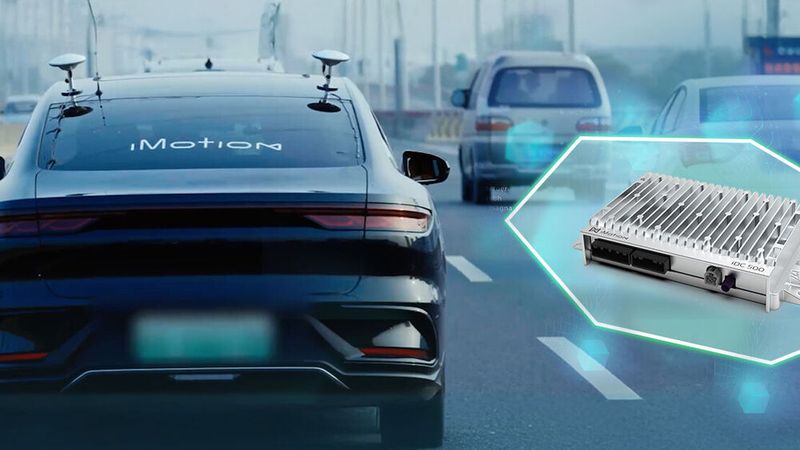
The Chinese company iMotion wants to reduce the stress of parking. With the help of a highly automated function, vehicles should be able to park themselves in less than 30 seconds. This is where the R-Car-V4H SoC from Renesas comes into play.
(Image: iMotiom)
For many drivers, parking is a nerve-wracking affair—whether it's squeezing into a parking space at the supermarket or maneuvering through narrow parking garages in the city center. There is even a term for the fear of parallel parking: parallelophobia. The Chinese company iMotion wants to reduce the stress of parking. With the help of a highly automated function, vehicles should be able to park themselves in less than 30 seconds—even in crowded or poorly marked areas. Walt Song, who founded iMotion Automotive Technology in 2016, has an easy-to-understand philosophy: "Make everything easy". This applies not only to the driver, but also to the car manufacturer. The goal? To bring functions that were originally developed for luxury vehicles to more affordable mid-range and entry-level models.
Parking Automation Also for Affordable Entry-Level Models
Automated Parking Assist (APA) systems not only promise less stress for the driver, but also fewer fender benders and kerb bumps. APA also allows more vehicles to be parked in a smaller space. However, for car manufacturers focusing on entry-level models, APA—like many other ADAS functions—is proving to be technically complex and cost-intensive. iMotion's integrated driving technology aims to counteract these hurdles.
The APA system guides drivers up to three kilometers along previously learned routes to their destination. With the help of cameras and ultrasonic sensors, it recognizes the surroundings in real time and guides the vehicle into the desired parking space. The technology works in vehicles with electric and combustion engines as well as in various vehicle types—including cars, trucks and off-road vehicles.
What sets iMotion apart from its competitors is its fully integrated system design. While many ADAS manufacturers focus solely on software or hardware, iMotion offers a vertically integrated stack—from algorithm development to middleware and embedded hardware. This is intended to optimize design resources, performance and costs.
At its heart is the intelligent, integrated iMotion iDC500 domain controller. It comprises an APA system based on 360-degree environment recognition and a TCP feature (Trained Commuting Pilot) with self-learning mapping technology. This navigates by "memorizing" certain routes and locally recorded environmental data.
360-degree environment recognition is made possible by vehicle cameras and iMotion's Bird's Eye View technology. This technology generates a bird's eye view of the surroundings to obtain a 3D map of the outside world. The mapping is performed by an AI-based neural network architecture, a so-called transformer model. This combines different camera images to generate a 3D representation of the environment. Competing models in this category are said to have significantly larger parameter scales and require more expensive AI processors with at least 100 TOPS of computing power. The developers at iMotion were able to optimize their algorithms so that they run on the more economical R-Car V4H chipset from Renesas with 34 TOPS—with the same performance. This efficiency gain makes it possible to offer functions such as automated parking and high-resolution, map-based highway piloting. This allows them to align their vehicles with both the expectations of end users and the regulatory safety requirements in Asia and Europe.
Cost-Efficient Parking Platform
In order to successfully integrate high-end ADAS functions into cost-effective hardware, the iMotion team had to overcome various challenges. Advanced sensor, planning and control functions had to be integrated into a compact computer platform. Strict performance and security requirements had to be taken into account.
One of the hurdles was to implement BEV transformers and Occupancy Grid Models (OCC) in Renesas' R-Car V4H architecture. BEV and OCC are a form of spatial representation often used in mobile robotics. iMotion uses a combination of different technologies:
Date: 08.12.2025
Naturally, we always handle your personal data responsibly. Any personal data we receive from you is processed in accordance with applicable data protection legislation. For detailed information please see our privacy policy.
Consent to the use of data for promotional purposes
I hereby consent to Vogel Communications Group GmbH & Co. KG, Max-Planck-Str. 7-9, 97082 Würzburg including any affiliated companies according to §§ 15 et seq. AktG (hereafter: Vogel Communications Group) using my e-mail address to send editorial newsletters. A list of all affiliated companies can be found here
Newsletter content may include all products and services of any companies mentioned above, including for example specialist journals and books, events and fairs as well as event-related products and services, print and digital media offers and services such as additional (editorial) newsletters, raffles, lead campaigns, market research both online and offline, specialist webportals and e-learning offers. In case my personal telephone number has also been collected, it may be used for offers of aforementioned products, for services of the companies mentioned above, and market research purposes.
Additionally, my consent also includes the processing of my email address and telephone number for data matching for marketing purposes with select advertising partners such as LinkedIn, Google, and Meta. For this, Vogel Communications Group may transmit said data in hashed form to the advertising partners who then use said data to determine whether I am also a member of the mentioned advertising partner portals. Vogel Communications Group uses this feature for the purposes of re-targeting (up-selling, cross-selling, and customer loyalty), generating so-called look-alike audiences for acquisition of new customers, and as basis for exclusion for on-going advertising campaigns. Further information can be found in section “data matching for marketing purposes”.
In case I access protected data on Internet portals of Vogel Communications Group including any affiliated companies according to §§ 15 et seq. AktG, I need to provide further data in order to register for the access to such content. In return for this free access to editorial content, my data may be used in accordance with this consent for the purposes stated here. This does not apply to data matching for marketing purposes.
Right of revocation
I understand that I can revoke my consent at will. My revocation does not change the lawfulness of data processing that was conducted based on my consent leading up to my revocation. One option to declare my revocation is to use the contact form found at https://contact.vogel.de. In case I no longer wish to receive certain newsletters, I have subscribed to, I can also click on the unsubscribe link included at the end of a newsletter. Further information regarding my right of revocation and the implementation of it as well as the consequences of my revocation can be found in the data protection declaration, section editorial newsletter.
in "Lightweight" decomposition AI framework breaks down complex Transformer models into smaller, more manageable components to facilitate processing.
Zero-copy memory scheduling reduces redundant data copying processes when transferring between different memory areas and thus reduces the CPU load.
For this purpose, computing operations are converted into more efficient formats that are better suited for processing by GPUs, CPUs and specialized AI accelerators.
Another challenge was to ensure system stability and functional safety across different markets and vehicle platforms—from cars and motorhomes to trucks. The modular, scalable design of the iMotion platform ensures global compatibility and robustness through extensive simulations and testing.
Partnership With Renesas: Practice-Oriented Design
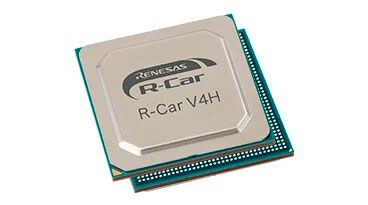
The strategic collaboration between iMotion and Renesas has been in place since 2020. The R-Car V4H in particular would have impressed with its balance of computing power, energy efficiency and scalability. The R-Car V4H system-on-chip (SoC) is manufactured using the 7 nm CMOS process and contains an integrated Arm Cortex-R52 core, which makes an external microcontroller obsolete. This increases the efficiency of the chip and reduces power consumption, PCB size and BOM costs. The SoC also integrates a CNN-IP AI accelerator, multiple DSPs and image processing engines optimized for iMotion's software stack.
The R-Car V4H is manufactured using the 7 nm CMOS process and contains an integrated Arm Cortex-R52 core.
(Image: Renesas)
The device is designed for ADAS and automated driving functions and delivers up to 34 TOPS of deep learning performance. It enables ultra-fast image recognition from camera, radar and lidar data, supporting functions such as surround view perception and realistic 3D visualization for autonomous parking. Highly integrated for cost-efficient electronic control units (ECUs), the R-Car V4H meets NCAP 2025 standards and supports Level 2+ autonomy. A dual-chip configuration ensures uninterrupted upgrades and fail-safe operation, which is essential for Level 3 systems.
It is not only the hardware that plays an important role in the partnership, but also the close cooperation with the Renesas engineering team. "We have worked hand in hand with Renesas for two years," explains company founder Walt Song. "The application teams in China and elsewhere have helped us solve critical bandwidth and integration challenges. This high level of collaboration was critical to bringing the iDC500 to market."
New Objectives
iMotion is continuously developing its technology portfolio through the commercialization of additional, complementary technologies such as adaptive cruise control, lane departure warning and collision warning systems as well as driver fatigue detection. The company plans to integrate its new driving assistance algorithm into series production vehicles this year. This is an important step on the way to complete end-to-end navigation from highway assistance to urban door-to-door guidance.
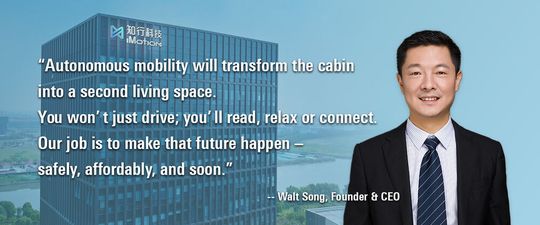
Walt Song, the founder of iMotion Automotive Technology, wants to bring intelligent mobility to the market in more affordable mid-range and entry-level models.
(Image: iMotion)
iMotion expands in Europe and begins market launch in Japan and the ASEAN region. The company is leveraging Renesas' global reach and local service networks to make vehicles safer, smarter and more intuitive. Song explains that this will enable a world in which autonomous vehicles become a mobile extension of the home and workplace: "In the future, autonomous mobility will transform the vehicle interior into a second living space. In the future, it will no longer just be about driving; we will also be able to read, relax or network. Our goal is to make this future a reality—safely, affordably and quickly." (se)
Pu Zhang, Sr Principal Engineer, High Performance Computing, Renesas
Secure and Compliant Authentication in Laboratories



:quality(80)/p7i.vogel.de/wcms/51/1b/511b420dbcc296aec09e3bffb051b8a8/0133581587v1.jpeg "The cables connect numerous machine components—often in confined spaces. (Image:Helu)")
:quality(80)/p7i.vogel.de/wcms/b5/67/b5676f3bfb36251ed31f9a0cccf650b6/0133167827v1.jpeg "Thanks to JumboFlex Generation 2, employees can effortlessly move wheelchairs weighing as much as 40 kilograms. (Image:Lard)")
:quality(80)/p7i.vogel.de/wcms/5e/c6/5ec615b7a51440f668259f2af9158cb9/0132654694v1.jpeg "Strategic Partnerships in Industry: As buyers and restructuring partners, Chinese investors are increasingly helping to preserve jobs in Germany. (Image: ©Anatolii Rymarchuk - stock.adobe.com)")
:quality(80)/p7i.vogel.de/wcms/eb/2b/eb2bd1b8487afe577b37363cd02f16ff/0113143253v1.jpeg "In our China Market Insider, we regularly provide you with relevant information straight from China. (Image:© Eisenhans - stock.adobe.com)")
:quality(80)/p7i.vogel.de/wcms/aa/3e/aa3e2603a812f8e7d33c00ba8ae28c9f/0133507886v1.jpeg "With the Iggy Rob, igus is bringing a humanoid robot into factories for a price of 47,999 euros ($54,718). (Image: igus)")
:quality(80)/p7i.vogel.de/wcms/92/64/92645c64ffbb6980976d39102388d120/0113143253v1.jpeg "In our China Market Insider, we regularly provide you with relevant information straight from China. (Image:© Eisenhans - stock.adobe.com)")
:quality(80)/p7i.vogel.de/wcms/c7/05/c70542511e0824ee491f7b55e21fa429/0133598424v1.jpeg "In logistics, AI is often implemented only on a case-by-case basis; data is stored in separate systems, and inventory levels, status values, and priorities are not defined consistently. (Image: ©m-project - stock.adobe.com)")
:quality(80)/p7i.vogel.de/wcms/3a/9c/3a9c1fd546e1f041b86bb1d03cf39101/0133610524v1.jpeg "The Mason W-01 combines industrial-grade humanoid hardware, Physical AI-based perception, and autonomous task planning. (Image:Nova X Robotics)")
:quality(80)/p7i.vogel.de/wcms/e7/94/e794290f265afbd0ffc7a06c4fe9d425/adobestock-1887113836--hypnotics-14-stock-adobe-com-ki-generiertv1.jpeg "In both autonomous driving and industrial production, there is growing skepticism as to whether full autonomy is always desirable. (Source: © Hypnotics 14 – stock.adobe.com / AI-generated)")
:quality(80)/p7i.vogel.de/wcms/a8/71/a8712e5c6ef536228444ab5275cedfe2/adobestock-340905887--gorodenkoff-stock-adobe-comv1.jpeg "A new position paper outlines the conditions that the business community, academia, and policymakers must jointly establish in order to ensure the long-term viability of industry in Germany and Europe. (Source: © Gorodenkoff – stock.adobe.com)")
:quality(80)/p7i.vogel.de/wcms/7d/eb/7deb25ca674fa4c781a9d1fab083f7cf/parker-entwicklungszentrum-hresv1.jpeg "The centerpiece of the Parker Center for Drive and Control Technology in Offenbach is the exhibition area. (Source: Parker Hannifin)")
:quality(80)/p7i.vogel.de/wcms/3d/ff/3dff5e51c24b30c8dc37c1d024887157/0133602931v1.jpeg "Just a few years ago, SpaceX specialists were working on the world’s largest rocket—the Starship. Now, Elon Musk’s company has reached a milestone during a test flight: Earth’s orbit! But there was also a downside... (Image: SpaceX)")
:quality(80)/p7i.vogel.de/wcms/78/ab/78abbfbab0565fabb19efe637aea30e8/nio-power-swap-station-4-china-guangzhou-2024-1400x933-jpgv1.webp "Nio and Geely are collaborating on battery replacement for electric cars. (Source: Nio)")
:quality(80)/p7i.vogel.de/wcms/2e/58/2e58c664e733dd182666606f850c5da4/0133400664v1.jpeg "The IM6 is sort of the crossover version of the IM5. (Image:MG Motor)")
:quality(80)/p7i.vogel.de/wcms/40/5f/405f41f4075e8798878011f0932a8195/0133509065v1.jpeg "Caruso has integrated Hyundai into its platform. (Image:Hyundai)")
:quality(80)/p7i.vogel.de/wcms/06/98/06989beb3f95b8fb06d71190c86cffde/tabletv1.jpeg "The cockpit view during a test drive in the simulator. (Source: Uccello et al., IEEE OJITS 2026)")
:quality(80)/p7i.vogel.de/wcms/40/34/4034915f85470ad8264659267e4f02d0/0133655653v1.jpeg "Cariad, Volkswagen's software subsidiary, continues to struggle. Now, another round of layoffs has been announced, which will result in the loss of many jobs ... (Image:Cariad)")
:quality(80)/p7i.vogel.de/wcms/e4/2a/e42af12e2a0816bb3d25fac9932903e9/0133646920v1.jpeg "TSMC's U.S. headquarters in Arizona: According to various media reports, the world's largest contract semiconductor manufacturer may be planning to build up to six additional fabs in the state of Texas. (Image:TSMC)")
:quality(80)/p7i.vogel.de/wcms/de/8c/de8c694e560ce8e8d7d43fa5b91917b3/0133668420v1.jpeg "Open-source AI tools: DeepSeek and Huawei are making programming tools for Ascend processors available, with the aim of simplifying development, chip communication, and AI computations on Huawei's hardware—and thereby intensifying competition with Nvidia. (Image:Dall-E / AI-generated)")
:quality(80)/p7i.vogel.de/wcms/86/25/8625a62499a6e70e629a2ddde2f01dcb/0133671173v1.jpeg "\"OpenAI\" has repeatedly experienced problems in which AI models have accessed the internet without authorization in order to carry out their tasks. The company has now fired three people whom it no longer trusts ... (Image:AI-generated)")
:fill(fff,0)/images.vogel.de/vogelonline/companyimg/76800/76895/65.jpg "FAULHABER_120mm.jpg ()")
:fill(fff,0)/p7i.vogel.de/companies/69/de/69de1b7403b0d/simtos-logo.jpeg "simtos-logo (SIMTOS)")
:quality(80):fill(efefef,0)/p7i.vogel.de/wcms/67/ac/67acb931a438c/elatec-wp-gmp.png "Elatec WP GMP")
:quality(80)/p7i.vogel.de/wcms/af/7c/af7cd87cd9c99f3ec21442f192992bae/0128044433v1.jpeg "In an SDV, software is the central product. It enables functions such as over-the-air updates, personalized driving experiences, and automated driving. To make this possible, the way vehicles are developed and designed must be fundamentally reimagined. (Image:Intellias)")
:quality(80)/p7i.vogel.de/wcms/83/43/834308b924a1309c6755fdf8d2c5ef52/zf-20-282-29-1915x1078v1.png "ZF and Horizon Robotics announced a collaboration to launch an advanced driver assistance system (ADAS) for the Chinese market supporting up to SAE Level 3 of automated driving and China’s urban “Navigation on Autopilot” (NOA). Pictured: Dr. Christian Brenneke, head of ZF’s Electronics & ADAS division, and Dr. Yu Kai, Founder & CEO of Horizon Robotics. (Image: ZF)")