Gear designOptimized tooth engagement through targeted deformed gearwheels
From
Dr.-Ing. Franz-Werner Adrian, Adrian Technologies, Prof. Jörg Adrian, Technische Hochschule Nürnberg Georg Simon Ohm | Translated by AI
7 min Reading Time
In order to optimize the load-bearing image of the teeth for all load conditions with the gearwheel, a load-dependent, targeted deformation of the wheel rim is generated so that the gearwheel remains perpendicular to the centerline of the unformed shaft.
The idea of the project is to design gears so that the load-bearing image is optimal not only at a certain load, but over a wide range of use.
(Image: antonmatveev - stock.adobe.com)
Current practice in mechanical engineering is to optimize the load distribution, and thus the performance of the gearswheel, for a specific load point. However, the load to be transferred or the torque to be transferred fluctuates over time in almost all applications. As a result, the gear stage is operated predominantly in non-optimal operating points. It was recognized that there is potential for improvement in a joint project conducted two years ago by drive technology manufacturer Adrian Technologies GmbH and the Faculty of Mechanical Engineering and Supply Technology at TH Nürnberg (all Germany). The participants set themselves the goal of achieving an optimized load distribution of the gears over a wide range of application. The idea was to improve the gear meshing by deliberately deformed gearswheels. The analytical calculations and simulations are promising.
In gearwheel design, the load-bearing verification [5] is of particular importance. The ideal engagement of two meshing teeth with a large contact area over the entire tooth width does not always occur even with straight-toothed gears. The load-bearing image is negatively influenced by a multitude of factors:
Firstly, a manufacturing deviation should be mentioned, which already generates a partially stronger load.
Additionally, deformations during operation often have a negative impact.
Additionally, optimization is carried out for only one load condition. When loads vary, different deformations occur on the gearwheel, which generally have a negative impact on the tooth load distribution.
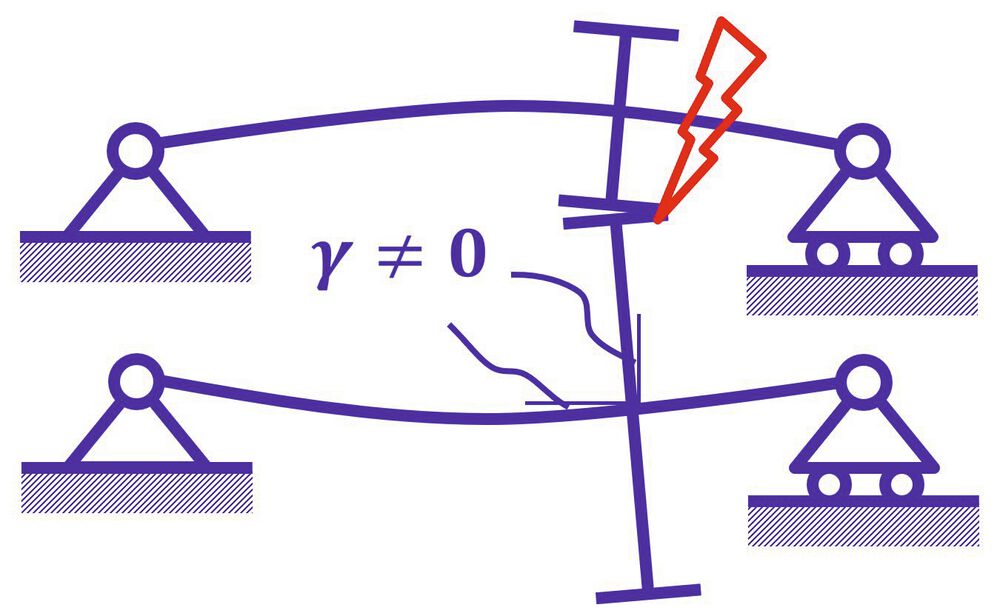
In addition to this, the applied load leads not only to the deformation of the gearwheel due to the radial force component, but also to a deformation of the shaft, which also influences the tooth load distribution of the spur gear pair.
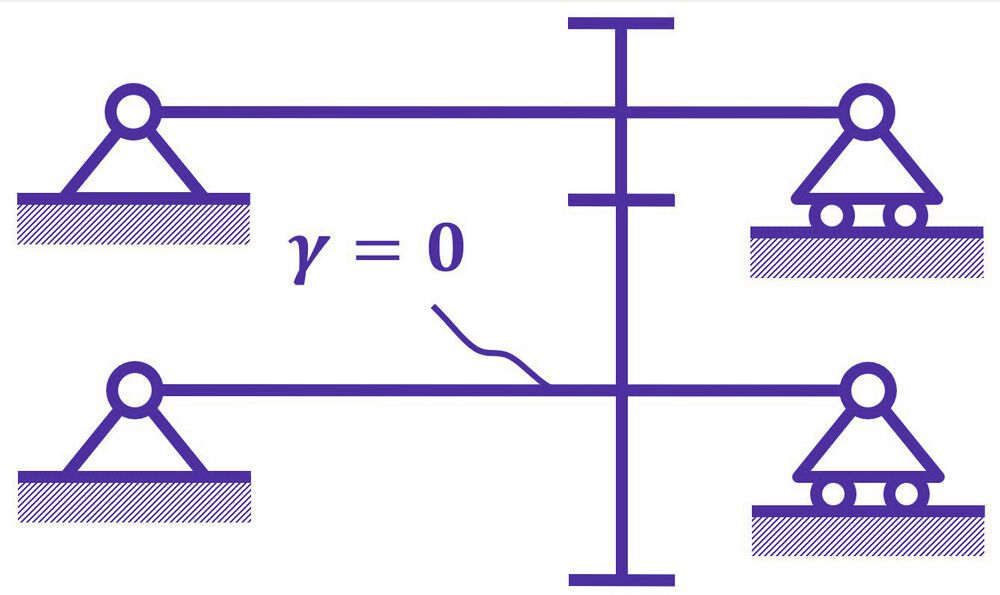
Classic design of a spur gear pair in the unloaded state: the tooth load distribution is optimal.
(Image:Adrian Technologies/TH Nuremberg)
Loaded spur gear pair: The contact pattern is not optimal.
(Image:Adrian Technologies/TH Nuremberg)
These effects of an uneven force distribution over the tooth width are taken into account in the load capacity analysis via the flank load KHβ. The deviations from production are taken into account via the manufacturing-related flank line deviation fma and the assembly as well as the elastic deformations via the flank line deviation due to deformation fsh. The pinion position to the bearings also flows into this via the factor K'.
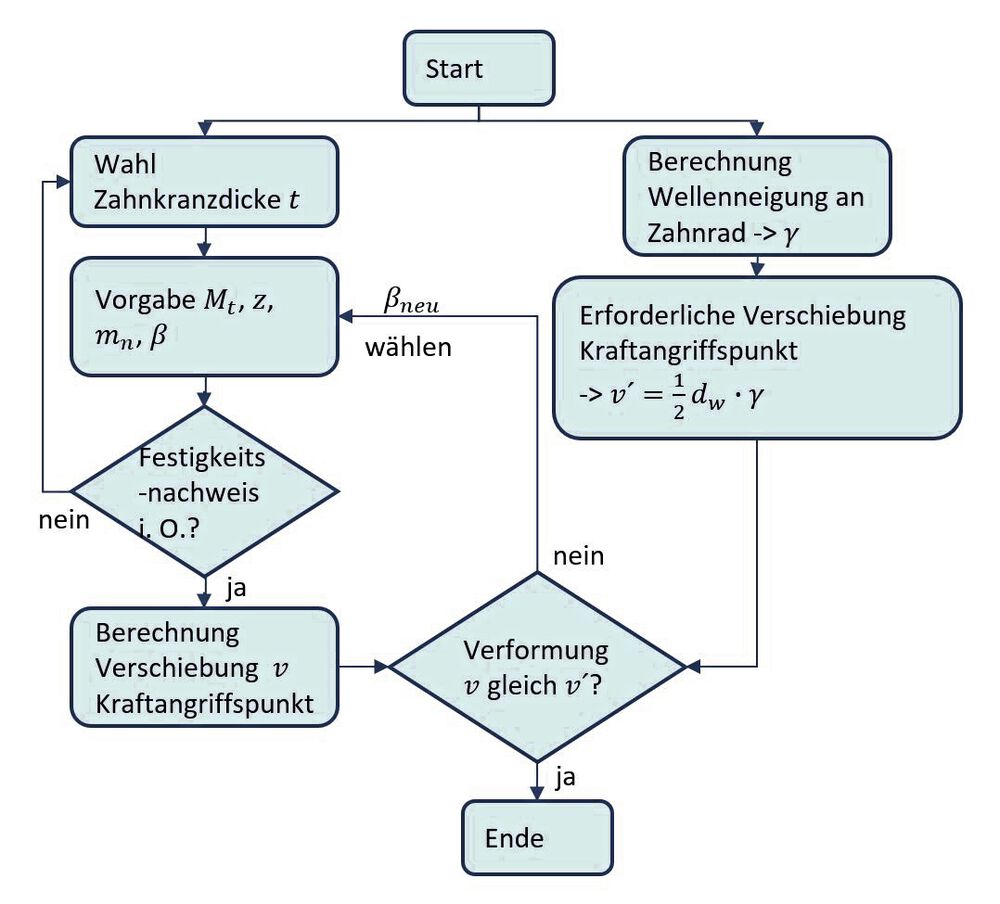
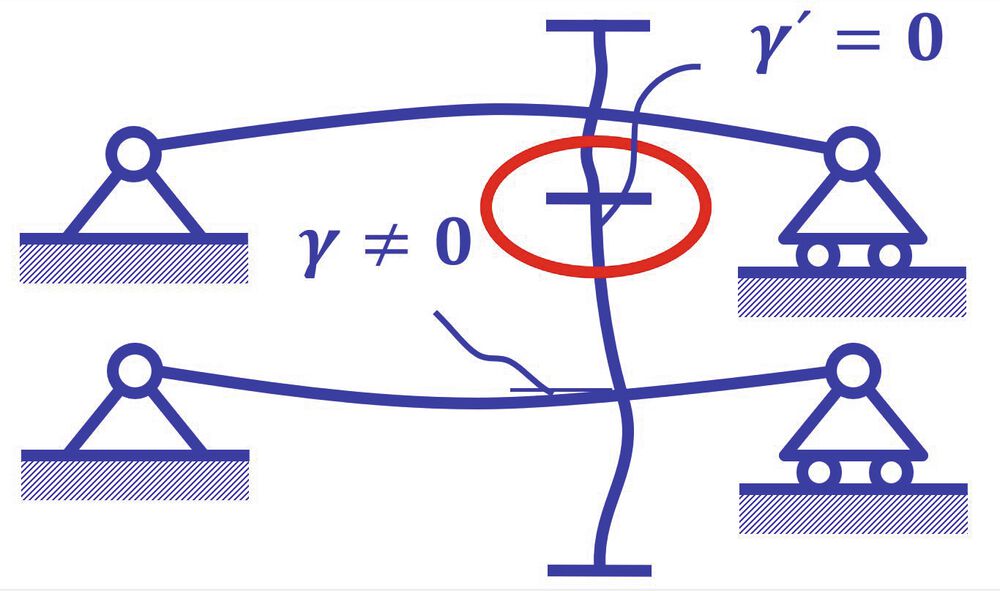
The aim is now to generate a load-dependent and targeted deformation of the wheel rim of the gears, so that the gear always remains perpendicular to the centerline of the undeformed shaft. This way, an optimal load distribution of the teeth in the tooth engagement can be generated for all load conditions. The deformation is determined by two factors: On the one hand, the stiffness is determined by the thickness of the wheel rim receptacle, on the other hand, the axial force for deforming the support is adjusted via the helix angle β. It should be noted that this method can only be applied for torsional moments with a constant direction of rotation. In the case of changing torque directions, a significantly negative state would be created after the reversal of the direction of rotation.
Optimization process: This is how the wheel rim can be optimized.
(Image:Adrian Technologies/TH Nürnberg)
Objective of the optimization: In the loaded state, there is optimal tooth engagement.
(Image:Adrian Technologies/TH Nürnberg)
Under the premise of the conventional roller bearing of gear shafts and the maximum allowable inclination of the shafts in the bearing points, in this use case according to [3], thin discs with small deflections can be assumed. This allows the application of the Kirchhoff model to the gear rim.
This minor deformation makes the structural theory of the first order applicable to plate theory, which allows a combination of disc theory for the radial and tangential force in helically cut spur gears with the plate theory of the axial force of the helically cut gear.
Determining the tilt angle of the gear
The process begins with the calculation of the bending line of the shaft. At the position of the gear, the inclination angle γ of the shaft is to be determined, which determines the inclination angle of the gear to be compensated. The approach is determined analytically according to [6] using a simplified shaft. The shaft is examined in a simplified manner, undercuts, grooves for retaining rings or even the transverse pressed joint are not considered in the examination of the bending line.
Radial and tangential force component
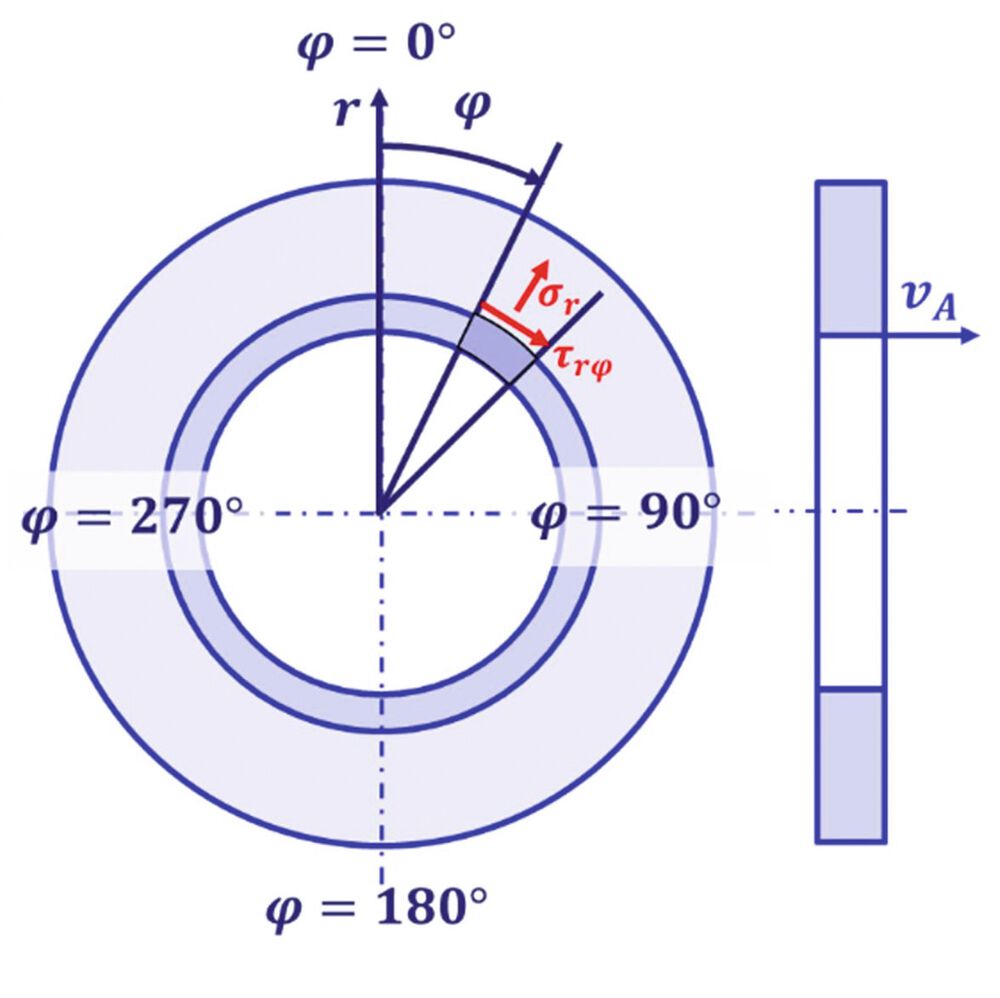
The radial force and the tangential force of the tooth engagement act in the median plane of the examined gear body. Since the loads occur within the median plane of the gear body, in this case the application of disk theory is sufficient. All stress and strain components are assumed to be constant over the gear body thickness t.
For both disc theories, the outer radius ra is defined as fixed in place. The radial beam from the centerline of the gear body to the point of force application is defined with the coordinate axis r. This results in the coordinate system in polar coordinates for the disc theories.
Date: 08.12.2025
Naturally, we always handle your personal data responsibly. Any personal data we receive from you is processed in accordance with applicable data protection legislation. For detailed information please see our privacy policy.
Consent to the use of data for promotional purposes
I hereby consent to Vogel Communications Group GmbH & Co. KG, Max-Planck-Str. 7-9, 97082 Würzburg including any affiliated companies according to §§ 15 et seq. AktG (hereafter: Vogel Communications Group) using my e-mail address to send editorial newsletters. A list of all affiliated companies can be found here
Newsletter content may include all products and services of any companies mentioned above, including for example specialist journals and books, events and fairs as well as event-related products and services, print and digital media offers and services such as additional (editorial) newsletters, raffles, lead campaigns, market research both online and offline, specialist webportals and e-learning offers. In case my personal telephone number has also been collected, it may be used for offers of aforementioned products, for services of the companies mentioned above, and market research purposes.
Additionally, my consent also includes the processing of my email address and telephone number for data matching for marketing purposes with select advertising partners such as LinkedIn, Google, and Meta. For this, Vogel Communications Group may transmit said data in hashed form to the advertising partners who then use said data to determine whether I am also a member of the mentioned advertising partner portals. Vogel Communications Group uses this feature for the purposes of re-targeting (up-selling, cross-selling, and customer loyalty), generating so-called look-alike audiences for acquisition of new customers, and as basis for exclusion for on-going advertising campaigns. Further information can be found in section “data matching for marketing purposes”.
In case I access protected data on Internet portals of Vogel Communications Group including any affiliated companies according to §§ 15 et seq. AktG, I need to provide further data in order to register for the access to such content. In return for this free access to editorial content, my data may be used in accordance with this consent for the purposes stated here. This does not apply to data matching for marketing purposes.
Right of revocation
I understand that I can revoke my consent at will. My revocation does not change the lawfulness of data processing that was conducted based on my consent leading up to my revocation. One option to declare my revocation is to use the contact form found at https://contact.vogel.de. In case I no longer wish to receive certain newsletters, I have subscribed to, I can also click on the unsubscribe link included at the end of a newsletter. Further information regarding my right of revocation and the implementation of it as well as the consequences of my revocation can be found in the data protection declaration, section editorial newsletter.
Axial force component of the gear engagement
The axial force occurring in helical gears acts perpendicular to the median plane of the wheel body and will cause a bending of the wheel body. This bending should be adjusted so that the centerline of the deformed tooth rim is parallel to the centerline of the unformed shaft. Thus, the inclination angle with positioning between the bearing locations will be less than the allowable inclination in the roller bearing locations. Due to the restrictive limitation of the inclination angle in bearing locations, in the applied plate theory, small deflections compared to the wheel body thickness must be assumed and thus a superposition of the results with the results of the disk consideration is possible.
The gear mesh forces are considered separately and finally the deformations are superimposed by superposition.
Comparison with FEM simulation
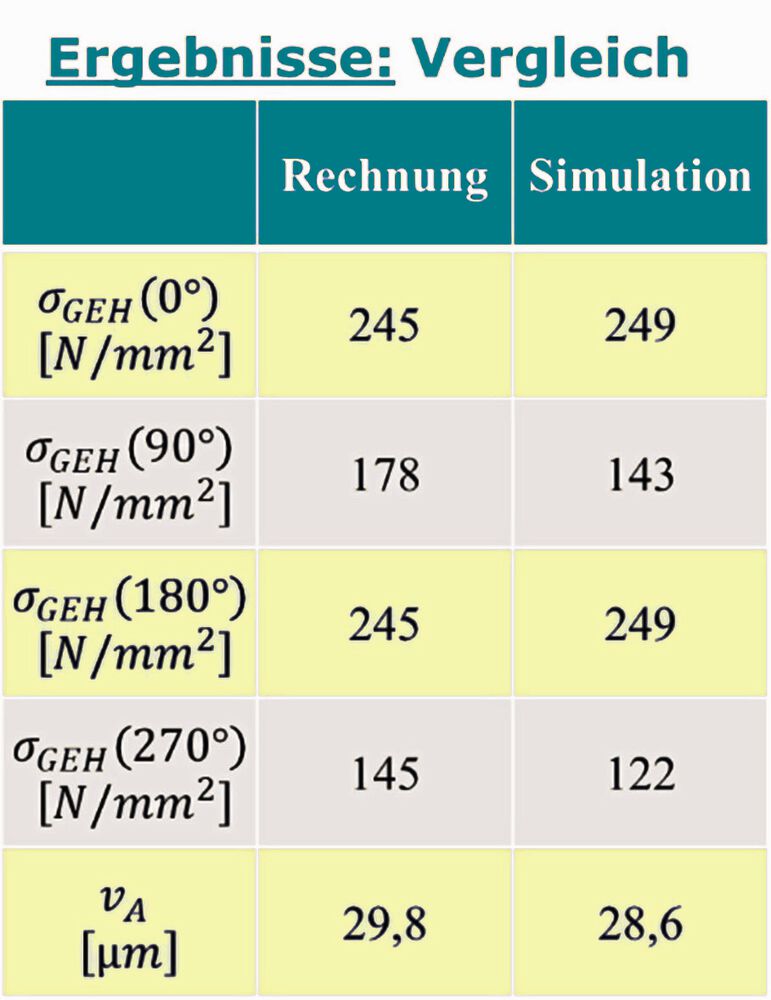
The axial displacement of the tooth contact point in the analytical calculation is 30 µm. In the simulation, a displacement in the opposite direction of 29 µm is obtained.
(Image:Adrian Technologies/TH Nuremberg)
The greatest stresses were expected on the inner ring and therefore determined and compared at the four circumferential points at Phi equal to 0°, 90°, 180°, and 270°. The stresses are determined very conservatively through the analytical calculation and thus have safety in the design. The displacement in the longitudinal direction v(A) is given in a displacement in µm, the difference is about 1 µm. This deviation is less than the later occurring manufacturing tolerances on the component.
(Image:Adrian Technologies/TH Nürnberg)
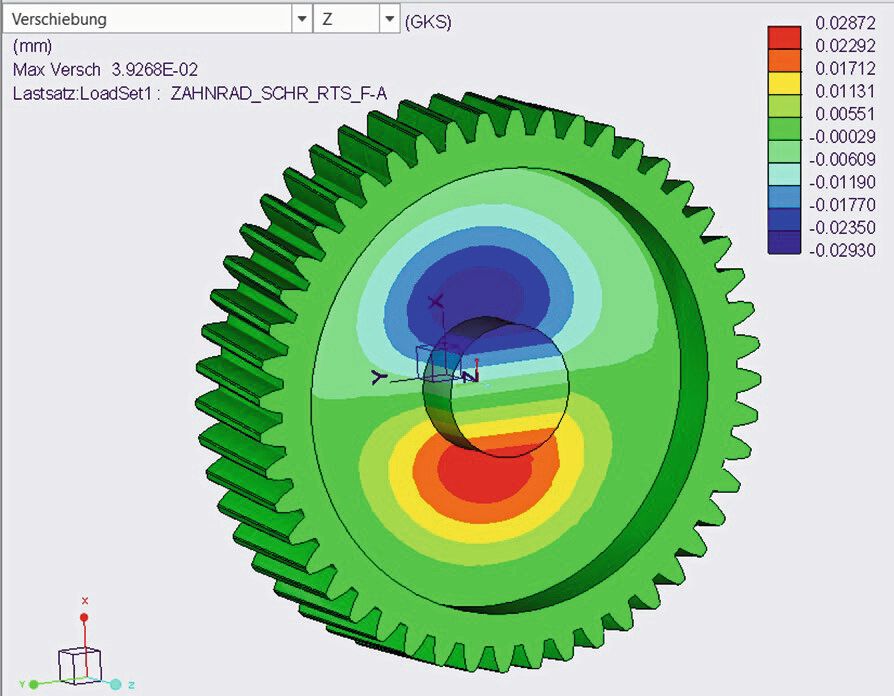
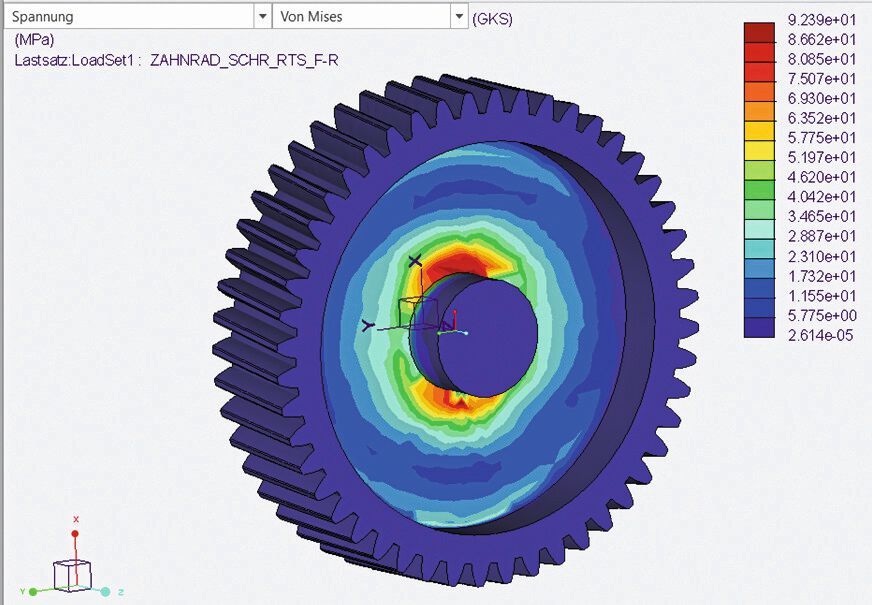
In the FEM simulation, the force components of the axial, radial, and tangential force are simulated separately. In addition to comparing these results with the calculation, the von Mises comparative stress is also calculated. This must not exceed the permissible stress of the wheel body. The optimization is achieved by a thicker wheel rim in case of too high comparative stress and an adjustment of the inclination angle β of the teeth to optimize the elastic deformation of the wheel rim.
The simulation shows the deformation of the wheel bodies.
(Image:Adrian Technologies/TH Nuremberg)
This is the stress diagram from the simulation for a specific radial load.
(Image:Adrian Technologies/TH Nuremberg)
This is accompanied by the determination of the deformation of the wheel rim. As can be seen in the table, the analytical calculation results in an axial displacement of the tooth contact point (rolling point C) of 30 µm, and the simulation results in a compensatory displacement in the opposite direction of 29 µm. This means that the negative influence on the load distribution caused by the inclination of the shaft can be almost completely compensated for.
The results show a sufficient agreement of the analytical calculation with the FEM simulation, thus suggesting a realistic representation of the analytical calculations. Tests that are planned as a second step are still pending. (dm)
Sources:
[1] Göldner, H. and others; "Textbook Higher Strength Theory"; Leipzig: Fachbuchverlag; Volume 1 Principles of Elasticity Theory; 3rd edition; ISBN 3-343-00495-2
[2] Göldner, H. and others; "Exercise Book Higher Strength Theory"; Leipzig: VEB Fachbuchverlag; Elasticity Theory, Plasticity Theory, Viscoelasticity Theory; 1978; ISBN 3-87664-037-7
[3] Altenbach, H. and others; "Flat Surface Structures"; Berlin: Springer-Vieweg-Verlag; Basics of modelling and calculation of disks and plates; 2nd edition; 2016; ISBN 978-3-662-47229-3
[4] Muschelischwili, N. I.; "Some Basic Tasks of Mathematical Elasticity Theory"; Munich: Carl Hanser Verlag; 1971; ISBN 3-446-10089-X
[5] DIN 3990-1 - Load capacity calculation of spur gears - Introduction and general influencing factors; Beuth-Verlag; December 1987
[6] Wittel, H. and others; "Roloff/Matek Machine Elements"; Springer-Verlag; 24th edition; ISBN 978-3-658-26279-2



:quality(80)/p7i.vogel.de/wcms/53/f7/53f7dadbe4d656a3fd4f4077445f29f6/0129828707v1.jpeg "Thanks to its compact design and drilling/unscrewing function, the Fire Birdie is suitable for applications with limited installation space and frequent tool changes. (Image:Marcel Kraibühler)")
:quality(80)/p7i.vogel.de/wcms/da/4d/da4da8d34671dc6bce80e496212de877/0129850788v1.jpeg "Mate-XT Go supports the arms and shoulders during overhead work and repetitive tasks and is designed to significantly reduce muscle strain in everyday working life. (Image:Comau)")
:quality(80)/p7i.vogel.de/wcms/95/97/95976dbaac68b249eb65e74c5aad5300/0129651893v1.jpeg "The C2.0 centric clamps, the S2 fixed jaw clamps and the \"gredoc\" zero-point clamping systems are used for machining the raw parts. Fastening is carried out with width across flats 27. (Image:Gressel)")
:quality(80)/p7i.vogel.de/wcms/57/1b/571b8895efb299d70846bbdbd7af2338/0130043886v1.jpeg "Servo hydraulics independent of the control system: The servo hydraulics software module is integrated directly into the b Maxx 5500 servo drive (pictured: Mehmet Sari, Export Sales Manager at Hürsan Pres (left), Özgür Deniz Demirbaş, Country Manager at Baumüller Turkey) (Image:Baumüller)")
:quality(80)/p7i.vogel.de/wcms/3b/27/3b27f6c5848be73acecb04054bf0a146/0130115209v1.jpeg "Spectroscopic glucose measurement with infrared spectroscopy enables more regular measurements without physical strain. (Image:Endrich)")
:quality(80)/p7i.vogel.de/wcms/3f/cc/3fccb748b0fe16f1f61249d94c72f126/0130149439v1.jpeg "Requirements for integrated power supply systems: Precise AC and DC power supply systems that not only provide energy, but also reliably combine measurement, analysis and system integration. (Image:Schulz Electronic)")
:quality(80)/p7i.vogel.de/wcms/fd/93/fd93e01c16f5a4709278499d981a459c/0130061090v1.jpeg "Revealed: These servo drives are assembled at Aerotech in Fürth. (Image:Aerotech)")
:quality(80)/p7i.vogel.de/wcms/cb/8a/cb8ae7f5205365efce3e7285154fc3cf/0130132198v1.jpeg "Markus Huber (left) and Nicolai Friis from TU Wien know how to make quantum computers multidimensional in order to perform computing operations even better. (Image:TU Vienna / A. Rommel)")
:quality(80)/p7i.vogel.de/wcms/63/21/6321beb732bf7d92640df46d7aa77573/0130125122v1.jpeg "As part of the Carbon Lab Factory Lausitz, a pilot plant for the production of sustainable, cost-effective and competitive carbon fibers will be built at the Guben site. (Image:Fraunhofer IAP / Kristin Stein)")
:quality(80)/p7i.vogel.de/wcms/53/4f/534fe0f168f6ee070ded4a48faca4cef/business-wire-main-image-1103x620v1.jpeg "The new UR AI Trainer, developed by Universal Robots and Scale AI, is the first direct lab-to-factory solution for AI model training.
(Source: Universal Robots)")
:quality(80)/p7i.vogel.de/wcms/08/70/087062e2e1a9b9add5777410dd746ee9/adobestock-1923991605-5607x3156v1v1.jpeg "A new type of tactile sensor, inspired by human skin, even recognizes grains of sand. (Image:Curioso.Photography - stock.adobe.com)")
:quality(80)/p7i.vogel.de/wcms/7f/08/7f087d7013424d123ab7275cd2e3fe55/adobestock-809456218--c2-a9-20degimages-20-e2-80-93-20stock-adobe-com-ki-generiert-4179x2351v1v1.jpeg "The digital upgrading of existing machines conserves resources, saves energy and reduces the need for new production. (Image:Degimages - stock.adobe.com/AI-generated)")
:quality(80)/p7i.vogel.de/wcms/90/db/90db3087d3af0560fcdb4dbc42443ce1/0130157448v1.jpeg "The switch to SDV is the most complex transformation the industry has ever had to master. The end consumer gets a vehicle that gains rather than loses value over its lifetime. (Image:Sonatus)")
:quality(80)/p7i.vogel.de/wcms/73/f0/73f00bb99a23197db05bb584fe78f20f/0130080581v1.jpeg "The \"China Speed\" analysis by Roland Berger shows that the speed of development has only a limited connection with labor costs. (Image:freely licensed at Pexels)")
:quality(80)/p7i.vogel.de/wcms/2f/5b/2f5ba6a150b52c2b8efada560c5cdafe/0130143442v1.jpeg "Automotive suppliers are facing a severe crisis, which is primarily due to a combination of structural change and economic problems. (Image:freely licensed at Pexels)")
:quality(80)/p7i.vogel.de/wcms/22/d0/22d03cd48e992435338b59464c428d41/0129739814v1.jpeg "More electric vehicles on the roads mean a higher demand for electricity - which should ideally be covered by renewable energies. (Image:BMW)")
:quality(80)/p7i.vogel.de/wcms/94/7a/947ac066b98cbcd3470e83ff9da3e25f/0130096114v1.jpeg "The use of amorphous steels in the stator enables a significant reduction in losses and increases the efficiency of modern electric motors in vehicle drives. (Image:Horse Powertrain)")
:quality(80)/p7i.vogel.de/wcms/e5/f1/e5f171d3d7ae021332cc0aeae4d6e299/0130127049v1.jpeg "In collaboration with Shanghai Jiao Tong University, Lenovo has presented a silicon anode battery under the name \"ED1000\" as a proof of concept for mobile workstations. (Image:Lenovo)")
:quality(80)/p7i.vogel.de/wcms/fa/69/fa696e59706b96fff02283dd74cc2398/0130129635v1.jpeg "Samsung Co-CEO Jun Young-hyun wants to respond to the AI-driven boom in demand in the memory market with contracts for up to five years. This should provide more planning security in the traditionally volatile storage business. At the same time, however, this is likely to increase the pressure on customers to secure precise long-term requirements, prices and supply chains. (Image:Samsung)")
:quality(80)/p7i.vogel.de/wcms/31/a8/31a883a47b86634c382923e78fd9a4c9/0130133225v1.jpeg "Figure 1: GMSL-capable point-to-point connection. (Image:ADI)")
:quality(80)/p7i.vogel.de/wcms/49/eb/49ebc645dd0d5b9f556f7674bd68675d/0117175872.jpeg "Classic design of a spur gear pair in the unloaded state: the tooth load distribution is optimal.(Image: Adrian Technologies/TH Nuremberg)")
:quality(80)/p7i.vogel.de/wcms/80/1d/801d3253e901b06b588fd22921955d1d/0117175876.jpeg "Loaded spur gear pair: The contact pattern is not optimal.(Image: Adrian Technologies/TH Nuremberg)")
:quality(80)/p7i.vogel.de/wcms/d1/a2/d1a21e3cfd030072d1f23fcc3e1dea51/0117188970.jpeg "Optimization process: This is how the wheel rim can be optimized.(Image: Adrian Technologies/TH Nürnberg)")
:quality(80)/p7i.vogel.de/wcms/fd/87/fd87f0c8fc171b6995123d7aa81e1ae5/0117175881.jpeg "Objective of the optimization: In the loaded state, there is optimal tooth engagement.(Image: Adrian Technologies/TH Nürnberg)")
:quality(80)/p7i.vogel.de/wcms/0b/97/0b97263190195d8c92455be45ef64b0b/0123798462v1.jpeg "Ringspann manufactures this helical coupling as a one-piece solution from stainless steel or aluminum. Helically running grooves—the helices—give the shaft connection flexible areas with precisely calculable elasticity. (Image:Ringspann)")
:quality(80)/p7i.vogel.de/wcms/c9/29/c929cd37395c3e8b8eb4feab75bb677d/0124603143v1.jpeg "Rolling bearings can be divided into ball bearings and roller bearings. Spherical roller bearings, like in the picture here, can take high loads in both directions. They are self-aligning and can compensate for misalignments and shaft deflections without significantly increasing friction losses or temperature. (Image:SKF)")