The information demand from users, science, and regulations on the engineering and use of products and resources is growing. This poses great challenges for manufacturers and operators of production systems.
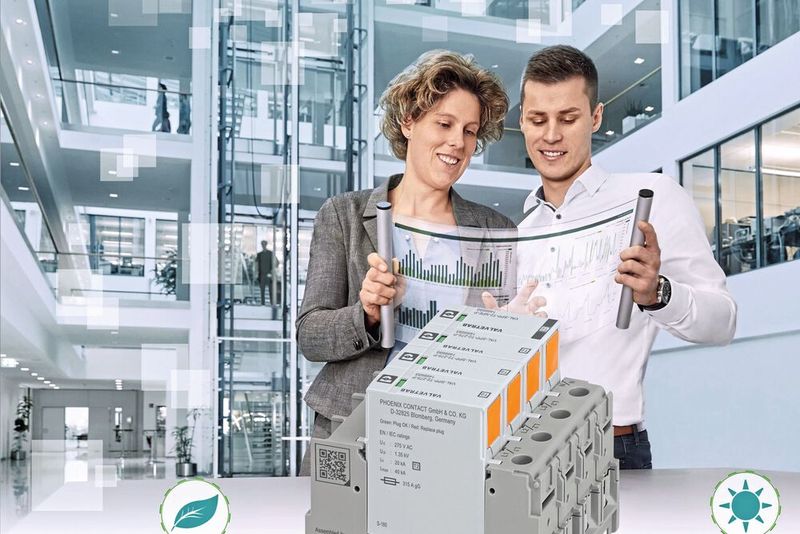
The growing information demand poses increasing challenges for manufacturers and operators of products and resources.
(Image: Phoenix Contact)
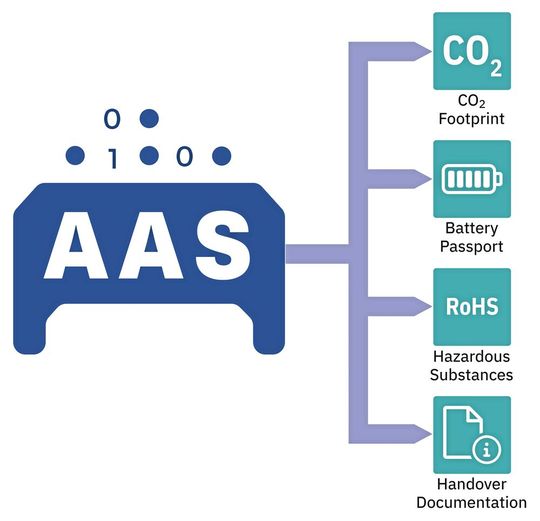
Information such as product data, declaration of used materials (such as RoHS or REAcH), display of the CO2 footprint along the value chain, or the battery passport proves to be demanding. This also applies to the industrial needs to provide these data paperlessly, automatically, cost-effectively, and internationally available at all times. The described challenges require a comprehensive understanding and implementation of data chains within and across company boundaries. To reduce costs and achieve worldwide use, the automated and interoperable availability of data proves to be a key success factor. In broad consensus, companies, component manufacturers, machine and plant builders, as well as associations, see the digital product passport as an industrial, internationally usable response to these requirements.
Data Standards And Uniform Exchange Formats as a Basis
To achieve a sustainable and climate-neutral economy and society, digitalization and networking are crucial aspects. The European Green Deal is the EU's path towards a circular economy and climate neutrality. It aims to create as much transparency as possible regarding supply chains. The digital product passport serves as an instrument for implementing the Green Deal. It continuously provides all relevant information throughout a product's entire lifecycle. The digital product passport thus meets the regulatory requirements regarding the materials and chemical substances used. It provides information on the batteries used, spare parts, repairs, and proper disposal.
Opportunities for New Business Models
In addition to mapping regulatory requirements, the digital product passport can become an essential component for manufacturers. Digitally provided product documentation and package inserts contribute to cost reduction as there are no printing costs. At the same time, they take into account the sustainability aspect by reducing paper circulation. Furthermore, with the help of the digital product passport, customer-specific digital services or additional information can be offered, providing added value to the customer. Thus, new business models can be developed that accelerate or facilitate the exchange of information.
For efficient processes, it is necessary that data communication takes place across industries as automatically, seamlessly, and with as little administrative effort as possible. Therefore, the digital product passport must be based on data standards and uniform exchange formats. Industry-wide data standards help simplify processes and thus operate more profitably. Moreover, uniform interfaces ensure secure communication and contribute to process continuity and optimization.
Seamless Communication in And Between IT And OT SSystems
In the sense of Industry 4.0, assets—such as produced components or machines—are merging with their digital twins. The assets interact on the digital level with IT and OT systems from different manufacturers. This requires mechanisms that ensure high acceptance of the technologies used. Only then can the data be made available and used in communication networks between companies or production systems (horizontal interaction) and within production systems down to the component level (vertical interaction).
The Asset Administration Shell (AAS) or the digital twin provides a consistent and, in essential aspects, standardized technical concept for this. With the AAS, seamless data transmission between and within OT and IT systems can be achieved. This is accomplished through uniform communication, uniform authentication of any participants, and the ability to interpret information across domains.
Standardization of Data Models By IDTA
The AAS includes sub-models that structure and represent product information.
(Image: Phoenix Contact)
In the network of the Plattform Industrie 4.0, important groundwork has been developed with the technologies of the AAS and brought to initial implementations. To ensure interoperability, technological sovereignty, and worldwide provision and further development of the AAS data logistics, cooperative processes of open-source development, supporting associations, and international standardization are utilized. The Industrial Digital Twin Association (IDTA) plays a central role here. It orchestrates the technology development and standardization of the offered data models. As submodels of the AAS, the data models contain the semantics and syntax of individual areas, such as the digital product passport. They can be expanded according to needs. With the AAS, product information can thus be structured and shared throughout the entire product lifecycle.
Date: 08.12.2025
Naturally, we always handle your personal data responsibly. Any personal data we receive from you is processed in accordance with applicable data protection legislation. For detailed information please see our privacy policy.
Consent to the use of data for promotional purposes
I hereby consent to Vogel Communications Group GmbH & Co. KG, Max-Planck-Str. 7-9, 97082 Würzburg including any affiliated companies according to §§ 15 et seq. AktG (hereafter: Vogel Communications Group) using my e-mail address to send editorial newsletters. A list of all affiliated companies can be found here
Newsletter content may include all products and services of any companies mentioned above, including for example specialist journals and books, events and fairs as well as event-related products and services, print and digital media offers and services such as additional (editorial) newsletters, raffles, lead campaigns, market research both online and offline, specialist webportals and e-learning offers. In case my personal telephone number has also been collected, it may be used for offers of aforementioned products, for services of the companies mentioned above, and market research purposes.
Additionally, my consent also includes the processing of my email address and telephone number for data matching for marketing purposes with select advertising partners such as LinkedIn, Google, and Meta. For this, Vogel Communications Group may transmit said data in hashed form to the advertising partners who then use said data to determine whether I am also a member of the mentioned advertising partner portals. Vogel Communications Group uses this feature for the purposes of re-targeting (up-selling, cross-selling, and customer loyalty), generating so-called look-alike audiences for acquisition of new customers, and as basis for exclusion for on-going advertising campaigns. Further information can be found in section “data matching for marketing purposes”.
In case I access protected data on Internet portals of Vogel Communications Group including any affiliated companies according to §§ 15 et seq. AktG, I need to provide further data in order to register for the access to such content. In return for this free access to editorial content, my data may be used in accordance with this consent for the purposes stated here. This does not apply to data matching for marketing purposes.
Right of revocation
I understand that I can revoke my consent at will. My revocation does not change the lawfulness of data processing that was conducted based on my consent leading up to my revocation. One option to declare my revocation is to use the contact form found at https://contact.vogel.de. In case I no longer wish to receive certain newsletters, I have subscribed to, I can also click on the unsubscribe link included at the end of a newsletter. Further information regarding my right of revocation and the implementation of it as well as the consequences of my revocation can be found in the data protection declaration, section editorial newsletter.
The AAS associated with the respective products are accessed through a globally unique identifier. This is printed on the product, for example, as a QR code. The identifier, which the manufacturer organizes independently, gives them the freedom to operate autonomously within their business models. The accompanying standardization activities make the architecture of the AAS (IEC 63278 parts 1 to 5) and the identifier (IEC 61406 parts 1 and 2) available as international standards. Consequently, the use of data for information provision and application in business models is individually enabled across countries and domains down to the component and feature level.
Automatic Calculation of the Product Carbon Footprint of a Control Cabinet
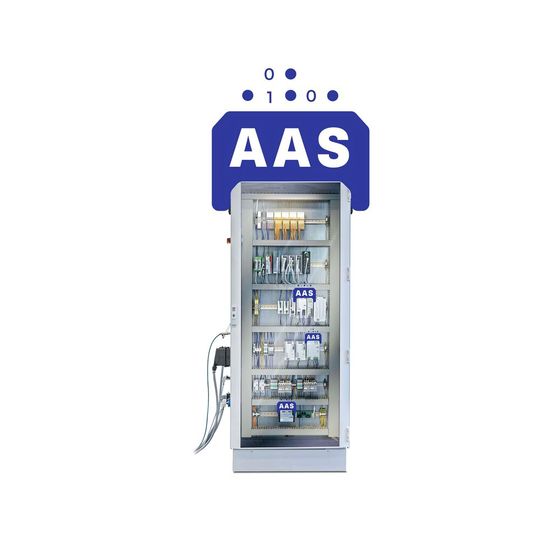
The example of control cabinet construction in the ZVEI illustrates how the framework format of the AAS can be practically realized. In the association's showcase, products from many participating companies are installed. It is demonstrated that the Product Carbon Footprint (PCF) of a control cabinet can be automatically calculated. The determined result is based on the digital nameplate submodel (DNP4.0) and the submodel for the PCF value of the individual items.
The AAS consolidates numerous pieces of information from different manufacturers into a comprehensive picture.
(Image: Phoenix Contact)
Each product installed in the control cabinet includes an AAS. This is accessible via a QR code and provides the instance information explicitly for this product. Based on this information, the cumulative PCF of all products installed there is calculated in the AAS of the entire control cabinet. For this, the software accesses the PCF submodels of the products and determines the complete installation's PCF value from the entered values. In addition to the PCF value, the AAS of the control cabinet provides further information such as the calculation standard. A significant aspect of the AAS is the interoperable information exchange. It allows the consolidation of numerous pieces of information from different globally active manufacturers into a comprehensive picture.
Use Information Automatically
Standardized mechanisms for data transparency promote sustainable actions and save resources when providing and implementing interfaces. Manufacturers of components, as well as machines and equipment, offer their products internationally. They provide their customers with product data and information on engineering and lifecycle. These can include, for example, software updates for intelligent products. With the AAS, this information, often available in individual documents or hard-to-automate PDFs, can now be used automatically. This simplifies processes for both the user and the manufacturer.
To create widespread impact, easy integration of interfaces by the user is needed. Infrastructure requirements similar to setting up an email account in a few hours apply here. The goal is to achieve implementation without significant demands on resources and budget. Integration into productive software systems such as ERP, PLM, and asset management systems or MES for production control is important. At this point, manufacturers and users of productive systems are called upon. They set requirements for software products or produce them, thus generating demand and direct customer benefits in the market. The AAS data logistics connects various companies communicatively with a low entry threshold.
Interoperable in data modeling and secure from external changes and misuse: these are the key technical conditions that go hand in hand with commercial needs. This includes low-effort integration into IT systems or use by mobile devices of users on-site. Optimization of processes, reduction of energy and material resources, promotion of sustainability along the product lifecycle: these aspects result in the economic success of the acting companies. For this purpose, the IDTA provides the technology (AAS architecture) and data models (submodels of the AAS) as open source and supports the IEC's standardization activities.
Significant efficiency potentials and digital value-added offerings
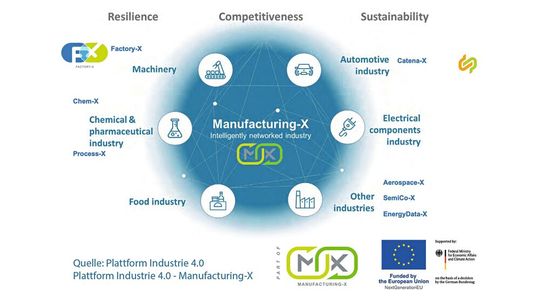
Data spaces for digital ecosystems in the industry create resilience, sustainability, and competitive strength.
(Image: Phoenix Contact)
The advancing digitalization is driving the implementation of AAS data logistics. The realization that significant efficiency potentials and digital value-added offerings can be leveraged through the collaboration of companies along the value chain also applies. Another step in this direction is the discussion and initial realizations of data spaces where companies can interact using digital means. Within the framework of the Manufacturing-X funding initiative, such trust spaces are being created, where companies, machines/resources, and components from different manufacturers can work together.
Examples like the digital product passport or the organization of software updates for a variety of products from different manufacturers show: The requirements for a circular economy, regulation, and product availability can be easily realized.
Wider Dissemination of AAS Data Logistics
Phoenix Contact aims to promote and productively support AAS data logistics and the digital product passport. The company is participating in the ZVEI showcase control cabinet for the digital product passport and in the funding project Factory-X under the Manufacturing-X funding framework with three use cases. In this way, a broader dissemination of the AAS data logistics and a simpler, cost-effective interaction with customers for the automatic provision of product data is to be achieved. Furthermore, Phoenix Contact wants to stand by its customers in the use of its products during their lifecycle. This includes the internationally available fulfillment of verification obligations and maintaining security or functional requirements.
Industry's demand on politics
The Digital Product Passport (DPP 4.0) consists of the Asset Administration Shell (AAS) and the Identification Layer, which can be accessed, for example, via a QR code. The AAS, developed by Plattform Industrie 4.0, is already in use in the industry today. Many companies from various industrial and application areas see the digital product passport DPP 4.0 as a feasible solution for the Digital Product Passport required by the EU.
To implement the Ecodesign Regulation/Digital Product Passport, various federal ministers were already addressed in September 2023 by the associations BDI, Bitkom, VCI, VDA, and VDMA. These include Steffi Lemke, Wolfgang Schmidt, Dr. Volker Wissing, and Dr. Robert Habeck. The aim was and still is to create an EU-wide, highly automatable, user-friendly, and internationally applicable provision of information. This allows product information to be made digitally available and largely cost-neutral.



:quality(80)/p7i.vogel.de/wcms/dd/08/dd086510d9ae7b50181f6070e4463b44/0129363730v1.jpeg "Typical application for ionizing devices: Wrapping films. (Picture: ©Adobe Stock/SMC)")
:quality(80)/p7i.vogel.de/wcms/35/57/3557c819943c53acec41a0ccba87da4f/0130049064v1.jpeg "Researchers at the Fraunhofer IWU in Chemnitz have long known that many typical sheet metal parts can be manufactured more cost-effectively using hollow embossing rollers. Now there is news to report ... (Image:Fraunhofer IWU)")
:quality(80)/p7i.vogel.de/wcms/59/02/590246e3b3f415c65edbee377c14ca77/26-06-pi-fraunhofer-iws-41450-direktplattieren-pic-01-7771x4369v1v1.jpeg "The Fraunhofer IWS has developed the new \"direct laser cladding\" process, which creates a functional layer directly on the base body by applying a strip-shaped metal to rotationally symmetrical components in a spiral and bonding it locally by laser. (Image:Christoph Wilsnack/Fraunhofer IWS)")
:quality(80)/p7i.vogel.de/wcms/73/60/73608418789b1d9c393f5e2fa974eda2/0130209906v1.jpeg "The robots of the X6 generation from b+m enable very high painting quality and are also particularly compact and easy to maintain. (Image:Beckhoff)")
:quality(80)/p7i.vogel.de/wcms/78/e9/78e9188c25a8a94e67c34c9bf8ffe495/visual-agile-20robots-20and-20google-20deepmind-20partner-20to-20bring-20intelligence-20to-20robotics-2500x1406v1v1.jpeg "Together, the partners are developing adaptable, intelligent robots for a wide range of applications (Image:Agile Robots SE)")
:quality(80)/p7i.vogel.de/wcms/e7/66/e7669ecf0260ae8fc54c214e34e4902a/0130316817v1.jpeg "Siemens and Palo Alto Networks offer tested cybersecurity solution for industrial 5G. (Image:Siemens)")
:quality(80)/p7i.vogel.de/wcms/9f/55/9f55324832c4f426958031375124d9de/siemens-20ubtech-20hmnd-1920x1079v1v1.png "Ready for the factory floor: While Ubtech is planning mass production, Siemens is already testing humanoids in real factory applications in Erlangen. (Image:Siemens)")
:quality(80)/p7i.vogel.de/wcms/11/36/113695ed260e29c8c2d9d39dc5f9d869/0130213768v1.jpeg "AI can work cheaply in China and deliver the results rapidly all over the world. (Image:Dall-E / AI-generated)")
:quality(80)/p7i.vogel.de/wcms/62/5f/625f41e87ebfef156a98c8e6393e32fd/0130211654v1.jpeg "Axial flux motors have some advantages over radial flux motor—but their production is currently still expensive. (Image:RWTH Aachen University)")
:quality(80)/p7i.vogel.de/wcms/77/9b/779b0685d010dfe45c9c2cb1cfecd467/0128886425v1.jpeg "The BlueEye is the first \"real\" hyperspectral camera for the UV range and covers the wavelength range from 220 to 380nm. (Image:Inno-spec GmbH)")
:quality(80)/p7i.vogel.de/wcms/e4/51/e451d52ce0182fb0aaa46a5774f832ef/26-04-pi-fraunhofer-iws-21160-bioslide-pic-01-4128x2321v1v1.jpeg "With the BioSlide research project, the Fraunhofer IWS is investigating how sliding systems can be designed to be more sustainable and energy-efficient. New materials can be tested in a particularly application-oriented manner on this plain bearing test stand. (Image:Fraunhofer IWS)")
![Thanks to advanced 3D printing technology, a more efficient use of resources should contribute to lower-emission aviation—this is the goal of ['skai]-lab. (Image:Oleksandr Pashchenko - stock.adobe.com / AI-generated)](https://cdn1.vogel.de/nghHNSbySccfOjG3n1qCA-FVOjQ=/288x162/smart/filters:format(jpg):quality(80)/p7i.vogel.de/wcms/62/64/626424c97a16e69f871bf216c9629c2a/adobestock-1927043193--c2-a9-20oleksandr-20pashchenko-20-e2-80-93-20stock-adobe-com-ki-generiertv1v1.jpeg "Thanks to advanced 3D printing technology, a more efficient use of resources should contribute to lower-emission aviation—this is the goal of ['skai]-lab. (Image:Oleksandr Pashchenko - stock.adobe.com / AI-generated)")
:quality(80)/p7i.vogel.de/wcms/c3/c4/c3c4ce270b083eeac55654148611f064/0130237945v1.jpeg "China is not giving up on hydrogen, but is intensifying its efforts. (Image:freely licensed from Pixabay)")
:quality(80)/p7i.vogel.de/wcms/4e/c0/4ec0bd19390b169edfa23677373dcdf1/0130260089v1.jpeg "Renewable fuels can supply European road traffic, according to a study. (Image:Aral)")
:quality(80)/p7i.vogel.de/wcms/6f/c9/6fc9050301d745cad25585c6780f8f51/0130197341v1.jpeg "Production facilities are a worthwhile target and are therefore at risk. (Image:ABB Robotics)")
:quality(80)/p7i.vogel.de/wcms/b6/62/b662adc2cec8227d8172509bbfb6ee42/25c0207-107-4961x2789v1v1.jpeg "The GLB is the second model based on Mercedes' new MMA platform. Apparently, Geely's platform is better and cheaper, which is why the two companies are negotiating a partnership. (Image:Mercedes-Benz)")
:quality(80)/p7i.vogel.de/wcms/4d/dd/4dddf438e91f394c04a095dbfd109d1c/0130236430v1.jpeg "Measurement modules: The 720301 module in combination with the SL2000 enables RMS and power calculations, among other things. (Image:Yokogawa)")
:quality(80)/p7i.vogel.de/wcms/61/fc/61fcf95f5cca15494ad18343901ae585/0130317237v1.jpeg "With the AGI CPU, Arm says it is taking a \"historic step\": With the processor aimed at AI in data centers, the company is presenting itself for the first time as a provider of its own chips, not just as a pure IP licensor. (Image:Arm)")
:quality(80)/p7i.vogel.de/wcms/82/90/8290dfe3595b6c6b33726ae8b76172c7/0130319587v1.jpeg "The concept image illustrates how the pattern of tiny protrusions and depressions created on the substrate (MgO, bottom) controls the arrangement of atoms in the superconducting material (YBCO, top). At the interface between the two layers, an electronic structure enables superconductivity to occur at higher temperatures than previously possible. (Image:Chalmers University of Technology / Riccardo Arpaia)")
:fill(fff,0)/images.vogel.de/vogelonline/companyimg/76800/76895/65.jpg "FAULHABER_120mm.jpg ()")
:fill(fff,0)/p7i.vogel.de/companies/67/eb/67eba621ef6ea/logo2.png "logo2 (Wuxi InfiMotion)")
:quality(80)/p7i.vogel.de/wcms/1a/53/1a53cc38b34b9a32444c7ede044e76a4/0124368441v1.jpeg "With Modbus Cloud Connect from Grandcentrix, all devices running Modbus RTU can connect with the cloud via cellular-based IoT. (Image:Grandcentrix)")
:quality(80)/p7i.vogel.de/wcms/28/a2/28a2e71cd1e9daaeba5ca4112060da8a/0123736082v1.jpeg "OI4 sees the solution for the digital industry in digital twins, based on the asset administration shell. (Image:redflower - stock.adobe.com / AI-generated)")
:quality(80)/p7i.vogel.de/wcms/11/03/110379b5a8899fde2bccffe8a075c5da/0120952935v1.jpeg "With the goal of a resilient value chain, ZVEI and IDTA are seeking additional partners. (Image:Sawyer0 - stock.adobe.com / AI-generated)")