Electrically powered snowmobiles are not only environmentally friendly, but also quiet. Factors that play an important role especially in the far north. However, their use at temperatures of up to minus 40 degrees Celsius poses high demands - particularly on the battery, which not only suffers from performance losses in the cold, but also faster aging. Aurora Powertrains, therefore, relies on pouch cells from Farasis Energy for its snowmobile eSled.
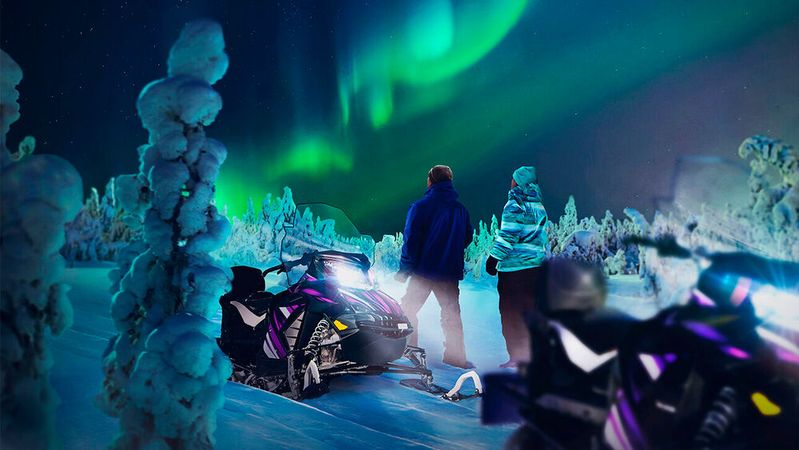
Electrically powered snowmobiles are environmentally friendly and quiet. Therefore, in the far north, especially for wildlife observations, they are a valuable alternative to their combustion engine counterparts.
(Image: Aurora Powertrains | Farasis Energy)
Biting cold, snow-white landscapes, and tourists who want to experience natural spectacles every minute - all this can be found in Lapland. The area can be well explored by snowmobile. With an electric snowmobile, it is also environmentally friendly and quiet. Aurora Powertrains, a manufacturer of electric snowmobiles based in the Lapland capital of Rovaniemi, produces a specially developed model with the eSled.
Requirements for the battery
The implementation of the eSled was a complex development task, as a snowmobile must also function at temperatures as low as -40°C and is constantly exposed to the influence of snow and moisture. The biggest challenges are the performance losses and the rapid aging of the battery in the cold. For Matti Autioniemi, founder and CEO of Aurora Powertrains, it was quickly clear that a battery module that works reliably under these conditions is not off-the-shelf. "We knew right away that we had to develop a module ourselves to meet the specific requirements. For this, we scoured the market for suitable cells that make optimal use of the limited space of a snowmobile and will last us a long time under extreme environmental influences," explained Autioniemi.
The selection of the optimal cells
The company set out in search of the right battery cells. The market offered a variety of high-quality cylindrical cells, but these were unsuitable for installation in a snowmobile. Only by fully utilizing the limited space in combination with a high energy density could the performance requirements be met. Moreover, the battery technology had to withstand extreme weather conditions. The snowmobiles were either on tour through the winter landscapes of Lapland or connected to a charger. Despite the low outside temperatures, the strain in the terrain made cooling of the battery technology necessary. Cylindrical cells do not dissipate heat quickly and efficiently enough due to their small surface area. A different solution was needed. The search was on for compact cells that offer many life cycles, are temperature-resistant, and bring a high energy density. In addition, the technology had to be robust, as for use in terrain and snow, the batteries are subjected to a completely different level of stress from shocks and moisture than when used in a conventional electric vehicle.
Perfect utilization of installation space
The choice fell on the unidirectional P32 pouch cells from Farasis Energy. Their rectangular shape and the ability to expand make optimal use of the available space. The largest battery variant of the eSled, with six modules, achieves an energy of 21 kilowatt-hours. Ranges of around 100 kilometers are possible. These values could not be achieved in the prototypes with cylindrical or prismatic cells. Perfect for Aurora Powertrains was also that a proprietary solution for thermal management could be used, enabling smooth operation at temperatures as low as -40 degrees Celsius.
Integrated films preheat cells
The collaboration between the Finnish company and Farasis Energy has been very good since the first development project. Farasis Energy develops suitable cells tailored to the requirements of Aurora Powertrains. Even the transition from the initially used P29 to the P32 cell went smoothly because there were no changes to the design. This allows Aurora Powertrains to benefit from the further development of the cell chemistry without having to redesign themselves. An active liquid cooling circuit balances temperature differences within the module.
Additionally, the developers integrated heating foils at the bottom, which preheat the cells to an optimal 25°C. Although tourist groups usually do not cover more than 25 kilometers in distance during the tours, being on the road for about 3 hours including breaks, the energy density and the associated maximum range of 100 kilometers provide the necessary safety margin in remote areas of Lapland.
Off-road, onboard, and abroad
Depending on the requirements, one can choose between three battery capacities for the eSled: In addition to the 21-kWh module, there are also variants with 7 or 14 kilowatt-hours available. The battery technology offers high robustness and good resistance to shocks. The water- and dust-proof battery is classified as IP67 as well as modular and scalable. This allows it to meet further requirements. Thus, Aurora Powertrains is currently developing concepts for a Finnish electric boat company and supporting an off-road vehicle project with a 120 kWh battery. Aurora Powertrains plans to produce around 600 eSleds by early 2025. The quiet, merely humming snowmobiles facilitate access to sensitive areas like national parks and make the excursions a pollution-free experience for tourists. "No engine noise, but listening to the explanations of the tour guide, observing animals undisturbed, and enjoying the beautiful landscape of the far north in an environmentally friendly way: These are the arguments in favor of electrically powered snowmobiles," concludes Matti Autioniemi.
Date: 08.12.2025
Naturally, we always handle your personal data responsibly. Any personal data we receive from you is processed in accordance with applicable data protection legislation. For detailed information please see our privacy policy.
Consent to the use of data for promotional purposes
I hereby consent to Vogel Communications Group GmbH & Co. KG, Max-Planck-Str. 7-9, 97082 Würzburg including any affiliated companies according to §§ 15 et seq. AktG (hereafter: Vogel Communications Group) using my e-mail address to send editorial newsletters. A list of all affiliated companies can be found here
Newsletter content may include all products and services of any companies mentioned above, including for example specialist journals and books, events and fairs as well as event-related products and services, print and digital media offers and services such as additional (editorial) newsletters, raffles, lead campaigns, market research both online and offline, specialist webportals and e-learning offers. In case my personal telephone number has also been collected, it may be used for offers of aforementioned products, for services of the companies mentioned above, and market research purposes.
Additionally, my consent also includes the processing of my email address and telephone number for data matching for marketing purposes with select advertising partners such as LinkedIn, Google, and Meta. For this, Vogel Communications Group may transmit said data in hashed form to the advertising partners who then use said data to determine whether I am also a member of the mentioned advertising partner portals. Vogel Communications Group uses this feature for the purposes of re-targeting (up-selling, cross-selling, and customer loyalty), generating so-called look-alike audiences for acquisition of new customers, and as basis for exclusion for on-going advertising campaigns. Further information can be found in section “data matching for marketing purposes”.
In case I access protected data on Internet portals of Vogel Communications Group including any affiliated companies according to §§ 15 et seq. AktG, I need to provide further data in order to register for the access to such content. In return for this free access to editorial content, my data may be used in accordance with this consent for the purposes stated here. This does not apply to data matching for marketing purposes.
Right of revocation
I understand that I can revoke my consent at will. My revocation does not change the lawfulness of data processing that was conducted based on my consent leading up to my revocation. One option to declare my revocation is to use the contact form found at https://contact.vogel.de. In case I no longer wish to receive certain newsletters, I have subscribed to, I can also click on the unsubscribe link included at the end of a newsletter. Further information regarding my right of revocation and the implementation of it as well as the consequences of my revocation can be found in the data protection declaration, section editorial newsletter.
Outlook
Even though the environmentally friendlier e-alternative to the conventional snowmobile meets all requirements in the tourism sector, there are numerous challenges on the path to a completely electric future. In the next five to ten years, the technology must be further developed to also replace specialized snowmobiles for use in deep snow or in racing with an e-variant. The many test kilometers of the eSleds and the spirit of innovation from Farasis Energy support this path. (se)



:quality(80)/p7i.vogel.de/wcms/a0/47/a04725ef9bd09fb6c9341a1bea1b5d93/0130443083v1.jpeg "Here, a type of plastic pallet is produced by thermoforming (vacuum forming or deep drawing) at the corresponding division of New England Plastics in the USA. This division, which specializes in so-called liners, is now part of Ringmetall ... (Image:New England Plastics)")
:quality(80)/p7i.vogel.de/wcms/e3/42/e342b3c593ea92d56604d3be969e9c9a/0130437231v1.jpeg "Daimler Truck will be building even more trucks at its Czech plant in Cheb in the future. This is because it is now being expanded for strategic cost-saving reasons ... (Image:Daimler Truck)")
:quality(80)/p7i.vogel.de/wcms/23/99/23992bf2dcdc432c9b7209c34a4a7c48/0129733089v1.jpeg "Stork relies on the modular Neoswiss turning system from Iscar to shorten the set-up times for its sliding headstock lathes and work more productively. (Image:Iscar)")
:quality(80)/p7i.vogel.de/wcms/7d/e2/7de2923434b2f1a78ba5482d8d335269/0113143253v1.jpeg "In our China Market Insider we regularly provide you with relevant information directly from China. (Image:© Eisenhans - stock.adobe.com)")
:quality(80)/p7i.vogel.de/wcms/b7/36/b736dfebc16c42d6901d0d0e1f390493/3d-druck-20factory-20--20ki-20generiert-1920x1079v1.png "(Source: AI-generated)")
:quality(80)/p7i.vogel.de/wcms/79/b2/79b21aad663f4a7bd4472afc1c1afc62/0130433994v1.jpeg "Mission Joyride: The free-flying robot (shown here in the rendering) will relieve the ISS crew of logistics tasks from 2027 with its two mechanical arms. (Image:Icarus Robotics)")
:quality(80)/p7i.vogel.de/wcms/6b/45/6b4546fa6ebf305c3660326909363f32/0130437089v1.jpeg "Industrial AI in action: Rockwell Automation presents practical solutions for self-controlling production systems at the Hannover Messe. (Image:Rainer Jensen, Deutsche Messe)")
:quality(80)/p7i.vogel.de/wcms/78/e9/78e9188c25a8a94e67c34c9bf8ffe495/visual-agile-20robots-20and-20google-20deepmind-20partner-20to-20bring-20intelligence-20to-20robotics-2500x1406v1v1.jpeg "Together, the partners are developing adaptable, intelligent robots for a wide range of applications (Image:Agile Robots SE)")
:quality(80)/p7i.vogel.de/wcms/59/a2/59a2b11f0aa1b700eff02addd5de8703/adobestock-1788280853--c2-a9-20satria-20-e2-80-93-20stock-adobe-com-5081x2860v1v1.jpeg "Quantum computers require extreme cooling to temperatures close to absolute zero in order to keep qubits stable. (Image:satria - stock.adobe.com)")
:quality(80)/p7i.vogel.de/wcms/62/5f/625f41e87ebfef156a98c8e6393e32fd/0130211654v1.jpeg "Axial flux motors have some advantages over radial flux motor—but their production is currently still expensive. (Image:RWTH Aachen University)")
:quality(80)/p7i.vogel.de/wcms/f6/ae/f6aec4f6241b36ed5e3a990ac9176b42/0130429460v1.jpeg "Verne, Pony.ai and Uber want to launch a robotaxi service in Europe. (Image:Verne)")
:quality(80)/p7i.vogel.de/wcms/d7/88/d788699f2974708a332baa4e7a62fa9e/0130438967v1.jpeg "Skoda is withdrawing from China. The brand has produced well over three million vehicles there. (Image:Skoda car)")
:quality(80)/p7i.vogel.de/wcms/b0/43/b043b86899837532aad62d63368a917a/0130371361v1.jpeg "Skoda leaves the chinese market.
(Image:Skoda)")
:quality(80)/p7i.vogel.de/wcms/c3/c4/c3c4ce270b083eeac55654148611f064/0130237945v1.jpeg "China is not giving up on hydrogen, but is intensifying its efforts. (Image:freely licensed from Pixabay)")
:quality(80)/p7i.vogel.de/wcms/ee/09/ee09acbd6dc896df25affaa9e871e6e5/0130440053v1.jpeg "IMS chip module for simple system integration into an ion mobility spectrometer. (Image:Fraunhofer IPMS)")
:quality(80)/p7i.vogel.de/wcms/10/6c/106cd22de5f68a0f74639d654827228c/0130345302v1.jpeg "Made in India: According to the India Electronics and Semiconductor Association (IESA), the country should be able to produce between 75 and 80 million chips by the beginning of 2027, once the plants currently under construction become operational. (Image:Pixabay (Montage: Sebastian Gerstl))")
:quality(80)/p7i.vogel.de/wcms/a5/ed/a5ed6fda029d362732a293d6b19d74c4/0130444216v1.jpeg "Thirteen executives from the Chinese chip industry have drawn up a plan to achieve an 80% self-sufficiency rate for semiconductors by 2030. (Image:Maxim_Kazmin - stock.adobe.com)")
:quality(80)/p7i.vogel.de/wcms/31/a6/31a646018b34d8e0a44bfc8bf17837f6/0130361632v1.jpeg "For many companies, PFAS are considered indispensable in electronics production. (Image:freely licensed)")
:fill(fff,0)/images.vogel.de/vogelonline/companyimg/76800/76895/65.jpg "FAULHABER_120mm.jpg ()")
:fill(fff,0)/p7i.vogel.de/companies/69/88/69882c428938e/tmts2026-ticec-banner-en-2000px.png "tmts2026-ticec-banner-en-2000px (https://www.tmts.tw/en)")
:quality(80)/p7i.vogel.de/wcms/6f/a4/6fa443ed1e0db0d4683188545438cc70/0127127874v1.jpeg "EVE Energy is one of the Chinese manufacturers heavily investing in solid-state batteries. (Image:EVE Energy)")
:quality(80)/p7i.vogel.de/wcms/53/ef/53ef65b954ddefadb2956dea1ca24369/bild1-deutz-agritechnica-4047x2275v1v1.jpeg "Telehandlers are pioneers in the application of electric drives. Pictured here: a Magni telehandler with a Deutz battery. (Image:Deutz AG)")