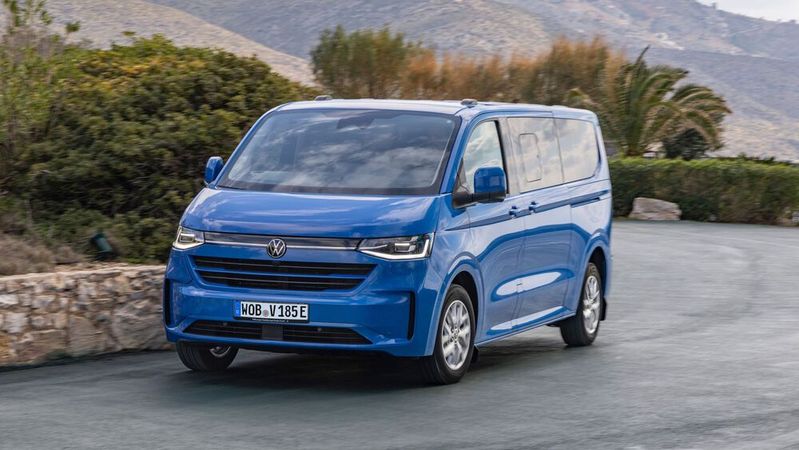
When it comes to comfortably transporting many people from A to B, the VW Caravelle is often the first choice for shuttle services. In the new generation, the large-capacity vehicle also runs electrically.
With the introduction of the new transporter, VW now also offers an electric Caravelle.
(Image: VW)
If you want to see minibuses in commercial use, a trip to major airports is recommended. Almost every second, small buses pull up there to pick up flight attendants, tour groups, or business people. Since the trips to hotels or convention centers are usually not too long, many shuttles now whir through the cities purely electrically. Range does not really play a role in such cases.
A market that VW would like to engage with more actively again. Although it is possible to carry up to six people in the ID Buzz, it's not really comfortable in the narrow rear of the electric vehicle.
A Caravelle, but not entirely VW anymore
With the introduction of the new transporter, there's also a Caravelle, now finally with an electric drive. It has taken long enough, which is why some commercial customers of VW have already moved to the competition. Mercedes, Peugeot, Opel, and many others have long been offering electric minibuses, sometimes simply and practically equipped, but also with leather seating and comfort features as VIP vehicles.
However, the new Caravelle is no longer based on Volkswagen technology but is essentially a modified Ford Tourneo Custom with a VW look. This does not change its qualities: From the digital cockpit to an entire array of electronic driving assistants—in terms of technology, connectivity, and operation, the new VW Bus is no less than modern passenger cars.
At 5.05 meters or 5.45 meters (approx. 16,6 or 17,9 ft) in the long version, depending on the seating, between five and eight passengers are generously accommodated. Furthermore, a substantial amount of luggage can be stored, at least in the rear of the long version. So if, for example, an aircraft crew needs to be transported to the airport with bags and equipment, this should not be a problem thanks to the more than one meter long luggage compartment.
A small but important feature is missing
Depending on the driving profile and range requirements, customers can choose from three drives with 100 kW, 160 kW, and 210 kW power, priced between 55,480 euros (60.101,48 USD) and 59,000 euros (63.914,70 USD). A 64 kWh battery is mounted in the underbody, which is good for over 300 electric kilometers in all versions. Charging at the wallbox or normal urban charging points is done at eleven kW. A stop at the fast charger allows electricity to flow at up to 125 kW and should bring the battery from ten to 80 percent in about three-quarters of an hour.
Unfortunately, VW or Ford failed to equip the model with a 22-kW onboard charger. Since powerful AC charging stations are usually available at hotels, airports, and trade fairs, the usual waiting time for passengers could be optimally utilized.
For this, VW offers numerous options, from leather seats to a three-zone climate control system, in addition to the three trim versions to make the interior more homely. The Pan Americana model, starting at 60,000 euros (64.998,00 USD), takes it to the extreme by offering not just practical details like electrically adjustable seats for the driver and front passenger, but also plenty of visual adornments.
The Caravelle offers an exceptionally pleasant driving experience. The fact that the vehicle, even in its most powerful version, doesn't leave black marks on the asphalt when you step on the accelerator is not a disadvantage for a shuttle. Rather, the acceleration can be well dosed, which accommodates the rear passengers with a pleasant, smooth driving style. Accordingly, the car is tuned more for comfort but is also well-damped, so the long body only briefly bounces on bumps.
Customers who can't commit to a fully electric vehicle can alternatively choose the classic diesel again. The TDI, also supplied by Ford, with a two-liter displacement is available in three power levels between 81 kW/110 hp and 125 kW/175 hp (starting at 43,945/52,294 euros). Alternatively, one could wait until early 2026. Then VW will offer the E-Hybrid, a gasoline engine with a plug-in capability, which should cover about 70 kilometers electrically (approx. 43 miles). This should suffice for local trips, and the combustion engine will take over on long distances. Expected cost: just under 53,500 euros (57.956,55 USD).
Date: 08.12.2025
Naturally, we always handle your personal data responsibly. Any personal data we receive from you is processed in accordance with applicable data protection legislation. For detailed information please see our privacy policy.
Consent to the use of data for promotional purposes
I hereby consent to Vogel Communications Group GmbH & Co. KG, Max-Planck-Str. 7-9, 97082 Würzburg including any affiliated companies according to §§ 15 et seq. AktG (hereafter: Vogel Communications Group) using my e-mail address to send editorial newsletters. A list of all affiliated companies can be found here
Newsletter content may include all products and services of any companies mentioned above, including for example specialist journals and books, events and fairs as well as event-related products and services, print and digital media offers and services such as additional (editorial) newsletters, raffles, lead campaigns, market research both online and offline, specialist webportals and e-learning offers. In case my personal telephone number has also been collected, it may be used for offers of aforementioned products, for services of the companies mentioned above, and market research purposes.
Additionally, my consent also includes the processing of my email address and telephone number for data matching for marketing purposes with select advertising partners such as LinkedIn, Google, and Meta. For this, Vogel Communications Group may transmit said data in hashed form to the advertising partners who then use said data to determine whether I am also a member of the mentioned advertising partner portals. Vogel Communications Group uses this feature for the purposes of re-targeting (up-selling, cross-selling, and customer loyalty), generating so-called look-alike audiences for acquisition of new customers, and as basis for exclusion for on-going advertising campaigns. Further information can be found in section “data matching for marketing purposes”.
In case I access protected data on Internet portals of Vogel Communications Group including any affiliated companies according to §§ 15 et seq. AktG, I need to provide further data in order to register for the access to such content. In return for this free access to editorial content, my data may be used in accordance with this consent for the purposes stated here. This does not apply to data matching for marketing purposes.
Right of revocation
I understand that I can revoke my consent at will. My revocation does not change the lawfulness of data processing that was conducted based on my consent leading up to my revocation. One option to declare my revocation is to use the contact form found at https://contact.vogel.de. In case I no longer wish to receive certain newsletters, I have subscribed to, I can also click on the unsubscribe link included at the end of a newsletter. Further information regarding my right of revocation and the implementation of it as well as the consequences of my revocation can be found in the data protection declaration, section editorial newsletter.
If the bus is to be more resilient, for example, as a construction site shuttle, VW again offers a seated version of the Transporter, with rubber instead of velour flooring, fewer USB ports, and other gadgets. The Transporter Kombi is available with the same engines and costs about 2,800 euros (3.033,24 USD) less.



:quality(80)/p7i.vogel.de/wcms/94/81/948196fc18c3feb4ec87165b218b5650/0129493778v1.jpeg "This is the Vector reconnaissance drone from the start-up Quantum Systems from Gilching near Munich. The specialists are so well received by investors that they can now look forward to an injection of 150 million euros to strengthen their position even further. (Image:Quantum Systems)")
:quality(80)/p7i.vogel.de/wcms/da/b1/dab1af09c1f7fd43c841d8c8c60882d7/0129466462v1.jpeg "The yellow device is an auxiliary tool that Subaru needs in vehicle production. The production of such tools can now be accelerated using the high-speed T25 nozzle from Stratsys in combination with the F770-3D 3D printer. Read more here ... (Image:Subaru)")
:quality(80)/p7i.vogel.de/wcms/26/50/2650410753c0bdf9c55989b752891a4f/0129485561v1.jpeg "Northern German industrial companies' confidence in relations with the USA is waning. (Image:ChatGPT)")
:quality(80)/p7i.vogel.de/wcms/37/9f/379f62914fcef347331e271270e3f755/ad1i8940-4368x2456v1.jpeg "(Source: SIMTOS)")
:quality(80)/p7i.vogel.de/wcms/05/63/05633ca5deb577945793fd0f553356b3/0129493475v1.jpeg "Lapp continued to invest in production capacities and technologies worldwide in the 2025 financial year. (Image:Lapp)")
:quality(80)/p7i.vogel.de/wcms/97/3a/973acc83133c28605f855d750523142e/0129492013v1.jpeg "During the opening, Agile One symbolically pressed the start button. (Image:Deutsche Telekom AG / Cindy Albrecht)")
:quality(80)/p7i.vogel.de/wcms/dd/4e/dd4e6ce73e0e700dcc0f0584813ef47f/0128875162v1.jpeg "Thanks to their high precision, robustness and integration capability, Micro-Epsilon's measurement technology solutions are not only suitable for new systems, but also ideal for retrofit applications. (Image:Micro-Epsilon Messtechnik GmbH & Co. KG)")
:quality(80)/p7i.vogel.de/wcms/17/61/1761a0165c23fe007d0a8e62d2a23121/0129467133v1.jpeg "The partnership between Dassault Systèmes and Nvidia aims to make the industry more effective with the help of AI and digital twins. (Picture: ©DC Studio - stock.adobe.com)")
:quality(80)/p7i.vogel.de/wcms/9b/e7/9be7c2ceb897aa2bf1ab4eb2198b8b96/roboter-20hand1-1240x698v1v1.jpeg "What if you could 3D print a soft robot with predictable shape-shifting capabilities already built in? (Image:Picture: Harvard University)")
:quality(80)/p7i.vogel.de/wcms/a7/34/a73475e9638e032c32288f53006abab7/newsimage417867-2665x1500v1v1.jpeg "Combination of a model from a scanning electron microscope image (left) with a section of the underlying crystal structure of a studied MXene with precisely controlled surface terminations. (Image:B. Schröder/HZDR)")
:quality(80)/p7i.vogel.de/wcms/d2/1a/d21a9b3e1333f306ffd6421e84f9e3d0/semiconductor-20image-20courtesy-20of-20gelest-3000x1688v1.jpeg "In a new collaboration, IBM will test the performance of Gelest precursor materials for dry resist EUV lithography, generating results that aim to guide Gelest on materials research and speed innovation toward smaller devices. (Source: Gelest)")
:quality(80)/p7i.vogel.de/wcms/f5/c6/f5c6cefa374d48138dc702821d41c7c6/greenspeed-visual-home-1500x843v1v1.jpeg "The EU Green Speed project is laying the foundations for cleaner and more competitive production of lithium-ion batteries in Europe. (Image:greenSPEED Consortium / VIRTUAL VEHICLE)")
:quality(80)/p7i.vogel.de/wcms/b9/47/b9470dd7a30574d74b6d95d26e4e4ee8/0129473060v1.jpeg "UE Studios has presented the Self-Driving Urban E-Shuttle to the public for the first time. (Image:UE Studios)")
:quality(80)/p7i.vogel.de/wcms/d0/bb/d0bb569e57d4b98f28bfa4b9600b245e/0129453908v1.jpeg "Tobias Sühlmann is Head of Design at Porsche. (Image:McLaren)")
:quality(80)/p7i.vogel.de/wcms/eb/73/eb73c6f1dc08af55057cfc298c8ef72f/0128683789v1.jpeg "Alpina has been an independent brand since January. In the picture: the BMW Alpina Roadstar V8 from 2002. (Image:BMW)")
:quality(80)/p7i.vogel.de/wcms/b7/1d/b71d25d354a0800790b525ebacd45168/a260075-large-960x540v1v1.jpeg "With the AI-supported dryer control system, Audi is testing the first application from an IPAI cooperation in series production in the paint shop at the Neckarsulm site. (Image:Audi)")
:quality(80)/p7i.vogel.de/wcms/8d/ff/8dffe7518cc69b90ea89c7b37f7de781/0129470810v1.jpeg "Demo of the ChipStack AI Super Agent. (Image:Cadence)")
:quality(80)/p7i.vogel.de/wcms/35/a7/35a7cbca29eb719318324ca2e70c33c7/0129484567v1.jpeg "The above-ground part of the IceCube experiment and the graphic simulation of a measurement signal from the detectors in the ice. Researchers can measure cosmic neutrinos with the IceCube observatory. (Image:Stephan Richter, IceCube; photomontage: Beatrix von Puttkamer)")
:quality(80)/p7i.vogel.de/wcms/42/c0/42c09f523fbe58320ac017087fb678b4/0129455974v1.jpeg "Schematic representation of a microlaser with a surface grating structured with nanometer precision. The compact semiconductor laser generates a directed beam of light with a beam profile that is precisely tailored to the respective application. (Image:AG Reitzenstein/TU Berlin)")
:quality(80)/p7i.vogel.de/wcms/72/e8/72e82e7be7eb9c7f3fe6e7bd6442b95d/0129427931v1.jpeg "Strategic: EPC licenses eGaN technology to Renesas (Image:freely licensed)")
:fill(fff,0)/p7i.vogel.de/companies/67/eb/67eba621ef6ea/logo2.png "logo2 (Wuxi InfiMotion)")
:quality(80)/p7i.vogel.de/wcms/d2/2a/d22a9d231a0f7a02f34c2d77fe881a62/0122398902v1.jpeg "Zeekr presents the electric minibus Mix at the CES. (Image:Geely)")
:quality(80)/p7i.vogel.de/wcms/46/12/461264677527aa7b57b1a144c7857db2/0123082216v1.jpeg "VW offers numerous options, from leather seats to a three-zone climate control system, in addition to the three trim versions to make the interior more homely.(Image: VW)")
:quality(80)/p7i.vogel.de/wcms/f4/78/f47833f2c3f085413f419e3cf43e151e/0123082220v1.jpeg "A 64 kWh battery is mounted in the underbody.(Image: VW)")
:quality(80)/p7i.vogel.de/wcms/b5/99/b599803975515ee012137a30e065a8fc/0123082218v1.jpeg "The new Caravelle is no longer based on Volkswagen technology but is essentially a modified Ford Tourneo Custom.(Image: VW)")
:quality(80)/p7i.vogel.de/wcms/7d/29/7d29a9e9899c11b4ecc69b87a2a069c2/0123082210v1.jpeg "The Caravelle drives exceptionally comfortably.(Image: VW)")
:quality(80):fill(efefef,0)/p7i.vogel.de/wcms/67/ad/67adf92d254d2/elatec-wp-smart-factory.png "Elatec WP Smart Factory")
:quality(80)/p7i.vogel.de/wcms/c4/76/c47699813b548dfa894a603a27350a38/0124272828v1.jpeg "Xpeng's model range could quickly grow. However, the Chinese have not yet confirmed whether they will bring their new flagship X9 to Europe. (Image:Xpeng)")
:quality(80)/p7i.vogel.de/wcms/ee/15/ee150e8cff6c661fa0851cc4ba4897e8/0123477116v1.jpeg "The electric fastback sedan ES90 complements the EX90. (Image:Volvo)")