Automated Guided Vehicles (AGVs) navigate with different technologies. This includes sensor technology, which must fit the intralogistics within the company. Only then can material transport be made as efficient as possible. The article provides an overview of the different navigation technologies.
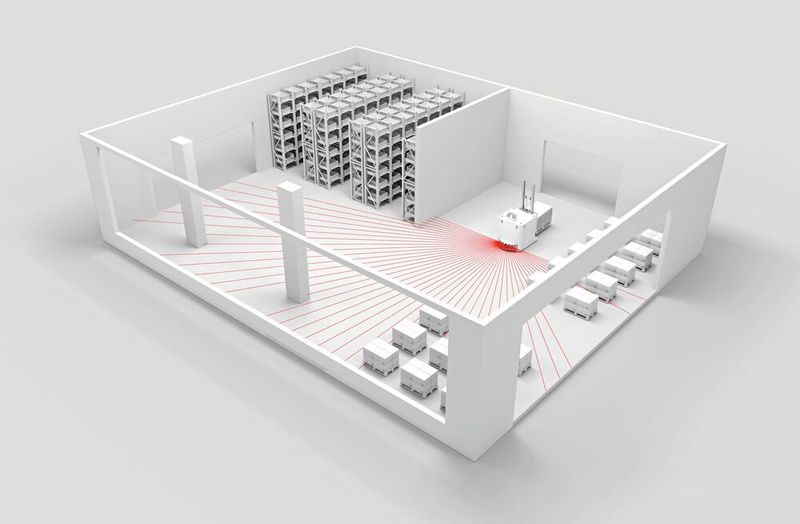
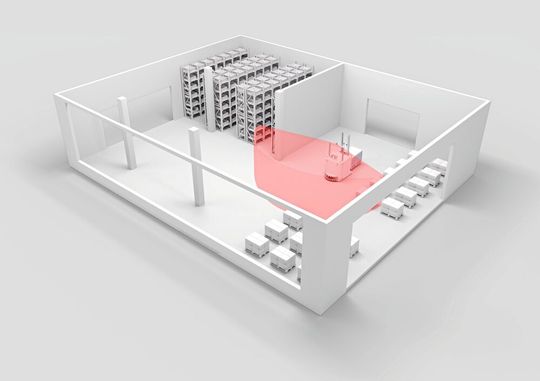
Laser navigation scores with precise and flexible navigation. With safety laser scanners like the RSL 400 from Leuze, this technology can be easily implemented.
(Image: Leuze)
Automated Guided Vehicles (AGVs) navigate with different technologies. Each has its own strengths and weaknesses. The technical requirements and local conditions are decisive for choosing the optimal solution. Sensor technology also plays a role in reliable navigation. The specialist for innovative and efficient sensor and safety solutions in automation technology Leuze assists decision-makers in choosing the optimal solution.
Particularly position accurate: laser navigation
For particularly precise and flexible navigation of AGVs, laser navigation, also known as contour navigation or natural navigation, is recommended. This is based on laser scanners or Lidar (Light Detection and Ranging). The AGV initially travels through its environment in "learning mode," capturing fixed points using a rotating laser beam and creating a map from them. Using this map, the AGV autonomously orients itself in the space. Obstacles can be safely detected and, if necessary, bypassed. Compared to camera-based systems, laser navigation works even in dark environments and poor lighting conditions. Note: Dust or dirt can affect the precision of the system. Regular maintenance and cleaning are therefore required. Additionally, the range of the laser beams is limited. Therefore, laser navigation is better suited for work areas with clearly defined contours than for wide, contourless environments.
Laser navigation
Main advantage of laser navigation: Precise and flexible navigation
Deployable sensor technology: Safety laser scanners, such as the RSL 400 safety laser scanner from Leuze. It combines safety technology and measurement output in one device.
In dynamic environments: laser triangulation
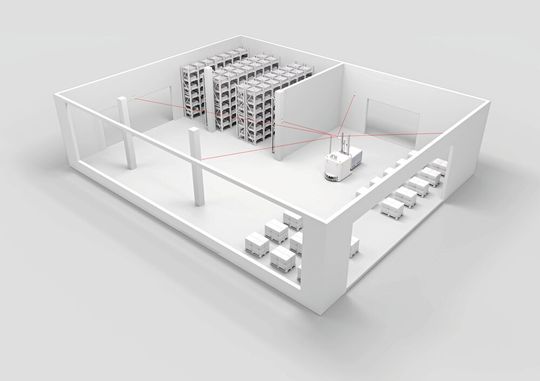
A laser scanner is also used in laser triangulation. In addition, at least three reflectors are installed in the room, through which the AGV determines its position. The technology is especially suitable for dynamic environments.
(Image: Leuze)
Laser triangulation uses reflectors in the room to determine the AGV's position with a laser scanner. The scanner requires line of sight to at least three reflectors installed several meters high. This enables very precise positioning and navigation of the AGV. This technology is useful in dynamic, frequently changing environments. Cost-wise, it should be noted that the sensor on the AGV must be mounted at reflector height. Additionally, the installation of reflectors in the room is necessary. These must be recognizable at all times for reliable positioning of the AGV. Note: Additional sensors are required to secure the travel path.
Laser triangulation
Main advantage of laser triangulation: Suitable for dynamic environments
Deployable sensor technology: Lidar sensors
The optical or inductive lane guidance
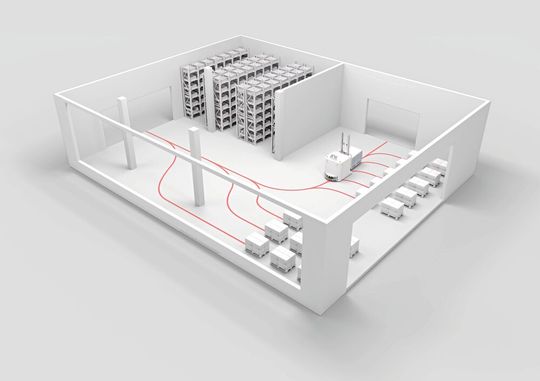
In inductive lane guidance, the AGV follows a magnetic tape or induction cable laid in the ground. In optical lane guidance, it follows a path marked on the ground. The technology is suitable for environments with clear paths. The costs are manageable.
(Image: Leuze)
Another type of AGV navigation is optical or inductive track guidance. With inductive track guidance, the AGV follows a magnetic tape or induction cable laid in the ground, and with optical track guidance, it follows a track applied to the floor. Sensors installed on the AGV detect the path, allowing precise vehicle alignment. The advantage is manageable acquisition and installation costs for the sensors. This technology is particularly suitable for environments with clear and predictable paths. It is independent of the vehicle type: The sensor is simply mounted on the AGV with a short distance to the ground. Disadvantages include the construction effort if a magnetic tape or induction cable needs to be laid. In this case, vehicles are also fixed to the previously defined track. This limits flexibility for new layouts or routes. Additionally, navigation in environments with many curves or narrow passages can be less precise compared to Lidar or camera technologies.
Optical/inductive lane guidance
Main advantage of optical/inductive lane guidance: Optimal for environments with clear paths
Deployable sensor technology: Optical lane guidance sensor, such as the OGS 600 from Leuze. The sensor detects the path using edge detection and sends the corresponding signals to the control.
Navigation by structure: grid navigation
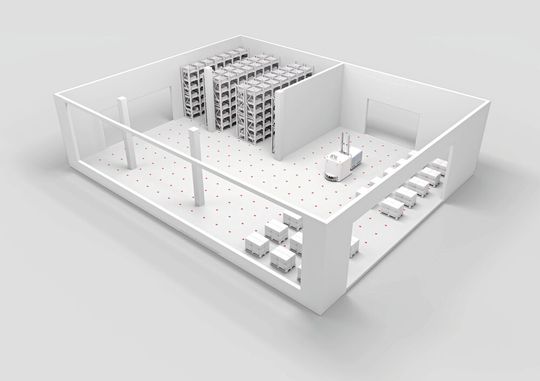
If there are clearly structured paths in intralogistics, grid navigation can be a good choice. The AGV uses 2D codes on the floor or transponders embedded in the floor as reference points.
(Image: Leuze)
Grid navigation is based on a coordinate system. It consists of 2D codes on the floor or transponders embedded in the ground. These are arranged in a grid-like pattern and serve as reference points for the AGV to determine its position. The AGV moves on predefined grid paths. This technology is easy to implement. The coordinate system allows for precise positioning and high navigation accuracy. Grid navigation is particularly useful in environments with predictable and structured paths, such as warehouses or production facilities with clear lanes. A disadvantage is the low flexibility for new routes or frequently changing environments. Installing transponders also requires physical interventions in the ground.
Grid navigation
Main advantage of grid navigation: Recommended for clear lanes
Deployable sensor technology: 2D code readers, such as the DCR 200i from Leuze. Installed on the AGV, the sensor reads the codes when passing over them. Advantages include the extremely compact design and the large working range of 1.6 inches to 14.2 inches.
Flexible driving: camera-based navigation
If high flexibility is required in intralogistics, AGVs can also be navigated using cameras. However, good lighting conditions are a prerequisite.
(Image: Leuze)
In camera-based navigation or vision guidance, cameras capture markers or patterns in the environment. The navigation software uses this data for positioning and navigating the AGV. The main advantage is the high flexibility when paths change frequently. However, camera-based systems often work only limitedly in poor lighting or low contrast conditions. Furthermore, their range is limited, and objects at greater distances cannot always be accurately detected. Compared to other navigation methods, implementing camera-based systems into the overall system can be more complex. The acquisition costs are often higher, requiring investment in high-quality cameras and image processing technology.
Camera-based navigation
Main advantage of camera-based navigation: Flexible with frequently changing paths
Naturally, we always handle your personal data responsibly. Any personal data we receive from you is processed in accordance with applicable data protection legislation. For detailed information please see our privacy policy.
Consent to the use of data for promotional purposes
I hereby consent to Vogel Communications Group GmbH & Co. KG, Max-Planck-Str. 7-9, 97082 Würzburg including any affiliated companies according to §§ 15 et seq. AktG (hereafter: Vogel Communications Group) using my e-mail address to send editorial newsletters. A list of all affiliated companies can be found here
Newsletter content may include all products and services of any companies mentioned above, including for example specialist journals and books, events and fairs as well as event-related products and services, print and digital media offers and services such as additional (editorial) newsletters, raffles, lead campaigns, market research both online and offline, specialist webportals and e-learning offers. In case my personal telephone number has also been collected, it may be used for offers of aforementioned products, for services of the companies mentioned above, and market research purposes.
Additionally, my consent also includes the processing of my email address and telephone number for data matching for marketing purposes with select advertising partners such as LinkedIn, Google, and Meta. For this, Vogel Communications Group may transmit said data in hashed form to the advertising partners who then use said data to determine whether I am also a member of the mentioned advertising partner portals. Vogel Communications Group uses this feature for the purposes of re-targeting (up-selling, cross-selling, and customer loyalty), generating so-called look-alike audiences for acquisition of new customers, and as basis for exclusion for on-going advertising campaigns. Further information can be found in section “data matching for marketing purposes”.
In case I access protected data on Internet portals of Vogel Communications Group including any affiliated companies according to §§ 15 et seq. AktG, I need to provide further data in order to register for the access to such content. In return for this free access to editorial content, my data may be used in accordance with this consent for the purposes stated here. This does not apply to data matching for marketing purposes.
Right of revocation
I understand that I can revoke my consent at will. My revocation does not change the lawfulness of data processing that was conducted based on my consent leading up to my revocation. One option to declare my revocation is to use the contact form found at https://contact.vogel.de. In case I no longer wish to receive certain newsletters, I have subscribed to, I can also click on the unsubscribe link included at the end of a newsletter. Further information regarding my right of revocation and the implementation of it as well as the consequences of my revocation can be found in the data protection declaration, section editorial newsletter.



:quality(80)/p7i.vogel.de/wcms/da/b1/dab1af09c1f7fd43c841d8c8c60882d7/0129466462v1.jpeg "The yellow device is an auxiliary tool that Subaru needs in vehicle production. The production of such tools can now be accelerated using the high-speed T25 nozzle from Stratsys in combination with the F770-3D 3D printer. Read more here ... (Image:Subaru)")
:quality(80)/p7i.vogel.de/wcms/26/50/2650410753c0bdf9c55989b752891a4f/0129485561v1.jpeg "Northern German industrial companies' confidence in relations with the USA is waning. (Image:ChatGPT)")
:quality(80)/p7i.vogel.de/wcms/37/9f/379f62914fcef347331e271270e3f755/ad1i8940-4368x2456v1.jpeg "(Source: SIMTOS)")
:quality(80)/p7i.vogel.de/wcms/a4/3c/a43c87e306c4b61c9afc01beec500296/-bcm8149-3936x2213v1.jpeg "(Source: TMBA)")
:quality(80)/p7i.vogel.de/wcms/05/63/05633ca5deb577945793fd0f553356b3/0129493475v1.jpeg "Lapp continued to invest in production capacities and technologies worldwide in the 2025 financial year. (Image:Lapp)")
:quality(80)/p7i.vogel.de/wcms/97/3a/973acc83133c28605f855d750523142e/0129492013v1.jpeg "During the opening, Agile One symbolically pressed the start button. (Image:Deutsche Telekom AG / Cindy Albrecht)")
:quality(80)/p7i.vogel.de/wcms/dd/4e/dd4e6ce73e0e700dcc0f0584813ef47f/0128875162v1.jpeg "Thanks to their high precision, robustness and integration capability, Micro-Epsilon's measurement technology solutions are not only suitable for new systems, but also ideal for retrofit applications. (Image:Micro-Epsilon Messtechnik GmbH & Co. KG)")
:quality(80)/p7i.vogel.de/wcms/17/61/1761a0165c23fe007d0a8e62d2a23121/0129467133v1.jpeg "The partnership between Dassault Systèmes and Nvidia aims to make the industry more effective with the help of AI and digital twins. (Picture: ©DC Studio - stock.adobe.com)")
:quality(80)/p7i.vogel.de/wcms/9b/e7/9be7c2ceb897aa2bf1ab4eb2198b8b96/roboter-20hand1-1240x698v1v1.jpeg "What if you could 3D print a soft robot with predictable shape-shifting capabilities already built in? (Image:Picture: Harvard University)")
:quality(80)/p7i.vogel.de/wcms/a7/34/a73475e9638e032c32288f53006abab7/newsimage417867-2665x1500v1v1.jpeg "Combination of a model from a scanning electron microscope image (left) with a section of the underlying crystal structure of a studied MXene with precisely controlled surface terminations. (Image:B. Schröder/HZDR)")
:quality(80)/p7i.vogel.de/wcms/d2/1a/d21a9b3e1333f306ffd6421e84f9e3d0/semiconductor-20image-20courtesy-20of-20gelest-3000x1688v1.jpeg "In a new collaboration, IBM will test the performance of Gelest precursor materials for dry resist EUV lithography, generating results that aim to guide Gelest on materials research and speed innovation toward smaller devices. (Source: Gelest)")
:quality(80)/p7i.vogel.de/wcms/f5/c6/f5c6cefa374d48138dc702821d41c7c6/greenspeed-visual-home-1500x843v1v1.jpeg "The EU Green Speed project is laying the foundations for cleaner and more competitive production of lithium-ion batteries in Europe. (Image:greenSPEED Consortium / VIRTUAL VEHICLE)")
:quality(80)/p7i.vogel.de/wcms/b9/47/b9470dd7a30574d74b6d95d26e4e4ee8/0129473060v1.jpeg "UE Studios has presented the Self-Driving Urban E-Shuttle to the public for the first time. (Image:UE Studios)")
:quality(80)/p7i.vogel.de/wcms/d0/bb/d0bb569e57d4b98f28bfa4b9600b245e/0129453908v1.jpeg "Tobias Sühlmann is Head of Design at Porsche. (Image:McLaren)")
:quality(80)/p7i.vogel.de/wcms/eb/73/eb73c6f1dc08af55057cfc298c8ef72f/0128683789v1.jpeg "Alpina has been an independent brand since January. In the picture: the BMW Alpina Roadstar V8 from 2002. (Image:BMW)")
:quality(80)/p7i.vogel.de/wcms/b7/1d/b71d25d354a0800790b525ebacd45168/a260075-large-960x540v1v1.jpeg "With the AI-supported dryer control system, Audi is testing the first application from an IPAI cooperation in series production in the paint shop at the Neckarsulm site. (Image:Audi)")
:quality(80)/p7i.vogel.de/wcms/8d/ff/8dffe7518cc69b90ea89c7b37f7de781/0129470810v1.jpeg "Demo of the ChipStack AI Super Agent. (Image:Cadence)")
:quality(80)/p7i.vogel.de/wcms/35/a7/35a7cbca29eb719318324ca2e70c33c7/0129484567v1.jpeg "The above-ground part of the IceCube experiment and the graphic simulation of a measurement signal from the detectors in the ice. Researchers can measure cosmic neutrinos with the IceCube observatory. (Image:Stephan Richter, IceCube; photomontage: Beatrix von Puttkamer)")
:quality(80)/p7i.vogel.de/wcms/42/c0/42c09f523fbe58320ac017087fb678b4/0129455974v1.jpeg "Schematic representation of a microlaser with a surface grating structured with nanometer precision. The compact semiconductor laser generates a directed beam of light with a beam profile that is precisely tailored to the respective application. (Image:AG Reitzenstein/TU Berlin)")
:quality(80)/p7i.vogel.de/wcms/72/e8/72e82e7be7eb9c7f3fe6e7bd6442b95d/0129427931v1.jpeg "Strategic: EPC licenses eGaN technology to Renesas (Image:freely licensed)")
:fill(fff,0)/images.vogel.de/vogelonline/companyimg/76800/76895/65.jpg "FAULHABER_120mm.jpg ()")
:fill(fff,0)/p7i.vogel.de/companies/67/eb/67eba621ef6ea/logo2.png "logo2 (Wuxi InfiMotion)")
:quality(80)/p7i.vogel.de/wcms/56/13/5613f98869a2c17e159c5993fb21f53c/0122035446v2.jpeg "The SMKL concept from Mitsubishi Electric makes it possible to implement customised digitalisation solutions for companies of any size. (Source: Mitsubishi Electric)")
:quality(80)/p7i.vogel.de/wcms/0a/83/0a832e8c11faa3d271324598eb2dd0b2/0126351342v1.jpeg "More precision, fewer costs: New sensors support areas such as robotics. (Image:Christopher White)")
:quality(80)/p7i.vogel.de/wcms/20/48/2048d7a876ec38da1df64a5c3c12d1ba/0129069977v1.jpeg "0129069977v1 (Image:AI-generated)")