The company Lorenz Hoffmann has switched the vacuum supply of its CNC machines to a dry screw vacuum pump. This not only saves 3,500 kWh of energy per year but also increases the precision of the machining process.
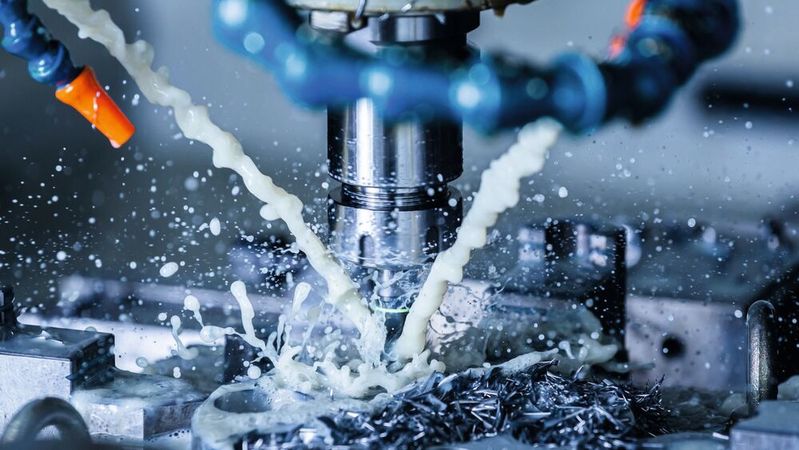
The Lorenz Hoffmann company has four CNC milling machines that were previously supplied by four rotary vane vacuum pumps (symbolic image).
The milling machine engages, coolant sprays, and metal chips fly. The milling tool moves with millimeter precision over a metal piece secured by vacuum in the production hall of Lorenz Hoffmann GmbH. The company, located south of Würzburg in Kreßberg, utilizes high-precision CNC milling machines in its shop to manufacture prototypes for mechanical engineering, among other things. With its 40 employees, the company has been producing prototypes, small series, and ready-to-install components for various industries for over forty years.
To meet the highest demands for precision, the workpieces must not shift by even one hundredth of a millimeter during the milling process. Therefore, they are secured using vacuum technology. Employees use special vacuum clamping plates connected to vacuum pumps for this purpose.
Less Energy, Higher Quality
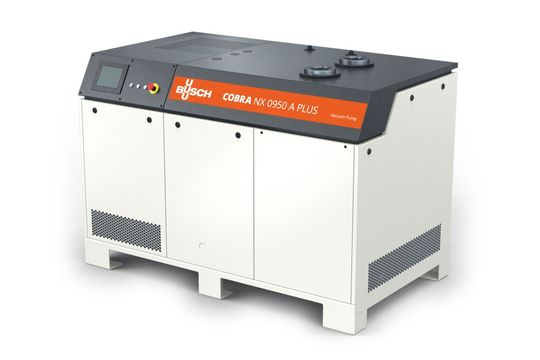
To supply its four CNC milling machines with vacuum, the company previously used a separate vacuum pump on each machine. Managing Director Andreas Hoffmann wanted to optimize the vacuum supply in his company and therefore turned to Busch. On the advice of the vacuum experts, he replaced the four oil-lubricated rotary vane vacuum pumps with a single Cobra Plus dry screw vacuum pump. This is connected to the four milling machines via pipes.
"By acquiring the Cobra, we save 3,500 kWh per year compared to the four oil-lubricated rotary vane pumps we previously used—and with even better holding performance," summarizes Hoffmann. This is because the screw vacuum pump is speed-controlled, allowing it to adjust its power to the actual demand, thereby consuming less energy than an uncontrolled pump, whose motor always operates at full speed.
The Federal Office of Economics and Export Control (Bafa) reimbursed Lorenz Hoffmann 40 percent of the purchase costs for the new vacuum pump.
(Image: Pfeiffer Vacuum)
"The Cobra regulates itself and always delivers exactly the performance we need. For example, if only one milling machine is used, the Cobra works at a lower speed than if several milling machines are used at the same time," explains the Managing Director.
This pump model is also fully networked and has a control and monitoring function. The power consumption, vacuum level and motor speed, for example, can be displayed on a color touchscreen. This allows employees to keep an eye on the vacuum supply at all times.
Better Working Conditions, Hardly Any Maintenance
All Cobra screw vacuum pumps from Busch operate completely contact-free, which means they do not require any oil in the compression chamber. "Since switching to the Cobra, we no longer have to change any oil, air/oil separators or filters. This saves around four working days of maintenance per year. So far, the COBRA has run without any faults and maintenance has not been necessary at all," Hoffmann praises.
In addition, the operation of the pump causes considerably less noise than the four old vacuum pumps. Since the replacement, the production hall has been significantly quieter than before. For the employees, this means a significant improvement in working conditions. "Previously, up to four pumps were running at 72 decibels each. The Cobra generates 63 decibels. That's why it's now only half as loud and it's much more pleasant to work," says the Managing Director.
Heating with Waste Heat Instead of Oil
Andreas Hoffmann emphasizes the importance of producing as sustainably and energy-efficiently as possible. By switching to the screw vacuum pump, he now has the opportunity to utilize the pump's waste heat for heating. To this end, he and his team developed a heat recovery system. "The COBRA has water cooling. The heated coolant water is routed through an air heater, allowing us to heat our production hall," he explains. This air heater includes a fan and a heating register that cools the water so it can be reused to cool the pump. As a result, the company, which previously relied on oil heating, now requires significantly less heating oil. "In summer, we direct the waste heat outside. In winter, it's retained in production. This makes it noticeably cooler in the production hall even during the warm season. Previously, the production hall always got very hot in summer," he adds.
Reimbursement Thanks to BAFA Funding
As energy-efficient technologies are subsidized in Germany, the experts at Busch assisted the company in applying for a BAFA grant. As a result, Lorenz Hoffmann received a 40 percent reimbursement of the acquisition costs for the new vacuum pump from the Federal Office for Economic Affairs and Export Control (BAFA).
Date: 08.12.2025
Naturally, we always handle your personal data responsibly. Any personal data we receive from you is processed in accordance with applicable data protection legislation. For detailed information please see our privacy policy.
Consent to the use of data for promotional purposes
I hereby consent to Vogel Communications Group GmbH & Co. KG, Max-Planck-Str. 7-9, 97082 Würzburg including any affiliated companies according to §§ 15 et seq. AktG (hereafter: Vogel Communications Group) using my e-mail address to send editorial newsletters. A list of all affiliated companies can be found here
Newsletter content may include all products and services of any companies mentioned above, including for example specialist journals and books, events and fairs as well as event-related products and services, print and digital media offers and services such as additional (editorial) newsletters, raffles, lead campaigns, market research both online and offline, specialist webportals and e-learning offers. In case my personal telephone number has also been collected, it may be used for offers of aforementioned products, for services of the companies mentioned above, and market research purposes.
Additionally, my consent also includes the processing of my email address and telephone number for data matching for marketing purposes with select advertising partners such as LinkedIn, Google, and Meta. For this, Vogel Communications Group may transmit said data in hashed form to the advertising partners who then use said data to determine whether I am also a member of the mentioned advertising partner portals. Vogel Communications Group uses this feature for the purposes of re-targeting (up-selling, cross-selling, and customer loyalty), generating so-called look-alike audiences for acquisition of new customers, and as basis for exclusion for on-going advertising campaigns. Further information can be found in section “data matching for marketing purposes”.
In case I access protected data on Internet portals of Vogel Communications Group including any affiliated companies according to §§ 15 et seq. AktG, I need to provide further data in order to register for the access to such content. In return for this free access to editorial content, my data may be used in accordance with this consent for the purposes stated here. This does not apply to data matching for marketing purposes.
Right of revocation
I understand that I can revoke my consent at will. My revocation does not change the lawfulness of data processing that was conducted based on my consent leading up to my revocation. One option to declare my revocation is to use the contact form found at https://contact.vogel.de. In case I no longer wish to receive certain newsletters, I have subscribed to, I can also click on the unsubscribe link included at the end of a newsletter. Further information regarding my right of revocation and the implementation of it as well as the consequences of my revocation can be found in the data protection declaration, section editorial newsletter.
However, Andreas Hoffmann is particularly pleased with the energy benefits and is proud of his heat recovery system, which was made possible by the new pump: "The purchase of the Cobra has proven to be twice as beneficial for us. We have lower power consumption than before and can use the waste heat from the pump for heating in winter."
Heating with waste heat instead of oil
It is important to Andreas Hoffmann to produce as sustainably and energy-efficiently as possible. By switching to the screw vacuum pump, he now has the opportunity to use the waste heat from the pump for heating. To this end, he and his team developed a heat recovery system. "The COBRA has a water cooling system. The heated cooling water is fed through an air heater. This is how we heat our production hall," he explains. This air heater contains a fan and a heating coil that cools the water down so that it can be reused to cool the pump. As a result, the company, which otherwise uses oil heating, requires significantly less heating oil. "In summer, we channel the waste heat outside. In winter, it stays in production. As a result, it is now noticeably cooler in the production hall, even in the warmer months. Previously, the production hall always heated up a lot in summer," he adds.
As energy-efficient technologies are subsidized in Germany, the experts from Busch supported the company in submitting a Bafa application. As a result, Lorenz Hoffmann was reimbursed 40 percent of the purchase costs for the new vacuum pump by the Federal Office of Economics and Export Control (BAFA).
However, Andreas Hoffmann is particularly pleased about the energy benefits and is proud of his heat recovery system, which was made possible by the new pump: "The purchase of the Cobra has been doubly worthwhile for us. We have lower electricity consumption than before and can use the waste heat from the pump for heating in winter."



:quality(80)/p7i.vogel.de/wcms/81/c6/81c6f01476cd66350d1a6467efede21d/screenshot-202026-01-28-20174921-783x440v1v1.png "Vacuum-brazed probes. (Image:iew inductive heating systems)")
:quality(80)/p7i.vogel.de/wcms/40/c5/40c5051cebdb10fdee9a283303434d9d/0129881741v1.jpeg "3D-printed tools and other components contribute to energy-saving, precise processes. (Image:Gerhard Schubert GmbH)")
:quality(80)/p7i.vogel.de/wcms/ae/bd/aebda515c684825e97579175874ea6bd/0129920231v1.jpeg "Hensoldt, a sensor specialist for critical defense applications among other things, now has a strategic milestone ahead of it. The company is planning to acquire Nedinsco, an optronics company from Venlo in the Netherlands. Here's what's to come ... (Image:Hensoldt)")
:quality(80)/p7i.vogel.de/wcms/c3/6f/c36f031df46d22615d941d077d32313c/0129800025v1.jpeg "The laser-assisted process is intended to make wafer cutting significantly more productive. (Image:Trumpf)")
:quality(80)/p7i.vogel.de/wcms/73/17/7317794432521bf911711b91287cfc28/0129961259v1.jpeg "ABB Robotics and Nvidia are enabling the widespread use of physical AI in the world of robotics. This means that systems can be created virtually and with high precision and optimized much more cost-effectively. In the large image the virtual system, next to it the real robot cell ... (Image:ABB)")
:quality(80)/p7i.vogel.de/wcms/09/a2/09a2e832b1c0271d299fc130201e5717/adobestock-1767409934-4191x2360v1.jpeg "(Source: © ImageFlow - stock.adobe.com)")
:quality(80)/p7i.vogel.de/wcms/3e/1c/3e1c58be6be95c1f511fc6fd6812cf20/0129887455v1.jpeg "The picture shows an aerial view of the existing site, supplemented by a visualization of the Smart Factory. The new production facility is to be built on the current parking lot. (Image:Siemens AG)")
:quality(80)/p7i.vogel.de/wcms/ee/2e/ee2ed86ee6920e691aaab10cc7d2dec6/0128979319v1.jpeg "Humanoid robots can support people without adapting the environment. (Picture: ©Gorodenkoff - stock.adobe.com)")
:quality(80)/p7i.vogel.de/wcms/28/00/28008d9477bb07daa3b28ce4ac0ae907/newsimage418436-1536x864v1v1.jpeg "Researchers have produced elastic ear cartilage from human cells in the laboratory, which remains dimensionally stable in animal models. (Image:ETH Zurich)")
:quality(80)/p7i.vogel.de/wcms/1e/7d/1e7d6a316cdd7a7ba5e84d7c9a3efb80/newsimage418837-3000x1687v1v1.jpeg "Driverless shuttles can strengthen public transport, especially in rural areas. (Image:ZF Friedrichshafen)")
:quality(80)/p7i.vogel.de/wcms/85/e8/85e89606edeeec55feac9ab5617e2440/newsimage418885-3500x1969v1v1.jpeg "Flexible: The solid electrolyte based on silicone is expandable and thus compensates for the cavities that form in solid-state batteries during charging and discharging. (Image:Empa)")
:quality(80)/p7i.vogel.de/wcms/e8/dc/e8dc27a8d9fba8fbd081987400bf6848/0127426198v1.jpeg "3D FEM models are detailed, large and computationally intensive. Thanks to ROM and the support of Cadfem, Wago has succeeded in setting up an e-shop for thermal simulation. (Image:WAGO)")
:quality(80)/p7i.vogel.de/wcms/a7/22/a722a06c823b5d7405eb9fb15a0b4e7d/0129931201v1.jpeg "The company offers access to its charging network, which now has more than 1,000,000 charging points across Europe, via the Elli app. (Image:Elli | Volkswagen)")
:quality(80)/p7i.vogel.de/wcms/89/5d/895dfb4fb9a90c33ddd287c7d09c9ffd/0129938355v1.jpeg "Ganfeng Lithium has developed semi-solid batteries for eVTOLs together with Geely subsidiary Aerofugia. (Image:Aerofugia)")
:quality(80)/p7i.vogel.de/wcms/7c/b5/7cb53f75b7254936bca07deea6df4ed7/0129926273v1.jpeg "Windrose and Hubjekt cooperate on Plug&Charge authentication. (Image:Wind rose)")
:quality(80)/p7i.vogel.de/wcms/09/5a/095a3ffb6f8fa4c4ccdd40e99ad4eb57/0129947820v1.jpeg "The developers at Irlbacher prevent the glass surface from falling below the dew point with 3D printing in the form of filigree conductor tracks on flat glass. (Image:Irlbacher)")
:quality(80)/p7i.vogel.de/wcms/64/97/6497d264fcf62cf4325443498b3826f3/0129930890v1.jpeg "Switching without mechanical contacts (Image:Endrich)")
:quality(80)/p7i.vogel.de/wcms/f3/c0/f3c0040f2b655e91b80158029c65b0cc/0127314142v1.jpeg "Nexperia's assembly and testing fab in Guangdong, China. (Image:Nexperia)")
:quality(80)/p7i.vogel.de/wcms/eb/06/eb069fcd5423295876bad3277dbea0bf/0129955418v1.jpeg "The Iran war and the supply chains: Electronic components are currently hardly affected by bottlenecks. (Image:Markus Kammermann)")
:quality(80)/p7i.vogel.de/wcms/ee/75/ee7566bf98b05455703bb7521fcb98a4/0129937679v1.jpeg "The search for new semiconductor materials is progressing. (Image:Dall-E / AI-generated)")
:fill(fff,0)/p7i.vogel.de/companies/67/eb/67eba621ef6ea/logo2.png "logo2 (Wuxi InfiMotion)")
:quality(80)/p7i.vogel.de/wcms/ee/b3/eeb394b07849a0e448296eface6d07d9/0124873261v4.jpeg "Bei dieser Innengewindeschleifmaschine hat Kammerer einen seiner eigenen Kugelgewindetriebe nachgerüstet. (Bild: Kammerer)")
:quality(80)/p7i.vogel.de/wcms/d4/e1/d4e1b77d7c8cff73e6109b9c60eff11a/0123991355v1.jpeg "In electric cars, the air conditioning system also ensures the ideal temperature for the high-voltage battery—damage can reduce charging performance and service life. (Image:Inficon)")
:quality(80)/p7i.vogel.de/wcms/81/c6/81c6f01476cd66350d1a6467efede21d/screenshot-202026-01-28-20174921-783x440v1v1.png "Vacuum-brazed probes. (Image:iew inductive heating systems)")