Anyone who still believes that employing several robotics experts and computer scientists is necessary for operating an industrial robot is mistaken. Modern platforms, AI, and other tools greatly simplify the use of these mechanical helpers.
With the help of modular and intelligent robots, the automation of manufacturing processes could be elevated to a new level.
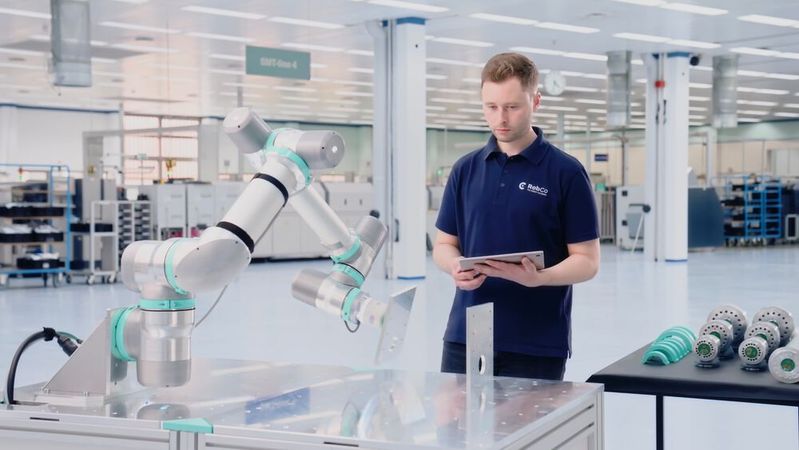
(Image: Robco)
For years, the Smart Factory has been a central topic in the manufacturing industry as demands continue to grow. In addition to striving for increased efficiency, challenges such as the ongoing lack of skilled workers, high customer expectations, strict quality standards, and growing regulatory requirements pose significant obstacles. To remain competitive, more and more companies are adopting technologies such as artificial intelligence (AI). Nevertheless, many production facilities struggle to keep pace with rapid digital developments, and in most factories, the implementation of Industry-X remains fragmented.
What is Industry-X?
Industry-X represents an evolution of Industry 4.0, taking it a step further by not only focusing on the digital transformation and automation of production processes but also including aspects of sustainability and the integration of data ecosystems such as Catena-X. By implementing an Industry-X approach, companies can simulate, monitor, optimize, and introduce innovations across the entire value chain in real-time. This enables faster and more cost-effective production of products while simultaneously minimizing environmental impact.
Production hardware, especially robots, should not be overlooked. Because the integration of AI-supported robotics enables highly dynamic and flexible production concepts, reduces costs, and offers a solution to the shortage of skilled workers.
Modular robots, like those offered by the German company Robco, are extremely flexible and specifically tailored to the needs of the manufacturing industry, particularly for small to medium-sized enterprises. Their modular kit system allows these robots to be easily reconfigured and used for different applications whenever required. They can be remotely configured, implemented, and managed via a digital twin, with no need for extensive programming knowledge or specialized personnel thanks to no-code software. Modular robotic systems utilize open platforms with APIs and integrate IoT functionality to enable predictive maintenance. Software updates are conducted "over the air," ensuring straightforward updates and maintenance of the robots.
Concrete application examples for modular robots
Quality Assurance through AI-Supported Modular Robots: Quality assurance of workpieces and components is a central challenge in manufacturing. In mass production, sampling inspections are common because manually checking each part would be uneconomical. The deployment of modular robots equipped with cameras or laser scanners and trained object recognition AI can monitor parts directly during the manufacturing process. For example, AI-supported modular robots are used for quality control of welds in Original Equipment Manufacturers (OEMs). A 3D laser profile sensor at the end of the robot arm enables precise object scans to detect flaws such as incorrect dimensions, pores, or interruptions. Automobile manufacturers employ this solution by integrating AI-based object recognition with the sensor data from welding robots to enable real-time analyses of each workpiece. This quality control also allows for root cause analyses to permanently eliminate sources of errors and supports the continuous improvement and automatic reconfiguration of welding robots to enhance product quality.
Nvidia Omniverse—Synchronous Digital Twin: Digital twins in the Nvidia Omniverse precisely and realistically visualize the robot and its environment. This is facilitated by loading a 3D model of the robot in the Universal Robot Description Format (URDF) into the robot simulation program. A special extension enables a connection via Websockets to the robot, continuously reading the angular positions of each robot arm. This data transfer allows for real-time analysis and visualization in the Omniverse, enabling the digital twin to interactively engage with its physical counterpart.
This technology offers numerous application possibilities:
Remote monitoring of production: Production managers can monitor production processes, assess process efficiency, and make optimizations without needing to be physically present. This capability is particularly valuable for companies with multiple locations or in situations with limited access to the factory floor or large distances.
Simulation of motion sequences: Pre-programmed simulations such as "weld seam inspection using a laser sensor" enable the planning and prediction of robot actions before the implementation of new production processes.
Manual control via user interface: Users can manually control both the digital model and the physical robot via a web interface. This allows potential positioning of the robot in a virtual environment to be tested, optimized, and then implemented in reality.
The compact motion data of the robot arm allow for seamless transmission to a cloud infrastructure. Within this infrastructure, a powerful virtual machine is used to process the visualizations of the robot arm. Access is secured through a VPN connection, ensuring the integrity and security of the data. This setup is accessible via a web browser, enabling control from virtually any endpoint device.
Date: 08.12.2025
Naturally, we always handle your personal data responsibly. Any personal data we receive from you is processed in accordance with applicable data protection legislation. For detailed information please see our privacy policy.
Consent to the use of data for promotional purposes
I hereby consent to Vogel Communications Group GmbH & Co. KG, Max-Planck-Str. 7-9, 97082 Würzburg including any affiliated companies according to §§ 15 et seq. AktG (hereafter: Vogel Communications Group) using my e-mail address to send editorial newsletters. A list of all affiliated companies can be found here
Newsletter content may include all products and services of any companies mentioned above, including for example specialist journals and books, events and fairs as well as event-related products and services, print and digital media offers and services such as additional (editorial) newsletters, raffles, lead campaigns, market research both online and offline, specialist webportals and e-learning offers. In case my personal telephone number has also been collected, it may be used for offers of aforementioned products, for services of the companies mentioned above, and market research purposes.
Additionally, my consent also includes the processing of my email address and telephone number for data matching for marketing purposes with select advertising partners such as LinkedIn, Google, and Meta. For this, Vogel Communications Group may transmit said data in hashed form to the advertising partners who then use said data to determine whether I am also a member of the mentioned advertising partner portals. Vogel Communications Group uses this feature for the purposes of re-targeting (up-selling, cross-selling, and customer loyalty), generating so-called look-alike audiences for acquisition of new customers, and as basis for exclusion for on-going advertising campaigns. Further information can be found in section “data matching for marketing purposes”.
In case I access protected data on Internet portals of Vogel Communications Group including any affiliated companies according to §§ 15 et seq. AktG, I need to provide further data in order to register for the access to such content. In return for this free access to editorial content, my data may be used in accordance with this consent for the purposes stated here. This does not apply to data matching for marketing purposes.
Right of revocation
I understand that I can revoke my consent at will. My revocation does not change the lawfulness of data processing that was conducted based on my consent leading up to my revocation. One option to declare my revocation is to use the contact form found at https://contact.vogel.de. In case I no longer wish to receive certain newsletters, I have subscribed to, I can also click on the unsubscribe link included at the end of a newsletter. Further information regarding my right of revocation and the implementation of it as well as the consequences of my revocation can be found in the data protection declaration, section editorial newsletter.
Assisted Operation of the Modular Robot with an XR Headset: The assisted operation of modular robots using an XR headset and the associated software offers an innovative way to familiarize users with controlling complex systems. By integrating Augmented Reality (AR), step-by-step instructions are provided directly in the user's field of view. Users receive virtual instructions in real-time, showing them how to perform specific actions. The XR headset guides the user through each step, from turning on the robot to readiness for operation, with the guidance dynamically adapting to the specific situation and environment. Virtual tiles, lines, and cues simplify the operation of the robot, even for individuals without prior experience. This flexibility allows for the customization of the training and operation process to suit different scenarios.
The method of assisted operation using an XR (extended reality) headset offers numerous advantages:
Reduced training time: Users can be quickly and effectively trained without the need to study extensive manuals or undergo specialized training.
Error reduction: New employees can familiarize themselves with the machinery in a virtual environment without actually operating it or disrupting ongoing operations. This reduces the risk of operational errors during the training phase and allows for safe training.
Interactive learning experience: The interactive learning experience through visual and interactive guides enhances user understanding and retention by allowing them to better process and remember complex information.
Simulation-based training for emergency situations: Using an XR headset, emergency scenarios can also be simulated, better preparing the operating staff for such situations and increasing safety.
Conclusion
The introduction of modular robots marks a significant step towards Industry-X in the manufacturing sector. Their flexibility and intelligence promise to elevate the automation of production processes to a new level. By integrating digital twins, it will be possible to virtually monitor and optimize production processes, leading to more efficient and agile manufacturing. Current use cases already demonstrate the immense potential of this technology. In the future, modular robots are expected to play a key role in leading the manufacturing industry into an era of flexibility, automation, and intelligence.



:quality(80)/p7i.vogel.de/wcms/a0/47/a04725ef9bd09fb6c9341a1bea1b5d93/0130443083v1.jpeg "Here, a type of plastic pallet is produced by thermoforming (vacuum forming or deep drawing) at the corresponding division of New England Plastics in the USA. This division, which specializes in so-called liners, is now part of Ringmetall ... (Image:New England Plastics)")
:quality(80)/p7i.vogel.de/wcms/23/99/23992bf2dcdc432c9b7209c34a4a7c48/0129733089v1.jpeg "Stork relies on the modular Neoswiss turning system from Iscar to shorten the set-up times for its sliding headstock lathes and work more productively. (Image:Iscar)")
:quality(80)/p7i.vogel.de/wcms/7d/e2/7de2923434b2f1a78ba5482d8d335269/0113143253v1.jpeg "In our China Market Insider we regularly provide you with relevant information directly from China. (Image:© Eisenhans - stock.adobe.com)")
:quality(80)/p7i.vogel.de/wcms/9d/2b/9d2b802f800e5caf17b2831e74228cd3/screenshot-202026-03-03-20103822-609x343v1v1.png "Visual comparison: on the left, a clean, burr-free cut edge; on the right, typical burr formation with oxidation discoloration. This illustrates how strongly parameter control and gas management influence the quality of the result. (CO₂ laser, oxygen cutting gas, sheet thickness approx. 15 mm). (Image:Picture: Rime)")
:quality(80)/p7i.vogel.de/wcms/b7/36/b736dfebc16c42d6901d0d0e1f390493/3d-druck-20factory-20--20ki-20generiert-1920x1079v1.png "(Source: AI-generated)")
:quality(80)/p7i.vogel.de/wcms/79/b2/79b21aad663f4a7bd4472afc1c1afc62/0130433994v1.jpeg "Mission Joyride: The free-flying robot (shown here in the rendering) will relieve the ISS crew of logistics tasks from 2027 with its two mechanical arms. (Image:Icarus Robotics)")
:quality(80)/p7i.vogel.de/wcms/6b/45/6b4546fa6ebf305c3660326909363f32/0130437089v1.jpeg "Industrial AI in action: Rockwell Automation presents practical solutions for self-controlling production systems at the Hannover Messe. (Image:Rainer Jensen, Deutsche Messe)")
:quality(80)/p7i.vogel.de/wcms/78/e9/78e9188c25a8a94e67c34c9bf8ffe495/visual-agile-20robots-20and-20google-20deepmind-20partner-20to-20bring-20intelligence-20to-20robotics-2500x1406v1v1.jpeg "Together, the partners are developing adaptable, intelligent robots for a wide range of applications (Image:Agile Robots SE)")
:quality(80)/p7i.vogel.de/wcms/59/a2/59a2b11f0aa1b700eff02addd5de8703/adobestock-1788280853--c2-a9-20satria-20-e2-80-93-20stock-adobe-com-5081x2860v1v1.jpeg "Quantum computers require extreme cooling to temperatures close to absolute zero in order to keep qubits stable. (Image:satria - stock.adobe.com)")
:quality(80)/p7i.vogel.de/wcms/62/5f/625f41e87ebfef156a98c8e6393e32fd/0130211654v1.jpeg "Axial flux motors have some advantages over radial flux motor—but their production is currently still expensive. (Image:RWTH Aachen University)")
:quality(80)/p7i.vogel.de/wcms/e3/42/e342b3c593ea92d56604d3be969e9c9a/0130437231v1.jpeg "Daimler Truck will be building even more trucks at its Czech plant in Cheb in the future. This is because it is now being expanded for strategic cost-saving reasons ... (Image:Daimler Truck)")
:quality(80)/p7i.vogel.de/wcms/f6/ae/f6aec4f6241b36ed5e3a990ac9176b42/0130429460v1.jpeg "Verne, Pony.ai and Uber want to launch a robotaxi service in Europe. (Image:Verne)")
:quality(80)/p7i.vogel.de/wcms/d7/88/d788699f2974708a332baa4e7a62fa9e/0130438967v1.jpeg "Skoda is withdrawing from China. The brand has produced well over three million vehicles there. (Image:Skoda car)")
:quality(80)/p7i.vogel.de/wcms/b0/43/b043b86899837532aad62d63368a917a/0130371361v1.jpeg "Skoda leaves the chinese market.
(Image:Skoda)")
:quality(80)/p7i.vogel.de/wcms/ee/09/ee09acbd6dc896df25affaa9e871e6e5/0130440053v1.jpeg "IMS chip module for simple system integration into an ion mobility spectrometer. (Image:Fraunhofer IPMS)")
:quality(80)/p7i.vogel.de/wcms/10/6c/106cd22de5f68a0f74639d654827228c/0130345302v1.jpeg "Made in India: According to the India Electronics and Semiconductor Association (IESA), the country should be able to produce between 75 and 80 million chips by the beginning of 2027, once the plants currently under construction become operational. (Image:Pixabay (Montage: Sebastian Gerstl))")
:quality(80)/p7i.vogel.de/wcms/a5/ed/a5ed6fda029d362732a293d6b19d74c4/0130444216v1.jpeg "Thirteen executives from the Chinese chip industry have drawn up a plan to achieve an 80% self-sufficiency rate for semiconductors by 2030. (Image:Maxim_Kazmin - stock.adobe.com)")
:quality(80)/p7i.vogel.de/wcms/31/a6/31a646018b34d8e0a44bfc8bf17837f6/0130361632v1.jpeg "For many companies, PFAS are considered indispensable in electronics production. (Image:freely licensed)")
:fill(fff,0)/images.vogel.de/vogelonline/companyimg/76800/76895/65.jpg "FAULHABER_120mm.jpg ()")
:fill(fff,0)/p7i.vogel.de/companies/69/88/69882c428938e/tmts2026-ticec-banner-en-2000px.png "tmts2026-ticec-banner-en-2000px (https://www.tmts.tw/en)")
:quality(80)/p7i.vogel.de/wcms/ad/da/adda2b0237d0167d79524dc8845649b8/0128720455v1.jpeg "Pepsico is digitizing selected production facilities and warehouses in the USA using Digital Twin Composer. (Image:Pepsico)")
:quality(80)/p7i.vogel.de/wcms/73/17/7317794432521bf911711b91287cfc28/0129961259v1.jpeg "ABB Robotics and Nvidia are enabling the widespread use of physical AI in the world of robotics. This means that systems can be created virtually and with high precision and optimized much more cost-effectively. In the large image the virtual system, next to it the real robot cell ... (Image:ABB)")