


:quality(80)/p7i.vogel.de/wcms/45/2e/452ebe27b324cc535db2760946dfd15d/0131742792v1.jpeg "A major advantage of the new system is, on the one hand, the stability of the holder system and, on the other hand, the internal coolant supply directly to the working area. (Image:Horn/Sauermann)")
:quality(80)/p7i.vogel.de/wcms/d1/6c/d16c902c1311170a225c4e1b7db7bd4b/0132073916v1.jpeg "Now there is finally a saw with an XXL rotating table, so that ton-heavy plastic or fiber composite material panels can be cut gently and quickly. It is called FK-6, and it was built by IMA Schelling Precision. Read here what has been done ... (Image:IMA Schelling Precision)")
:quality(80)/p7i.vogel.de/wcms/50/9a/509a5a7e54f038aadfea20d1e98bf3e2/0113143253v1.jpeg "In our China Market Insider, we regularly provide you with relevant information directly from China. (Image:© Eisenhans - stock.adobe.com)")
:quality(80)/p7i.vogel.de/wcms/3f/32/3f3272843333b0e8215db84152362ba8/0132070616v1.jpeg "Linear guides combined with other components form complex systems for automation. (Image:IEF-Werner)")
:quality(80)/p7i.vogel.de/wcms/9d/b0/9db0180b9d22b66c04fe5dba7c288b0e/0131649599v1.jpeg "It may still take some time before this vision becomes reality. And whether workshop robots necessarily need human-like legs is also not certain. (Image: AI-generated)")
:quality(80)/p7i.vogel.de/wcms/e5/0d/e50d800573729eefbdcdcd6ee5211fb8/adobestock-1696648818--c2-a9-20alexander-20-e2-80-93-20stock-adobe-comv1.jpeg "At Limtronik, the use of AI is not based on an isolated innovation project but on a digital infrastructure that has been developed over years. (Source: © Alexander – stock.adobe.com)")
:quality(80)/p7i.vogel.de/wcms/14/dc/14dc9fff54875a06b98592536134e0e3/0131864932v1.jpeg "The complete IO-Link package makes the difference. When the interaction of sensors, powerful masters, and a manufacturer-independent configuration tool is seamless, significantly enhanced machine performance is possible. (Image:Baumer)")
:quality(80)/p7i.vogel.de/wcms/1c/78/1c78ac0aaadd921509594b8b9683853e/adar-one---electronics-480x270v1.jpeg "The world's first safety-certified 3D ultrasonic sensor, ADAR One, introduces a new safety layer for robotics, a certified 3D perceptual foundation that sits beneath any camera, AI stack, or motion system, independently verifying that the space around a robot is safe. (Image: Sonair)")
:quality(80)/p7i.vogel.de/wcms/04/eb/04ebee99febeb716da7782b9e42d78b8/0132051842v1.jpeg "The Basic Day Thermal Management is an essential part of the \"Power of Electronics\" conference and originally evolved from the \"Cooling Days.\" (Image: Stefan Bausewein)")
:quality(80)/p7i.vogel.de/wcms/19/27/1927ccde4c7d25ce6f4e274a06bfc06c/cover-20imagev1.jpeg "Additive manufacturing has established itself as a complementary alternative to traditional machining for automotive tools, offering greater speed and flexibility. (Source: Stratasys)")
:quality(80)/p7i.vogel.de/wcms/15/00/1500298944949437fde0e0ba332eaa3c/adobestock-1898612059v1.jpeg "(Source: Anusa - stock.adobe.com)")
:quality(80)/p7i.vogel.de/wcms/5f/59/5f59f681a45fb2359bb8c8c07d4adb55/siemens-pave360-automotive-01v1.jpeg "Virtual twins, AI-powered tests, and new validation concepts: vehicle development is becoming increasingly software-driven—and is thus gaining speed. (Image: Siemens)")
:quality(80)/p7i.vogel.de/wcms/b6/bb/b6bbb8b6cfc885e28518d42d31efaaa4/org-blobs-user-response-file-output-e3944719-21bc-489b-908d-2e20572fbcf0-file-1782765707127-jpgv1.jpeg "In China, several companies are working on sodium-ion batteries for heavy trucks. (Image: )")
:quality(80)/p7i.vogel.de/wcms/bd/28/bd28688c768b9a6ab0fbfe23bd355643/0132083515v1.jpeg "Europe's car manufacturers may soon have the Chinese competition right on their doorstep! This is because they are increasingly looking for factories in Europe to bypass new additional tariffs on hybrids. BYD will start manufacturing in Hungary this year and likely elsewhere too... (Image: BYD)")
:quality(80)/p7i.vogel.de/wcms/2a/7d/2a7d061766e1b35d02e969606076158e/0132082107v1.jpeg "By separating the drive board and application, the driverless vehicle U-Shift II becomes a versatile multi-talent for shuttle and logistics services. (Image: KIT)")
:quality(80)/p7i.vogel.de/wcms/55/e3/55e36b0fa8130f29e52a6a6030b2ff40/0132081018v1.jpeg "Maintenance before failure instead of repair afterward: Volkswagen is expanding its digital services for commercial vehicle fleets and focusing more on data-driven service processes. (Image: Connected cars)")
:quality(80)/p7i.vogel.de/wcms/52/07/52071244e4b5cc28a8834b26ae30eee6/0132094074v1.jpeg "Symbol image: Photonics. (Image: Dall-E / AI-generated)")
:quality(80)/p7i.vogel.de/wcms/78/66/7866a25d3734c5caed45c3ea0f516dff/0132071151v1.jpeg "Under the name \"Rollable Flex,\" Samsung Display has already presented prototypes of a rollable OLED display. (Image:Samsung Display)")
:quality(80)/p7i.vogel.de/wcms/d4/f9/d4f93e4bfa02c1e6e242d5d8318fbcf5/0132044846v1.jpeg "The South Korean chip manufacturers Samsung and SK Hynix are on the rise. But that is not enough for the country! South Korea's government now aims to invest billions to maintain its leading role in the long term ... (Image: Samsung Electronics)")
:quality(80)/p7i.vogel.de/wcms/fe/e1/fee174199114ed9d7825cc5d8c6da984/0132076430v1.jpeg "Can AI replace classical motor control? Burger Engineering and TH Nürnberg have investigated this. (Image: Burger Engineering / istockphoto.com)")
:fill(fff,0)/images.vogel.de/vogelonline/companyimg/76800/76895/65.jpg "FAULHABER_120mm.jpg ()")
:fill(fff,0)/p7i.vogel.de/companies/68/a4/68a47beec75ce/logo-cmyk-de.jpeg "logo-cmyk-de (https://www.datatec.eu/)")
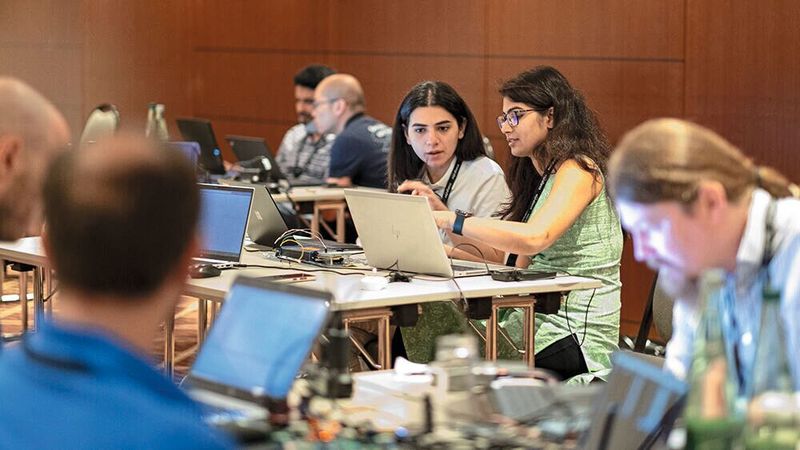
:quality(80)/p7i.vogel.de/wcms/55/12/5512dd4193b6db3b3cc064392e3d4a92/0126146175v1.jpeg "MIPI I3C Interop Workshop in Munich(Image: Angelika Güc)")
:quality(80)/p7i.vogel.de/wcms/a9/d8/a9d82b294560388eeed0f2db62204ea2/0126145931v1.jpeg "(Image: Angelika Güc)")
:quality(80)/p7i.vogel.de/wcms/67/2b/672b2c7a3a436e5caea27085588ed64f/0126145938v1.jpeg "MIPI I3C supports options for more powerful modes with high data rates, enabling speeds of over 30 Mbit/s in single-lane mode without compromising energy-efficient design.(Image: Angelika Güc)")
:quality(80)/p7i.vogel.de/wcms/5d/51/5d51013439c3e98e821dc2111610af78/0126145939v1.jpeg "MIPI I3C reduces energy consumption for transmitting 1 kB by 5 to 18 times compared to conventional I2C.(Image: Angelika Güc)")
:quality(80):fill(efefef,0)/p7i.vogel.de/wcms/67/ad/67adf4a647532/elatec-wp-machine-authentication.png "Elatec WP Machine Authentication")
Date: 08.12.2025
Naturally, we always handle your personal data responsibly. Any personal data we receive from you is processed in accordance with applicable data protection legislation. For detailed information please see our privacy policy.
Consent to the use of data for promotional purposes
I hereby consent to Vogel Communications Group GmbH & Co. KG, Max-Planck-Str. 7-9, 97082 Würzburg including any affiliated companies according to §§ 15 et seq. AktG (hereafter: Vogel Communications Group) using my e-mail address to send editorial newsletters. A list of all affiliated companies can be found here
Newsletter content may include all products and services of any companies mentioned above, including for example specialist journals and books, events and fairs as well as event-related products and services, print and digital media offers and services such as additional (editorial) newsletters, raffles, lead campaigns, market research both online and offline, specialist webportals and e-learning offers. In case my personal telephone number has also been collected, it may be used for offers of aforementioned products, for services of the companies mentioned above, and market research purposes.
Additionally, my consent also includes the processing of my email address and telephone number for data matching for marketing purposes with select advertising partners such as LinkedIn, Google, and Meta. For this, Vogel Communications Group may transmit said data in hashed form to the advertising partners who then use said data to determine whether I am also a member of the mentioned advertising partner portals. Vogel Communications Group uses this feature for the purposes of re-targeting (up-selling, cross-selling, and customer loyalty), generating so-called look-alike audiences for acquisition of new customers, and as basis for exclusion for on-going advertising campaigns. Further information can be found in section “data matching for marketing purposes”.
In case I access protected data on Internet portals of Vogel Communications Group including any affiliated companies according to §§ 15 et seq. AktG, I need to provide further data in order to register for the access to such content. In return for this free access to editorial content, my data may be used in accordance with this consent for the purposes stated here. This does not apply to data matching for marketing purposes.
Right of revocation
I understand that I can revoke my consent at will. My revocation does not change the lawfulness of data processing that was conducted based on my consent leading up to my revocation. One option to declare my revocation is to use the contact form found at https://contact.vogel.de. In case I no longer wish to receive certain newsletters, I have subscribed to, I can also click on the unsubscribe link included at the end of a newsletter. Further information regarding my right of revocation and the implementation of it as well as the consequences of my revocation can be found in the data protection declaration, section editorial newsletter.
:quality(80)/p7i.vogel.de/wcms/a8/f7/a8f769adac577406bb0c56f5b7535564/0131874725v1.jpeg "Huge success: In 1983, the Controller Area Network was born. A revolution, as it reduced wiring efforts, is fail-safe, and real-time capable. (Image: ©Elena - stock.adobe.com / AI-generated)")
:quality(80)/p7i.vogel.de/wcms/87/f8/87f87cbd3669c82cf8a929f50541f806/0130618626v1.jpeg "Microchip's new hybrid MCU system-in-package SAM9X75 enables MPU computing power with the familiar development environment of MCU-based designs, (Image:Microchip)")