It has its charm, small but big enough for most errands in the city – however, it is relatively expensive. We took a spin in the Microlino. What are the pros and cons?
The Microlino is now available in Germany.
(Image: Wehner - Vogel Communication Group)
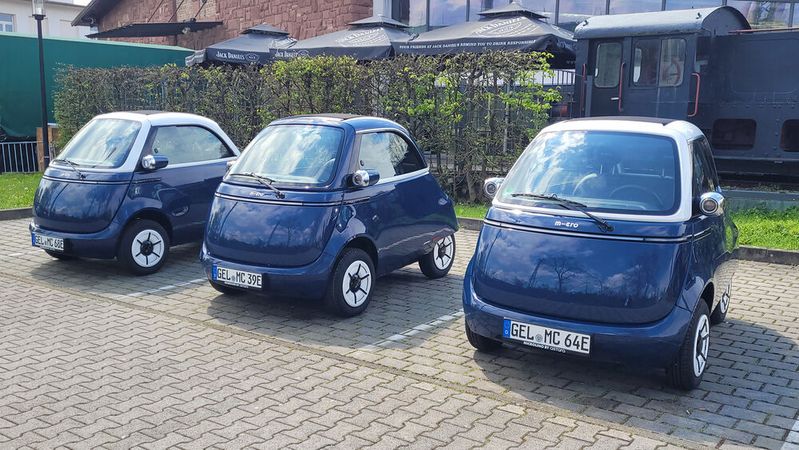
"Cute," writes someone on LinkedIn when I post a few photos of my test drive with the Microlino last week. "Truly adorable," says a friend to whom I recount my encounter with the retro electric car, inspired by the cabin scooters of the 1950s. The design is quite successful. The "must-have factor" is quite high.
The company founders Wim, Merlin, and Oliver Ouboter noticed this when they first presented the concept at the Geneva Motor Show in 2016. The plan: if there are 500 reservations for the vehicle, it should be built. And the response was significant. Enough interested parties were quickly found.
Before the car hit the road, several hurdles had to be overcome. Initially, the original production partner was sold, leading to issues with the new owner that escalated into a legal dispute. Additionally, the challenges of the coronavirus pandemic and supply chain disruptions arose. As a result, it wasn't until 2023 that the car could actually be launched - first in Switzerland, and now as of last week, in Germany.
"This is not a car," it says at the presentation. No. It is a light electric vehicle in the L7e class. Different requirements apply to such vehicles compared to cars: they must weigh a maximum of 450 kilograms (without the battery) and have a maximum power of 15 KW. Additionally, they must meet significantly lower safety requirements.
However, the Microlino has a self-supporting body made of steel and aluminum, unlike most vehicles in its class. The usual construction is a tubular frame with plastic cladding. The Microlino is therefore expected to be safer and more durable.
Entry through the front door
What comes to mind when you see the Microlino for the first time? Clearly, the BMW Isetta – at least for those interested in cars and automotive history. Like the classic model, the Microlino has its door at the front. It swings open sideways after I press the button under the left side mirror.
The entry is a bit unusual. I crawl in and pull the door closed using a loop. Thanks to a Soft-Close function, it doesn't require much force. The seating arrangement consists of a longitudinally adjustable two-seater bench, which becomes quite cozy when traveling with a passenger. The height provides sufficient but not ample space. At 1.83 meters, I sit quite comfortably. Taller individuals may need to slightly tilt their head towards the center.
The steering wheel reminds me of the Momo sports steering wheels that were popular in my late youth, installed in their lowered VW Polo cars. There is no airbag, as it is not required in this vehicle class and would increase the price and weight. Behind it, there is a digital instrument display. To the right, there is a small, narrow touchscreen for controlling ventilation, lighting, and other basic vehicle functions. It looks stylish and is a cool, practical solution.
After all, there is no need for an infotainment touchscreen - because the Microlino does not have an infotainment system. Navigation is done with the smartphone, with the holder for it being included as standard. Those who want to listen to music can do so with a Bluetooth speaker that comes with the vehicle depending on the equipment variant. It fits in the cup holder next to the passenger and can be powered via USB.
There are a total of four USB ports, which is more than in some cars. However, all four are Type-A ports. Microlino drivers will have to go without modern USB-C ports. However, the advantages of USB-C are mainly evident in data connections. In the Microlino, it's all about charging.
Three battery variants
Speaking of power: The Microlino is available with three battery variants: The smallest has a capacity of 6 kWh and enables a range of up to 91 kilometers. In the middle battery variant with 10.5 kWh, the vehicle can travel up to 177 kilometers on a single charge according to the datasheet. Additionally, there is a 14 kWh battery that allows a range of up to 230 kilometers.
The Microlino is equipped with a Type 2 connector and can be charged with the corresponding cable at both AC charging stations and wallboxes as well as at a household power outlet. The charging capacity is the same, 2.6 kW or 1.35 kW for the smallest battery variant. It takes about three to four hours to fully charge the battery when drained.
The Microlino is powered by a 12.5 kW/17 PS electric motor at the rear. It generates a maximum torque of 89 Nm and enables a top speed of 90 km/h. The WLTP power consumption ranges from 5.9 to 6.6 kWh per 100 kilometers depending on the battery size.
Date: 08.12.2025
Naturally, we always handle your personal data responsibly. Any personal data we receive from you is processed in accordance with applicable data protection legislation. For detailed information please see our privacy policy.
Consent to the use of data for promotional purposes
I hereby consent to Vogel Communications Group GmbH & Co. KG, Max-Planck-Str. 7-9, 97082 Würzburg including any affiliated companies according to §§ 15 et seq. AktG (hereafter: Vogel Communications Group) using my e-mail address to send editorial newsletters. A list of all affiliated companies can be found here
Newsletter content may include all products and services of any companies mentioned above, including for example specialist journals and books, events and fairs as well as event-related products and services, print and digital media offers and services such as additional (editorial) newsletters, raffles, lead campaigns, market research both online and offline, specialist webportals and e-learning offers. In case my personal telephone number has also been collected, it may be used for offers of aforementioned products, for services of the companies mentioned above, and market research purposes.
Additionally, my consent also includes the processing of my email address and telephone number for data matching for marketing purposes with select advertising partners such as LinkedIn, Google, and Meta. For this, Vogel Communications Group may transmit said data in hashed form to the advertising partners who then use said data to determine whether I am also a member of the mentioned advertising partner portals. Vogel Communications Group uses this feature for the purposes of re-targeting (up-selling, cross-selling, and customer loyalty), generating so-called look-alike audiences for acquisition of new customers, and as basis for exclusion for on-going advertising campaigns. Further information can be found in section “data matching for marketing purposes”.
In case I access protected data on Internet portals of Vogel Communications Group including any affiliated companies according to §§ 15 et seq. AktG, I need to provide further data in order to register for the access to such content. In return for this free access to editorial content, my data may be used in accordance with this consent for the purposes stated here. This does not apply to data matching for marketing purposes.
Right of revocation
I understand that I can revoke my consent at will. My revocation does not change the lawfulness of data processing that was conducted based on my consent leading up to my revocation. One option to declare my revocation is to use the contact form found at https://contact.vogel.de. In case I no longer wish to receive certain newsletters, I have subscribed to, I can also click on the unsubscribe link included at the end of a newsletter. Further information regarding my right of revocation and the implementation of it as well as the consequences of my revocation can be found in the data protection declaration, section editorial newsletter.
So, let's drive! Where is the start button? There isn't one. The Microlino has an ignition key. So insert it, turn it, and wait. Nothing happens. Did I do something wrong? No, it just takes a while for the system to start up and the display to turn on. Release the handbrake (mechanical) and off you go.
Time for full throttle. Of course, the Microlino is not a sports car. But especially at the beginning, it pushes forward quite well. A Sport button is supposed to provide a short burst of additional power. I can't really feel it. After five seconds, the boost is already over - for energy saving reasons.
You feel every pothole
However, as the speed increases, it becomes quite loud. These are not wind or rolling noises. The drive produces a high-pitched whirring sound that can be quite annoying over time. At low speeds in the city, this may not be a significant issue, but those looking to frequently utilize the top speed should be aware of this. Similarly, in terms of suspension, one should not expect car standards in the Microlino. While it features an independent suspension system that is not necessarily common in this class, one can feel every bump and pothole on the road.
The Microlino has a trunk volume of 230 liters, which is a decent size considering the vehicle's dimensions. Three beverage crates can fit in the rear compartment of this small electric car. The microcar weighs 435 kilograms without the battery. With the battery, depending on its size, the weight ranges from 496 to 530 kilograms. The permissible total weight is 750 kilograms, leaving 220 kilograms for the driver, passenger, and luggage. This should be sufficient in most cases.
The biggest advantage of the Microlino: It requires little space. And it can - where permitted - park sideways with its 2.52 meters in length. Through the front door, you can then exit directly onto the sidewalk.
Pioneer Edition for Market Launch
At the market launch, the Pioneer Edition is initially available, limited to 999 units. 400 units are designated for Germany. This variant comes with LED headlights and a LED strip at the front and rear. A folding roof provides light and additional fresh air. The seats are upholstered in vegan leather. The vehicle is equipped with the middle-sized battery for power storage. A plaque with an engraved serial number aims to enhance exclusivity. The price starts at 22,690 euros.
The three regular equipment variants will be available for order later in the year. The entry-level version "Urban" comes with the small battery and a fixed roof, starting at a minimum of 17,690 euros. The folding roof option costs an additional 590 euros. The "Dolce" variant, priced at a minimum of 19,690 euros, will be available with all three battery options. The "Competizione," starting at 21,690 euros, offers the medium and large battery versions. The surcharge for the next larger battery is 1,500 euros each.
The Dolce features bright exterior colors and chrome on the windows and headlights in a retro design. The Competizione, on the other hand, provides a more modern touch with matte exterior paintwork. The LED light strip at the front and rear, the soft top fabric roof, and the vegan leather upholstery in the interior are all standard equipment in both variants.
No bargain
The Microlino is not a bargain at these prices. For comparison: The L7e competitor Ari 902 is available from 13,990 euros. The Dacia Spring is available for 22,750 euros before deducting the environmental bonus - and it is a full-fledged car.
The high prices of the Microlino are mainly due to the small production volumes. In 2023, 4,000 units are planned to be produced at the manufacturing partner Cecomp in Turin. Currently, ten vehicles are produced per day. The aim is to quickly increase this number to 20. With a two-shift operation, up to 10,000 units per year should be achievable. In addition to scaling up production, the developers also plan to make adjustments to reduce the cost of the vehicles.
The Microlino, like other L7e category vehicles, does not qualify for the environmental bonus compared to passenger car models, and therefore does not receive nationwide support. While there are some local or regional funding initiatives, the actual amount paid for the model depends on the place of residence or registration. An initiative by several manufacturers aims to raise awareness among policymakers on this issue.
Nevertheless, Germany is the most important market: 1,500 of the planned 4,000 units are intended to be sold here this year.



:quality(80)/p7i.vogel.de/wcms/a0/47/a04725ef9bd09fb6c9341a1bea1b5d93/0130443083v1.jpeg "Here, a type of plastic pallet is produced by thermoforming (vacuum forming or deep drawing) at the corresponding division of New England Plastics in the USA. This division, which specializes in so-called liners, is now part of Ringmetall ... (Image:New England Plastics)")
:quality(80)/p7i.vogel.de/wcms/e3/42/e342b3c593ea92d56604d3be969e9c9a/0130437231v1.jpeg "Daimler Truck will be building even more trucks at its Czech plant in Cheb in the future. This is because it is now being expanded for strategic cost-saving reasons ... (Image:Daimler Truck)")
:quality(80)/p7i.vogel.de/wcms/23/99/23992bf2dcdc432c9b7209c34a4a7c48/0129733089v1.jpeg "Stork relies on the modular Neoswiss turning system from Iscar to shorten the set-up times for its sliding headstock lathes and work more productively. (Image:Iscar)")
:quality(80)/p7i.vogel.de/wcms/7d/e2/7de2923434b2f1a78ba5482d8d335269/0113143253v1.jpeg "In our China Market Insider we regularly provide you with relevant information directly from China. (Image:© Eisenhans - stock.adobe.com)")
:quality(80)/p7i.vogel.de/wcms/b7/36/b736dfebc16c42d6901d0d0e1f390493/3d-druck-20factory-20--20ki-20generiert-1920x1079v1.png "(Source: AI-generated)")
:quality(80)/p7i.vogel.de/wcms/79/b2/79b21aad663f4a7bd4472afc1c1afc62/0130433994v1.jpeg "Mission Joyride: The free-flying robot (shown here in the rendering) will relieve the ISS crew of logistics tasks from 2027 with its two mechanical arms. (Image:Icarus Robotics)")
:quality(80)/p7i.vogel.de/wcms/6b/45/6b4546fa6ebf305c3660326909363f32/0130437089v1.jpeg "Industrial AI in action: Rockwell Automation presents practical solutions for self-controlling production systems at the Hannover Messe. (Image:Rainer Jensen, Deutsche Messe)")
:quality(80)/p7i.vogel.de/wcms/78/e9/78e9188c25a8a94e67c34c9bf8ffe495/visual-agile-20robots-20and-20google-20deepmind-20partner-20to-20bring-20intelligence-20to-20robotics-2500x1406v1v1.jpeg "Together, the partners are developing adaptable, intelligent robots for a wide range of applications (Image:Agile Robots SE)")
:quality(80)/p7i.vogel.de/wcms/59/a2/59a2b11f0aa1b700eff02addd5de8703/adobestock-1788280853--c2-a9-20satria-20-e2-80-93-20stock-adobe-com-5081x2860v1v1.jpeg "Quantum computers require extreme cooling to temperatures close to absolute zero in order to keep qubits stable. (Image:satria - stock.adobe.com)")
:quality(80)/p7i.vogel.de/wcms/62/5f/625f41e87ebfef156a98c8e6393e32fd/0130211654v1.jpeg "Axial flux motors have some advantages over radial flux motor—but their production is currently still expensive. (Image:RWTH Aachen University)")
:quality(80)/p7i.vogel.de/wcms/f6/ae/f6aec4f6241b36ed5e3a990ac9176b42/0130429460v1.jpeg "Verne, Pony.ai and Uber want to launch a robotaxi service in Europe. (Image:Verne)")
:quality(80)/p7i.vogel.de/wcms/d7/88/d788699f2974708a332baa4e7a62fa9e/0130438967v1.jpeg "Skoda is withdrawing from China. The brand has produced well over three million vehicles there. (Image:Skoda car)")
:quality(80)/p7i.vogel.de/wcms/b0/43/b043b86899837532aad62d63368a917a/0130371361v1.jpeg "Skoda leaves the chinese market.
(Image:Skoda)")
:quality(80)/p7i.vogel.de/wcms/c3/c4/c3c4ce270b083eeac55654148611f064/0130237945v1.jpeg "China is not giving up on hydrogen, but is intensifying its efforts. (Image:freely licensed from Pixabay)")
:quality(80)/p7i.vogel.de/wcms/ee/09/ee09acbd6dc896df25affaa9e871e6e5/0130440053v1.jpeg "IMS chip module for simple system integration into an ion mobility spectrometer. (Image:Fraunhofer IPMS)")
:quality(80)/p7i.vogel.de/wcms/10/6c/106cd22de5f68a0f74639d654827228c/0130345302v1.jpeg "Made in India: According to the India Electronics and Semiconductor Association (IESA), the country should be able to produce between 75 and 80 million chips by the beginning of 2027, once the plants currently under construction become operational. (Image:Pixabay (Montage: Sebastian Gerstl))")
:quality(80)/p7i.vogel.de/wcms/a5/ed/a5ed6fda029d362732a293d6b19d74c4/0130444216v1.jpeg "Thirteen executives from the Chinese chip industry have drawn up a plan to achieve an 80% self-sufficiency rate for semiconductors by 2030. (Image:Maxim_Kazmin - stock.adobe.com)")
:quality(80)/p7i.vogel.de/wcms/31/a6/31a646018b34d8e0a44bfc8bf17837f6/0130361632v1.jpeg "For many companies, PFAS are considered indispensable in electronics production. (Image:freely licensed)")
:fill(fff,0)/images.vogel.de/vogelonline/companyimg/76800/76895/65.jpg "FAULHABER_120mm.jpg ()")
:quality(80)/p7i.vogel.de/wcms/e5/ee/e5ee073648492750f5074b1be0e98493/0125688721v1.jpeg "Mercedes introduces the CLA as a sleek estate. (Image:Mercedes-Benz)")
:quality(80)/p7i.vogel.de/wcms/ed/32/ed3205b7d4728c3aa2e53449b080432f/0125560388v1.jpeg "Mazda puts another e-car on the road. (Image:Mazda)")