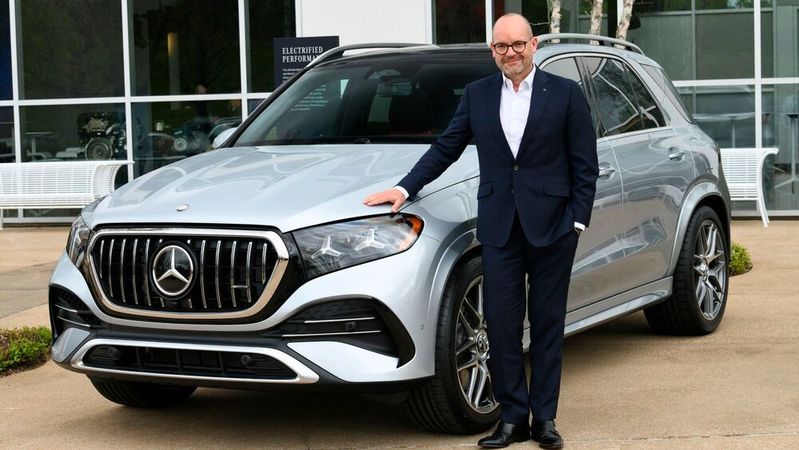
Head of Development Jörg Burzer explains the importance of the GLE and GLS models for Mercedes and how the company intends to position itself on the global markets in future.
Jörg Burzer, Head of Development at Mercedes Benz Group AG
(Image: Mercedes)
Mercedes is realigning its strategy. The focus is on the flexible electrification of products. In addition to the expansion of purely electric models, the Swabian company is continuing to focus on electrified combustion engines in order to meet different customer needs and global market conditions. The manufacturer recently presented its revised GLE and GLS models. They have undergone extensive technical revisions—it is already the second facelift of the SUVs. Jörg Burzer, Member of the Board of Management and Chief Technology Officer of Mercedes-Benz Group AG, explains how the Mercedes engineers went about this and how the OEM intends to strike a balance between markets such as the USA, China and Europe.
Mr Burzer, the coming generations of the GLE and GLS will rely on hybridized combustion engines instead of purely electric drives. What role do such electrified combustion engines play in your global product strategy—Mercedes wanted to become largely electric by the end of the decade?
Jörg Burzer: Our strategy is clear: we are driving electrification forward at high speed, but are deliberately remaining flexible. Our new electric cars such as the CLA have been extremely well received and achieved fantastic test results. At the same time, electrified combustion engines are a key component—they reduce CO2 across the fleet, enable our customers to make a gradual switch and ensure our attractiveness in markets where charging infrastructure or usage scenarios still limit purely electric drives.
What do you think are the highlights of the GLE and GLS?
We have made targeted technical enhancements to the GLE and GLS. The biggest change has actually taken place in the car: Thanks to our MB.OS operating system, new assistance functions are now possible, such as partially automated driving in accordance with Level 2++. We have also extensively updated our engine portfolio: The focus is on fully electrified drives with 48-volt technology as well as a significantly upgraded plug-in hybrid with a long electric range. Added to this are noticeable advances in driving comfort.
In the USA, large SUVs with combustion engines remain in high demand, while in China the demand for electric vehicles is growing continuously and local manufacturers now dominate. How does Mercedes balance these conflicting market demands with global models such as the GLE and GLS?
We rely on a consistently electrified combustion engine portfolio that intelligently combines performance, efficiency and comfort. All petrol and diesel engines are equipped with 48-volt technology and an integrated starter generator—this ensures noticeably better efficiency and the comfort that is typical of Mercedes. Another key component is the plug-in hybrid with in-line six-cylinder engine, which enables a purely electric range of over 62 miles (100 kilometers). For most people, this makes purely electric driving possible in everyday life. The GLE thus remains an all-round SUV, is prepared for future emissions requirements and covers customer needs in the most important market regions.
Mercedes is expanding its local production in the most important markets, for example with additional SUV production in the USA and the planned local production of an extended GLE in China. Is this "local-for-local" strategy more important in future than a uniform global model strategy?
Our local production is gaining in importance without replacing the global model strategy. The decisive factor is the combination: we standardize where it brings economies of scale and efficiency—and localize where it increases customer proximity, flexibility and resilience. For our products, this means a globally uniform Mercedes DNA and a localization strategy that can react quickly to market requirements. In addition to production, local supplier networks are also an important factor.
Chinese brands are increasingly focusing on highly digitalized, aggressively priced electric vehicles. How can Mercedes defend its position in the luxury segment when technological innovation and software expertise are increasingly becoming differentiating features?
In the segments relevant to Mercedes, the quality of the overall integration of hardware, software, safety and user experience is decisive in addition to the speed of individual innovations. In the combination of innovation and our core values such as safety, quality and driving comfort, our products are absolute leaders. The key to this is our MB.OS operating system, which enables us to continuously develop digital functions, assistance systems and comfort features. One example: our system for semi-automated driving—Drive Assist Pro—was developed in cooperation with partners such as Nvidia and Momenta. Here we combine cutting-edge technology with the quality and safety you expect from Mercedes.
In which areas do you still see real potential for expansion over the next ten to twenty years—for example in new markets, in the software business, in luxury segments or in new vehicle concepts?
We see growth potential where we can differentiate ourselves through cutting-edge technology and outstanding customer experiences. This is what has made us strong for 140 years. Take the new VLE or the GLS—it feels like an S-Class. Automated driving also offers many opportunities, which is why we are also working with partners on robotaxis. I am convinced that the industry as a whole is only at the beginning here. Above all, our goal is sustainable, profitable growth—supported by our pioneering role in innovation and our strong brand.
Mercedes is one of the first manufacturers to put Level 3 automation on the road. What role will automated driving play in the future for Mercedes' positioning in the luxury segment?
We have always been pioneers in automated driving and will continue to develop this further. For us, this means both increased comfort and technological differentiation. For our customers, it primarily means relief and greater safety. Take our assisted driving system, for example: You enter your destination into the navigation system and the car takes over many driving tasks while the driver monitors. This is already possible in China and will soon be in the USA and Europe. This approach underlines our claim to bring innovations into series production early, but above all safely and responsibly. This is what Mercedes stands for.
Date: 08.12.2025
Naturally, we always handle your personal data responsibly. Any personal data we receive from you is processed in accordance with applicable data protection legislation. For detailed information please see our privacy policy.
Consent to the use of data for promotional purposes
I hereby consent to Vogel Communications Group GmbH & Co. KG, Max-Planck-Str. 7-9, 97082 Würzburg including any affiliated companies according to §§ 15 et seq. AktG (hereafter: Vogel Communications Group) using my e-mail address to send editorial newsletters. A list of all affiliated companies can be found here
Newsletter content may include all products and services of any companies mentioned above, including for example specialist journals and books, events and fairs as well as event-related products and services, print and digital media offers and services such as additional (editorial) newsletters, raffles, lead campaigns, market research both online and offline, specialist webportals and e-learning offers. In case my personal telephone number has also been collected, it may be used for offers of aforementioned products, for services of the companies mentioned above, and market research purposes.
Additionally, my consent also includes the processing of my email address and telephone number for data matching for marketing purposes with select advertising partners such as LinkedIn, Google, and Meta. For this, Vogel Communications Group may transmit said data in hashed form to the advertising partners who then use said data to determine whether I am also a member of the mentioned advertising partner portals. Vogel Communications Group uses this feature for the purposes of re-targeting (up-selling, cross-selling, and customer loyalty), generating so-called look-alike audiences for acquisition of new customers, and as basis for exclusion for on-going advertising campaigns. Further information can be found in section “data matching for marketing purposes”.
In case I access protected data on Internet portals of Vogel Communications Group including any affiliated companies according to §§ 15 et seq. AktG, I need to provide further data in order to register for the access to such content. In return for this free access to editorial content, my data may be used in accordance with this consent for the purposes stated here. This does not apply to data matching for marketing purposes.
Right of revocation
I understand that I can revoke my consent at will. My revocation does not change the lawfulness of data processing that was conducted based on my consent leading up to my revocation. One option to declare my revocation is to use the contact form found at https://contact.vogel.de. In case I no longer wish to receive certain newsletters, I have subscribed to, I can also click on the unsubscribe link included at the end of a newsletter. Further information regarding my right of revocation and the implementation of it as well as the consequences of my revocation can be found in the data protection declaration, section editorial newsletter.
In view of the different regulatory frameworks in markets such as the USA, Europe and China, is Mercedes planning to monetize automated driving more strongly as a software or subscription business in future, and do you see similar future potential in this as in traditional vehicle sales?
Thanks to MB.OS, our vehicles are now software-defined—which means we can also provide updates and functions within the life cycle. This allows us to keep vehicles up-to-date for years to come and offer new options in a targeted manner. Automated driving plays an important role here because it offers customers a clear, tangible benefit. Think about the second or third owner of a vehicle: they may find other things important than the previous owner. However, the decisive factor for us is that monetization follows customer benefit—and not the other way around.



:quality(80)/p7i.vogel.de/wcms/60/eb/60ebe43de41f833157b476b2e1641811/0130090160v1.jpeg "The Surface Control Automotive measuring system from Micro-Epsilon automatically detects dents, scratches and other surface defects on body shells. (Image:Micro-Epsilon)")
:quality(80)/p7i.vogel.de/wcms/26/8a/268aba929d72bd089234bd512aab9b08/0130487474v1.jpeg "The works meeting at Volkswagen is over! Here is a brief overview of the most important aspects ... (Image:VW)")
:quality(80)/p7i.vogel.de/wcms/50/63/5063e5b91e7897c13b882440c7f106d4/0128575929v1.jpeg "How is Edge AI changing the industry? Local data processing meets distributed intelligence to promote sustainability and efficiency. (Picture: ©tippapatt - stock.adobe.com)")
:quality(80)/p7i.vogel.de/wcms/a0/47/a04725ef9bd09fb6c9341a1bea1b5d93/0130443083v1.jpeg "Here, a type of plastic pallet is produced by thermoforming (vacuum forming or deep drawing) at the corresponding division of New England Plastics in the USA. This division, which specializes in so-called liners, is now part of Ringmetall ... (Image:New England Plastics)")
:quality(80)/p7i.vogel.de/wcms/d3/3d/d33d26b35aa1e64f5c41d19d22c5c5dc/0130496518v1.jpeg "(Image:Speedbot)")
:quality(80)/p7i.vogel.de/wcms/f0/ca/f0caaaa9fc2347a5221760a94f92e831/0129880873v1.jpeg "Human-machine collaboration takes on a new quality. This is because the automation task is formulated in natural language and the AI takes over its implementation directly in the project. This allows users to implement Codesys projects more quickly. (Image:Codesys)")
:quality(80)/p7i.vogel.de/wcms/b7/36/b736dfebc16c42d6901d0d0e1f390493/3d-druck-20factory-20--20ki-20generiert-1920x1079v1.png "(Source: AI-generated)")
:quality(80)/p7i.vogel.de/wcms/79/b2/79b21aad663f4a7bd4472afc1c1afc62/0130433994v1.jpeg "Mission Joyride: The free-flying robot (shown here in the rendering) will relieve the ISS crew of logistics tasks from 2027 with its two mechanical arms. (Image:Icarus Robotics)")
:quality(80)/p7i.vogel.de/wcms/59/a2/59a2b11f0aa1b700eff02addd5de8703/adobestock-1788280853--c2-a9-20satria-20-e2-80-93-20stock-adobe-com-5081x2860v1v1.jpeg "Quantum computers require extreme cooling to temperatures close to absolute zero in order to keep qubits stable. (Image:satria - stock.adobe.com)")
:quality(80)/p7i.vogel.de/wcms/49/38/493876a248943456b7e4a6db6edfc454/0130230765v1.jpeg "Safe and reliable in aircraft construction: light-curing adhesive bond combined with universal fastening elements. (Source: Delo)")
:quality(80)/p7i.vogel.de/wcms/c2/57/c257d627beec10e94252cde72830adf6/0130472803v1.jpeg "With the Twingo E-Tech, Renault is now launching a purely electrically powered new edition of the Twingo small car (Image:Renault)")
:quality(80)/p7i.vogel.de/wcms/c1/43/c143c24b62e51b848b2586b52bcd20e2/0130468443v1.jpeg "Jörg Burzer, Head of Development at Mercedes Benz Group AG (Image:Mercedes)")
:quality(80)/p7i.vogel.de/wcms/24/8d/248dccded0abab4dc0a3a7abcc462884/0130497946v1.jpeg "A receiver test for 10BASE-T1S developed by Keysight promotes the testing of function-critical receivers to ensure the reliability and safety of future on-board networks. (Image:Keysight)")
:quality(80)/p7i.vogel.de/wcms/b5/c7/b5c749d16c8a2e789c1469c2c8c1c387/0130452780v1.jpeg "Volvo Trucks completes road tests with its new hydrogen-powered trucks. (Image:Volvo Trucks)")
:quality(80)/p7i.vogel.de/wcms/86/e0/86e09ea9c278d112c55b995b843abfee/0130494578v1.jpeg "PV system on the roof of the Elbfabrik, a Fraunhofer IFF research factory. A sensor system can detect faults in large-scale PV systems at an early stage. (Image:Fraunhofer IFF/Anne Bornkessel)")
:quality(80)/p7i.vogel.de/wcms/ee/09/ee09acbd6dc896df25affaa9e871e6e5/0130440053v1.jpeg "IMS chip module for simple system integration into an ion mobility spectrometer. (Image:Fraunhofer IPMS)")
:quality(80)/p7i.vogel.de/wcms/10/6c/106cd22de5f68a0f74639d654827228c/0130345302v1.jpeg "Made in India: According to the India Electronics and Semiconductor Association (IESA), the country should be able to produce between 75 and 80 million chips by the beginning of 2027, once the plants currently under construction become operational. (Image:Pixabay (Montage: Sebastian Gerstl))")
:quality(80)/p7i.vogel.de/wcms/a5/ed/a5ed6fda029d362732a293d6b19d74c4/0130444216v1.jpeg "Thirteen executives from the Chinese chip industry have drawn up a plan to achieve an 80% self-sufficiency rate for semiconductors by 2030. (Image:Maxim_Kazmin - stock.adobe.com)")
:fill(fff,0)/images.vogel.de/vogelonline/companyimg/76800/76895/65.jpg "FAULHABER_120mm.jpg ()")
:quality(80):fill(efefef,0)/p7i.vogel.de/wcms/67/ad/67adf92d254d2/elatec-wp-smart-factory.png "Elatec WP Smart Factory")
:quality(80)/p7i.vogel.de/wcms/0d/4a/0d4a1d7129c5838744eecb4765db6698/0126570766v1.jpeg "China currently accounts for two-thirds of global EV sales. Europe follows with 17 percent, and the USA with seven percent. (Image:AI-generated)")
:quality(80)/p7i.vogel.de/wcms/59/4e/594e3a6d542bcd770c7b458afabf5371/25c0228-003-4961x2790v1v1.jpeg "The first models of the new fully electric Mercedes GLC are being built at the plant in Bremen, Germany. (Image: Mercedes-Benz)")