Shoulders, slots, edges, pockets, and cavities: Where right angles are involved, corner cutters are usually not far behind—at least in machining. But as is often the case, the devil is in the details. That's why Iscar offers specialized solutions for 90-degree machining.
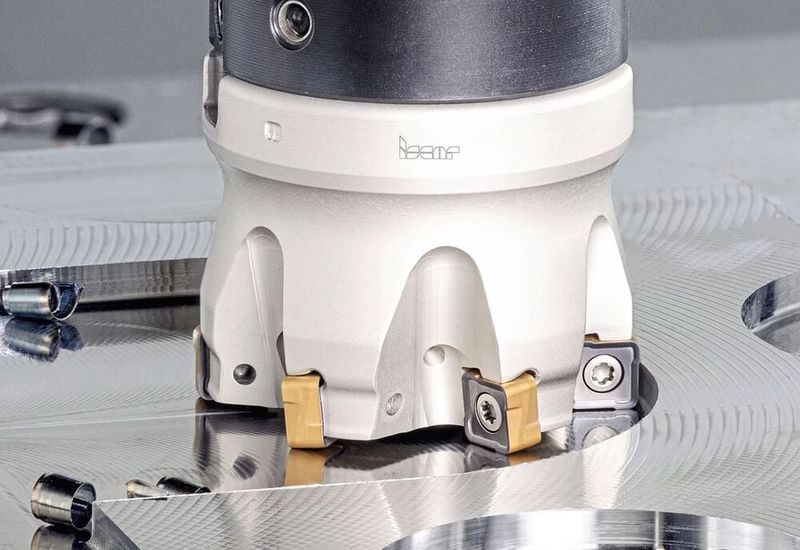
The Neodo-S890 indexable inserts combine a square profile with specially shaped chip and side faces into an economical overall package.
(Image: Iscar)
Corner milling cutters are perhaps the most commonly used milling tools. They are used by operators to create shoulders, slots, edges, pockets, and cavities. The choice of a suitable model is essential, as the properties of each variant are as diverse as their fields of application. Cutter type, cutting geometry, and specific tool configuration are just three of the adjustments manufacturers use to tailor their tools to a particular application area.
The right configuration depends on the material, removal behavior, desired precision, required surface quality, and the individual characteristics of the machine being operated. For instance, solid carbide (VHM) cutters offer very high machining accuracy, while indexable insert concepts (WSP) excel when working under high loads and in terms of cost-effectiveness. However, the geometry of the WSP also has a decisive influence on the overall performance of the tool.
To meet the demands of the industry, Iscar has been continuously refining its portfolio for more than 30 years, pursuing various approaches in the process.
Since its introduction in the early 1990s, the tool manufacturer has continuously developed its Helimill series. A special feature of the product family: helical positive indexable inserts. The rake face and helical flank (relief) form a highly positive cutting edge in Helimill. This results in significantly reduced energy consumption and a very smooth cut. With the Helimill concept, Iscar further emphasized the design of WSP in its development work.
Rectangular or square WSP differ greatly in their properties from rhombic or triangular counterparts. Their shape determines, for example, the number of usable cutting edges. Additionally, square or triangular WSP are wider than rhombic forms and provide enough space for a larger central hole—and thus larger clamping screws. This allows the insert to be securely attached to the tool body, but this configuration also limits the minimum diameter of the cutter, which in turn can reduce the stability of the tool.
Rhombic inserts, on the other hand, offer a harmonious combination of cutting edge length, different corner radii, approach possibilities, and insert strength. The only drawback: the shape allows only two cutting edges. A double-sided design of the WSP partially compensates for this disadvantage but also brings limitations. The two-sided configuration influences the clearance angle and increases the axial rake angle of the cutter in which the insert is mounted.
Successful tool concepts are precisely tailored to the requirements of the application areas for which they were developed. Accordingly, Iscar's product portfolio is broad.
Three cases, three specialists
With the Neo-Logiq campaign, Iscar responded to the growing demand for fast and productive solutions for the challenges of the machining industry.
For roughing, semi-finishing, face, and corner milling of steel and cast iron, Iscar introduced the Neodo-S890 series. The shape and stability of the robust and double-sided WSP are achieved through a special sintering process. The square profile provides the user with a total of eight helical cutting edges—four on each side. The combination of a positive radial and negative axial rake angle promises a consistent cut with low energy consumption—especially in applications with interrupted cuts or varying machining conditions. Thanks to its wiper, Neodo produces very high surface finishes. The dovetail clamping securely connects the WSP to the shank. This makes Neodo an effective and economical solution for face milling on shoulders, for example, and wherever access and space are limited by clamping devices.
For users aiming for maximum productivity, Iscar developed the 90-degree Helido Trigon tools. These tools have a double-positive cutting geometry: meaning two positive rake angles—both axial and radial. Although the cutter with its triangular WSP has only six cutting edges, the specific configuration offers a higher number of teeth than comparable tools. This allows for very high feed rates and great productivity.
Date: 08.12.2025
Naturally, we always handle your personal data responsibly. Any personal data we receive from you is processed in accordance with applicable data protection legislation. For detailed information please see our privacy policy.
Consent to the use of data for promotional purposes
I hereby consent to Vogel Communications Group GmbH & Co. KG, Max-Planck-Str. 7-9, 97082 Würzburg including any affiliated companies according to §§ 15 et seq. AktG (hereafter: Vogel Communications Group) using my e-mail address to send editorial newsletters. A list of all affiliated companies can be found here
Newsletter content may include all products and services of any companies mentioned above, including for example specialist journals and books, events and fairs as well as event-related products and services, print and digital media offers and services such as additional (editorial) newsletters, raffles, lead campaigns, market research both online and offline, specialist webportals and e-learning offers. In case my personal telephone number has also been collected, it may be used for offers of aforementioned products, for services of the companies mentioned above, and market research purposes.
Additionally, my consent also includes the processing of my email address and telephone number for data matching for marketing purposes with select advertising partners such as LinkedIn, Google, and Meta. For this, Vogel Communications Group may transmit said data in hashed form to the advertising partners who then use said data to determine whether I am also a member of the mentioned advertising partner portals. Vogel Communications Group uses this feature for the purposes of re-targeting (up-selling, cross-selling, and customer loyalty), generating so-called look-alike audiences for acquisition of new customers, and as basis for exclusion for on-going advertising campaigns. Further information can be found in section “data matching for marketing purposes”.
In case I access protected data on Internet portals of Vogel Communications Group including any affiliated companies according to §§ 15 et seq. AktG, I need to provide further data in order to register for the access to such content. In return for this free access to editorial content, my data may be used in accordance with this consent for the purposes stated here. This does not apply to data matching for marketing purposes.
Right of revocation
I understand that I can revoke my consent at will. My revocation does not change the lawfulness of data processing that was conducted based on my consent leading up to my revocation. One option to declare my revocation is to use the contact form found at https://contact.vogel.de. In case I no longer wish to receive certain newsletters, I have subscribed to, I can also click on the unsubscribe link included at the end of a newsletter. Further information regarding my right of revocation and the implementation of it as well as the consequences of my revocation can be found in the data protection declaration, section editorial newsletter.
The tool is suitable for roughing on machines with low torque and high speed. Typical application areas include shoulder and slot milling, side grooves, and bevels.
With the triangular indexable inserts of the Heli3Mill cutters, Iscar completes its range for 90-degree machining. The product group features particularly sharp cutting edges and polished rake faces, making it designed for the machining of aluminum alloys and other non-ferrous materials. The special chip formers ensure very good chip control and enable high surface finishes.



:quality(80)/p7i.vogel.de/wcms/60/eb/60ebe43de41f833157b476b2e1641811/0130090160v1.jpeg "The Surface Control Automotive measuring system from Micro-Epsilon automatically detects dents, scratches and other surface defects on body shells. (Image:Micro-Epsilon)")
:quality(80)/p7i.vogel.de/wcms/26/8a/268aba929d72bd089234bd512aab9b08/0130487474v1.jpeg "The works meeting at Volkswagen is over! Here is a brief overview of the most important aspects ... (Image:VW)")
:quality(80)/p7i.vogel.de/wcms/50/63/5063e5b91e7897c13b882440c7f106d4/0128575929v1.jpeg "How is Edge AI changing the industry? Local data processing meets distributed intelligence to promote sustainability and efficiency. (Picture: ©tippapatt - stock.adobe.com)")
:quality(80)/p7i.vogel.de/wcms/a0/47/a04725ef9bd09fb6c9341a1bea1b5d93/0130443083v1.jpeg "Here, a type of plastic pallet is produced by thermoforming (vacuum forming or deep drawing) at the corresponding division of New England Plastics in the USA. This division, which specializes in so-called liners, is now part of Ringmetall ... (Image:New England Plastics)")
:quality(80)/p7i.vogel.de/wcms/29/d8/29d83fa92093c7f247429e060be46c7b/0130378625v1.jpeg "Secures and monitors circuits directly in the field: Turck's IP67 TBIF fuse with IO-Link (Image:Turck GmbH)")
:quality(80)/p7i.vogel.de/wcms/d3/3d/d33d26b35aa1e64f5c41d19d22c5c5dc/0130496518v1.jpeg "(Image:Speedbot)")
:quality(80)/p7i.vogel.de/wcms/f0/ca/f0caaaa9fc2347a5221760a94f92e831/0129880873v1.jpeg "Human-machine collaboration takes on a new quality. This is because the automation task is formulated in natural language and the AI takes over its implementation directly in the project. This allows users to implement Codesys projects more quickly. (Image:Codesys)")
:quality(80)/p7i.vogel.de/wcms/b7/36/b736dfebc16c42d6901d0d0e1f390493/3d-druck-20factory-20--20ki-20generiert-1920x1079v1.png "(Source: AI-generated)")
:quality(80)/p7i.vogel.de/wcms/79/b2/79b21aad663f4a7bd4472afc1c1afc62/0130433994v1.jpeg "Mission Joyride: The free-flying robot (shown here in the rendering) will relieve the ISS crew of logistics tasks from 2027 with its two mechanical arms. (Image:Icarus Robotics)")
:quality(80)/p7i.vogel.de/wcms/59/a2/59a2b11f0aa1b700eff02addd5de8703/adobestock-1788280853--c2-a9-20satria-20-e2-80-93-20stock-adobe-com-5081x2860v1v1.jpeg "Quantum computers require extreme cooling to temperatures close to absolute zero in order to keep qubits stable. (Image:satria - stock.adobe.com)")
:quality(80)/p7i.vogel.de/wcms/49/38/493876a248943456b7e4a6db6edfc454/0130230765v1.jpeg "Safe and reliable in aircraft construction: light-curing adhesive bond combined with universal fastening elements. (Source: Delo)")
:quality(80)/p7i.vogel.de/wcms/26/e1/26e1c8d1f56a588b078196508a069155/0130500702v1.jpeg "Hyundai plans a large truck for North America (Image:Hyundai)")
:quality(80)/p7i.vogel.de/wcms/61/eb/61eb2c9fe2ec3295593bd63ebc610f59/0130504331v1.jpeg "Headquarters of the Chinese truck start-up Zeron. (Image:Jiangsu 01 Automobile Technology/Screen shot)")
:quality(80)/p7i.vogel.de/wcms/c2/57/c257d627beec10e94252cde72830adf6/0130472803v1.jpeg "With the Twingo E-Tech, Renault is now launching a purely electrically powered new edition of the Twingo small car (Image:Renault)")
:quality(80)/p7i.vogel.de/wcms/c1/43/c143c24b62e51b848b2586b52bcd20e2/0130468443v1.jpeg "Jörg Burzer, Head of Development at Mercedes Benz Group AG (Image:Mercedes)")
:quality(80)/p7i.vogel.de/wcms/89/f2/89f2b2de703956abfb30ea456d77a463/0130471595v1.jpeg "The joint venture between TDK and Nippon Chemical Industrial focuses on the development of ceramic materials for electronic components. (Image:TDK Corporation)")
:quality(80)/p7i.vogel.de/wcms/e4/a0/e4a0da27805e96aa8976f04add4b3bec/0130458429v1.jpeg "Fit for extreme conditions: This illustration shows a photonic chip whose components have been bonded with high stability using the new connection technology. (Image:NIST)")
:quality(80)/p7i.vogel.de/wcms/9b/84/9b845ee38e4fb3c8ea07d1735d9e36fd/0130451629v1.jpeg "The windshield as a projection screen: a high-precision and low-latency system architecture is required for implementation. This requires the seamless integration of different technologies. (Image:Harman)")
:quality(80)/p7i.vogel.de/wcms/86/e0/86e09ea9c278d112c55b995b843abfee/0130494578v1.jpeg "PV system on the roof of the Elbfabrik, a Fraunhofer IFF research factory. A sensor system can detect faults in large-scale PV systems at an early stage. (Image:Fraunhofer IFF/Anne Bornkessel)")
:quality(80)/p7i.vogel.de/wcms/e5/56/e556e72572c421a13071be62ddcb31ea/0124376715v1.jpeg "The CCGT 09T304 turning insert is well-suited for roughing Ecobrass. (Image:Iscar)")
:quality(80)/p7i.vogel.de/wcms/d7/6b/d76bd173651b1fba43261ebd8f9b75e2/0125926576v1.jpeg "The six-edged Quickturn for fast multidirectional face and profile turning features an extremely stable clamping system. (Image:Iscar)")