Machine retrofitting is often seen as a stopgap solution - a compromise between a limited budget and the desire for modern production technology. This view falls short of the mark, as EWS Weigele and Emag show.
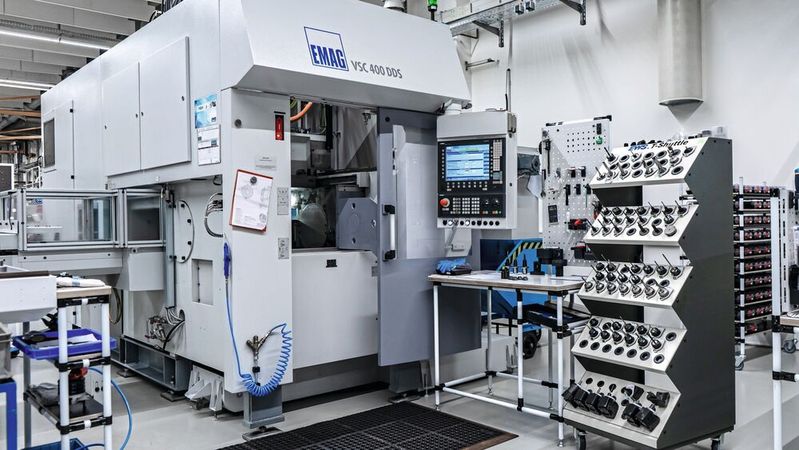
The VSC 400 DDS retrofit machine from EMAG at EWS Weigele with tool shuttle for external tool preparation - the basis for reliable hard machining of gears.
(Image: Emag Systems)
EWS Weigele manufactures high-precision tool holder systems with an in-house production depth of 90 to 95 percent - from the raw material to the assembled product. An essential part of this production chain is the manufacture of bevel gears and spur gears for driven tool units. The typical batch size structure is two to five workpieces per order.
With this high level of vertical integration, any machine downtime has a direct impact on delivery capability. When the existing gear production had to be modernized, the central question was not only "Which technology?", but above all "How fast?".
The decision to retrofit the VSC 400 DDS was based on a clear calculation: the delivery time for a comparable new machine would have been eight to twelve months, plus several weeks for commissioning and process qualification. The retrofit made it possible to resume production after just a few weeks. The basic mechanical structure of the machine was intact and the employees were familiar with the machine concept - ideal conditions for rapid modernization.
Technological Upgrade: Automation and Pick-Up
The retrofit included the complete technological modernization while retaining the basic mechanical structure:
Control technology: Replacement with a current CNC system with extended functions and interfaces for production data acquisition. The new control system enables direct integration into the digital production management system.
Automation interfaces: Adaptation of the machine-side interfaces to the Varia quick-change system used at the factory and the workpiece feed via a rotary indexing conveyor belt.
The investment costs were around 70 percent of a comparable new machine - with full technological performance.
Pick-up principle: Process stability through mechanical guidance
The VSC 400 DDS is based on the concept of the vertical lathe with pick-up spindle. The workpiece is not inserted into a chuck manually or by a robot, but is picked up from a defined position by the work spindle itself. The gear wheel is located on a workpiece carrier in the rotary indexing conveyor system. The work spindle picks up the workpiece from the pick-up station and transports it into the work area.
This process eliminates insertion inaccuracies. The repeat accuracy of the workpiece pick-up is in the range of a few micrometers, as the positioning is mechanically defined by the workpiece carrier geometry. In contrast to robot systems with grippers, insertion errors due to contamination, workpiece mix-ups or recognition errors are eliminated by design.
The process stability is demonstrated in practice: At EWS, the complete hard machining of the gears is carried out on the VSC 400 DDS - hard turning with PCD or CBN tools, grinding of defined functional surfaces and final fine machining. Batch sizes of several dozen workpieces are produced without intermediate measurement. The required tolerances are maintained over the entire batch.
Varia Quick-Change System: Set-up Times in Minutes
With batch sizes of two to five workpieces and processing times of 4 to 7 minutes per part, the pure processing time per batch is between 20 and 100 minutes. Traditional set-up times of two hours would destroy the economic efficiency.
EWS uses its own Varia quick-change system, available in three standardized sizes (VX3, VX4, V5). The system is based on a bayonet lock with a defined tightening torque. The repeat accuracy is in the range of a few micrometers. Both static and driven tools can be accommodated.
The tool change takes place according to a well thought-out process: While the machine is running, the tools for the next job are installed in Varia holders outside the machine, measured and placed in a tool shuttle. The tool data is transferred to the control system. CAM programming is carried out with digital twins of the tools so that collision checks are carried out before the physical changeover.
Once the current job is complete, the tools are removed from the tool shuttle and inserted into the turret positions via the bayonet lock. The mechanical changeover process takes just a few seconds per tool. The machine downtime for job changes is reduced to 5 to 10 minutes for a complete turret.
Automation: Three Hours of Unmanned Operation
The rotary indexing conveyor system holds workpieces for up to three hours of unmanned operation. The workpieces are placed on workpiece carriers, which ensure a defined support surface and positioning. The operator loads the conveyor belt at the start of the shift and can devote himself to other activities during the processing time.
This form of "flexible automation" enables economical machine operation even with small batch sizes - a decisive difference to large-scale automation, where dedicated systems only pay for themselves with large quantities.
Digital Production Control: From the CAM System to the Machine
Production is based on an end-to-end digital process. Every tool and every tool holder exists as a digital twin in the system. The NC programs are created with CAM software, using not abstract tool geometries but the exact digital models of the tool holders actually used.
Date: 08.12.2025
Naturally, we always handle your personal data responsibly. Any personal data we receive from you is processed in accordance with applicable data protection legislation. For detailed information please see our privacy policy.
Consent to the use of data for promotional purposes
I hereby consent to Vogel Communications Group GmbH & Co. KG, Max-Planck-Str. 7-9, 97082 Würzburg including any affiliated companies according to §§ 15 et seq. AktG (hereafter: Vogel Communications Group) using my e-mail address to send editorial newsletters. A list of all affiliated companies can be found here
Newsletter content may include all products and services of any companies mentioned above, including for example specialist journals and books, events and fairs as well as event-related products and services, print and digital media offers and services such as additional (editorial) newsletters, raffles, lead campaigns, market research both online and offline, specialist webportals and e-learning offers. In case my personal telephone number has also been collected, it may be used for offers of aforementioned products, for services of the companies mentioned above, and market research purposes.
Additionally, my consent also includes the processing of my email address and telephone number for data matching for marketing purposes with select advertising partners such as LinkedIn, Google, and Meta. For this, Vogel Communications Group may transmit said data in hashed form to the advertising partners who then use said data to determine whether I am also a member of the mentioned advertising partner portals. Vogel Communications Group uses this feature for the purposes of re-targeting (up-selling, cross-selling, and customer loyalty), generating so-called look-alike audiences for acquisition of new customers, and as basis for exclusion for on-going advertising campaigns. Further information can be found in section “data matching for marketing purposes”.
In case I access protected data on Internet portals of Vogel Communications Group including any affiliated companies according to §§ 15 et seq. AktG, I need to provide further data in order to register for the access to such content. In return for this free access to editorial content, my data may be used in accordance with this consent for the purposes stated here. This does not apply to data matching for marketing purposes.
Right of revocation
I understand that I can revoke my consent at will. My revocation does not change the lawfulness of data processing that was conducted based on my consent leading up to my revocation. One option to declare my revocation is to use the contact form found at https://contact.vogel.de. In case I no longer wish to receive certain newsletters, I have subscribed to, I can also click on the unsubscribe link included at the end of a newsletter. Further information regarding my right of revocation and the implementation of it as well as the consequences of my revocation can be found in the data protection declaration, section editorial newsletter.
This enables a collision check as early as the programming phase, tool path optimization based on actual tool dimensions and the automatic generation of setup data. The operator receives a digital set-up list that tells him exactly which tools are to be set up in which order. This system minimizes set-up errors and significantly shortens the training time for new employees.
Quality Assurance Through Process Stability
At EWS, quality is not ensured by measuring, but by process stability. The combination of the process stability of the pick-up principle, the repeat accuracy of the Varia tool system and the thermal stability of the vertical machine enables the production of gears with tolerances in the micrometer range - without 100 percent control.
The statistical process capability is monitored by regular spot checks. Only when the measured values show that the process is stable is individual testing dispensed with. This production strategy significantly reduces throughput time and quality assurance costs.
Retrofit as a Conscious Technological Decision
The EWS project shows that retrofitting is not an emergency solution, but can be a technically and economically superior alternative to a new investment - especially if the basic mechanical structure can still be used for decades. The key benefits:
Availability: Production resumption after weeks instead of months. A decisive competitive factor with a high in-house production depth.
Process reliability: Pick-up principle eliminates insertion inaccuracies. Tight tolerances are maintained without intermediate measurement.
Flexibility: Quick-change system reduces set-up times to minutes. Frequent product changes become economically viable.
Economy: Investment costs at around 70 percent of a new machine with comparable performance.
Sustainability: Extension of the machine service life by 10 to 15 years with significantly reduced resource consumption.
For manufacturing companies with small batch production, high quality requirements and a high level of in-house production, the concept offers a tried-and-tested approach to modernizing production technology.



:quality(80)/p7i.vogel.de/wcms/a0/47/a04725ef9bd09fb6c9341a1bea1b5d93/0130443083v1.jpeg "Here, a type of plastic pallet is produced by thermoforming (vacuum forming or deep drawing) at the corresponding division of New England Plastics in the USA. This division, which specializes in so-called liners, is now part of Ringmetall ... (Image:New England Plastics)")
:quality(80)/p7i.vogel.de/wcms/23/99/23992bf2dcdc432c9b7209c34a4a7c48/0129733089v1.jpeg "Stork relies on the modular Neoswiss turning system from Iscar to shorten the set-up times for its sliding headstock lathes and work more productively. (Image:Iscar)")
:quality(80)/p7i.vogel.de/wcms/7d/e2/7de2923434b2f1a78ba5482d8d335269/0113143253v1.jpeg "In our China Market Insider we regularly provide you with relevant information directly from China. (Image:© Eisenhans - stock.adobe.com)")
:quality(80)/p7i.vogel.de/wcms/9d/2b/9d2b802f800e5caf17b2831e74228cd3/screenshot-202026-03-03-20103822-609x343v1v1.png "Visual comparison: on the left, a clean, burr-free cut edge; on the right, typical burr formation with oxidation discoloration. This illustrates how strongly parameter control and gas management influence the quality of the result. (CO₂ laser, oxygen cutting gas, sheet thickness approx. 15 mm). (Image:Picture: Rime)")
:quality(80)/p7i.vogel.de/wcms/b7/36/b736dfebc16c42d6901d0d0e1f390493/3d-druck-20factory-20--20ki-20generiert-1920x1079v1.png "(Source: AI-generated)")
:quality(80)/p7i.vogel.de/wcms/79/b2/79b21aad663f4a7bd4472afc1c1afc62/0130433994v1.jpeg "Mission Joyride: The free-flying robot (shown here in the rendering) will relieve the ISS crew of logistics tasks from 2027 with its two mechanical arms. (Image:Icarus Robotics)")
:quality(80)/p7i.vogel.de/wcms/6b/45/6b4546fa6ebf305c3660326909363f32/0130437089v1.jpeg "Industrial AI in action: Rockwell Automation presents practical solutions for self-controlling production systems at the Hannover Messe. (Image:Rainer Jensen, Deutsche Messe)")
:quality(80)/p7i.vogel.de/wcms/78/e9/78e9188c25a8a94e67c34c9bf8ffe495/visual-agile-20robots-20and-20google-20deepmind-20partner-20to-20bring-20intelligence-20to-20robotics-2500x1406v1v1.jpeg "Together, the partners are developing adaptable, intelligent robots for a wide range of applications (Image:Agile Robots SE)")
:quality(80)/p7i.vogel.de/wcms/59/a2/59a2b11f0aa1b700eff02addd5de8703/adobestock-1788280853--c2-a9-20satria-20-e2-80-93-20stock-adobe-com-5081x2860v1v1.jpeg "Quantum computers require extreme cooling to temperatures close to absolute zero in order to keep qubits stable. (Image:satria - stock.adobe.com)")
:quality(80)/p7i.vogel.de/wcms/49/38/493876a248943456b7e4a6db6edfc454/0130230765v1.jpeg "Safe and reliable in aircraft construction: light-curing adhesive bond combined with universal fastening elements. (Source: Delo)")
:quality(80)/p7i.vogel.de/wcms/b5/c7/b5c749d16c8a2e789c1469c2c8c1c387/0130452780v1.jpeg "Volvo Trucks completes road tests with its new hydrogen-powered trucks. (Image:Volvo Trucks)")
:quality(80)/p7i.vogel.de/wcms/ba/69/ba6975f417a85147084f38dc2cd209e2/0130451386v1.jpeg "Together with Nvidia, Hyundai wants to develop an architecture that will be used for level 4 robotaxis (image) as well as for level 2 customer vehicles. (Image:Hyundai)")
:quality(80)/p7i.vogel.de/wcms/93/4d/934de334b47abaa526c78cba1417d7af/0130343495v1.jpeg "The new SU7 is available in three price categories, \"Standard\", \"Pro\" and \"Max\" (Image:Xiaomi)")
:quality(80)/p7i.vogel.de/wcms/df/a0/dfa048434bb94f1b7d030e346b25b3ae/0130373541v1.jpeg "From August, BMW will be producing the i3 at its main plant in Munich - which the car manufacturer has extensively rebuilt for this purpose. (Image:Rainer Haeckl)")
:quality(80)/p7i.vogel.de/wcms/ee/09/ee09acbd6dc896df25affaa9e871e6e5/0130440053v1.jpeg "IMS chip module for simple system integration into an ion mobility spectrometer. (Image:Fraunhofer IPMS)")
:quality(80)/p7i.vogel.de/wcms/10/6c/106cd22de5f68a0f74639d654827228c/0130345302v1.jpeg "Made in India: According to the India Electronics and Semiconductor Association (IESA), the country should be able to produce between 75 and 80 million chips by the beginning of 2027, once the plants currently under construction become operational. (Image:Pixabay (Montage: Sebastian Gerstl))")
:quality(80)/p7i.vogel.de/wcms/a5/ed/a5ed6fda029d362732a293d6b19d74c4/0130444216v1.jpeg "Thirteen executives from the Chinese chip industry have drawn up a plan to achieve an 80% self-sufficiency rate for semiconductors by 2030. (Image:Maxim_Kazmin - stock.adobe.com)")
:quality(80)/p7i.vogel.de/wcms/31/a6/31a646018b34d8e0a44bfc8bf17837f6/0130361632v1.jpeg "For many companies, PFAS are considered indispensable in electronics production. (Image:freely licensed)")
:fill(fff,0)/images.vogel.de/vogelonline/companyimg/76800/76895/65.jpg "FAULHABER_120mm.jpg ()")
:fill(fff,0)/p7i.vogel.de/companies/69/88/69882c428938e/tmts2026-ticec-banner-en-2000px.png "tmts2026-ticec-banner-en-2000px (https://www.tmts.tw/en)")
:quality(80)/p7i.vogel.de/wcms/25/0c/250c18bdf26fbe0a021fff11e247f6c4/0129272275v1.jpeg "The VSC 400 DDS retrofit machine from EMAG at EWS Weigele with tool shuttle for external tool preparation - the basis for reliable hard machining of gears.(Image: Emag Systems)")
:quality(80)/p7i.vogel.de/wcms/cf/6b/cf6be46b2ce00e07b4b8496b5ea74045/0129272260v1.jpeg "Tools in the Varia quick-change system - externally set up and measured for fast tool changes and minimal machine downtimes.(Image: Emag Systems)")
:quality(80)/p7i.vogel.de/wcms/91/56/9156ccbad63a82be086504d4afc0ff07/0129272267v1.jpeg "Tool holder with Varia interface in the warehouse at EWS.(Image: Emag Systems)")
:quality(80)/p7i.vogel.de/wcms/aa/3d/aa3de3deba1411352451600172bfa09e/0129272271v1.jpeg "Bevel gears on workpiece carriers in the rotary indexing conveyor of the VSC 400 DDS - the pick-up spindle removes the workpiece precisely and reproducibly for hard machining at EWS.(Image: Emag Systems)")
:quality(80)/p7i.vogel.de/wcms/fe/36/fe36a8568001c2bdb405792c74184068/0129266114v1.jpeg "Bevel gears on workpiece carriers in the rotary indexing conveyor of the VSC 400 DDS - the pick-up spindle removes the workpiece precisely and reproducibly for hard machining at EWS. (Image:Emag)")
:quality(80)/p7i.vogel.de/wcms/23/99/23992bf2dcdc432c9b7209c34a4a7c48/0129733089v1.jpeg "Stork relies on the modular Neoswiss turning system from Iscar to shorten the set-up times for its sliding headstock lathes and work more productively. (Image:Iscar)")