To machine lead-free brass effortlessly, Iscar and the Wieland Group have jointly developed a wide range of drills, milling cutters, turning, and grooving tools.
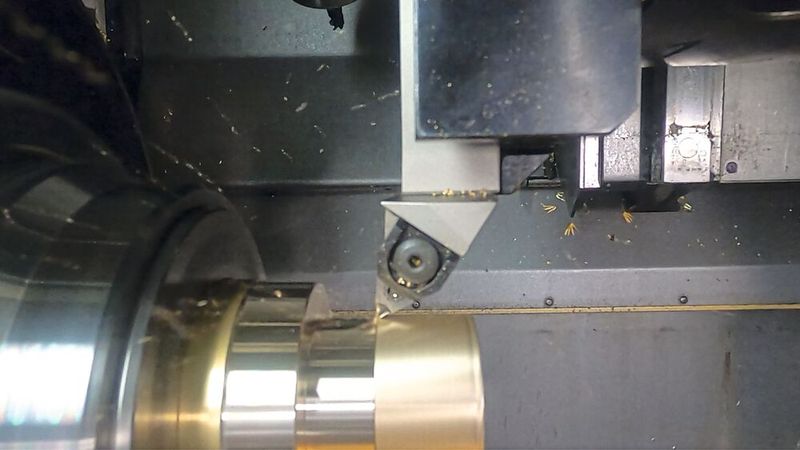
Tests showed that standard tools from Iscar, such as the Logiq6Turn, work excellently in lead-free material.
(Image: Iscar)
Emerging from a bell foundry in Ulm (Germany) in 1820, the Wieland Group is now an internationally operating provider of copper alloys, copper semi-finished products, as well as component and system solutions. With a global network of more than 80 production facilities, service and trading locations, and approximately 10,000 employees, the company offers a broad portfolio of products, technologies, and services. From prototypes to series production, Wieland develops solutions for industries including automotive, aerospace, electronics, refrigeration, and air conditioning technology.
Reach Annex 17, RoHS, DWD, and ELV – numerous international regulations limit the lead content in copper alloys. Materials previously used and proven are thus only partially usable in the long term. For this reason, Wieland has developed the ecoline series, a family of lead-free products intended to replace them. However, their machining presents new challenges, as lead imparts specific properties to lead-containing brass alloys, such as improving machinability and tool life.
Industrially important free-machining brass contains, for example, between 0.5 and 3.5 percent lead in small particles as chip breakers. The element is present in the material structure in finely dispersed particles. The more lead it contains, the easier the material is to machine. Lead provides a certain lubrication during machining and results in short chips.
The challenge lies in ensuring these characteristics even without lead.
Angelos Tanios, Prozessingenieur bei Wieland
To make these properties available in lead-free brass, Wieland uses silicon and phosphorus in its ecoline alloys, such as eco SZ3. The resulting phosphides are distributed within the alloy similarly to lead particles and act as predetermined breaking points for the chips. This allows the new materials to achieve very good machinability. Nevertheless, lead-reduced or lead-free materials pose challenges to the machining process to match the exceptional performance of lead-containing materials.
During tests, we occasionally observed increased wear on the cutting edges, and burrs formed on parts in some areas. It is also critical that long chips can form, which may wrap around tools, clog the workspace in the machine, and ultimately make chip removal from the system more difficult.
Christian Erb, Application Engineer bei Wieland
The team led by Christian Erb and Angelos Tanios knew that even the lead-free material would need to be machined economically and reliably—with the right tool. For this reason, they turned to their long-standing tool partner Iscar and presented the issue to Florian Schöffler, consulting and sales, and application technician Martin Staudacher. Since not many companies are yet working with the new lead-free brass, the tool specialists also lacked experience for recommendations. "But we have an ace up our sleeve for such cases—our TechCenter in Ettlingen," says Florian Schöffler.
In the well-equipped "playground for big boys," Iscar tests its own products on the one hand but primarily solves its customers' technical problems on the other. "So we invited the Wieland team to Ettlingen to brainstorm solutions together," says Martin Staudacher. "In the TechCenter, we were able to test what works best. After all, experience shows that trying beats studying."
The ecoline family from Wieland includes alloys with very different properties to meet various user requirements. For the trials in the TechCenter, the material experts from Ulm provided three-meter bar material made of eco SZ3 (CuZn40SiP) in diameters of 26 and 38 millimeters (~1 to 1.5 inches). "We chose this alloy because its properties are closest to the widely used brasses CW614 and CW617," says Christian Erb. "This allows us to cover a wide range of applications."
With lead-containing material, extremely sharp tools, such as aluminum geometries, usually work best. "In SZ3, however, these exact tools led to extremely long chips during our tests," says Werner Lederbogen, work preparation at Wieland. "We therefore switched to less sharp steel geometries with protective chamfers. That then worked perfectly."
Cutting materials with a suitable C-chipbreaker as well as a very smooth and polished coating allow for good chip flow.
Marco Huck, Application Engineer im TechCenter bei Iscar
Which coating will ultimately prove to be the best for lead-free materials can only be determined when tool service life is considered in a specific application case.
Tests on Long-Turning and Short-Turning Machines
The 26mm (~1 inch) material was to be machined on the Swiss-type lathe. To simulate typical industrial processes, a component resembling a fitting was created—in one go and almost exclusively using standard tools. For cutting off and grooving, the TechCenter team used the resource-efficient DoGrip with a cutting insert only one millimeter wide. Holes were made using a SolidDrill solid carbide (VHM) drill and Sumocham indexable head drills with diameters of 32 and 4 millimeters (~1.3 to 0.2 inches).
During turning and pre-turning, Isoturn tools with F1M chipformers performed well. Using the new three-edged Picco3Cut, they created chamfers and finished the internal corrections, while key surfaces were milled with a four-edged Multimaster solid carbide (VHM) cutter in the wear-resistant, TiAlN PVD-coated fine-grain grade IC908. The 1.5-pitch thread was cut by the machinists with an Iscar Thread milling cutter with ISO indexable inserts. Only for the form groove was a special tool used: it was created with a precisely tailored five-edged Penta-27 cutting insert with a laser-engraved chipformer.
Date: 08.12.2025
Naturally, we always handle your personal data responsibly. Any personal data we receive from you is processed in accordance with applicable data protection legislation. For detailed information please see our privacy policy.
Consent to the use of data for promotional purposes
I hereby consent to Vogel Communications Group GmbH & Co. KG, Max-Planck-Str. 7-9, 97082 Würzburg including any affiliated companies according to §§ 15 et seq. AktG (hereafter: Vogel Communications Group) using my e-mail address to send editorial newsletters. A list of all affiliated companies can be found here
Newsletter content may include all products and services of any companies mentioned above, including for example specialist journals and books, events and fairs as well as event-related products and services, print and digital media offers and services such as additional (editorial) newsletters, raffles, lead campaigns, market research both online and offline, specialist webportals and e-learning offers. In case my personal telephone number has also been collected, it may be used for offers of aforementioned products, for services of the companies mentioned above, and market research purposes.
Additionally, my consent also includes the processing of my email address and telephone number for data matching for marketing purposes with select advertising partners such as LinkedIn, Google, and Meta. For this, Vogel Communications Group may transmit said data in hashed form to the advertising partners who then use said data to determine whether I am also a member of the mentioned advertising partner portals. Vogel Communications Group uses this feature for the purposes of re-targeting (up-selling, cross-selling, and customer loyalty), generating so-called look-alike audiences for acquisition of new customers, and as basis for exclusion for on-going advertising campaigns. Further information can be found in section “data matching for marketing purposes”.
In case I access protected data on Internet portals of Vogel Communications Group including any affiliated companies according to §§ 15 et seq. AktG, I need to provide further data in order to register for the access to such content. In return for this free access to editorial content, my data may be used in accordance with this consent for the purposes stated here. This does not apply to data matching for marketing purposes.
Right of revocation
I understand that I can revoke my consent at will. My revocation does not change the lawfulness of data processing that was conducted based on my consent leading up to my revocation. One option to declare my revocation is to use the contact form found at https://contact.vogel.de. In case I no longer wish to receive certain newsletters, I have subscribed to, I can also click on the unsubscribe link included at the end of a newsletter. Further information regarding my right of revocation and the implementation of it as well as the consequences of my revocation can be found in the data protection declaration, section editorial newsletter.
The entire process from the bar to the finished part takes only about two minutes and delivers very good results.
Thomas Eiberle, Einrichter bei Wieland
The 38-millimeter diameter material was machined by the team on a short-turning lathe. A sliding bearing bushing was created as the test object, modeled on actual components. The bar material was rough-machined using the new three-edged QuickTLock with an extremely stable clamping system and finished with the Logiq6Turn, featuring positive indexable inserts with six 55-degree edges. A four-edged Multimaster solid carbide (VHM) cutter created the key surfaces. The team drilled a face bore using a DR-Twist drill with a 32-millimeter diameter and finished it with a Whisperline boring bar.
For the groove cut, the machinists also used the DoGrip here with a cutting width of only one millimeter.
In the successful machining on this machine, the Varia-VX quick-change system from our partner EWS also provided support, reducing setup time and securely transmitting torque. Additionally, the collision-optimized tool adapter Spanntop mini 65 from our partner Hainbuch allowed us to get very close to the chuck.
Jörg Huber, Application Engineer im TechCenter bei Iscar
The test results on both machines were convincing. With the tools used, the expert team can manufacture the components reliably and in one go on both the Swiss-type lathe and the short-turning lathe. "We consistently achieved nice short chips, and the surface quality is also spot on," says Christian Erb with satisfaction. Angelos Tanios sums up the findings: "With the right tools, even lead-free material can be machined without any issues."



:quality(80)/p7i.vogel.de/wcms/35/57/3557c819943c53acec41a0ccba87da4f/0130049064v1.jpeg "Researchers at the Fraunhofer IWU in Chemnitz have long known that many typical sheet metal parts can be manufactured more cost-effectively using hollow embossing rollers. Now there is news to report ... (Image:Fraunhofer IWU)")
:quality(80)/p7i.vogel.de/wcms/77/9b/779b0685d010dfe45c9c2cb1cfecd467/0128886425v1.jpeg "The BlueEye is the first \"real\" hyperspectral camera for the UV range and covers the wavelength range from 220 to 380nm. (Image:Inno-spec GmbH)")
:quality(80)/p7i.vogel.de/wcms/73/60/73608418789b1d9c393f5e2fa974eda2/0130209906v1.jpeg "The robots of the X6 generation from b+m enable very high painting quality and are also particularly compact and easy to maintain. (Image:Beckhoff)")
:quality(80)/p7i.vogel.de/wcms/82/90/8290dfe3595b6c6b33726ae8b76172c7/0130319587v1.jpeg "The concept image illustrates how the pattern of tiny protrusions and depressions created on the substrate (MgO, bottom) controls the arrangement of atoms in the superconducting material (YBCO, top). At the interface between the two layers, an electronic structure enables superconductivity to occur at higher temperatures than previously possible. (Image:Chalmers University of Technology / Riccardo Arpaia)")
:quality(80)/p7i.vogel.de/wcms/dd/08/dd086510d9ae7b50181f6070e4463b44/0129363730v1.jpeg "Typical application for ionizing devices: Wrapping films. (Picture: ©Adobe Stock/SMC)")
:quality(80)/p7i.vogel.de/wcms/78/e9/78e9188c25a8a94e67c34c9bf8ffe495/visual-agile-20robots-20and-20google-20deepmind-20partner-20to-20bring-20intelligence-20to-20robotics-2500x1406v1v1.jpeg "Together, the partners are developing adaptable, intelligent robots for a wide range of applications (Image:Agile Robots SE)")
:quality(80)/p7i.vogel.de/wcms/e7/66/e7669ecf0260ae8fc54c214e34e4902a/0130316817v1.jpeg "Siemens and Palo Alto Networks offer tested cybersecurity solution for industrial 5G. (Image:Siemens)")
:quality(80)/p7i.vogel.de/wcms/9f/55/9f55324832c4f426958031375124d9de/siemens-20ubtech-20hmnd-1920x1079v1v1.png "Ready for the factory floor: While Ubtech is planning mass production, Siemens is already testing humanoids in real factory applications in Erlangen. (Image:Siemens)")
:quality(80)/p7i.vogel.de/wcms/59/02/590246e3b3f415c65edbee377c14ca77/26-06-pi-fraunhofer-iws-41450-direktplattieren-pic-01-7771x4369v1v1.jpeg "The Fraunhofer IWS has developed the new \"direct laser cladding\" process, which creates a functional layer directly on the base body by applying a strip-shaped metal to rotationally symmetrical components in a spiral and bonding it locally by laser. (Image:Christoph Wilsnack/Fraunhofer IWS)")
:quality(80)/p7i.vogel.de/wcms/e4/51/e451d52ce0182fb0aaa46a5774f832ef/26-04-pi-fraunhofer-iws-21160-bioslide-pic-01-4128x2321v1v1.jpeg "With the BioSlide research project, the Fraunhofer IWS is investigating how sliding systems can be designed to be more sustainable and energy-efficient. New materials can be tested in a particularly application-oriented manner on this plain bearing test stand. (Image:Fraunhofer IWS)")
![Thanks to advanced 3D printing technology, a more efficient use of resources should contribute to lower-emission aviation—this is the goal of ['skai]-lab. (Image:Oleksandr Pashchenko - stock.adobe.com / AI-generated)](https://cdn1.vogel.de/nghHNSbySccfOjG3n1qCA-FVOjQ=/288x162/smart/filters:format(jpg):quality(80)/p7i.vogel.de/wcms/62/64/626424c97a16e69f871bf216c9629c2a/adobestock-1927043193--c2-a9-20oleksandr-20pashchenko-20-e2-80-93-20stock-adobe-com-ki-generiertv1v1.jpeg "Thanks to advanced 3D printing technology, a more efficient use of resources should contribute to lower-emission aviation—this is the goal of ['skai]-lab. (Image:Oleksandr Pashchenko - stock.adobe.com / AI-generated)")
:quality(80)/p7i.vogel.de/wcms/78/28/7828775af76773458b4d1409ceb1cf0c/368945-20dam-20imagery-digital-transformation-pc-1920x1079v1v1.jpeg "Complex development projects with high regulatory requirements, such as in the aerospace industry, benefit in particular from the Intelligent Product Lifecycle. (Image:PTC)")
:quality(80)/p7i.vogel.de/wcms/c1/79/c179ce9acd000e7cf48318e03e3fe4da/0130333964v1.jpeg "Magna is expanding its hybrid portfolio with the DHD REX, a dedicated hybrid drive for REEVs. (Image:Magna)")
:quality(80)/p7i.vogel.de/wcms/62/5f/625f41e87ebfef156a98c8e6393e32fd/0130211654v1.jpeg "Axial flux motors have some advantages over radial flux motor—but their production is currently still expensive. (Image:RWTH Aachen University)")
:quality(80)/p7i.vogel.de/wcms/80/c2/80c2ea3fbe2df808a263d99adad93f66/0130160344v1.jpeg "Francois Provost has been CEO of Renault since summer 2025. (Image:Renault)")
:quality(80)/p7i.vogel.de/wcms/8d/f8/8df87aa10e28419e1869acb641b4c4dd/0130324805v1.jpeg "With the Affela 1 in the Signature Edition, the Sony Honda Mobility joint project was to be launched in a few months' time. (Image:SHM)")
:quality(80)/p7i.vogel.de/wcms/4d/dd/4dddf438e91f394c04a095dbfd109d1c/0130236430v1.jpeg "Measurement modules: The 720301 module in combination with the SL2000 enables RMS and power calculations, among other things. (Image:Yokogawa)")
:quality(80)/p7i.vogel.de/wcms/61/fc/61fcf95f5cca15494ad18343901ae585/0130317237v1.jpeg "With the AGI CPU, Arm says it is taking a \"historic step\": With the processor aimed at AI in data centers, the company is presenting itself for the first time as a provider of its own chips, not just as a pure IP licensor. (Image:Arm)")
:quality(80)/p7i.vogel.de/wcms/11/36/113695ed260e29c8c2d9d39dc5f9d869/0130213768v1.jpeg "AI can work cheaply in China and deliver the results rapidly all over the world. (Image:Dall-E / AI-generated)")
:quality(80)/p7i.vogel.de/wcms/22/08/22085b4997a696887dd5a712a30b262b/0130211045v1.jpeg "Imec has announced that the world's most advanced high numerical aperture (High NA) EUV lithography system, the ASML EXE:5200, has arrived at its 300mm cleanroom in Leuven. (Image:Imec)")
:fill(fff,0)/p7i.vogel.de/companies/67/eb/67eba621ef6ea/logo2.png "logo2 (Wuxi InfiMotion)")
:quality(80)/p7i.vogel.de/wcms/71/76/7176248790abe7fdcd4457109c06bb32/0128231954v1.jpeg "Lead-free brass can also be machined effortlessly with standard tools from Iscar.(Image: Iscar)")
:quality(80)/p7i.vogel.de/wcms/c7/54/c75434b5b81d3589cb92ceee87ac3d88/0128231960v1.jpeg "Discussing final details on the Penta 8 (from left): machine operator Thomas Eiberle, Christian Erb, application engineer, process engineer Angelos Tanios, all from Wieland; Marco Huck, application engineer in the TechCenter, Florian Schöffler, consulting and sales, Jörg Huber, application engineer in the TechCenter, all from Iscar; and Werner Lederbogen, work preparation at Wieland.(Image: Iscar)")
:quality(80)/p7i.vogel.de/wcms/27/ed/27ed595614f7d77b70b7746ab788a1bf/0128231957v1.jpeg "Collaborating at Iscar's TechCenter on suitable tool solutions for machining lead-free brass (from left): machine operator Thomas Eiberle, process engineer Angelos Tanios, both from Wieland; application technicians Martin Staudacher and Marco Huck, application engineer at the TechCenter, both from Iscar; Christian Erb, application engineer at Wieland; Florian Schöffler, consulting and sales at Iscar; Werner Lederbogen, work preparation at Wieland; and Jörg Huber, application engineer at the TechCenter at Iscar.(Image: Iscar)")
:quality(80)/p7i.vogel.de/wcms/36/70/36700cdbd641c42bd9d1a6958754a96d/0128232212v1.jpeg "\"We consistently have nice short chips, and the surface quality is also right,\" says Christian Erb, Application Engineer at Wieland, with satisfaction.(Image: Iscar)")
:quality(80)/p7i.vogel.de/wcms/55/c5/55c56781dc11e7113fcaa2e0b53e5d04/0125002081v1.jpeg "The tests showed that standard tools from Iscar, such as the \"LOGIQ6TURN,\" work excellently in lead-free material. (Image:Iscar)")
:quality(80)/p7i.vogel.de/wcms/d7/6b/d76bd173651b1fba43261ebd8f9b75e2/0125926576v1.jpeg "The six-edged Quickturn for fast multidirectional face and profile turning features an extremely stable clamping system. (Image:Iscar)")