The electronics industry has a problem with its use of toxic substances and forever chemicals, and with its huge contribution to the mountains of electronic waste dumped in landfill sites. The pollution problem is bad for the industry’s reputation. It’s bad for the bottom line too: society is losing patience, and is increasingly legislating to curb the industry’s use of some materials, and to increase the cost of using others.
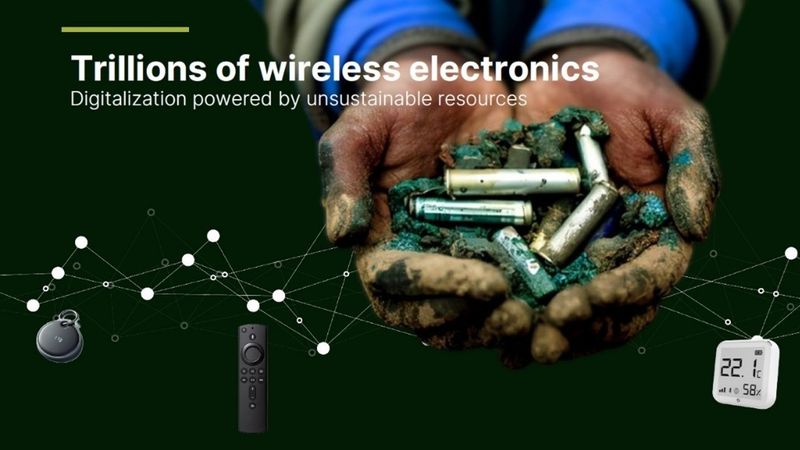
Because batteries’ components are hard to recycle, large amounts of e-waste end up in landfill.
(Bild: Ligna Energy)
In the past, the industry’s approach has too often been to defer the implementation of solutions by reducing harms rather than by eliminating them. But this is not a good look. When a smoker consults a medical practitioner about their health, the advice is not to reduce cigarette consumption – it is to stop smoking altogether. Likewise, the electronics industry’s goal should not be to reduce the environmental harm caused by the use of pollutants such as heavy metals and PFAS, it should be to eliminate the harm entirely. The example of Ligna Energy’s development of a safe, recyclable supercapacitor shows how this can be done.
Storing up environmental dangers
The problem of the incorporation of harmful chemicals in a product’s composition is particularly acute in the energy storage sector of the electronics industry. Batteries are commonly made with dangerous chemicals including lithium, manganese and cobalt. Aside from the effect of these chemicals when released into the environment on disposal, even their extraction as raw materials from the earth is often damaging, especially when mining takes place in regions of the world that experience armed conflict. And it is hard to overstate the scale of the problem of e-waste: according to the European Commission, 244,000 tonnes of portable batteries were sold in the European Union in 2022. In the same year, only 111,000 tonnes of used portable batteries were collected for recycling.
In response, governments worldwide are imposing increasingly stringent regulations on the makers of products that contain a battery. For example, The European Union’s latest Batteries Regulation 2023/1542 is aimed at ensuring that, ‘in the future, batteries have a low carbon footprint, use minimal harmful substances, need less raw materials from non-EU countries, and are collected, reused and recycled to a high degree in Europe’, according to the European Commission. In 2023, the US Environmental Protection Agency proposed new rules governing the recycling and management of lithium batteries at their end of life. Given the environmental harms associated with batteries, and the costs involved in compliance with regulation, it is not surprising that product manufacturers are turning to energy harvesting as a green alternative power source, most often using an on-device photovoltaic cell to generate electricity. This is bringing the green credentials of supercapacitors into the spotlight, since energy harvesting systems require a form of energy storage, and a battery is the least green option. Supercapacitors might appear at first glance environmentally friendlier, as they typically contain no cobalt, although some hybrid supercaps contain lithium electrodes. But traditional supercaps have other pollutants hidden inside their case, including PFAS. So manufacturers of products with an autonomous, wire-free power supply cannot achieve true sustainability just by implementing energy harvesting: use of a traditional supercap might cause less harm than a battery, but it definitely does not eliminate the harm.
A new safe, non-toxic supercapacitor
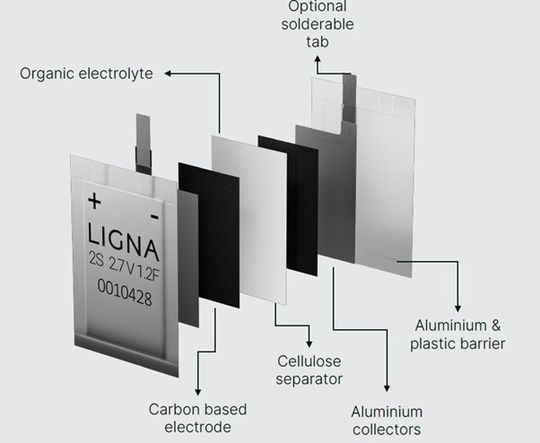
Ligna Energy uses active carbon electrodes and other bio-materials in the composition of the S-Power supercaps.
(Bild: Ligna Energy)
It was this absence of a green option for energy storage which led Ligna Energy to create a completely safe, non-toxic supercap. Ligna’s S-Power supercaps are based on bio-materials, including active carbon electrodes derived from coconut husks, and a paper separator made from a material derived from forestry products. The S-Power products contain no toxic or harmful chemicals – no heavy metals and no PFAS. They are completely safe on disposal, and – unlike batteries or traditional supercaps – are easily recyclable by standard methods such as shredding and washing, or by recovery through incineration.
So what is the big difference between Ligna Energy’s approach, and the wider electronics industry’s continued tolerance of the use of toxic ingredient materials? We believe that it starts with our ethos, which underpins our business practices. Ligna Energy’s mission is to provide green and safe energy storage solutions which drive the development of the Internet of Things industry in a more sustainable direction. This mission is being realised through the development of the S-Power products, and the innovations in high-volume production which make the technology’s commercialisation possible. And underlying this practical goal, Ligna has followed two important principles of operation: An end-to-end green design philosophy and a commitment to original research to discover and deploy new non-toxic materials where necessary
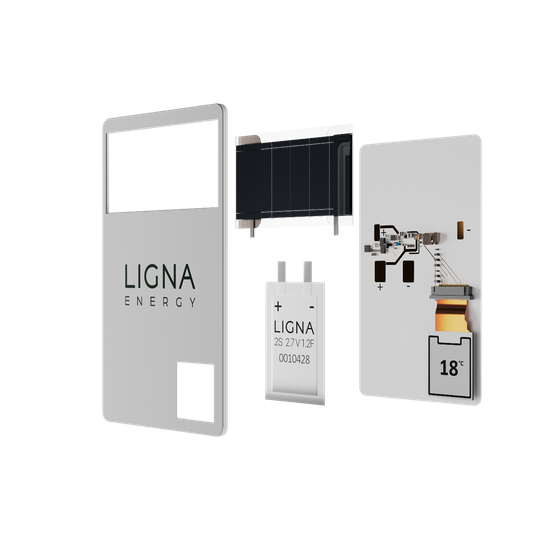
A concept design for a smart indoor thermostat using harvested light energy stored in a Ligna Energy S-Power 2S supercap.
(Bild: Ligna Energy)
The green design philosophy is expressed in a commitment to sustainability in every aspect of a Ligna product: not only the use of non-toxic and bio-based materials, but also innovations which reduce the carbon footprint of the product – just 6g CO2e per unit for the 1.2F S-Power 2S – as well as active partnerships with energy harvesting product manufacturers to make it easier for OEMs to replace batteries with PV cells or other forms of harvesting.
Date: 08.12.2025
Naturally, we always handle your personal data responsibly. Any personal data we receive from you is processed in accordance with applicable data protection legislation. For detailed information please see our privacy policy.
Consent to the use of data for promotional purposes
I hereby consent to Vogel Communications Group GmbH & Co. KG, Max-Planck-Str. 7-9, 97082 Würzburg including any affiliated companies according to §§ 15 et seq. AktG (hereafter: Vogel Communications Group) using my e-mail address to send editorial newsletters. A list of all affiliated companies can be found here
Newsletter content may include all products and services of any companies mentioned above, including for example specialist journals and books, events and fairs as well as event-related products and services, print and digital media offers and services such as additional (editorial) newsletters, raffles, lead campaigns, market research both online and offline, specialist webportals and e-learning offers. In case my personal telephone number has also been collected, it may be used for offers of aforementioned products, for services of the companies mentioned above, and market research purposes.
Additionally, my consent also includes the processing of my email address and telephone number for data matching for marketing purposes with select advertising partners such as LinkedIn, Google, and Meta. For this, Vogel Communications Group may transmit said data in hashed form to the advertising partners who then use said data to determine whether I am also a member of the mentioned advertising partner portals. Vogel Communications Group uses this feature for the purposes of re-targeting (up-selling, cross-selling, and customer loyalty), generating so-called look-alike audiences for acquisition of new customers, and as basis for exclusion for on-going advertising campaigns. Further information can be found in section “data matching for marketing purposes”.
In case I access protected data on Internet portals of Vogel Communications Group including any affiliated companies according to §§ 15 et seq. AktG, I need to provide further data in order to register for the access to such content. In return for this free access to editorial content, my data may be used in accordance with this consent for the purposes stated here. This does not apply to data matching for marketing purposes.
Right of revocation
I understand that I can revoke my consent at will. My revocation does not change the lawfulness of data processing that was conducted based on my consent leading up to my revocation. One option to declare my revocation is to use the contact form found at https://contact.vogel.de. In case I no longer wish to receive certain newsletters, I have subscribed to, I can also click on the unsubscribe link included at the end of a newsletter. Further information regarding my right of revocation and the implementation of it as well as the consequences of my revocation can be found in the data protection declaration, section editorial newsletter.
The other important aspect of Ligna’s approach is the commitment to discovering new, safe alternative materials. To create a completely non-toxic supercap, Ligna Energy could not simply specify a set of known components and assemble them in accordance with existing product ‘recipes’: it had to perform scientific research to test and validate new, safe materials, and then develop specialised production methods for assembling them in a supercap with precise, repeatable characteristics. The combination of a unique manufacturing set-up, a flat form factor, and validated material innovations form the core of Ligna Energy’s distinctive appeal: the marriage of sustainability and cost effectiveness. In other words, the S-Power products are the result of a deliberate, purposeful research effort aimed at creating a truly sustainable and safe alternative to existing supercap products that were neither sustainable nor safe. This, then, is how the electronics industry can pursue a path to the elimination of harmful chemicals, and not just a reduction in their use, or mitigation of the effects of their use: through an adherence to the principle of causing zero harm, and a commitment to the research and development required to create new alternatives to dangerous and unsafe materials in use today.



:quality(80)/p7i.vogel.de/wcms/40/c5/40c5051cebdb10fdee9a283303434d9d/0129881741v1.jpeg "3D-printed tools and other components contribute to energy-saving, precise processes. (Image:Gerhard Schubert GmbH)")
:quality(80)/p7i.vogel.de/wcms/e5/fa/e5fa9fa2e3b44ee1894fdf95bbe828fe/0129904146v1.jpeg "Airports and other critical infrastructure in Europe are to be better protected against drones. (Picture: ©assetseller - stock.adobe.com)")
:quality(80)/p7i.vogel.de/wcms/ae/bd/aebda515c684825e97579175874ea6bd/0129920231v1.jpeg "Hensoldt, a sensor specialist for critical defense applications among other things, now has a strategic milestone ahead of it. The company is planning to acquire Nedinsco, an optronics company from Venlo in the Netherlands. Here's what's to come ... (Image:Hensoldt)")
:quality(80)/p7i.vogel.de/wcms/c3/6f/c36f031df46d22615d941d077d32313c/0129800025v1.jpeg "The laser-assisted process is intended to make wafer cutting significantly more productive. (Image:Trumpf)")
:quality(80)/p7i.vogel.de/wcms/e8/dc/e8dc27a8d9fba8fbd081987400bf6848/0127426198v1.jpeg "3D FEM models are detailed, large and computationally intensive. Thanks to ROM and the support of Cadfem, Wago has succeeded in setting up an e-shop for thermal simulation. (Image:WAGO)")
:quality(80)/p7i.vogel.de/wcms/9c/ac/9cac6246660e746c5a3989399ac4d250/0128561645v1.jpeg "Artificial intelligence can drive efficiency in smart factories through centralized data management and predictive maintenance. (Picture: ©Fardived - stock.adobe.com)")
:quality(80)/p7i.vogel.de/wcms/6b/e2/6be235b5ad8a442ccd9d164b0b300d8b/0129763992v1.jpeg "As early as 2020, the Zimmer Group announced that it would convert its production to be sustainably CO2-neutral. (Image:Zimmer Group)")
:quality(80)/p7i.vogel.de/wcms/d4/ba/d4bab9481e66f8570f40eb8ef2a90198/0129795613v1.jpeg "A camera inspection during removal ensures that the components are placed correctly in the KLTs. (Image:Yaskawa Europe)")
:quality(80)/p7i.vogel.de/wcms/76/81/7681b6450512b2cce1e453cd3d732543/0129479309v1.jpeg "Symbolic image: Model-based design combines virtual system models with real machines and systems in order to simulate, validate and coordinate functions, control and software early on in the development process. (Image:Dall-E / AI-generated)")
:quality(80)/p7i.vogel.de/wcms/5c/0f/5c0fee074c4b6c8e8c0993f3217c2f5a/0129773718v1.jpeg "The General Fusion demonstration reactor. (Image:General Fusion)")
:quality(80)/p7i.vogel.de/wcms/b5/5e/b55ed9355e0395ec0caf111d6af6b494/adobestock-495980372--c2-a9-20natali-mis-20-e2-80-93-20stock-adobe-com-6720x3778v1v1.jpeg "Which engineering skills will be in vogue in 2026? (Image:natali_mis - stock.adobe.com)")
:quality(80)/p7i.vogel.de/wcms/bf/a5/bfa5d882e93f159ce93e933742272b00/nord-vibn-cmyk-2196x1235v1v1.jpeg "With digital twins for virtual commissioning, Nord supports customers in ensuring that systems are available more quickly, even with complex drive systems. (Image:Nord Drivesystems)")
:quality(80)/p7i.vogel.de/wcms/e4/01/e40186c9a7d04cbecb20fab20ff79094/0129886097v1.jpeg "Skoda has inaugurated a new battery plant in Mlada Boleslav to meet rising demand, but also to reduce battery costs by 30 percent. (Image:Skoda)")
:quality(80)/p7i.vogel.de/wcms/74/7b/747b6bc4d758c5dd4b5c24a763ae493d/0129897614v1.jpeg "Huawei Intelligent Automotive Solutions has presented a lidar with a resolution of 896 lines. (Image:HIMA via ChinaEVHome)")
:quality(80)/p7i.vogel.de/wcms/ba/b7/bab7bfd052f35da3c39388508faa350e/0129851977v1.jpeg "The third generation of the Mazda CX-5 scores above all with its inner values. (Image:Mauritz - VCG)")
:quality(80)/p7i.vogel.de/wcms/81/24/8124e33f53ec73fa99374f407cc11b61/0129727992-541x304v1v1.jpeg "The development of control elements and HMI systems for commercial vehicles can lead to interactions. (Image:Preh / AI-generated)")
:quality(80)/p7i.vogel.de/wcms/8b/46/8b46730ba87a86f16d696f043cf0e3d1/0129887022v1.jpeg "Linyi Yunchuan's S2000 platform has risen to a height of two kilometers and fed the energy generated into the grid. (Image:Linyi Yunchuan)")
:quality(80)/p7i.vogel.de/wcms/92/f8/92f8bf81914500bcda78f63dab8da720/0129926751v1.jpeg "Only recently, the US government allowed high-end chips for AI such as Nvidia's H200 series (pictured) to be exported to China under certain conditions. But now the tax is being pulled back all the harder: An eDraft envisages tighter controls on the export of hardware for AI technologies worldwide. Even allies would be affected. (Image:Nvidia)")
:quality(80)/p7i.vogel.de/wcms/84/cc/84cc506003388ecffaab464677c7afa6/0129843694v1.jpeg "Launched last year, ASML's TWINSCAN XT:260 is an i-line scanner with a throughput of 270 wafers per hour. With a focus on the increased demands of AI chips, ASML wants to shift its focus away from pure front-end tools for chip production in the next ten to fifteen years with packaging and bonding technologies. (Image:ASML)")
:quality(80)/p7i.vogel.de/wcms/8f/48/8f48b0ed0d6c5c4f299b1310a7b577e9/0129830738v1.jpeg "Data centers in orbit are indeed dreams of the future, while data centers under water are already being tested. (Image:Dall-E / AI-generated)")
:fill(fff,0)/images.vogel.de/vogelonline/companyimg/76800/76895/65.jpg "FAULHABER_120mm.jpg ()")
:fill(fff,0)/p7i.vogel.de/companies/69/88/69882c428938e/tmts2026-ticec-banner-en-2000px.png "tmts2026-ticec-banner-en-2000px (https://www.tmts.tw/en)")
:fill(fff,0)/p7i.vogel.de/companies/67/eb/67eba621ef6ea/logo2.png "logo2 (Wuxi InfiMotion)")
:quality(80)/p7i.vogel.de/wcms/10/4c/104cebcc22d9d6eb8672628c72c27476/0126348125v1.jpeg "The graphene electrode is the secret behind the new supercapacitors. (Image:Empa)")
:quality(80)/p7i.vogel.de/wcms/2c/8d/2c8da4b72e35ded278178929afb94d55/0129561713v1.jpeg "Change in direction: The shift away from PFAS in semiconductor manufacturing and the move toward sustainable chip production is demonstrated by the trilateral collaboration between Fraunhofer ENAS, the Paul Scherrer Institute PSI, and Memsstar Limited, which rely on the environmentally friendly Gas-MacEtch technology. (Image:andreyarmyagov/Canva)")