E-mobility is booming—but what happens to the vast amounts of spent batteries? As part of the "DeMoBat" research project, the Fraunhofer IPA successfully tested how battery systems can be dismantled using the KR Quantec from Kuka, in order to recycle valuable components.
In the successful "DeMoBat" project for industrial battery dismantling at the Fraunhofer IPA in Stuttgart, technology from Kuka played a central role.
(Image: Kuka)
In March 2023, EU countries made a decision of enormous significance: from 2035 onwards, only emission-free cars and vans will be allowed to be newly registered in Europe. The future of the automotive industry lies in e-mobility, as the forecasts also show: While approximately 27.7 million electric vehicles were driving around the world in 2022, this number is expected to exceed 226 million by 2030, according to the International Energy Agency (IEA). In Germany, by then, nearly a quarter of all cars will be electric vehicles—currently, it's just two percent.
With the increasing number of battery electric vehicles, the pile of spent batteries is also growing, as they currently have an average lifespan of about ten years. At the same time, the raw materials for their production are becoming increasingly scarce and expensive. One solution is battery recycling.
Using the industrial robot KR Quantec from Kuka, the Fraunhofer Institute for Production Technology and Automation IPA in Stuttgart demonstrates a viable approach: In the research project "De Mo Bat—Industrial Dismantling of Batteries and Electric Motors," experts from twelve consortium partners studied over several years how battery systems from electric vehicles can be sustainably and economically refurbished.
Battery disassembly: complex and life-threatening
The focus was on the disassembly of batteries. The prerequisite for being able to recycle their components is a pure separation into their constituents. "Dismantling batteries presents three major challenges," explains Anwar Al Assadi, group leader at Fraunhofer-IPA. "First, working with high-voltage technology requires specially qualified professionals. Second, manual disassembly involves health risks due to high voltage and dangerous gases, with the worst-case scenario being spontaneous combustion. And third, disassembly by hand takes a very long time and is accordingly cost-intensive. This often makes recycling currently unprofitable."
This challenge is ideally suited for a robot-based solution. Thus, a KR Quantec with a payload capacity of 270 kilograms was completely operated using the Pitasc software developed at Fraunhofer-IPA and controlled by Kuka's "Robot Sensor Interface" software, which facilitated the integration of external sensors. "In this way, we were able to regulate important disassembly steps in real-time and automate various processes that had to be done manually until now."
Robot kills three birds with one stone
Thus, Kuka's technology in battery disassembly helps solve three problems at once:
The use of robots alleviates the shortage of skilled workers,
minimizes the safety risk for employees and
ensures that battery recycling is economically viable due to its efficiency.
The value of robots in this context is demonstrated by the successful research project at the Fraunhofer-IPA. Here, the KR Quantec carried out a variety of disassembly steps: from loosening screws and opening seal joints to cutting cables. "The complexity lies in the fact that there are incredibly many different battery systems on the market," explains Al Assadi. "And each looks different inside." Sometimes, manufacturers even change the structure of the battery systems within a vehicle series. As a six-axis articulated robot, the KR Quantec is perfectly suited for this task: With its six degrees of freedom, it can optimally adjust to the different dimensions and geometries of the battery system, and its payload capacity can handle the high torques.
Battery model and screws are automatically recognized
Ideal for this application is software like Pitasc from Fraunhofer-IPA, which, in conjunction with the robotic components, recognizes what needs to be done regardless of the specific battery model. Supporting vision systems for automatically recognizing screws and other components eliminate the need for manual teaching of the robot for each individual process step. To prevent collisions with components, a success check is performed after each disassembly step using sensors and 3D camera systems. The signals are then transmitted to the central process control, ensuring a safe process flow.
Date: 08.12.2025
Naturally, we always handle your personal data responsibly. Any personal data we receive from you is processed in accordance with applicable data protection legislation. For detailed information please see our privacy policy.
Consent to the use of data for promotional purposes
I hereby consent to Vogel Communications Group GmbH & Co. KG, Max-Planck-Str. 7-9, 97082 Würzburg including any affiliated companies according to §§ 15 et seq. AktG (hereafter: Vogel Communications Group) using my e-mail address to send editorial newsletters. A list of all affiliated companies can be found here
Newsletter content may include all products and services of any companies mentioned above, including for example specialist journals and books, events and fairs as well as event-related products and services, print and digital media offers and services such as additional (editorial) newsletters, raffles, lead campaigns, market research both online and offline, specialist webportals and e-learning offers. In case my personal telephone number has also been collected, it may be used for offers of aforementioned products, for services of the companies mentioned above, and market research purposes.
Additionally, my consent also includes the processing of my email address and telephone number for data matching for marketing purposes with select advertising partners such as LinkedIn, Google, and Meta. For this, Vogel Communications Group may transmit said data in hashed form to the advertising partners who then use said data to determine whether I am also a member of the mentioned advertising partner portals. Vogel Communications Group uses this feature for the purposes of re-targeting (up-selling, cross-selling, and customer loyalty), generating so-called look-alike audiences for acquisition of new customers, and as basis for exclusion for on-going advertising campaigns. Further information can be found in section “data matching for marketing purposes”.
In case I access protected data on Internet portals of Vogel Communications Group including any affiliated companies according to §§ 15 et seq. AktG, I need to provide further data in order to register for the access to such content. In return for this free access to editorial content, my data may be used in accordance with this consent for the purposes stated here. This does not apply to data matching for marketing purposes.
Right of revocation
I understand that I can revoke my consent at will. My revocation does not change the lawfulness of data processing that was conducted based on my consent leading up to my revocation. One option to declare my revocation is to use the contact form found at https://contact.vogel.de. In case I no longer wish to receive certain newsletters, I have subscribed to, I can also click on the unsubscribe link included at the end of a newsletter. Further information regarding my right of revocation and the implementation of it as well as the consequences of my revocation can be found in the data protection declaration, section editorial newsletter.
Al Assadi points out that a significant complication arises from automakers needing to pack as many components as possible into the batteries in very confined spaces. This greatly limits the range of motion during disassembly. Additional challenges include the varying positions of cables and the numerous adhesives in a battery, which are much harder to automate than unscrewing. "However, we have found solutions for these issues as well, which we now want to further develop for industrial use." He emphasizes that it is crucial to construct flexible systems to address these challenges effectively.
KR Quantec: Attractive for a variety of applications
The versatility of the KR Quantec series is one of its major advantages. "Thanks to its sleek geometry and small footprint, the Quantec allows for the construction of a flexible and future-oriented system," states Thomas Schmidberger, Global Business Development Manager Electronics at Kuka. "Additionally, like all Kuka robots, it is standard ESD-certified to ensure safe handling of electrostatically sensitive components." The new generation of the KR Quantec offers exceptional energy efficiency thanks to standard DC controllers: Energy consumption has been significantly reduced both in motion and in standby operation. In production movement, the six-axis robots consume about 30 percent less energy than the previous model due to the regeneration of braking energy, and in the 'waiting in control' operating state, they use even 60 percent less.
Thus, the KR Quantec is not only suitable for the disassembly of batteries but also attractive for a wide range of applications. Its modular system also promises tailor-made robots and quick delivery times—and ultimately, a low total cost of ownership (TCO). With a carrying capacity of 120 to 300 kilograms, the robots in the KR Quantec series also belong to the high payload class and have the largest payload and reach portfolio in this segment on the market. The ability to upgrade the payload capacity in the field, along with the Motion Modes for high process quality, make them a sensible and safe investment for the future of any production.



:quality(80)/p7i.vogel.de/wcms/a0/47/a04725ef9bd09fb6c9341a1bea1b5d93/0130443083v1.jpeg "Here, a type of plastic pallet is produced by thermoforming (vacuum forming or deep drawing) at the corresponding division of New England Plastics in the USA. This division, which specializes in so-called liners, is now part of Ringmetall ... (Image:New England Plastics)")
:quality(80)/p7i.vogel.de/wcms/e3/42/e342b3c593ea92d56604d3be969e9c9a/0130437231v1.jpeg "Daimler Truck will be building even more trucks at its Czech plant in Cheb in the future. This is because it is now being expanded for strategic cost-saving reasons ... (Image:Daimler Truck)")
:quality(80)/p7i.vogel.de/wcms/23/99/23992bf2dcdc432c9b7209c34a4a7c48/0129733089v1.jpeg "Stork relies on the modular Neoswiss turning system from Iscar to shorten the set-up times for its sliding headstock lathes and work more productively. (Image:Iscar)")
:quality(80)/p7i.vogel.de/wcms/7d/e2/7de2923434b2f1a78ba5482d8d335269/0113143253v1.jpeg "In our China Market Insider we regularly provide you with relevant information directly from China. (Image:© Eisenhans - stock.adobe.com)")
:quality(80)/p7i.vogel.de/wcms/b7/36/b736dfebc16c42d6901d0d0e1f390493/3d-druck-20factory-20--20ki-20generiert-1920x1079v1.png "(Source: AI-generated)")
:quality(80)/p7i.vogel.de/wcms/79/b2/79b21aad663f4a7bd4472afc1c1afc62/0130433994v1.jpeg "Mission Joyride: The free-flying robot (shown here in the rendering) will relieve the ISS crew of logistics tasks from 2027 with its two mechanical arms. (Image:Icarus Robotics)")
:quality(80)/p7i.vogel.de/wcms/6b/45/6b4546fa6ebf305c3660326909363f32/0130437089v1.jpeg "Industrial AI in action: Rockwell Automation presents practical solutions for self-controlling production systems at the Hannover Messe. (Image:Rainer Jensen, Deutsche Messe)")
:quality(80)/p7i.vogel.de/wcms/78/e9/78e9188c25a8a94e67c34c9bf8ffe495/visual-agile-20robots-20and-20google-20deepmind-20partner-20to-20bring-20intelligence-20to-20robotics-2500x1406v1v1.jpeg "Together, the partners are developing adaptable, intelligent robots for a wide range of applications (Image:Agile Robots SE)")
:quality(80)/p7i.vogel.de/wcms/59/a2/59a2b11f0aa1b700eff02addd5de8703/adobestock-1788280853--c2-a9-20satria-20-e2-80-93-20stock-adobe-com-5081x2860v1v1.jpeg "Quantum computers require extreme cooling to temperatures close to absolute zero in order to keep qubits stable. (Image:satria - stock.adobe.com)")
:quality(80)/p7i.vogel.de/wcms/62/5f/625f41e87ebfef156a98c8e6393e32fd/0130211654v1.jpeg "Axial flux motors have some advantages over radial flux motor—but their production is currently still expensive. (Image:RWTH Aachen University)")
:quality(80)/p7i.vogel.de/wcms/f6/ae/f6aec4f6241b36ed5e3a990ac9176b42/0130429460v1.jpeg "Verne, Pony.ai and Uber want to launch a robotaxi service in Europe. (Image:Verne)")
:quality(80)/p7i.vogel.de/wcms/d7/88/d788699f2974708a332baa4e7a62fa9e/0130438967v1.jpeg "Skoda is withdrawing from China. The brand has produced well over three million vehicles there. (Image:Skoda car)")
:quality(80)/p7i.vogel.de/wcms/b0/43/b043b86899837532aad62d63368a917a/0130371361v1.jpeg "Skoda leaves the chinese market.
(Image:Skoda)")
:quality(80)/p7i.vogel.de/wcms/c3/c4/c3c4ce270b083eeac55654148611f064/0130237945v1.jpeg "China is not giving up on hydrogen, but is intensifying its efforts. (Image:freely licensed from Pixabay)")
:quality(80)/p7i.vogel.de/wcms/ee/09/ee09acbd6dc896df25affaa9e871e6e5/0130440053v1.jpeg "IMS chip module for simple system integration into an ion mobility spectrometer. (Image:Fraunhofer IPMS)")
:quality(80)/p7i.vogel.de/wcms/10/6c/106cd22de5f68a0f74639d654827228c/0130345302v1.jpeg "Made in India: According to the India Electronics and Semiconductor Association (IESA), the country should be able to produce between 75 and 80 million chips by the beginning of 2027, once the plants currently under construction become operational. (Image:Pixabay (Montage: Sebastian Gerstl))")
:quality(80)/p7i.vogel.de/wcms/a5/ed/a5ed6fda029d362732a293d6b19d74c4/0130444216v1.jpeg "Thirteen executives from the Chinese chip industry have drawn up a plan to achieve an 80% self-sufficiency rate for semiconductors by 2030. (Image:Maxim_Kazmin - stock.adobe.com)")
:quality(80)/p7i.vogel.de/wcms/31/a6/31a646018b34d8e0a44bfc8bf17837f6/0130361632v1.jpeg "For many companies, PFAS are considered indispensable in electronics production. (Image:freely licensed)")
:fill(fff,0)/images.vogel.de/vogelonline/companyimg/76800/76895/65.jpg "FAULHABER_120mm.jpg ()")
:fill(fff,0)/p7i.vogel.de/companies/69/88/69882c428938e/tmts2026-ticec-banner-en-2000px.png "tmts2026-ticec-banner-en-2000px (https://www.tmts.tw/en)")
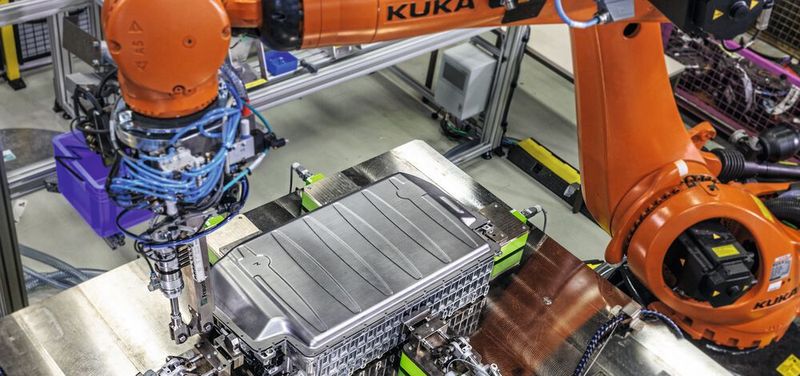
:quality(80)/p7i.vogel.de/wcms/66/d0/66d06945895f2833a2c227da9bcef0bf/0120187013v1.jpeg "High flexibility and low total cost of ownership (TCO) characterize the KR Quantec.(Image: Kuka)")
:quality(80)/p7i.vogel.de/wcms/d6/6d/d66d35a255c53b56e36c6b71ce3fc356/0120187016v1.jpeg "Supportive imaging systems for automatic recognition of screws and other components made manual teaching of the KR Quantec for each individual process step unnecessary.(Image: Kuka)")
:quality(80)/p7i.vogel.de/wcms/09/2c/092c559c27de32010e98f969949e6c16/0120187011v1.jpeg "Manual battery disassembly is costly and life-threatening for humans. A robot-based application solves these problems.(Image: Kuka)")
:quality(80)/p7i.vogel.de/wcms/77/8c/778cb9d88575af14789ff49853adcbd2/0120187020v1.jpeg "The robot performs a variety of tasks: from loosening screws to opening sealing joints or cutting cables.(Image: Kuka)")
:quality(80)/p7i.vogel.de/wcms/61/07/6107d45e2aea279583620f86991596b6/0126197636v1.jpeg "Using a disassembly demonstrator developed at Fraunhofer IWU, the scientists demonstrate how disassembly can be automated and carried out efficiently. (Image:Fraunhofer IWU)")
:quality(80)/p7i.vogel.de/wcms/20/48/2048d7a876ec38da1df64a5c3c12d1ba/0129069977v1.jpeg "0129069977v1 (Image:AI-generated)")