Around three years ago, Knauf automated the inspection of print quality on its packaging with camera sensors. Meanwhile, several plants are using image processing from IPF Electronic to seamlessly inspect the quality of package labeling—with consistently positive experiences.
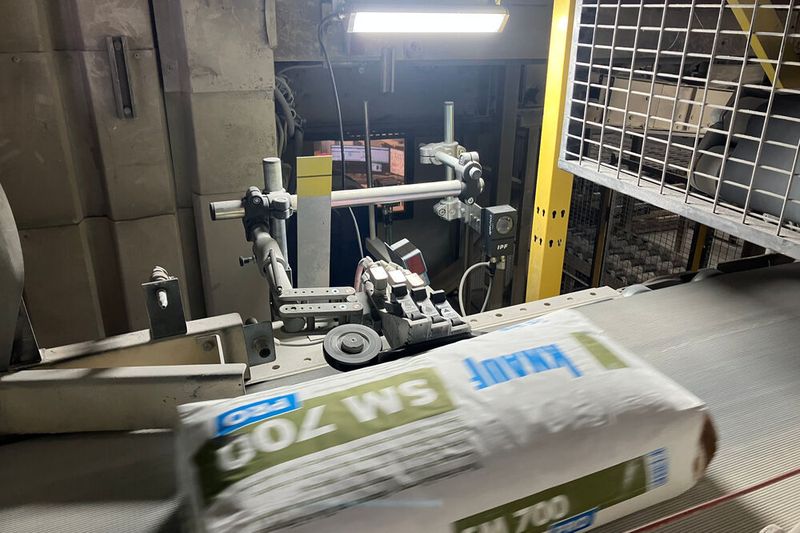
A compact camera from the OC53 series seamlessly inspects the quality of labeling on packaging with finished products immediately behind the printer.
(Image: ipf electronic)
The building materials and systems manufacturer Knauf has recently started using image processing from IPF in several of its plants. One of these plants is located in Lauterhofen, about 31 miles east of Nuremberg, Germany. "We produce several thousand tons of lime-cement plaster per month. And every single bag of finished product is labeled on the two production lines for base coat and finish coat plaster," explains Josef Geitner, plant manager at the Lauterhofen site. The labeling takes place at the respective conveyor belts of the two production lines using a printer that applies the markings to the packaging with inkjet heads. This amounts to approximately 1,500 bags per production line per hour.
Failures Prevent A Secure Process
Immediately afterward, it is checked whether the labeling is complete and, above all, easily readable. "This is not about whether the information is correct, as this is already checked before printing, but exclusively about print quality," emphasizes Thomas Schötz, master electrician and head of maintenance in Lauterhofen, Germany.
In the early days, this was done through visual inspection by employees, during which the two conveyor belts had to be stopped regularly.
About three years ago, the inspection of print quality on the packaging was automated using two camera sensors. One of the reasons for this was the labeling requirement with the so-called UFI code (Unique Formula Identifier) in accordance with the EU regulation for seamless traceability of chemical products, CLP (Classification, Labelling and Packaging).
However, the two devices failed to meet expectations, as Thomas Schötz reports: "The cameras stopped functioning several times a day. Since the cause could not be reproduced, we had to restart the devices more frequently, which was quite frustrating and nerve-wracking. As a result, a reliable process flow with consistently dependable inspection of print quality could not be ensured in the long term."
As there was already contact with IPF at the time, the company's application specialist, Christian Büttner, was consulted. He ultimately recommended an industrial camera from the OC53 series. It consists of variable camera sensors in different designs, ranging from a compact device with a lens, image sensor, and lighting, to highly flexible solutions with a C-mount lens mount and integrated flash controller for lighting control. The cameras are complemented by a free, powerful parameterization software that offers a very extensive range of graduated inspection features, allowing the devices to be used in a variety of applications with very different tasks.
From High Precision to Easy Operation
Of course, the plant manager and maintenance manager at Knauf had very specific expectations for the new solution, given their previous experiences. Josef Geitner elaborates: "The devices needed to enable a process-reliable, consistently error-free capture of the print on the packaging with high reading accuracy. Additionally, the solutions had to integrate seamlessly into the two production lines for base and finish coat plaster and communicate smoothly with the plant's control systems. Furthermore, we wanted simple operation so that we could make our own adjustments and optimizations. The demanding operating conditions also had to be taken into account—that is, a relatively dusty environment with comparatively high temperatures in summer and low temperatures in winter."
Compact Camera Plus Industrial Light
In an initial step, a test system was installed in the fall of 2024 on the production line for the finish coat plaster, specifically a compact camera with white light, type OC539E24, featuring an integrated lens, as well as a robust industrial LED light from the EM51 series by IPF, to exclude poor lighting conditions or ambient light from the outset when evaluating print quality. The camera, installed directly behind the printer and connected to the PLC, is triggered by a photoelectric sensor that detects the individual packages as soon as they are within the detection range of the camera lens.
Evaluation Based on A Test Feature
For the actual inspection, only one feature needs to be checked: the print quality. Due to production conditions, the position of the three-line print varies in the camera image. To remain independent of this, the software function "position tracking" is used. By teaching this function, the camera software automatically tracks the three relevant inspection areas to ensure that the respective relevant print is fully captured during inspection. This has the crucial advantage of being able to select only the truly important inspection areas of an object, thereby specifically ignoring other potentially disruptive influences on the object's surface during inspection.
Date: 08.12.2025
Naturally, we always handle your personal data responsibly. Any personal data we receive from you is processed in accordance with applicable data protection legislation. For detailed information please see our privacy policy.
Consent to the use of data for promotional purposes
I hereby consent to Vogel Communications Group GmbH & Co. KG, Max-Planck-Str. 7-9, 97082 Würzburg including any affiliated companies according to §§ 15 et seq. AktG (hereafter: Vogel Communications Group) using my e-mail address to send editorial newsletters. A list of all affiliated companies can be found here
Newsletter content may include all products and services of any companies mentioned above, including for example specialist journals and books, events and fairs as well as event-related products and services, print and digital media offers and services such as additional (editorial) newsletters, raffles, lead campaigns, market research both online and offline, specialist webportals and e-learning offers. In case my personal telephone number has also been collected, it may be used for offers of aforementioned products, for services of the companies mentioned above, and market research purposes.
Additionally, my consent also includes the processing of my email address and telephone number for data matching for marketing purposes with select advertising partners such as LinkedIn, Google, and Meta. For this, Vogel Communications Group may transmit said data in hashed form to the advertising partners who then use said data to determine whether I am also a member of the mentioned advertising partner portals. Vogel Communications Group uses this feature for the purposes of re-targeting (up-selling, cross-selling, and customer loyalty), generating so-called look-alike audiences for acquisition of new customers, and as basis for exclusion for on-going advertising campaigns. Further information can be found in section “data matching for marketing purposes”.
In case I access protected data on Internet portals of Vogel Communications Group including any affiliated companies according to §§ 15 et seq. AktG, I need to provide further data in order to register for the access to such content. In return for this free access to editorial content, my data may be used in accordance with this consent for the purposes stated here. This does not apply to data matching for marketing purposes.
Right of revocation
I understand that I can revoke my consent at will. My revocation does not change the lawfulness of data processing that was conducted based on my consent leading up to my revocation. One option to declare my revocation is to use the contact form found at https://contact.vogel.de. In case I no longer wish to receive certain newsletters, I have subscribed to, I can also click on the unsubscribe link included at the end of a newsletter. Further information regarding my right of revocation and the implementation of it as well as the consequences of my revocation can be found in the data protection declaration, section editorial newsletter.
Subsequently, monitoring of print quality is carried out using the "area size" feature inspection, with its "sensitivity" set to the grayscale values of the prints. Finally, in the area function, the reference value for the number of pixels present in the previously defined inspection areas is established via teach-in, ensuring that the print is assessed as complete and legible.
Seamless Automated Inspection
As the tests with different packaging on the finishing plaster line were extremely successful, two cameras were installed at the beginning of 2025, one replacing the test system and another on the production line for base plaster.
If the prints on at least three consecutive packages on one of the two production lines are evaluated as NIO, the conveyor belt is stopped via a PLC signal along with an additional acoustic alarm. The system operator can then recheck the respective bags and decide, for example, whether the print is still legible or if the printer is running low on ink or the print heads need cleaning.
Josef Geitner, Operations Manager at the Lauterhofen plant
To document the process, the images of the bags classified as defective are stored in the internal camera memory, and after more than 38 images, the oldest are deleted. "Based on the images, we check the readability of the prints afterward so that we can adjust the camera's software parameters if the print quality is still acceptable from our perspective. The software is so easy to use that even our shift supervisors can make minor adjustments without any issues," says Thomas Schötz.
Meanwhile, a total of 12 camera systems have been ordered for installation in other Knauf plants. In one of these plants, there was a request not only to assess the quality of the print on the bags but also to check the lettering itself using the OCR function of the camera sensors. "Additionally, a camera has been installed in another plant where the print is inspected at even higher process speeds. And here, too, the reliability of the system is highly satisfactory," concludes Josef Geitner.
Future-Proof Authentication with Universal RFID Readers



:quality(80)/p7i.vogel.de/wcms/a0/47/a04725ef9bd09fb6c9341a1bea1b5d93/0130443083v1.jpeg "Here, a type of plastic pallet is produced by thermoforming (vacuum forming or deep drawing) at the corresponding division of New England Plastics in the USA. This division, which specializes in so-called liners, is now part of Ringmetall ... (Image:New England Plastics)")
:quality(80)/p7i.vogel.de/wcms/23/99/23992bf2dcdc432c9b7209c34a4a7c48/0129733089v1.jpeg "Stork relies on the modular Neoswiss turning system from Iscar to shorten the set-up times for its sliding headstock lathes and work more productively. (Image:Iscar)")
:quality(80)/p7i.vogel.de/wcms/7d/e2/7de2923434b2f1a78ba5482d8d335269/0113143253v1.jpeg "In our China Market Insider we regularly provide you with relevant information directly from China. (Image:© Eisenhans - stock.adobe.com)")
:quality(80)/p7i.vogel.de/wcms/9d/2b/9d2b802f800e5caf17b2831e74228cd3/screenshot-202026-03-03-20103822-609x343v1v1.png "Visual comparison: on the left, a clean, burr-free cut edge; on the right, typical burr formation with oxidation discoloration. This illustrates how strongly parameter control and gas management influence the quality of the result. (CO₂ laser, oxygen cutting gas, sheet thickness approx. 15 mm). (Image:Picture: Rime)")
:quality(80)/p7i.vogel.de/wcms/b7/36/b736dfebc16c42d6901d0d0e1f390493/3d-druck-20factory-20--20ki-20generiert-1920x1079v1.png "(Source: AI-generated)")
:quality(80)/p7i.vogel.de/wcms/79/b2/79b21aad663f4a7bd4472afc1c1afc62/0130433994v1.jpeg "Mission Joyride: The free-flying robot (shown here in the rendering) will relieve the ISS crew of logistics tasks from 2027 with its two mechanical arms. (Image:Icarus Robotics)")
:quality(80)/p7i.vogel.de/wcms/6b/45/6b4546fa6ebf305c3660326909363f32/0130437089v1.jpeg "Industrial AI in action: Rockwell Automation presents practical solutions for self-controlling production systems at the Hannover Messe. (Image:Rainer Jensen, Deutsche Messe)")
:quality(80)/p7i.vogel.de/wcms/78/e9/78e9188c25a8a94e67c34c9bf8ffe495/visual-agile-20robots-20and-20google-20deepmind-20partner-20to-20bring-20intelligence-20to-20robotics-2500x1406v1v1.jpeg "Together, the partners are developing adaptable, intelligent robots for a wide range of applications (Image:Agile Robots SE)")
:quality(80)/p7i.vogel.de/wcms/59/a2/59a2b11f0aa1b700eff02addd5de8703/adobestock-1788280853--c2-a9-20satria-20-e2-80-93-20stock-adobe-com-5081x2860v1v1.jpeg "Quantum computers require extreme cooling to temperatures close to absolute zero in order to keep qubits stable. (Image:satria - stock.adobe.com)")
:quality(80)/p7i.vogel.de/wcms/49/38/493876a248943456b7e4a6db6edfc454/0130230765v1.jpeg "Safe and reliable in aircraft construction: light-curing adhesive bond combined with universal fastening elements. (Source: Delo)")
:quality(80)/p7i.vogel.de/wcms/b5/c7/b5c749d16c8a2e789c1469c2c8c1c387/0130452780v1.jpeg "Volvo Trucks completes road tests with its new hydrogen-powered trucks. (Image:Volvo Trucks)")
:quality(80)/p7i.vogel.de/wcms/ba/69/ba6975f417a85147084f38dc2cd209e2/0130451386v1.jpeg "Together with Nvidia, Hyundai wants to develop an architecture that will be used for level 4 robotaxis (image) as well as for level 2 customer vehicles. (Image:Hyundai)")
:quality(80)/p7i.vogel.de/wcms/93/4d/934de334b47abaa526c78cba1417d7af/0130343495v1.jpeg "The new SU7 is available in three price categories, \"Standard\", \"Pro\" and \"Max\" (Image:Xiaomi)")
:quality(80)/p7i.vogel.de/wcms/df/a0/dfa048434bb94f1b7d030e346b25b3ae/0130373541v1.jpeg "From August, BMW will be producing the i3 at its main plant in Munich - which the car manufacturer has extensively rebuilt for this purpose. (Image:Rainer Haeckl)")
:quality(80)/p7i.vogel.de/wcms/ee/09/ee09acbd6dc896df25affaa9e871e6e5/0130440053v1.jpeg "IMS chip module for simple system integration into an ion mobility spectrometer. (Image:Fraunhofer IPMS)")
:quality(80)/p7i.vogel.de/wcms/10/6c/106cd22de5f68a0f74639d654827228c/0130345302v1.jpeg "Made in India: According to the India Electronics and Semiconductor Association (IESA), the country should be able to produce between 75 and 80 million chips by the beginning of 2027, once the plants currently under construction become operational. (Image:Pixabay (Montage: Sebastian Gerstl))")
:quality(80)/p7i.vogel.de/wcms/a5/ed/a5ed6fda029d362732a293d6b19d74c4/0130444216v1.jpeg "Thirteen executives from the Chinese chip industry have drawn up a plan to achieve an 80% self-sufficiency rate for semiconductors by 2030. (Image:Maxim_Kazmin - stock.adobe.com)")
:quality(80)/p7i.vogel.de/wcms/31/a6/31a646018b34d8e0a44bfc8bf17837f6/0130361632v1.jpeg "For many companies, PFAS are considered indispensable in electronics production. (Image:freely licensed)")
:fill(fff,0)/images.vogel.de/vogelonline/companyimg/76800/76895/65.jpg "FAULHABER_120mm.jpg ()")
:quality(80)/p7i.vogel.de/wcms/f5/ed/f5ed3d4e6bc14ab3c6bce207709248aa/0126618789v1.jpeg "The OC53 series consists of versatile camera sensors in various configurations, ranging from compact devices (left) to highly flexible solutions with a C-mount lens connection and integrated flash controller.(Image: ipf electronic)")
:quality(80)/p7i.vogel.de/wcms/f6/01/f601e4a4b2e3eeab4fa7556a4210c607/0126619063v1.jpeg "The \"layer tracking\" feature ensures that the relevant part of the print is fully captured during inspection.(Image: Knauf Gips KG, Lauterhofen plant)")
:quality(80)/p7i.vogel.de/wcms/81/59/8159ad06ddb820066b1b985c72487bc7/0126619080v1.jpeg "On average, 1,500 bags per hour are inspected per production line by the camera sensors (one device in the foreground).(Image: Knauf Gips KG, Lauterhofen plant)")
:quality(80)/p7i.vogel.de/wcms/28/c7/28c72a764108c39bc0c9f503d8d41d89/0126618786v1.jpeg "A second camera, also equipped with an industrial light from the EM51 series by IPF, is located on the production line for base plaster.(Image: ipf electronic)")
:quality(80):fill(efefef,0)/p7i.vogel.de/wcms/67/ae/67ae0b9ac31f8/elatec-wp-universal-reader.png "Elatec WP Universal Reader")
:quality(80)/p7i.vogel.de/wcms/0f/f6/0ff6f9a6cd9c75444535324692d31706/0128327423v1.jpeg "The triple lens distance sensor for close-up photography from Kyocera. The module measures 1.10 in x 1.18 in x 1.57 in. The camera uses three lenses and proprietary AI to detect semi-transparent, thin and fine line-shaped objects that were previously difficult to see with the human eye and conventional stereo cameras. (Image:Kyocera)")
:quality(80)/p7i.vogel.de/wcms/89/9d/899d884f9985332b5b1d24accaeda899/0127167987v1.jpeg "Image processing systems ensure economical quality control at a U.S. diesel engine manufacturer. (Image: ©Vision On Line/AdobeStock)")