According to a recent study, the transportation sector accounts for 27 percent of global greenhouse gas emissions. Industrial image processing and artificial intelligence (AI) are helping to further develop electric vehicles and their batteries.
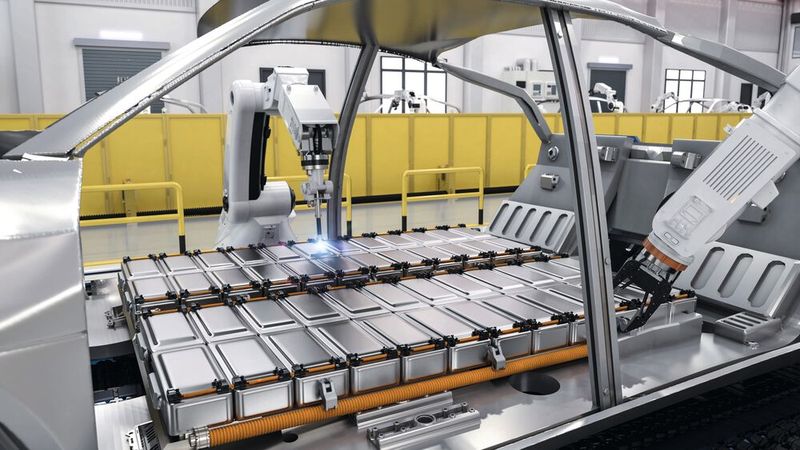
High-quality battery packs are the basis for high-performance electric vehicles.
(Image: Phonlamai Photo/Shutterstock.)
According to an analysis conducted by the World Resources Institute using data from the International Energy Agency, 10 percent of passenger cars sold worldwide in 2022 were fully electric—ten times more than just five years earlier. Norway leads the way with 80 percent of all-electric car sales, followed by Iceland (41 percent), Sweden (32 percent), the Netherlands (24 percent) and China (22 percent).
China's position is remarkable: as the world's largest car market, the country had more sales of electric vehicles in 2022 than the rest of the world combined. China has strategically invested in the production of electric cars, and Chinese consumers can now choose from more than 300 electric car models.
Factors such as the cost of EVs, range, and the time it takes to charge the battery all play a role in growth. Experts predict that the technology will reach a tipping point when it becomes cheaper to buy, own and operate an EV than a conventional combustion vehicle, and that the growth curve will then point upwards rapidly.
As the demand for electric vehicles continues to grow, it is essential to look at the heart of these vehicles—the battery. The most commonly used battery type for electric vehicles today is the lithium-ion battery (LIB) due to its high energy density and voltage, stability, low weight and long life.
According to Grandview Research, the increasing adoption of electric vehicles is a catalyst for the remarkable rise in global LIB production. The global LIB market size was estimated at USD 54.4 billion in 2023 and is expected to register a compound annual growth rate of 20.3 percent from 2024 to 2030. Governments and industries around the world are prioritizing the transition to sustainable and environmentally friendly transportation by creating incentives to support climate goals, leading to an increase in demand for electric vehicles. LIBs have proven to be the cornerstone of this automotive revolution. These batteries power electric vehicles and give them the range and performance needed to compete with conventional combustion engine vehicles.
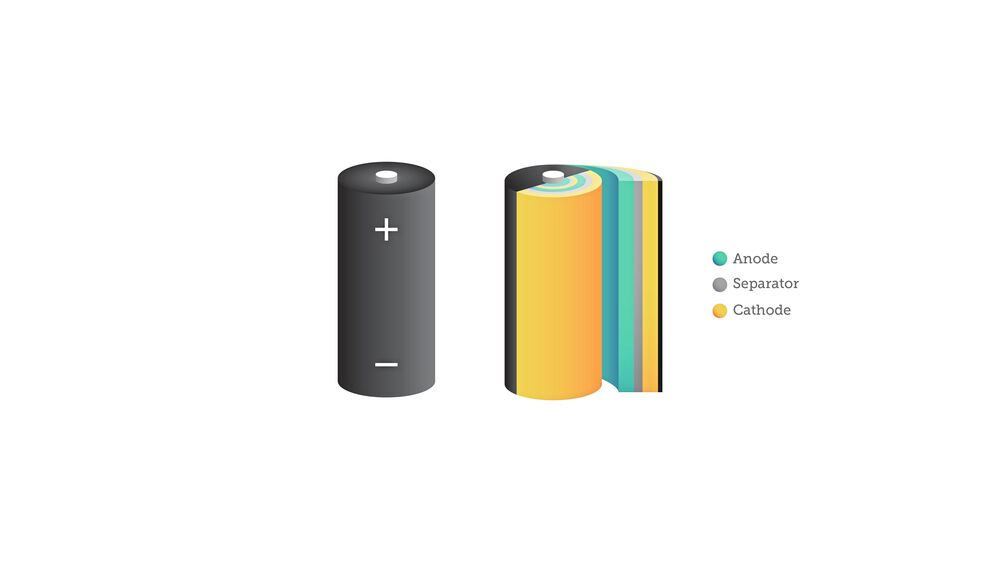
The inside of a lithium-ion battery.
(Image:Teledyne DALSA)
The role of battery packs in an electric vehicle
At the heart of every electric vehicle is the battery—an essential component that determines not only the vehicle's performance, but also its range. Each battery pack is made up of modules, and these modules are based on individual cells that are very similar to the familiar AA batteries. Lithium-ion batteries are the current gold standard for powering electric vehicles, and the manufacturing and testing of these batteries is critical. As explained in the Tech Briefs EV Battery Innovation Special Report, cylindrical cells are used in many LIBs because they are mature and less expensive to manufacture. Since 2008, the average cost of an electric vehicle LIB pack has fallen by 89 percent, from US$1,355/kWh to US$153/kWh in 2022, and is expected to fall to US$100/kWh by 2026.
Cylindrical cells were one of the first types of lithium batteries to be mass-produced. They consist of anode, separator and cathode plates that are pushed into each other and rolled up. These cells are well suited to automated production and the shape allows the cell to withstand higher internal pressure without deformation. These cells are placed in a so-called clamshell housing (a shell-like plastic housing) and form a module. Several modules then form the battery pack that powers an electric vehicle. Thousands of battery cells are required for each vehicle, and the battery pack is a decisive factor in the weight and cost of the finished vehicle.
Alan Eddy is Chief Technology Officer at Tensor ID, a systems integrator that works with the largest lithium-ion battery manufacturers and leading electric vehicle manufacturers. He explains: "When inspecting batteries that power electric vehicles, the inspection system must overcome several challenges, including a thorough inspection of each battery cell for issues such as rust or dents. If a single cell is damaged, the life of the entire battery pack is shortened."
The manufacturing process for LIBs involves complex steps, from the procurement of raw materials to the assembly of the cells and the packaging of the finished battery pack. Detailed quality control during this process is crucial for the efficiency and safety of the batteries. Inspection takes place at various stages of battery production. During the inspection of the foils used to manufacture the electrodes (cathodes and anodes), at various stages of assembly and in the inspection of the finished battery cells and modules.
Date: 08.12.2025
Naturally, we always handle your personal data responsibly. Any personal data we receive from you is processed in accordance with applicable data protection legislation. For detailed information please see our privacy policy.
Consent to the use of data for promotional purposes
I hereby consent to Vogel Communications Group GmbH & Co. KG, Max-Planck-Str. 7-9, 97082 Würzburg including any affiliated companies according to §§ 15 et seq. AktG (hereafter: Vogel Communications Group) using my e-mail address to send editorial newsletters. A list of all affiliated companies can be found here
Newsletter content may include all products and services of any companies mentioned above, including for example specialist journals and books, events and fairs as well as event-related products and services, print and digital media offers and services such as additional (editorial) newsletters, raffles, lead campaigns, market research both online and offline, specialist webportals and e-learning offers. In case my personal telephone number has also been collected, it may be used for offers of aforementioned products, for services of the companies mentioned above, and market research purposes.
Additionally, my consent also includes the processing of my email address and telephone number for data matching for marketing purposes with select advertising partners such as LinkedIn, Google, and Meta. For this, Vogel Communications Group may transmit said data in hashed form to the advertising partners who then use said data to determine whether I am also a member of the mentioned advertising partner portals. Vogel Communications Group uses this feature for the purposes of re-targeting (up-selling, cross-selling, and customer loyalty), generating so-called look-alike audiences for acquisition of new customers, and as basis for exclusion for on-going advertising campaigns. Further information can be found in section “data matching for marketing purposes”.
In case I access protected data on Internet portals of Vogel Communications Group including any affiliated companies according to §§ 15 et seq. AktG, I need to provide further data in order to register for the access to such content. In return for this free access to editorial content, my data may be used in accordance with this consent for the purposes stated here. This does not apply to data matching for marketing purposes.
Right of revocation
I understand that I can revoke my consent at will. My revocation does not change the lawfulness of data processing that was conducted based on my consent leading up to my revocation. One option to declare my revocation is to use the contact form found at https://contact.vogel.de. In case I no longer wish to receive certain newsletters, I have subscribed to, I can also click on the unsubscribe link included at the end of a newsletter. Further information regarding my right of revocation and the implementation of it as well as the consequences of my revocation can be found in the data protection declaration, section editorial newsletter.
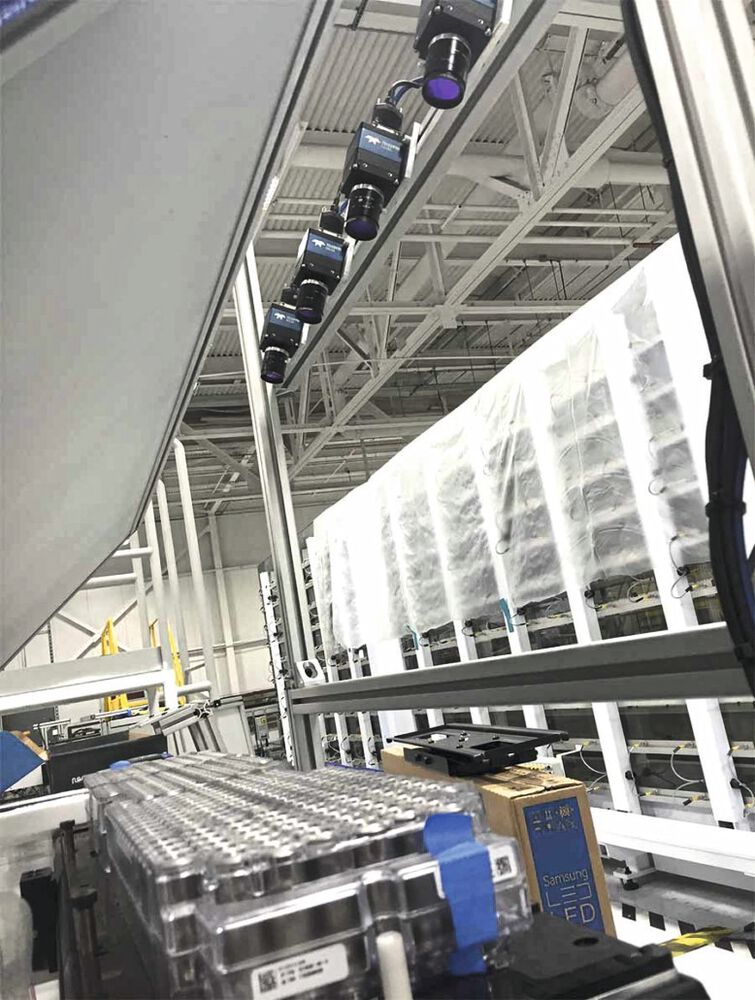
Image 3: AI improves inspection performance and is used to detect rust. Four high-resolution cameras from Teledyne DALSA are used at Tensor ID to inspect the battery module.
(Image:Tensor ID)
Battery production and quality control
Quality control in the manufacture of batteries is a major challenge due to variations in production and the potential impact of defects on performance and safety. Identifying internal defects, especially microscopic defects, is a difficult task. This is where machine vision and AI come into play. In the context of battery manufacturing, machine vision systems can analyze intricate details with unmatched accuracy, speed and efficiency. If an electric car contains a 95 kWh battery pack (Tesla Model S) and the cost per kWh is 150 US dollars, the battery alone adds 14,300 US dollars to the production cost. The quality of the batteries is therefore a decisive factor for electric vehicle manufacturers.
At Tensor ID, the system integrator develops machine vision systems for the inspection of finished battery cells and modules, but machine vision can be used at any stage of inspection, including manufacturing and assembly, as Eddy explains: "We've been supplying cameras with barcode readers for these inspections for years, but there's a lot more to machine vision than that. To automate and become more efficient, battery manufacturers need to look at every element of the inspection process from start to finish."
Tensor ID's vision inspection system uses Teledyne DALSA area scan cameras to inspect each individual battery cell, both during full assembly and just before the clamshell housing is fitted. The battery manufacturers have to consider issues such as reading the barcode, identifying rust and dents and determining polarity. The individual battery cells are delivered by the supplier in boxes and removed by a robot for inspection. Each individual battery cell must be inspected before it is inserted into the clamshell module that becomes part of the battery pack. To accurately inspect the battery stack, Tensor ID uses four Teledyne DALSA Genie Nano cameras positioned to capture an image composed of an entire stack just under 1 meter wide.
When inspecting for rust spots, an AI-based software platform is used to classify the images. "AI has brought about a real change in the inspection of batteries. Rust is particularly difficult to detect due to the shiny, reflective surface of battery cells," says Eddy. Tensor ID's system trains the AI model with Teledyne DALSA's Astrocyte AI training tool to recognize the difference between rust and other anomalies, such as a fingerprint or a dust spot. The system is then able to identify battery cells with rusty spots and sort them out. In addition to inspection, AI will also play an important role in optimizing battery performance. AI-driven algorithms can analyze large amounts of data to fine-tune battery management systems, improve efficiency and extend battery life. AI-driven charging will make the process smarter and more convenient for electric car drivers.
Advantages of industrial inspection of lithium-ion batteries
One of the main advantages of inspection with machine vision systems is their accuracy, precision and ability to meet the highest quality standards. Conventional inspection methods can miss microscopic defects that can significantly affect battery performance. Machine vision systems combined with artificial intelligence, on the other hand, are able to detect even the smallest defects, such as a dent of 130 micrometers, which is about the width of a human hair. This ensures maximum accuracy and precision in the inspection process.
Machine vision not only improves the accuracy, but also the efficiency and speed of the testing process. Automated systems can quickly analyze large quantities of batteries, reducing production time and costs. This efficiency not only benefits manufacturers, but also contributes to the overall scalability of electric vehicle production.
Ensuring the safety and reliability of electric vehicles is of paramount importance. Machine vision plays a crucial role in this by identifying potential defects that could compromise the integrity of the battery pack and limit its ability to fully charge. By eliminating substandard batteries before they are used, machine vision contributes to the overall safety of electric vehicles and increases the reliability of their energy sources.
The future of batteries for electric vehicles is promising as the technology continues to develop. Key trends to watch out for include the development of solid-state batteries that offer higher energy density and safety. The next generation of materials is also being researched to improve the performance and sustainability of batteries. The average range of an electric car is currently around 350 km (approx. 217 miles), but cobalt-free batteries could have a range of up to 800 km (497 miles) on a single charge, and new solid-state batteries that can be recharged in just seven minutes are being tested. In addition to technological advances, the industry is also focusing on sustainable battery manufacturing practices. This includes exploring innovative recycling methods to minimize environmental impact and pursuing a circular economy approach that reuses materials from old batteries for new ones.
The transport sector currently accounts for 27 percent of global greenhouse gas emissions. Replacing combustion engines with electric or hybrid engines can therefore reduce global pollution. To make the transition to electric vehicles a success, manufacturers must produce lithium-ion batteries of the highest quality. Alan Eddy from Tensor ID concludes: "The inspection of batteries for electric vehicles is complex. Even if it fails in just one percent of cases, that's already high."
By combining the precision of AI with the requirements of quality control, machine vision ensures that the battery is a reliable, safe and efficient powerhouse. Looking to the future, the integration of AI, the development of advanced battery technologies and the commitment to sustainability in the electric vehicle industry hold great promise. (mr)
*Matthias Moser is Business Development Leader at Teledyne DALSA
This article was first published on our sister website www.ElektronikPraxis.de (German Language)



:quality(80)/p7i.vogel.de/wcms/a0/47/a04725ef9bd09fb6c9341a1bea1b5d93/0130443083v1.jpeg "Here, a type of plastic pallet is produced by thermoforming (vacuum forming or deep drawing) at the corresponding division of New England Plastics in the USA. This division, which specializes in so-called liners, is now part of Ringmetall ... (Image:New England Plastics)")
:quality(80)/p7i.vogel.de/wcms/23/99/23992bf2dcdc432c9b7209c34a4a7c48/0129733089v1.jpeg "Stork relies on the modular Neoswiss turning system from Iscar to shorten the set-up times for its sliding headstock lathes and work more productively. (Image:Iscar)")
:quality(80)/p7i.vogel.de/wcms/7d/e2/7de2923434b2f1a78ba5482d8d335269/0113143253v1.jpeg "In our China Market Insider we regularly provide you with relevant information directly from China. (Image:© Eisenhans - stock.adobe.com)")
:quality(80)/p7i.vogel.de/wcms/9d/2b/9d2b802f800e5caf17b2831e74228cd3/screenshot-202026-03-03-20103822-609x343v1v1.png "Visual comparison: on the left, a clean, burr-free cut edge; on the right, typical burr formation with oxidation discoloration. This illustrates how strongly parameter control and gas management influence the quality of the result. (CO₂ laser, oxygen cutting gas, sheet thickness approx. 15 mm). (Image:Picture: Rime)")
:quality(80)/p7i.vogel.de/wcms/b7/36/b736dfebc16c42d6901d0d0e1f390493/3d-druck-20factory-20--20ki-20generiert-1920x1079v1.png "(Source: AI-generated)")
:quality(80)/p7i.vogel.de/wcms/79/b2/79b21aad663f4a7bd4472afc1c1afc62/0130433994v1.jpeg "Mission Joyride: The free-flying robot (shown here in the rendering) will relieve the ISS crew of logistics tasks from 2027 with its two mechanical arms. (Image:Icarus Robotics)")
:quality(80)/p7i.vogel.de/wcms/6b/45/6b4546fa6ebf305c3660326909363f32/0130437089v1.jpeg "Industrial AI in action: Rockwell Automation presents practical solutions for self-controlling production systems at the Hannover Messe. (Image:Rainer Jensen, Deutsche Messe)")
:quality(80)/p7i.vogel.de/wcms/78/e9/78e9188c25a8a94e67c34c9bf8ffe495/visual-agile-20robots-20and-20google-20deepmind-20partner-20to-20bring-20intelligence-20to-20robotics-2500x1406v1v1.jpeg "Together, the partners are developing adaptable, intelligent robots for a wide range of applications (Image:Agile Robots SE)")
:quality(80)/p7i.vogel.de/wcms/59/a2/59a2b11f0aa1b700eff02addd5de8703/adobestock-1788280853--c2-a9-20satria-20-e2-80-93-20stock-adobe-com-5081x2860v1v1.jpeg "Quantum computers require extreme cooling to temperatures close to absolute zero in order to keep qubits stable. (Image:satria - stock.adobe.com)")
:quality(80)/p7i.vogel.de/wcms/49/38/493876a248943456b7e4a6db6edfc454/0130230765v1.jpeg "Safe and reliable in aircraft construction: light-curing adhesive bond combined with universal fastening elements. (Source: Delo)")
:quality(80)/p7i.vogel.de/wcms/b5/c7/b5c749d16c8a2e789c1469c2c8c1c387/0130452780v1.jpeg "Volvo Trucks completes road tests with its new hydrogen-powered trucks. (Image:Volvo Trucks)")
:quality(80)/p7i.vogel.de/wcms/ba/69/ba6975f417a85147084f38dc2cd209e2/0130451386v1.jpeg "Together with Nvidia, Hyundai wants to develop an architecture that will be used for level 4 robotaxis (image) as well as for level 2 customer vehicles. (Image:Hyundai)")
:quality(80)/p7i.vogel.de/wcms/93/4d/934de334b47abaa526c78cba1417d7af/0130343495v1.jpeg "The new SU7 is available in three price categories, \"Standard\", \"Pro\" and \"Max\" (Image:Xiaomi)")
:quality(80)/p7i.vogel.de/wcms/df/a0/dfa048434bb94f1b7d030e346b25b3ae/0130373541v1.jpeg "From August, BMW will be producing the i3 at its main plant in Munich - which the car manufacturer has extensively rebuilt for this purpose. (Image:Rainer Haeckl)")
:quality(80)/p7i.vogel.de/wcms/ee/09/ee09acbd6dc896df25affaa9e871e6e5/0130440053v1.jpeg "IMS chip module for simple system integration into an ion mobility spectrometer. (Image:Fraunhofer IPMS)")
:quality(80)/p7i.vogel.de/wcms/10/6c/106cd22de5f68a0f74639d654827228c/0130345302v1.jpeg "Made in India: According to the India Electronics and Semiconductor Association (IESA), the country should be able to produce between 75 and 80 million chips by the beginning of 2027, once the plants currently under construction become operational. (Image:Pixabay (Montage: Sebastian Gerstl))")
:quality(80)/p7i.vogel.de/wcms/a5/ed/a5ed6fda029d362732a293d6b19d74c4/0130444216v1.jpeg "Thirteen executives from the Chinese chip industry have drawn up a plan to achieve an 80% self-sufficiency rate for semiconductors by 2030. (Image:Maxim_Kazmin - stock.adobe.com)")
:quality(80)/p7i.vogel.de/wcms/31/a6/31a646018b34d8e0a44bfc8bf17837f6/0130361632v1.jpeg "For many companies, PFAS are considered indispensable in electronics production. (Image:freely licensed)")
:fill(fff,0)/images.vogel.de/vogelonline/companyimg/76800/76895/65.jpg "FAULHABER_120mm.jpg ()")
:quality(80)/p7i.vogel.de/wcms/d6/c2/d6c29fed2099d2471cf31ea0e660f91e/0129501568v1.jpeg "BMW's sixth-generation cylindrical lithium-ion cells. (Image:BMW)")
:quality(80)/p7i.vogel.de/wcms/fb/c5/fbc5a1d3151a05241d0b5afc0f017759/0129596854v1.jpeg "The prospects for European cell production have been poor for some time. The reasons for this are high production costs, technical difficulties in ramping up production and overcapacity on the market. (Image:McKinsey)")