The recent electronica trade fair in Munich showcased cutting-edge technology across 18 halls, with nearly 3,500 exhibitors participating. Here’s a concise overview of the innovations particularly relevant to the automotive industry.
This system detects head movements and uses them to calculate a steering angle for a vehicle.
(Bild: Arrow Electronics)
This year, Electronica was more international than ever, occupying 18 halls at the Munich Trade Fair Center, according to the organizer, Messe München. Despite the sales crisis that has significantly impacted the electronics industry, the overall mood was positive. This was partly due to the introduction of new products and technologies, which provided a solid foundation for meaningful discussions.
For automotive industry professionals, the event kicked off a day early with the electronica Automotive Conference. At the conference, Christophe Pincemin, Executive Director of Smart Surfaces & Lighting at the supplier Yangfeng, shared insights into interior megatrends in China. To succeed in the Chinese market, "interiors must be fresh and meticulously detailed, cater to family needs, and incorporate elements of Chinese culture," summarized Pincemin. Additionally, interior functionality must closely align with user requirements. In the country’s megacities, vehicle usage differs significantly from other regions. "Parents driving their children to sports or music lessons in large cities often don’t have time to return home in between." Instead, they wait in their vehicles nearby until lessons are over.
Jens Kahrweg, COO, SVP & Head of System LSI at Samsung Semiconductor Europe, provided insights into semiconductor trends for cockpits. In recent years, more functions have been integrated into system-on-chips (SoCs), but a reversal of this trend is now on the horizon. He noted a growing interest in chiplets. These are integrated circuits (ICs) that contain a specific subset of functions. Multiple chiplets can be assembled into a single processor within one package, with each chiplet contributing a portion of the processor's overall functionality.
Expandable System-on-Chip with Chiplets
Renesas incorporates the chiplet approach in its newly unveiled "R-Car X5H" at Electronica. This SoC is the first component of the "R-Car X5" series and is built using the latest three-nanometer process technology for the automotive industry. In addition to powerful native NPU (Neural Processing Unit) and GPU processors, computational power is enhanced through chiplet expansions. For example, by combining a 400-TOPS on-chip NPU with an external NPU via a chiplet extension, AI processing performance can be increased three- to fourfold or more.
Since there is no standardized framework for chiplets within the automotive industry yet, Renesas plans to use the standard Universal Chiplet Interconnect Express (UCle) for die-to-die connections and corresponding APIs.
As the most powerful component of the fifth-generation R-Car family, samples of the R-Car X5H are expected to be available in the first half of 2025. Production is slated to begin in the second half of 2027.
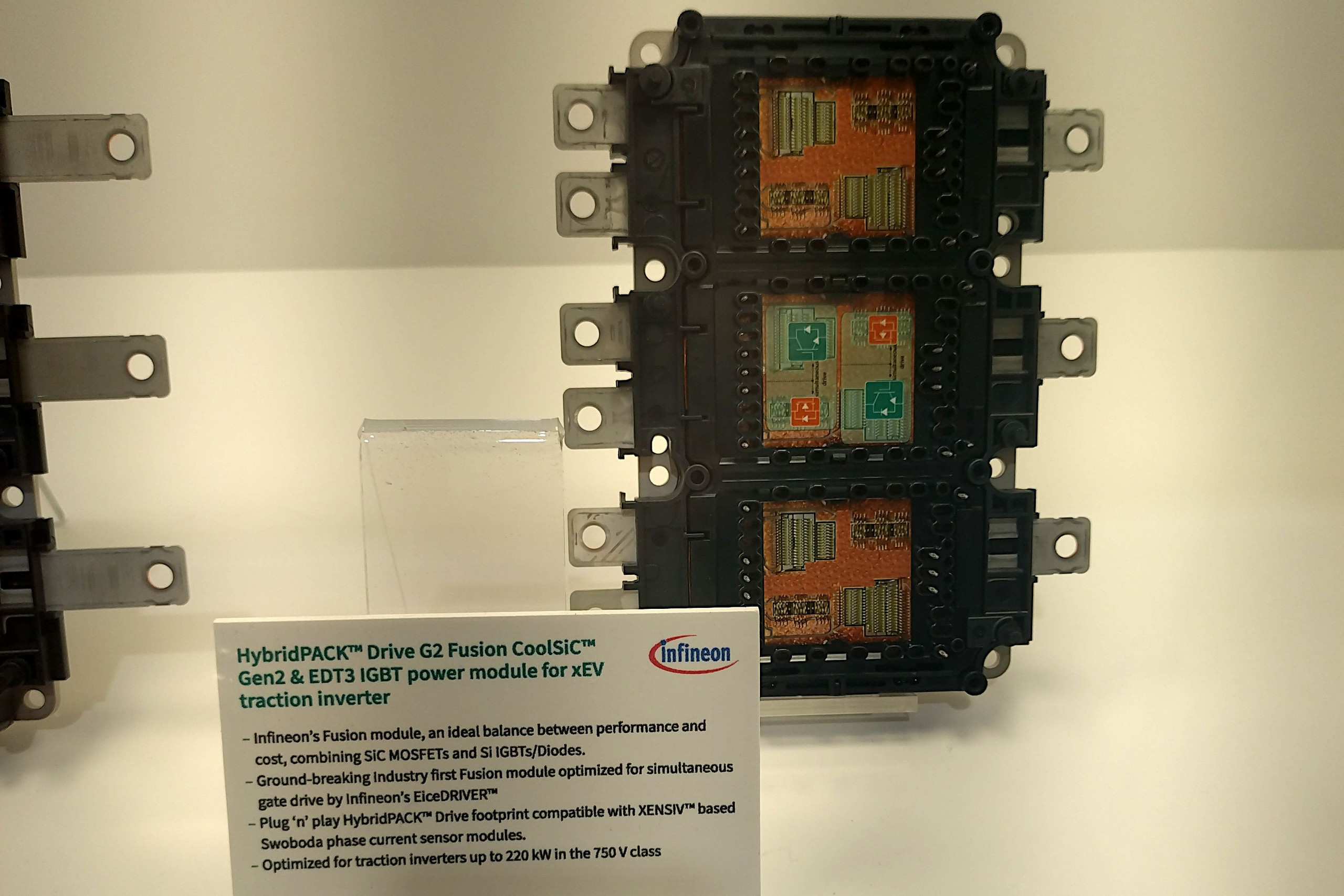
Infinion showed a control module for an inverter for electric cars. Two areas use SiC semiconductors and one area uses less expensive IGBT chips (center). Overall, performance should hardly decrease at lower costs.
(Bild: Sven Prawitz/VCG)
Infineon Combines SiC and IGBT for EV Inverters
Infineon unveiled a new variant of its silicon carbide (SiC) power module designed for electric drives. The product, titled HybridPACK Drive G2 Fusion CoolSiC, combines the efficiency and performance of SiC semiconductors with the cost-effectiveness of IGBT technology. This module for EV inverters integrates two SiC-based components (CoolSiC) and one silicon-based component (EDT3 IGBT). By using a mix of 30% SiC and 70% silicon, system suppliers can achieve nearly the same efficiency as a full SiC solution. The module is suitable for power levels up to 220 kW in the 750-volt class.
Wireless Battery Management System Based on Ultra-Wideband
NXP Semiconductors showcased a wireless battery management system (BMS) using ultra-wideband (UWB) technology at Electronica. According to the company, this innovation decouples mechanical and electrical development, enabling automakers to bring vehicles to market more flexibly and quickly. Additionally, the system reduces development costs compared to traditional wired battery management systems.
With UWB technology, complex wiring harnesses within the battery pack are no longer needed, which simplifies assembly and reduces manual labor. Eliminating connectors and cables between battery modules also increases energy density. NXP plans to provide its wireless BMS to automakers for evaluation and development starting in the second quarter of 2025.
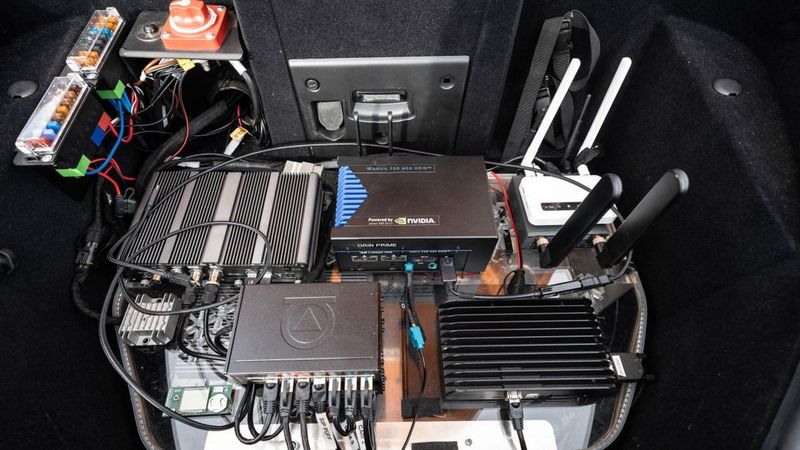
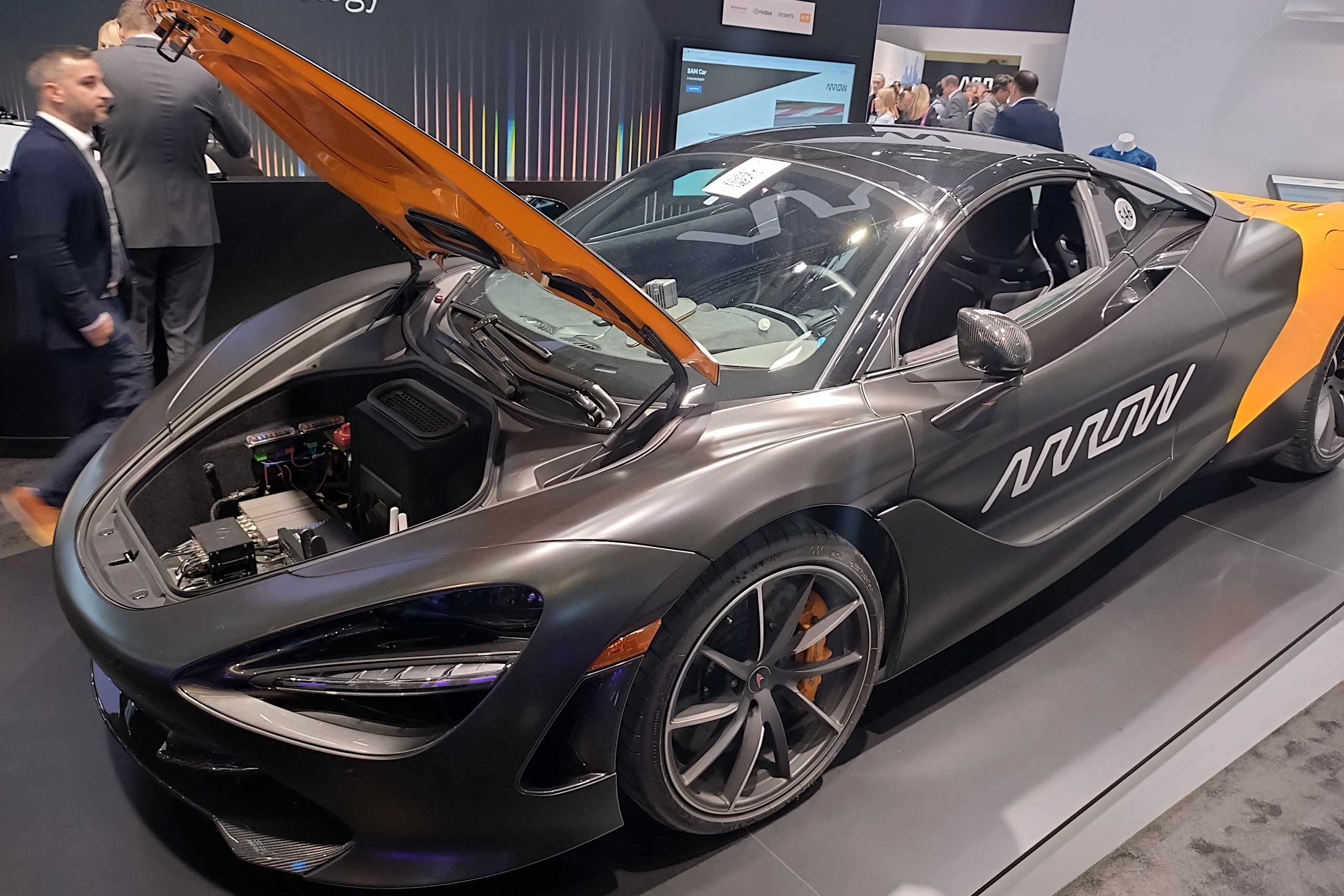
The current “SAM Car” – a modified McLaren 720S Spyder – has the electronics for gesture recognition and vehicle control in the front of the luggage compartment.
Arrow Electronics presented the "SAM Car" (Semi-Autonomous Mobility) at the Munich event, a modified McLaren 720S Spyder designed to showcase the company’s engineering expertise. The vehicle has been adapted to allow former race car driver Sam Schmidt, who is paralyzed (tetraplegic), to drive it using only head movements and a sip-and-puff system for acceleration and braking.
Arrow's engineers developed the steering system using the latest Nvidia Jetson AGX Orin module. According to the company, this is the only platform capable of the high precision and low latency required for controlling a car at racing speeds. A pair of stereo cameras on the dashboard tracks Schmidt’s head movements in real-time, sending data to the Nvidia module. Schmidt, seated in the passenger seat, controls the car by tilting his head: "Imagine resting your chin on a shelf and turning your head left or right," explained project leader Joe Verrengia. Machine learning was used to train the system to recognize Schmidt’s head positions. The system can even compensate for abrupt movements, such as sneezing.
The improved steering system—an upgrade from the previous Sam Car, a Corvette Stingray—could find applications in everyday life, believes Verrengia. Potential uses include vehicles and heavy equipment in agriculture, warehouses, public transportation, and construction sites, enabling drivers—whether physically impaired or not—to perform multiple tasks.
Arrow has expanded its Automotive Center of Excellence in Munich and Istanbul (Turkey). This growth has been supported by the acquisition of IQmine, a development service provider for the automotive and transportation industries. Headquartered in Munich with an additional location in Istanbul, IQmine brings expertise in AUTOSAR (Automotive Open System Architecture), ECU software development, functional safety, and vehicle diagnostics.
Date: 08.12.2025
Naturally, we always handle your personal data responsibly. Any personal data we receive from you is processed in accordance with applicable data protection legislation. For detailed information please see our privacy policy.
Consent to the use of data for promotional purposes
I hereby consent to Vogel Communications Group GmbH & Co. KG, Max-Planck-Str. 7-9, 97082 Würzburg including any affiliated companies according to §§ 15 et seq. AktG (hereafter: Vogel Communications Group) using my e-mail address to send editorial newsletters. A list of all affiliated companies can be found here
Newsletter content may include all products and services of any companies mentioned above, including for example specialist journals and books, events and fairs as well as event-related products and services, print and digital media offers and services such as additional (editorial) newsletters, raffles, lead campaigns, market research both online and offline, specialist webportals and e-learning offers. In case my personal telephone number has also been collected, it may be used for offers of aforementioned products, for services of the companies mentioned above, and market research purposes.
Additionally, my consent also includes the processing of my email address and telephone number for data matching for marketing purposes with select advertising partners such as LinkedIn, Google, and Meta. For this, Vogel Communications Group may transmit said data in hashed form to the advertising partners who then use said data to determine whether I am also a member of the mentioned advertising partner portals. Vogel Communications Group uses this feature for the purposes of re-targeting (up-selling, cross-selling, and customer loyalty), generating so-called look-alike audiences for acquisition of new customers, and as basis for exclusion for on-going advertising campaigns. Further information can be found in section “data matching for marketing purposes”.
In case I access protected data on Internet portals of Vogel Communications Group including any affiliated companies according to §§ 15 et seq. AktG, I need to provide further data in order to register for the access to such content. In return for this free access to editorial content, my data may be used in accordance with this consent for the purposes stated here. This does not apply to data matching for marketing purposes.
Right of revocation
I understand that I can revoke my consent at will. My revocation does not change the lawfulness of data processing that was conducted based on my consent leading up to my revocation. One option to declare my revocation is to use the contact form found at https://contact.vogel.de. In case I no longer wish to receive certain newsletters, I have subscribed to, I can also click on the unsubscribe link included at the end of a newsletter. Further information regarding my right of revocation and the implementation of it as well as the consequences of my revocation can be found in the data protection declaration, section editorial newsletter.
Semiconductor Companies Must Learn the Language of OEMs
Gigabit Multimedia Serial Link (GMSL) was a key focus for Analog Devices at Electronica. The technology's potential was demonstrated on a large display, such as those used in luxury vehicles for rear-seat entertainment or as pillar-to-pillar monitors. With a GMSL connection, such hardware can achieve resolutions of 8K x 2K pixels using just one cable. Shortly before Electronica, the electronics manufacturer announced a partnership with Keysight Technologies, aiming to simplify the testing of GMSL2 devices.
In an interview with AAI sisterbrand 'Automobil Industrie', Patrick Morgan, Corporate Vice President and General Manager of Automotive & Energy, discussed new ways of collaborating with automakers. "We need to learn the language of OEMs," Morgan emphasized. As a result, Analog Devices is now specifically hiring employees with previous experience at automakers. Morgan also highlighted an increased focus on sharing product roadmaps compared to the past, extending even to co-creation projects. He believes Analog Devices is well-positioned for such collaborations, partly thanks to its development center in Limerick, Ireland. When asked if similar centers were planned for Asia or North America, Morgan declined to comment.
Texas Instruments introduced the new TMS320F28P55x series of C2000 real-time microcontrollers, which feature an integrated Neural Processing Unit (NPU). This additional technology enables "highly accurate and low-latency fault detection" with claimed accuracy levels of up to 99%.
Another innovation showcased by the supplier was a 64-bit core named C29, part of the F29H85x series. This core is designed to more than double real-time control performance compared to previous generations. The C29 will support an Automotive Safety Integrity Level (ASIL) up to D and Safety Integrity Level (SIL) 3.
Electronica 2024 in Numbers
- 3,480 exhibitors, 76% from abroad - Approximately 80,000 visitors, with 54% coming from outside Germany - Top 10 visitor countries (after Germany): Italy, China, France, Austria, United Kingdom (UK), Switzerland, USA, Spain, Netherlands, and PolandThe next Electronica will take place from November 10 to 13, 2026.



:quality(80)/p7i.vogel.de/wcms/dd/08/dd086510d9ae7b50181f6070e4463b44/0129363730v1.jpeg "Typical application for ionizing devices: Wrapping films. (Picture: ©Adobe Stock/SMC)")
:quality(80)/p7i.vogel.de/wcms/35/57/3557c819943c53acec41a0ccba87da4f/0130049064v1.jpeg "Researchers at the Fraunhofer IWU in Chemnitz have long known that many typical sheet metal parts can be manufactured more cost-effectively using hollow embossing rollers. Now there is news to report ... (Image:Fraunhofer IWU)")
:quality(80)/p7i.vogel.de/wcms/59/02/590246e3b3f415c65edbee377c14ca77/26-06-pi-fraunhofer-iws-41450-direktplattieren-pic-01-7771x4369v1v1.jpeg "The Fraunhofer IWS has developed the new \"direct laser cladding\" process, which creates a functional layer directly on the base body by applying a strip-shaped metal to rotationally symmetrical components in a spiral and bonding it locally by laser. (Image:Christoph Wilsnack/Fraunhofer IWS)")
:quality(80)/p7i.vogel.de/wcms/73/60/73608418789b1d9c393f5e2fa974eda2/0130209906v1.jpeg "The robots of the X6 generation from b+m enable very high painting quality and are also particularly compact and easy to maintain. (Image:Beckhoff)")
:quality(80)/p7i.vogel.de/wcms/78/e9/78e9188c25a8a94e67c34c9bf8ffe495/visual-agile-20robots-20and-20google-20deepmind-20partner-20to-20bring-20intelligence-20to-20robotics-2500x1406v1v1.jpeg "Together, the partners are developing adaptable, intelligent robots for a wide range of applications (Image:Agile Robots SE)")
:quality(80)/p7i.vogel.de/wcms/e7/66/e7669ecf0260ae8fc54c214e34e4902a/0130316817v1.jpeg "Siemens and Palo Alto Networks offer tested cybersecurity solution for industrial 5G. (Image:Siemens)")
:quality(80)/p7i.vogel.de/wcms/9f/55/9f55324832c4f426958031375124d9de/siemens-20ubtech-20hmnd-1920x1079v1v1.png "Ready for the factory floor: While Ubtech is planning mass production, Siemens is already testing humanoids in real factory applications in Erlangen. (Image:Siemens)")
:quality(80)/p7i.vogel.de/wcms/11/36/113695ed260e29c8c2d9d39dc5f9d869/0130213768v1.jpeg "AI can work cheaply in China and deliver the results rapidly all over the world. (Image:Dall-E / AI-generated)")
:quality(80)/p7i.vogel.de/wcms/62/5f/625f41e87ebfef156a98c8e6393e32fd/0130211654v1.jpeg "Axial flux motors have some advantages over radial flux motor—but their production is currently still expensive. (Image:RWTH Aachen University)")
:quality(80)/p7i.vogel.de/wcms/77/9b/779b0685d010dfe45c9c2cb1cfecd467/0128886425v1.jpeg "The BlueEye is the first \"real\" hyperspectral camera for the UV range and covers the wavelength range from 220 to 380nm. (Image:Inno-spec GmbH)")
:quality(80)/p7i.vogel.de/wcms/e4/51/e451d52ce0182fb0aaa46a5774f832ef/26-04-pi-fraunhofer-iws-21160-bioslide-pic-01-4128x2321v1v1.jpeg "With the BioSlide research project, the Fraunhofer IWS is investigating how sliding systems can be designed to be more sustainable and energy-efficient. New materials can be tested in a particularly application-oriented manner on this plain bearing test stand. (Image:Fraunhofer IWS)")
![Thanks to advanced 3D printing technology, a more efficient use of resources should contribute to lower-emission aviation—this is the goal of ['skai]-lab. (Image:Oleksandr Pashchenko - stock.adobe.com / AI-generated)](https://cdn1.vogel.de/nghHNSbySccfOjG3n1qCA-FVOjQ=/288x162/smart/filters:format(jpg):quality(80)/p7i.vogel.de/wcms/62/64/626424c97a16e69f871bf216c9629c2a/adobestock-1927043193--c2-a9-20oleksandr-20pashchenko-20-e2-80-93-20stock-adobe-com-ki-generiertv1v1.jpeg "Thanks to advanced 3D printing technology, a more efficient use of resources should contribute to lower-emission aviation—this is the goal of ['skai]-lab. (Image:Oleksandr Pashchenko - stock.adobe.com / AI-generated)")
:quality(80)/p7i.vogel.de/wcms/c3/c4/c3c4ce270b083eeac55654148611f064/0130237945v1.jpeg "China is not giving up on hydrogen, but is intensifying its efforts. (Image:freely licensed from Pixabay)")
:quality(80)/p7i.vogel.de/wcms/4e/c0/4ec0bd19390b169edfa23677373dcdf1/0130260089v1.jpeg "Renewable fuels can supply European road traffic, according to a study. (Image:Aral)")
:quality(80)/p7i.vogel.de/wcms/6f/c9/6fc9050301d745cad25585c6780f8f51/0130197341v1.jpeg "Production facilities are a worthwhile target and are therefore at risk. (Image:ABB Robotics)")
:quality(80)/p7i.vogel.de/wcms/b6/62/b662adc2cec8227d8172509bbfb6ee42/25c0207-107-4961x2789v1v1.jpeg "The GLB is the second model based on Mercedes' new MMA platform. Apparently, Geely's platform is better and cheaper, which is why the two companies are negotiating a partnership. (Image:Mercedes-Benz)")
:quality(80)/p7i.vogel.de/wcms/4d/dd/4dddf438e91f394c04a095dbfd109d1c/0130236430v1.jpeg "Measurement modules: The 720301 module in combination with the SL2000 enables RMS and power calculations, among other things. (Image:Yokogawa)")
:quality(80)/p7i.vogel.de/wcms/61/fc/61fcf95f5cca15494ad18343901ae585/0130317237v1.jpeg "With the AGI CPU, Arm says it is taking a \"historic step\": With the processor aimed at AI in data centers, the company is presenting itself for the first time as a provider of its own chips, not just as a pure IP licensor. (Image:Arm)")
:quality(80)/p7i.vogel.de/wcms/82/90/8290dfe3595b6c6b33726ae8b76172c7/0130319587v1.jpeg "The concept image illustrates how the pattern of tiny protrusions and depressions created on the substrate (MgO, bottom) controls the arrangement of atoms in the superconducting material (YBCO, top). At the interface between the two layers, an electronic structure enables superconductivity to occur at higher temperatures than previously possible. (Image:Chalmers University of Technology / Riccardo Arpaia)")
:fill(fff,0)/images.vogel.de/vogelonline/companyimg/76800/76895/65.jpg "FAULHABER_120mm.jpg ()")
:fill(fff,0)/p7i.vogel.de/companies/67/eb/67eba621ef6ea/logo2.png "logo2 (Wuxi InfiMotion)")
:quality(80)/p7i.vogel.de/wcms/eb/94/eb94a9e1462da95af76b560f1dd32c19/0126804626v1.jpeg "The requirements for automotive chips are clear. However, opinions differ on the right chip technology. (Image:NXP)")
:quality(80)/p7i.vogel.de/wcms/47/8e/478e8d86c55178db8084e7a585499d59/iaa-20mobility-202025-jf-1-14603-7921x4455v1v1.jpeg "At the IAA 2025, companies from China were represented in large numbers, including many highly regarded startups. (Image:Image: IAA Mobility/Messe München)")