Modern test benches require more than classic power supply units. Dynamic load changes and increasing power densities demand high-precision, stable and reproducible AC and DC power sources. Integrated power supply systems are required that not only provide energy, but also reliably combine measurement, analysis and system integration.
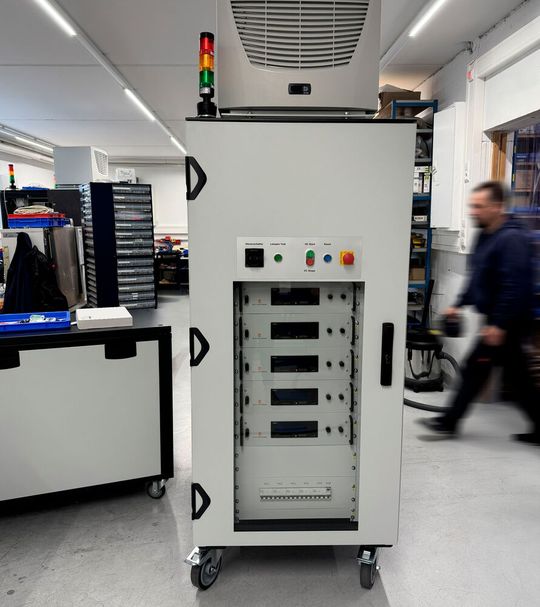
Requirements for integrated power supply systems: Precise AC and DC power supply systems that not only provide energy, but also reliably combine measurement, analysis and system integration.
(Image: Schulz Electronic)
Today, electronic assemblies, semiconductor components, power electronics, batteries and energy storage devices must be tested under realistic conditions. Test benches should be able to reproduce a wide range of operating conditions—from rapid load changes and complex switch-on sequences to fault and limit case simulations. At the same time, the requirements for measurement accuracy, reproducibility, efficiency and operational safety are increasing.
"At this point at the latest, it becomes necessary to offer not only individual devices as a classic stand-alone solution, but also individual solutions in a customer-specific rack as part of a system integration," emphasizes Stephan Wilde, Sales Manager Central Region (zip code 7) at Schulz-Electronic. The company specializes in precise AC and DC power supply solutions for industrial and scientific applications. He adds: "Several components have to be synchronized, external measuring systems have to be connected and complex control systems have to be implemented, which involves increased integration effort." Modern test environments therefore require holistic power supply solutions that are flexibly scalable and can be seamlessly integrated into existing test and production environments.
Increasing Demands on Precision And Dynamics
"Today's test environments demand far more than just a stable voltage source—instead, flexible, precise and integrable systems that can reliably map complex test scenarios are required. Ideally, a turnkey system," explains Wilde. This is because dynamic load changes in particular place high demands on the control quality of power supply systems. Voltage dips or overshoots can falsify measurement results or endanger sensitive components. Programmable power supplies offer decisive advantages here. They not only enable precise control of voltage and current, but also integrate measurement and analysis functions directly into the system. This allows test setups to be designed more compactly and test results to be documented consistently.
From Individual Devices to Integrated Systems
While classic power supply units are usually designed for clearly defined, static tasks, modern test benches must be able to react flexibly to different test requirements. "As soon as tests become more dynamic and complex, this is no longer feasible with the mere use of individual devices. This quickly results in confusing setups with high coordination and maintenance costs," emphasizes Moritz Dehn, Sales Manager Central Region (PLZ 3) at Schulz-Electronic.
Integrated power supply systems, on the other hand, combine the power source, electronic load, measurement and analysis functions in one platform. Modular concepts allow power, channels and functions to be adapted precisely to the respective application. This not only facilitates scaling from laboratory set-ups to series or production environments, but also increases operational reliability. Thanks to the modular and cascadable architecture, the system performance can be easily scaled and expanded for future projects as required.
Exemplary Applications from Testing And Development
One example of this development is modular DC power analyzers such as the IT2705 from ITECH. Thanks to its modular design, the system can be flexibly adapted to different applications. In semiconductor and electronics testing, several channels can be operated in parallel to characterize components under dynamic load and supply scenarios. High-resolution measurement functions enable a detailed analysis of the electrical behavior.
The combination of precise power supply and integrated analysis also plays a central role in battery laboratories. Charging and discharging profiles can be mapped realistically, while battery simulations enable operation under a wide range of conditions. For the characterization of DC-DC converters, such a system combines current source, load, measurement and analysis in one device, which significantly simplifies and accelerates the test setup. "It is precisely the combination of modularity, high measurement resolution and integrated analysis that makes such platforms interesting for very different test tasks," says Dehn.
System Integration As the Key to Efficiency
However, as the complexity of the tests increases, the focus is also shifting more towards system integration. It is not only the performance of individual components that is essential, but also their interaction in the overall system. Interfaces, automation and remote controllability are key requirements for use in modern test and production lines. Stable, reproducible and economical test processes can only be achieved if power sources, electronic loads, measurement and control technology and higher-level software solutions are properly coordinated.
Date: 08.12.2025
Naturally, we always handle your personal data responsibly. Any personal data we receive from you is processed in accordance with applicable data protection legislation. For detailed information please see our privacy policy.
Consent to the use of data for promotional purposes
I hereby consent to Vogel Communications Group GmbH & Co. KG, Max-Planck-Str. 7-9, 97082 Würzburg including any affiliated companies according to §§ 15 et seq. AktG (hereafter: Vogel Communications Group) using my e-mail address to send editorial newsletters. A list of all affiliated companies can be found here
Newsletter content may include all products and services of any companies mentioned above, including for example specialist journals and books, events and fairs as well as event-related products and services, print and digital media offers and services such as additional (editorial) newsletters, raffles, lead campaigns, market research both online and offline, specialist webportals and e-learning offers. In case my personal telephone number has also been collected, it may be used for offers of aforementioned products, for services of the companies mentioned above, and market research purposes.
Additionally, my consent also includes the processing of my email address and telephone number for data matching for marketing purposes with select advertising partners such as LinkedIn, Google, and Meta. For this, Vogel Communications Group may transmit said data in hashed form to the advertising partners who then use said data to determine whether I am also a member of the mentioned advertising partner portals. Vogel Communications Group uses this feature for the purposes of re-targeting (up-selling, cross-selling, and customer loyalty), generating so-called look-alike audiences for acquisition of new customers, and as basis for exclusion for on-going advertising campaigns. Further information can be found in section “data matching for marketing purposes”.
In case I access protected data on Internet portals of Vogel Communications Group including any affiliated companies according to §§ 15 et seq. AktG, I need to provide further data in order to register for the access to such content. In return for this free access to editorial content, my data may be used in accordance with this consent for the purposes stated here. This does not apply to data matching for marketing purposes.
Right of revocation
I understand that I can revoke my consent at will. My revocation does not change the lawfulness of data processing that was conducted based on my consent leading up to my revocation. One option to declare my revocation is to use the contact form found at https://contact.vogel.de. In case I no longer wish to receive certain newsletters, I have subscribed to, I can also click on the unsubscribe link included at the end of a newsletter. Further information regarding my right of revocation and the implementation of it as well as the consequences of my revocation can be found in the data protection declaration, section editorial newsletter.
In addition, the standardization of test setups is becoming increasingly important. Standardized interfaces, clearly defined test sequences and a consistent database not only make it easier to compare measurement results, but also to scale test concepts across different development stages. The importance of a well thought-out system architecture is particularly evident when transferring laboratory set-ups to pre-series or production environments.
A solution provider such as Schulz-Electronic therefore deliberately acts as a system integrator in this context, supporting companies from application-oriented consulting and the selection of suitable power supply and test systems through to individual system and rack construction. The aim is to provide turnkey solutions that are precisely tailored to the respective application and can be seamlessly integrated into existing processes.
More and more often, renting a system is preferred to buying one. Wilde explains the reasons for this: "In times when budgets are tight but projects have to be implemented, people like to fall back on temporary solutions." In addition to installment plan, leasing and free test devices are also available.
"It always starts with a thorough requirements analysis in order to save time and effort later on. A system integrator must therefore work closely with the respective company right from the concept phase," explains Wilde.
Service And Support Over the Entire Life Cycle
In addition to the technical design at the beginning, service also plays a decisive role later on during operation. Maintenance, repairs or adjustments must be carried out quickly and reliably in order to minimize downtimes. Local, authorized service by the solution provider or system integrator offers clear advantages here.
Schulz-Electronic, for example, maintains a service workshop in Germany that is authorized by international manufacturers and offers technical support throughout the entire life cycle of the systems. Users benefit from short response times and dedicated contact persons. This is a highly relevant factor for the operational reliability of complex test benches.
"Companies receive advice, system integration (e.g. systems from a few kilowatts to several hundred kilowatts) and service from a single source. This reduces interfaces and increases reliability in operation," Wilde summarizes.
Trends continue to drive demand Electrification, rising power densities and increasing automation are currently shaping many sectors: from semiconductor production and electromobility to energy technology and the data center industry. At the same time, the requirements for energy efficiency, thermal management and data analysis are growing.
"Power supply systems are increasingly becoming central analysis and test platforms in research and development," observes Dehn. This makes them an integral part of modern testing and production concepts. Almost every electrical application touches a power supply system during its life cycle.
Conclusion: Supply, Measurement, Analysis And System Integration Combined in One Solution
Today, precise AC and DC power supply systems are far more than just pure energy sources. They form the backbone of modern test benches by combining supply, measurement, analysis and system integration in a single solution. Integrated, modular concepts, such as the IT2705 from ITECH, enable reproducible test results, high efficiency and safe scaling from laboratory to production environments.
Solution providers and system integrators such as Schulz-Electronic support users in implementing these requirements, from early consultation and individual system and rack construction through to service and support during operation. In this way, even complex test tasks can be implemented reliably, economically and future-proof. And support customers in the long term with customized solutions developed specifically for them.



:quality(80)/p7i.vogel.de/wcms/53/f7/53f7dadbe4d656a3fd4f4077445f29f6/0129828707v1.jpeg "Thanks to its compact design and drilling/unscrewing function, the Fire Birdie is suitable for applications with limited installation space and frequent tool changes. (Image:Marcel Kraibühler)")
:quality(80)/p7i.vogel.de/wcms/da/4d/da4da8d34671dc6bce80e496212de877/0129850788v1.jpeg "Mate-XT Go supports the arms and shoulders during overhead work and repetitive tasks and is designed to significantly reduce muscle strain in everyday working life. (Image:Comau)")
:quality(80)/p7i.vogel.de/wcms/95/97/95976dbaac68b249eb65e74c5aad5300/0129651893v1.jpeg "The C2.0 centric clamps, the S2 fixed jaw clamps and the \"gredoc\" zero-point clamping systems are used for machining the raw parts. Fastening is carried out with width across flats 27. (Image:Gressel)")
:quality(80)/p7i.vogel.de/wcms/57/1b/571b8895efb299d70846bbdbd7af2338/0130043886v1.jpeg "Servo hydraulics independent of the control system: The servo hydraulics software module is integrated directly into the b Maxx 5500 servo drive (pictured: Mehmet Sari, Export Sales Manager at Hürsan Pres (left), Özgür Deniz Demirbaş, Country Manager at Baumüller Turkey) (Image:Baumüller)")
:quality(80)/p7i.vogel.de/wcms/3b/27/3b27f6c5848be73acecb04054bf0a146/0130115209v1.jpeg "Spectroscopic glucose measurement with infrared spectroscopy enables more regular measurements without physical strain. (Image:Endrich)")
:quality(80)/p7i.vogel.de/wcms/3f/cc/3fccb748b0fe16f1f61249d94c72f126/0130149439v1.jpeg "Requirements for integrated power supply systems: Precise AC and DC power supply systems that not only provide energy, but also reliably combine measurement, analysis and system integration. (Image:Schulz Electronic)")
:quality(80)/p7i.vogel.de/wcms/fd/93/fd93e01c16f5a4709278499d981a459c/0130061090v1.jpeg "Revealed: These servo drives are assembled at Aerotech in Fürth. (Image:Aerotech)")
:quality(80)/p7i.vogel.de/wcms/cb/8a/cb8ae7f5205365efce3e7285154fc3cf/0130132198v1.jpeg "Markus Huber (left) and Nicolai Friis from TU Wien know how to make quantum computers multidimensional in order to perform computing operations even better. (Image:TU Vienna / A. Rommel)")
:quality(80)/p7i.vogel.de/wcms/63/21/6321beb732bf7d92640df46d7aa77573/0130125122v1.jpeg "As part of the Carbon Lab Factory Lausitz, a pilot plant for the production of sustainable, cost-effective and competitive carbon fibers will be built at the Guben site. (Image:Fraunhofer IAP / Kristin Stein)")
:quality(80)/p7i.vogel.de/wcms/53/4f/534fe0f168f6ee070ded4a48faca4cef/business-wire-main-image-1103x620v1.jpeg "The new UR AI Trainer, developed by Universal Robots and Scale AI, is the first direct lab-to-factory solution for AI model training.
(Source: Universal Robots)")
:quality(80)/p7i.vogel.de/wcms/08/70/087062e2e1a9b9add5777410dd746ee9/adobestock-1923991605-5607x3156v1v1.jpeg "A new type of tactile sensor, inspired by human skin, even recognizes grains of sand. (Image:Curioso.Photography - stock.adobe.com)")
:quality(80)/p7i.vogel.de/wcms/7f/08/7f087d7013424d123ab7275cd2e3fe55/adobestock-809456218--c2-a9-20degimages-20-e2-80-93-20stock-adobe-com-ki-generiert-4179x2351v1v1.jpeg "The digital upgrading of existing machines conserves resources, saves energy and reduces the need for new production. (Image:Degimages - stock.adobe.com/AI-generated)")
:quality(80)/p7i.vogel.de/wcms/90/db/90db3087d3af0560fcdb4dbc42443ce1/0130157448v1.jpeg "The switch to SDV is the most complex transformation the industry has ever had to master. The end consumer gets a vehicle that gains rather than loses value over its lifetime. (Image:Sonatus)")
:quality(80)/p7i.vogel.de/wcms/73/f0/73f00bb99a23197db05bb584fe78f20f/0130080581v1.jpeg "The \"China Speed\" analysis by Roland Berger shows that the speed of development has only a limited connection with labor costs. (Image:freely licensed at Pexels)")
:quality(80)/p7i.vogel.de/wcms/2f/5b/2f5ba6a150b52c2b8efada560c5cdafe/0130143442v1.jpeg "Automotive suppliers are facing a severe crisis, which is primarily due to a combination of structural change and economic problems. (Image:freely licensed at Pexels)")
:quality(80)/p7i.vogel.de/wcms/22/d0/22d03cd48e992435338b59464c428d41/0129739814v1.jpeg "More electric vehicles on the roads mean a higher demand for electricity - which should ideally be covered by renewable energies. (Image:BMW)")
:quality(80)/p7i.vogel.de/wcms/94/7a/947ac066b98cbcd3470e83ff9da3e25f/0130096114v1.jpeg "The use of amorphous steels in the stator enables a significant reduction in losses and increases the efficiency of modern electric motors in vehicle drives. (Image:Horse Powertrain)")
:quality(80)/p7i.vogel.de/wcms/e5/f1/e5f171d3d7ae021332cc0aeae4d6e299/0130127049v1.jpeg "In collaboration with Shanghai Jiao Tong University, Lenovo has presented a silicon anode battery under the name \"ED1000\" as a proof of concept for mobile workstations. (Image:Lenovo)")
:quality(80)/p7i.vogel.de/wcms/fa/69/fa696e59706b96fff02283dd74cc2398/0130129635v1.jpeg "Samsung Co-CEO Jun Young-hyun wants to respond to the AI-driven boom in demand in the memory market with contracts for up to five years. This should provide more planning security in the traditionally volatile storage business. At the same time, however, this is likely to increase the pressure on customers to secure precise long-term requirements, prices and supply chains. (Image:Samsung)")
:quality(80)/p7i.vogel.de/wcms/31/a8/31a883a47b86634c382923e78fd9a4c9/0130133225v1.jpeg "Figure 1: GMSL-capable point-to-point connection. (Image:ADI)")
:fill(fff,0)/images.vogel.de/vogelonline/companyimg/76800/76895/65.jpg "FAULHABER_120mm.jpg ()")
:fill(fff,0)/p7i.vogel.de/companies/67/eb/67eba621ef6ea/logo2.png "logo2 (Wuxi InfiMotion)")
:quality(80):fill(efefef,0)/p7i.vogel.de/wcms/69/1f/691f21f5d458e/aai-agritechnica-whitepaper-coverbild.png "AAI_Agritechnica Whitepaper_Coverbild")
:quality(80)/p7i.vogel.de/wcms/01/ef/01ef95e2decfda0824d001ba76186d7c/0124433354v1.jpeg "Given the variety of differently constructed systems, the digitization of low-voltage networks always requires individual technical adaptations. With the Smart Grid Interface Module SGIM, EMH Energie-Messtechnik GmbH offers a flexible basis for retrofit solutions of any kind. (Image:EMH Energie-Messtechnik GmbH)")
:quality(80)/p7i.vogel.de/wcms/a4/b5/a4b5d53e2b20f56fbba1b9031878eb75/0128894662v1.jpeg "The 6G mobile communication generation places high demands on test hardware. The RF measurement technology provider Anritsu is taking a new approach to test environments. (Image:freely licensed)")