After the completion of pre-development and the start of series production, the customer suddenly demanded delivery in their own packaging instead of bulk material. A reliable automation solution with a robot and tray stacker was required.
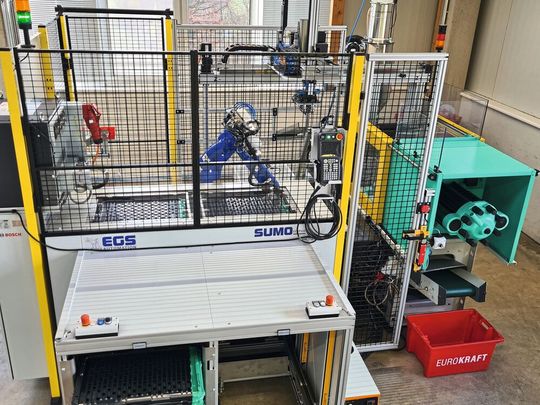
The overall system includes the palletizing system, the robot, and the transfer station.
(Image: EGS Automation)
Franz Wolf Kunststoffverarbeitung GmbH is a medium-sized family business in its third generation and has been on the market for over 50 years. Based in Kirchheim in the Unterallgäu region (Germany), around 40 employees are engaged in production, toolmaking, quality assurance, and logistics. Speaking with managing partner Petra Kaiser and technical director Moritz Kaiser, both highlight their in-house toolmaking alongside their long-standing expertise in injection molding manufacturing as a key competence for success. This area guarantees high quality, even over long production periods and large quantities. It also ensures the necessary flexibility for prototype development and small series production.
The machinery of Wolf Kunststoffverarbeitung consists of around 40 machines with a clamping force range of 17 to 143 U.S. tons and is regularly modernized. By now, around one-third of the machines are fully electric, which positively impacts the company's energy consumption. Customers are supplied from the automotive, electronics, hydraulics, sensor technology, and communication sectors.
On one of the production systems, a small precision plastic part for a steering angle sensor is manufactured in large quantities. The part is injection-molded eightfold with a sprue on an Arburg Allrounder 44 U.S. tons machine. The entire shot is removed by linear handling and separated from the sprue. In the process, each group of four parts lies mirrored opposite each other on the sprue.
Customer Requirement: Place Parts Individually in Packaging
The individual parts were previously placed on a conveyor belt by the handling system, where they unsortedly ended up in a box. The system was fully designed, set up, and commissioned when the customer suddenly surprised the company Wolf with the requirement to deliver the parts individually placed in their own, already existing, packaging in the future.
The reason for such a request is usually that subsequent processing is automated, and thus the parts must be delivered in an automation-friendly manner. In this specific case, it meant that approximately 1,400 parts per hour needed to be properly placed in customer trays in the format of 24 × 16 inches, with 112 parts in each tray. The trays then had to be stacked on Euro pallets and fitted with a lid. This would have required the equivalent of nearly two people throughout the entire production period, combined with a very monotonous task.
Extraction handling is indeed a very fast and cost-effective solution for removing parts from an injection molding machine, but it is not really suitable for individually placing parts into trays. The existing linear handling was therefore not a viable solution for the tray packaging process. Furthermore, a solution also had to be found for destacking and stacking the trays for preparation for the packaging process.
Faced with this task, Moritz Kaiser recalled information he had received in a newsletter from a customer of his company. This long-standing customer, Dunkermotoren, which is supplied with injection-molded parts, had announced that an automation company had been acquired and now belongs to the group and thus to the parent company Ametec.
Turnkey Custom Solutions And Standard Solutions
EGS Automation from Donaueschingen has been a provider of robot-based automation systems since 1999 and, since 2021, a subsidiary of Dunkermotoren. EGS Automation focuses on customers in the metal and plastics processing industries. EGS offers both customized, turnkey special solutions and, with the Sumo series, a product line of standardized automation solutions.
Faced with the task, EGS was able to offer the appropriate solution based on a standard palletizing system. The foundation of the system is a Sumo Ecoplex2, a tray stacker capable of processing stacks up to 2.6 feet high in a tray format of 24 × 16 inches. These can be fed and removed via conveyor belts. In this specific case, the belts hold four stacks, corresponding to an autonomy of approximately 12 hours. The handling of individual parts is performed by a Yaskawa GP7 articulated robot with a reach of nearly 3.3 feet and a payload of 15.4 pounds.
The question of transferring the parts from the injection molding machine remained. "The existing handling system from Dürrschmidt was supposed to continue managing the removal. Therefore, a transfer had to be implemented, and we were concerned that there might be issues at the interface, both during coordination and later in operation," expressed Moritz Kaiser his concerns.
Date: 08.12.2025
Naturally, we always handle your personal data responsibly. Any personal data we receive from you is processed in accordance with applicable data protection legislation. For detailed information please see our privacy policy.
Consent to the use of data for promotional purposes
I hereby consent to Vogel Communications Group GmbH & Co. KG, Max-Planck-Str. 7-9, 97082 Würzburg including any affiliated companies according to §§ 15 et seq. AktG (hereafter: Vogel Communications Group) using my e-mail address to send editorial newsletters. A list of all affiliated companies can be found here
Newsletter content may include all products and services of any companies mentioned above, including for example specialist journals and books, events and fairs as well as event-related products and services, print and digital media offers and services such as additional (editorial) newsletters, raffles, lead campaigns, market research both online and offline, specialist webportals and e-learning offers. In case my personal telephone number has also been collected, it may be used for offers of aforementioned products, for services of the companies mentioned above, and market research purposes.
Additionally, my consent also includes the processing of my email address and telephone number for data matching for marketing purposes with select advertising partners such as LinkedIn, Google, and Meta. For this, Vogel Communications Group may transmit said data in hashed form to the advertising partners who then use said data to determine whether I am also a member of the mentioned advertising partner portals. Vogel Communications Group uses this feature for the purposes of re-targeting (up-selling, cross-selling, and customer loyalty), generating so-called look-alike audiences for acquisition of new customers, and as basis for exclusion for on-going advertising campaigns. Further information can be found in section “data matching for marketing purposes”.
In case I access protected data on Internet portals of Vogel Communications Group including any affiliated companies according to §§ 15 et seq. AktG, I need to provide further data in order to register for the access to such content. In return for this free access to editorial content, my data may be used in accordance with this consent for the purposes stated here. This does not apply to data matching for marketing purposes.
Right of revocation
I understand that I can revoke my consent at will. My revocation does not change the lawfulness of data processing that was conducted based on my consent leading up to my revocation. One option to declare my revocation is to use the contact form found at https://contact.vogel.de. In case I no longer wish to receive certain newsletters, I have subscribed to, I can also click on the unsubscribe link included at the end of a newsletter. Further information regarding my right of revocation and the implementation of it as well as the consequences of my revocation can be found in the data protection declaration, section editorial newsletter.
Cooperation Between Manufacturers And Integrators
Interface coordination and workspace monitoring, however, are part of EGS's daily routine. They are accustomed to adapting to different communication protocols. In robotics, mutual space monitoring and interlocking individual robots with one another is a typical task. "In this specific case, the cooperative approach of Dürrschmidt made coordination very easy for us," says Hartmut Pfalzgraf, who is responsible for this project at EGS.
Technically, the transfer was implemented such that the handling system places the entire shot without a sprue into a transfer station, arranged exactly as it is molded in the tool. In this station, every single part is monitored by sensors for presence. This station was developed by EGS and is designed to be positioned within the working range of both robots. After the handling system has placed the eight parts of a shot, the Yaskawa robot rushes to the transfer station, using a revolver gripper tool to pick up four parts one after another, moves to the tray, which is already positioned for filling in the Sumo palletizing system, and places the four parts one by one into the next free nests. This process is then repeated for the second group of four parts from the same shot. During this, the opposite orientation of the parts from the injection molding tool is resolved, and each part is placed correctly. The machine molds eight parts every 21 seconds, meaning the path between the tray and the transfer station must be traversed four times within that time frame, completing a total of 16 pick-and-place operations, each accompanied by reorientation of the gripper tool. A challenging task that leaves the Yaskawa robot restless for a second, fully utilizing its dynamics.
The trays enter the tray stacker empty in a stack, are lifted, and provided to the robot for filling. Once a tray is filled, it is transferred onto the stack of filled trays until the stack reaches its full height and is then discharged onto the conveyor belt. The belt systems at the input and output of the palletizing system each hold space for four stacks of empty trays and four stacks of filled trays. This allows the system to run autonomously for about 12 hours. "An operator only needs to transfer four filled stacks from the belt to a Euro pallet every 12 hours and remove it. Then they fetch a new empty Euro pallet and place four new empty tray stacks on it. All in all, less than ten minutes of work, and then the automation runs autonomously again for 12 hours," says Moritz Kaiser with satisfaction.
Two-Day Training for the Staff
With the system, the first articulated robot has been introduced into the production of Franz Wolf Kunststoffverarbeitung. Initial fears and reservations have proven to be unfounded. During the installation and handover of the system, a two-day training session was conducted for the staff on operating the system and handling possible disruptions and problems. For operating the system, the robot programming handheld device is not required. If assistance from EGS is needed, it can be provided quickly via the system's integrated remote maintenance module.
"Robot programming skills are absolutely not necessary for operating the system. However, we have grown fond of robotics with its flexibility and reliability. This will not be the last robot in our production, and we want to gradually delve deeper into the subject. EGS supports us exactly to the extent that we want and need," praises Petra Kaiser regarding the collaboration so far and provides an outlook on the near future.
"We were also very surprised by the detailed and clear system documentation and operating manual that came with the system. This is obviously not just documentation material to meet standards and regulations, but also well-designed and intended for regular use," concludes Moritz Kaiser.
The automation was subsequently integrated into the existing spatial conditions, and the machine and equipment did not need to be moved for this. The Sumo system allows for the largely flexible alignment of the palletizing system to the robot, enabling the operator side to be optimally aligned with material logistics.



:quality(80)/p7i.vogel.de/wcms/72/a0/72a0ffc94f0929c8b193b4bc40638d72/0129755066v1.jpeg "Tens of billions less! After Ford and General Motors, Stellantis is now also feeling the painful consequences of Donald Trump's decision to change its electric car strategy ... (Image:Stellantis)")
:quality(80)/p7i.vogel.de/wcms/7f/fd/7ffd32863352c40f562f4245e4766e61/0129745849v1.jpeg "After US President Donald Trump once again resorted to his favorite weapon, tariffs, concerns rose in the EU that the so-called tariff deal could become invalid. But it looks as if the sea remains relatively calm ... (Image:F. Schneidler)")
:quality(80)/p7i.vogel.de/wcms/53/69/5369bed136061188d873441dfefd6d6e/0129245111v1.jpeg "The company revised the factory layout even though construction work had already begun. (Image:Efeso Management Consultants)")
:quality(80)/p7i.vogel.de/wcms/d2/d7/d2d79e3fb84663cb7e918c88f123989b/0129733908v1.jpeg "Mineral decision! This is how lithium is mined. There is a lot of it in Chile, Australia, Bolivia and also in Zimbabwe. However, the latter country has now announced that the export of all minerals, including lithium concentrate, will be stopped. Read more about the reasons here ... (Image:Largbatt)")
:quality(80)/p7i.vogel.de/wcms/d9/bd/d9bd1bfa7d02f586e092f06c61ee3d9a/0129464423v1.jpeg "This is what the Black Soldier Fly (BSF) looks like. The first impression is of a common two-winged insect. But appearances are deceptive, because its larvae are true protein reactors, whose industriousness is now to be exploited for food ... (Image:Fly Friends)")
:quality(80)/p7i.vogel.de/wcms/13/4d/134dee0c2b8af6b4f28937ca5b586e0d/0129499541v1.jpeg "The industry now needs to build a flexible, powerful and sovereign infrastructure that can exploit the full potential of artificial intelligence while guaranteeing control over data and processes. (Picture: ©Gorodenkoff - stock.adobe.com)")
:quality(80)/p7i.vogel.de/wcms/c6/71/c671ce338f12be49d39d1b04b40a54f7/0129697443v1.jpeg "Claas is working on making its combine harvesters fit for refurbishment. (Image:Claas)")
:quality(80)/p7i.vogel.de/wcms/f2/4b/f24b8f1c3070e7f13e4f0ffd7854e75a/0129653538v1.jpeg "The production of the BMW iX3 is to be taken as far as possible in terms of sustainability. This is also ensured by the climate-friendly Blueprint recycled steel from Thyssenkrupp Steel ... (Image:BMW)")
:quality(80)/p7i.vogel.de/wcms/f5/7e/f57ef535ee35e7b3b7ff15a8a63cef10/eds-keyvisual-8000x4496v1.jpeg "(Source: European Defence Supply)")
:quality(80)/p7i.vogel.de/wcms/af/a3/afa312176d956068af20491957eef642/newsimage418262-3100x1745v1v1.jpeg "The autonomous shuttle of the Aula AI project during a demonstration of sensor data with artificial fog. (Image:University of Magdeburg)")
:quality(80)/p7i.vogel.de/wcms/84/2d/842d51915fa4fe69c72da5cc4ba52ed1/newsimage418103-3408x1917v1v1.jpeg "3 Printing can also be sustainable—if recyclable ink is used. (Image:Hereon/Steffen Niemann)")
:quality(80)/p7i.vogel.de/wcms/b0/78/b078e07634ffd4d5ee6b73af42cc7c55/newsimage418259-1000x563v1v1.jpeg "Magnesium during forming. (Image:TU Bergakademie Freiberg)")
:quality(80)/p7i.vogel.de/wcms/c7/5e/c75e5942cd1d7e6bce973391af6dafe8/0129757614v1.jpeg "Pony.ai is cooperating with Moore Threads to bring Level 4 autonomous driving to the roads in China more quickly. (Image:Pony.ai)")
:quality(80)/p7i.vogel.de/wcms/a8/9f/a89ff7a3e28a19c03a22fd16cf3404b4/0129761837v1.jpeg "KD and Hitachi High-Tech have concluded a distribution agreement. (Image:KD)")
:quality(80)/p7i.vogel.de/wcms/29/b5/29b536a22d9b5ac80387b02620cce554/20260212-sue-60-6000x3372v1v1.jpeg "The People Mover at its world premiere. The large polycarbonate windshield is clearly visible. One of several materials contributed by Covestro. (Image:UE | STUDIOS)")
:quality(80)/p7i.vogel.de/wcms/a0/3e/a03e71cec3a956df095607a0b176a7b0/0129584071v1.jpeg "Andreas Mindt will be Head of Design at the Volkswagen Group from March. (Image:Volkswagen AG)")
:quality(80)/p7i.vogel.de/wcms/eb/4e/eb4e449562174ec95a5b3d30fb0137a2/0129648135v1.jpeg "The III-V germanium PV module with an efficiency of 34.2% is currently the most efficient solar module in the world. (Image:Jacob Forster)")
:quality(80)/p7i.vogel.de/wcms/92/c2/92c23fd5d95286c8c8c634314f6b22f8/0129722027v1.jpeg "The Meta Group has signed a five-year contract for GPU and CPU deliveries to expand its AI capacities. The agreement covers the delivery of up to 6 gigawatts of GPU computing power with a total value of around USD 60 billion. (Image:freely licensed)")
:quality(80)/p7i.vogel.de/wcms/01/77/017742db7d5eb5964c297bb8917df701/0129696639v1.jpeg "Mini-STX K3921-N: The motherboard masters Intel's Core i3 and N-Series processors and can connect multiple monitors with Full HD. (Image:Kontron)")
:quality(80)/p7i.vogel.de/wcms/17/21/1721b98b7580a86c7790f607395878a1/0129697493v1.jpeg "Universal: Motors are used everywhere. (Image:Microchip Technology)")
:fill(fff,0)/images.vogel.de/vogelonline/companyimg/76800/76895/65.jpg "FAULHABER_120mm.jpg ()")
:fill(fff,0)/p7i.vogel.de/companies/67/eb/67eba621ef6ea/logo2.png "logo2 (Wuxi InfiMotion)")
:quality(80):fill(efefef,0)/p7i.vogel.de/wcms/67/ad/67adf92d254d2/elatec-wp-smart-factory.png "Elatec WP Smart Factory")
:quality(80)/p7i.vogel.de/wcms/cf/b8/cfb85f27d7786bc99685ec5a2639a410/0129003760v1.jpeg "Setting a good example ourselves: Igus has already automated its production and logistics with low-cost automation components at 2,500 locations. (Image:Igus)")
:quality(80)/p7i.vogel.de/wcms/c9/9c/c99c57d6ca20002966fec4a251bc7262/image-1-duo-700-small-1920x1079v1.jpeg "Functionalised rear-end-lights are produced on the ENGEL duo 700 – with high precision and using clearmelt and foilmelt in a single integrated process with a compact footprint. (Image: ENGEL)")