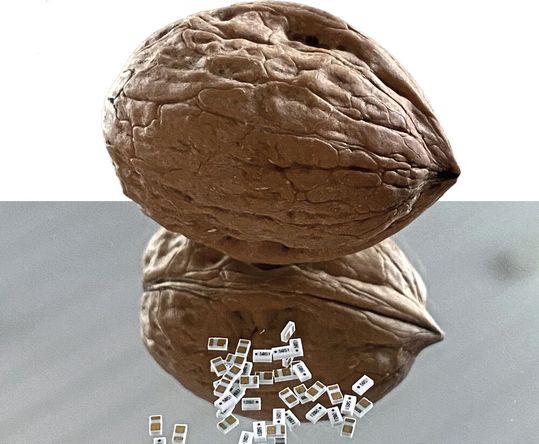
A look back in time shows an amazing development towards miniaturization—a time when size was not only a matter of scale, but also a sign of innovation.
From the first transistor to today's highly complex microchip, electronic components have consistently become smaller, with each new development bringing opportunities and challenges.
(Image: RPtec GmbH)
In this development, technologies such as SAP (Semi-Additive Process) and mSAP (Modified Semi-Additive Process) play an important role. These methods have changed the manufacture of circuit boards and paved the way for ever more powerful and compact electronic devices. At the end of the review, we take a look at the latest development - the ultra-thin copper foil Nanotus, which opens a new chapter in the history of miniaturization. Dive with us into the world of macro dimensions and discover the possibilities of modern technology.
Challenges and hurdles of miniaturization
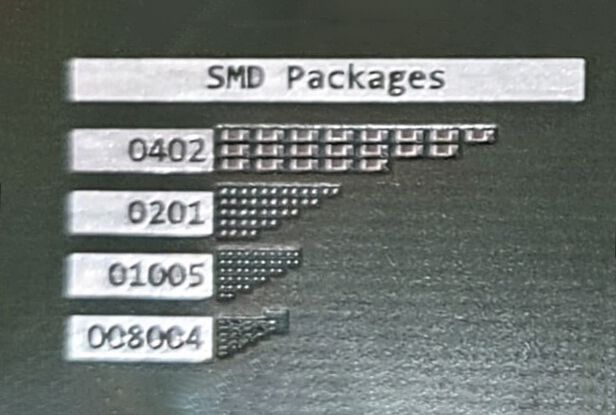
Miniaturization of SMD form factors
(Image:RPtec GmbH)
Despite the impressive advances in miniaturization, engineers and scientists face significant challenges. The smaller the components become, the more difficult it becomes to ensure their performance and reliability. One of the biggest hurdles is precision in the manufacture of tiny structures, which are often only a few nanometers in size. Production costs rise with increasing complexity, and the requirements for purity and material quality increase. In addition, thermal and electrical properties must be carefully controlled to avoid short circuits and overheating.
In this complex environment, every innovation requires not only technical know-how, but also creative problem solving and substantial investments in research and development. The balance between miniaturization and functionality remains a central challenge that necessitates constant adjustments and progress.
Innovations through miniaturization, mSAP and SAP technology
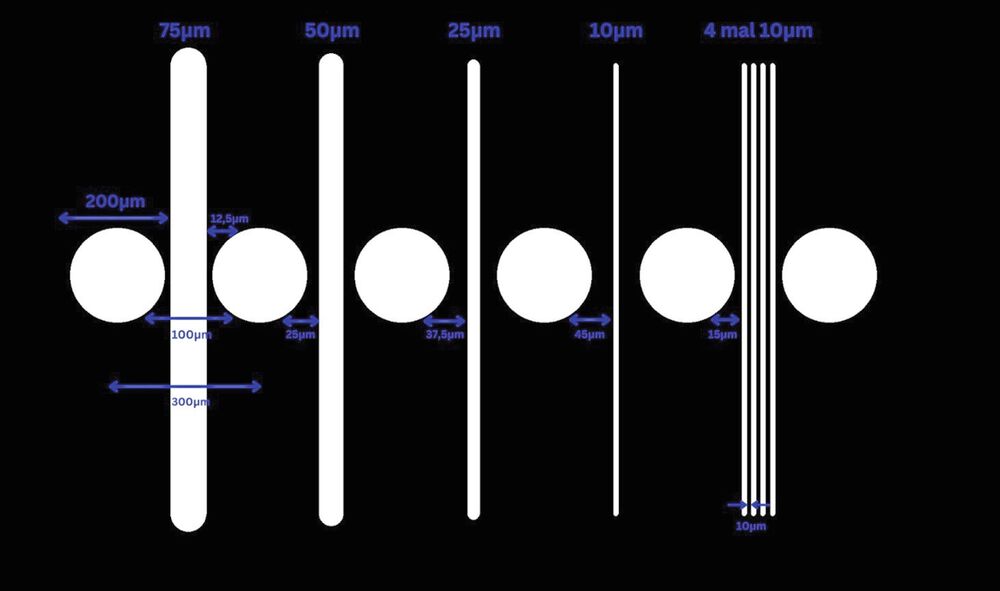
Structures on a 300 µm BGA. (Solder resist stays on the outside).
(Image:RPtec GmbH)
Miniaturization is a key driver of modern electronics. It enables more compact and powerful devices that are used in numerous applications from mobile phones to medical devices to high-performance computers. The ongoing reduction in component size means that more and more functions can be accommodated in smaller spaces, leading to more efficient and versatile products.
A crucial aspect here are technologies such as SAP (Semi-Additive Process) and mSAP (Modified Semi-Additive Process), which enable the manufacture of highly precise and dense conductor tracks. These technologies have expanded the boundaries of traditional PCB design (Printed Circuit Board) and open up entirely new possibilities for electronics development. In medicine, this leads to the development of innovative micro-implants and wearable diagnostic systems that are more precise and less invasive. In industrial automation and the Internet of Things (IoT), miniaturization enables networking of numerous devices and sensors, leading to better-connected systems.
The history of miniaturization
The history of miniaturization is a fascinating journey that goes far back and is closely linked to the development of electronics. Already in the early days of electronics there were efforts to reduce the size of components and thus increase the performance and efficiency of devices. An important milestone in this development was the introduction of integrated circuits in the 1950s and 1960s, which laid the foundation for modern miniaturization.
In the 1990s a standard for conductor track widths of 250 to 300 µm became established. At that time, it was a major challenge to manufacture these conductor tracks precisely and reliably. Widths of 50 µm could be realized, but this was associated with very high scrap rates, making production inefficient and costly. Nevertheless, the drive for ever smaller and more powerful components continued to drive innovation forward.
Today, just a few decades later, the standard has shifted significantly. Modern manufacturing technologies allow tracks widths of 125 µm to be made routinely and reliably. Even more impressive is the ability to produce tracks with widths of up to 10 µm—a scale that was unimaginable at the time. These advances are not only the result of technological innovations but also the result of intensive research and development.
The beginning of SAP and mSAP technology
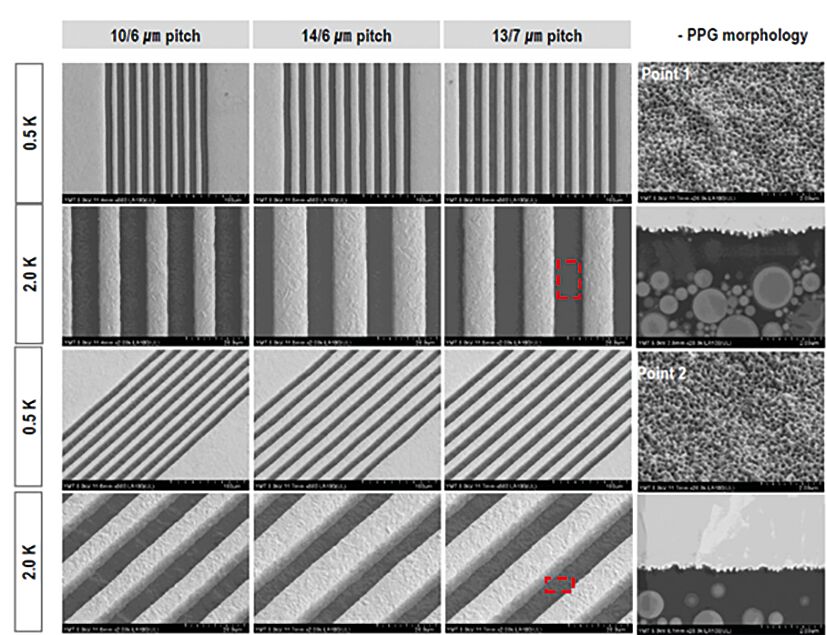
mSAP - fine pitch performance.
(Image:YMT Co. Ltd.)
The continuous miniaturization of components has not only significantly increased the performance of electronic devices, but has also laid the foundation for new applications and technologies that enrich our lives in many ways.
The development of SAP and mSAP technologies began in the late 1980s and early 1990s, as requirements for the miniaturization and performance of electronic devices steadily increased. Traditional manufacturing processes hit their limits, as they were unable to reliably produce the increasingly finer and more complex tracks. It became clear that new methods were needed to meet the rising requirements for precision and efficiency.
Date: 08.12.2025
Naturally, we always handle your personal data responsibly. Any personal data we receive from you is processed in accordance with applicable data protection legislation. For detailed information please see our privacy policy.
Consent to the use of data for promotional purposes
I hereby consent to Vogel Communications Group GmbH & Co. KG, Max-Planck-Str. 7-9, 97082 Würzburg including any affiliated companies according to §§ 15 et seq. AktG (hereafter: Vogel Communications Group) using my e-mail address to send editorial newsletters. A list of all affiliated companies can be found here
Newsletter content may include all products and services of any companies mentioned above, including for example specialist journals and books, events and fairs as well as event-related products and services, print and digital media offers and services such as additional (editorial) newsletters, raffles, lead campaigns, market research both online and offline, specialist webportals and e-learning offers. In case my personal telephone number has also been collected, it may be used for offers of aforementioned products, for services of the companies mentioned above, and market research purposes.
Additionally, my consent also includes the processing of my email address and telephone number for data matching for marketing purposes with select advertising partners such as LinkedIn, Google, and Meta. For this, Vogel Communications Group may transmit said data in hashed form to the advertising partners who then use said data to determine whether I am also a member of the mentioned advertising partner portals. Vogel Communications Group uses this feature for the purposes of re-targeting (up-selling, cross-selling, and customer loyalty), generating so-called look-alike audiences for acquisition of new customers, and as basis for exclusion for on-going advertising campaigns. Further information can be found in section “data matching for marketing purposes”.
In case I access protected data on Internet portals of Vogel Communications Group including any affiliated companies according to §§ 15 et seq. AktG, I need to provide further data in order to register for the access to such content. In return for this free access to editorial content, my data may be used in accordance with this consent for the purposes stated here. This does not apply to data matching for marketing purposes.
Right of revocation
I understand that I can revoke my consent at will. My revocation does not change the lawfulness of data processing that was conducted based on my consent leading up to my revocation. One option to declare my revocation is to use the contact form found at https://contact.vogel.de. In case I no longer wish to receive certain newsletters, I have subscribed to, I can also click on the unsubscribe link included at the end of a newsletter. Further information regarding my right of revocation and the implementation of it as well as the consequences of my revocation can be found in the data protection declaration, section editorial newsletter.
SAP, the "Semi-Additive Process", was developed to meet these challenges. It enables the manufacture of highly precise and dense conductor tracks and was a significant advancement in circuit board production. Over time, the mSAP method, the "Modified Semi-Additive Process", emerged as an advancement of SAP. MSAP offers even more flexibility and adaptability, as it uses the more versatile FR4 base material, as opposed to the SAP process, which is limited to base materials from the Ajinomoto company.
These technologies are crucial to meet the growing demand for more compact and powerful electronic devices. They allow the size of the conductor tracks to be further reduced, thus increasing the functionality and performance of the devices. Without the advances in SAP and mSAP technology, many of today's highly advanced electronic devices would not be possible.
Introduction and function of mSAP technology
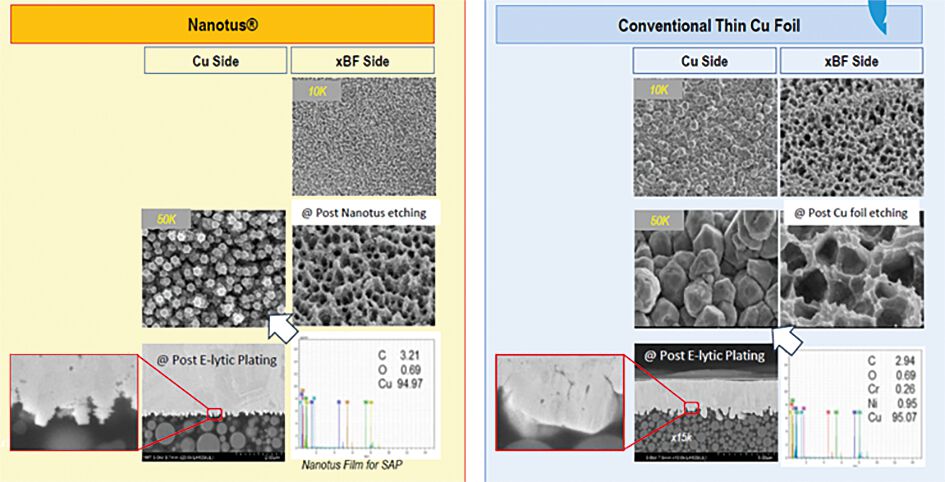
Nanotus compared to conventional copper foil.
(Image:YMT Co. Ltd.)
The process of mSAP technology begins with the application of a thin layer of copper to the substrate. A photolithographic mask is then used to define the desired conductor track pattern. Electrolytic deposition is used to apply copper to the exposed areas of the mask to form the conductor tracks. After removing the mask, excess copper is etched away, leaving only the precisely defined conductor tracks.
This method allows for the production of conductor paths with widths and spacings in the range of a few micrometers, which is essential for the high density and precision of modern electronic circuits. The integration of an ultra-thin copper foil is crucial for the entire process.
Ultra-thin copper foil Nanotus
The ultra-thin Nanotus copper foil from YMT Co Ltd represents a breakthrough for MSAP and SAP technologies. Due to its extremely thin nature, this foil is particularly suitable for the production of ultrafine conductor tracks with the highest precision and efficiency. Nanotus is characterized by a special surface treatment that significantly improves adherence to the base materials. This improved adhesive property can be likened to a hook and loop fastener, which ensures a reliable connection. This allows for more precise placement and structuring of the conductor tracks, which in turn leads to higher quality and performance of the electronic components.
In addition, the low roughness of the Nanotus surface improves signal transmission and reduces signal losses, which is particularly advantageous for high-frequency applications. By reducing interference and signal losses, electronic devices and components made with Nanotus can offer higher performance and reliability. This underscores the versatility and innovative power of the Nanotus copper foil in modern technological applications.
Conclusion for the electronics industry
The advances in miniaturization and the ongoing development of MSAP technologies have fundamentally changed the electronics industry and opened up new perspectives for the design and manufacture of electronic devices. The introduction of the ultra-thin Nanotus copper foil represents a milestone in this development, as it offers significant advantages in terms of precision, density and performance of conductor tracks. These innovations will continue to drive the electronics industry forward and promote the development of ever smaller and more powerful devices. (mbf)
In short
The difference between mSAP and SAP lies in the circuit board manufacturing techniques. SAP (Semi-Additive Process) uses a thin layer of copper that is masked, electrolytically reinforced and etched, and is often used for High-Density Interconnect (HDI) circuit boards. mSAP (modified Semi-Additive Process) is an advancement of the SAP process with improved chemicals and process controls that enable finer structures (e.g. 15 µm lines and spaces). mSAP is particularly suitable for highly compact and powerful electronics such as modern mobile devices. The tracks have a much lower roughness of the copper and therefore a much lower attenuation, which benefits signal integrity.
*Linda Lüüs is the executive assistant at RPtec GmbH.
This article was first published on our sister brand 'ELEKTRONIKPRAXIS' (German Edition), Vogel Communications Group



:quality(80)/p7i.vogel.de/wcms/dd/08/dd086510d9ae7b50181f6070e4463b44/0129363730v1.jpeg "Typical application for ionizing devices: Wrapping films. (Picture: ©Adobe Stock/SMC)")
:quality(80)/p7i.vogel.de/wcms/35/57/3557c819943c53acec41a0ccba87da4f/0130049064v1.jpeg "Researchers at the Fraunhofer IWU in Chemnitz have long known that many typical sheet metal parts can be manufactured more cost-effectively using hollow embossing rollers. Now there is news to report ... (Image:Fraunhofer IWU)")
:quality(80)/p7i.vogel.de/wcms/59/02/590246e3b3f415c65edbee377c14ca77/26-06-pi-fraunhofer-iws-41450-direktplattieren-pic-01-7771x4369v1v1.jpeg "The Fraunhofer IWS has developed the new \"direct laser cladding\" process, which creates a functional layer directly on the base body by applying a strip-shaped metal to rotationally symmetrical components in a spiral and bonding it locally by laser. (Image:Christoph Wilsnack/Fraunhofer IWS)")
:quality(80)/p7i.vogel.de/wcms/73/60/73608418789b1d9c393f5e2fa974eda2/0130209906v1.jpeg "The robots of the X6 generation from b+m enable very high painting quality and are also particularly compact and easy to maintain. (Image:Beckhoff)")
:quality(80)/p7i.vogel.de/wcms/78/e9/78e9188c25a8a94e67c34c9bf8ffe495/visual-agile-20robots-20and-20google-20deepmind-20partner-20to-20bring-20intelligence-20to-20robotics-2500x1406v1v1.jpeg "Together, the partners are developing adaptable, intelligent robots for a wide range of applications (Image:Agile Robots SE)")
:quality(80)/p7i.vogel.de/wcms/e7/66/e7669ecf0260ae8fc54c214e34e4902a/0130316817v1.jpeg "Siemens and Palo Alto Networks offer tested cybersecurity solution for industrial 5G. (Image:Siemens)")
:quality(80)/p7i.vogel.de/wcms/9f/55/9f55324832c4f426958031375124d9de/siemens-20ubtech-20hmnd-1920x1079v1v1.png "Ready for the factory floor: While Ubtech is planning mass production, Siemens is already testing humanoids in real factory applications in Erlangen. (Image:Siemens)")
:quality(80)/p7i.vogel.de/wcms/11/36/113695ed260e29c8c2d9d39dc5f9d869/0130213768v1.jpeg "AI can work cheaply in China and deliver the results rapidly all over the world. (Image:Dall-E / AI-generated)")
:quality(80)/p7i.vogel.de/wcms/62/5f/625f41e87ebfef156a98c8e6393e32fd/0130211654v1.jpeg "Axial flux motors have some advantages over radial flux motor—but their production is currently still expensive. (Image:RWTH Aachen University)")
:quality(80)/p7i.vogel.de/wcms/77/9b/779b0685d010dfe45c9c2cb1cfecd467/0128886425v1.jpeg "The BlueEye is the first \"real\" hyperspectral camera for the UV range and covers the wavelength range from 220 to 380nm. (Image:Inno-spec GmbH)")
:quality(80)/p7i.vogel.de/wcms/e4/51/e451d52ce0182fb0aaa46a5774f832ef/26-04-pi-fraunhofer-iws-21160-bioslide-pic-01-4128x2321v1v1.jpeg "With the BioSlide research project, the Fraunhofer IWS is investigating how sliding systems can be designed to be more sustainable and energy-efficient. New materials can be tested in a particularly application-oriented manner on this plain bearing test stand. (Image:Fraunhofer IWS)")
![Thanks to advanced 3D printing technology, a more efficient use of resources should contribute to lower-emission aviation—this is the goal of ['skai]-lab. (Image:Oleksandr Pashchenko - stock.adobe.com / AI-generated)](https://cdn1.vogel.de/nghHNSbySccfOjG3n1qCA-FVOjQ=/288x162/smart/filters:format(jpg):quality(80)/p7i.vogel.de/wcms/62/64/626424c97a16e69f871bf216c9629c2a/adobestock-1927043193--c2-a9-20oleksandr-20pashchenko-20-e2-80-93-20stock-adobe-com-ki-generiertv1v1.jpeg "Thanks to advanced 3D printing technology, a more efficient use of resources should contribute to lower-emission aviation—this is the goal of ['skai]-lab. (Image:Oleksandr Pashchenko - stock.adobe.com / AI-generated)")
:quality(80)/p7i.vogel.de/wcms/c3/c4/c3c4ce270b083eeac55654148611f064/0130237945v1.jpeg "China is not giving up on hydrogen, but is intensifying its efforts. (Image:freely licensed from Pixabay)")
:quality(80)/p7i.vogel.de/wcms/4e/c0/4ec0bd19390b169edfa23677373dcdf1/0130260089v1.jpeg "Renewable fuels can supply European road traffic, according to a study. (Image:Aral)")
:quality(80)/p7i.vogel.de/wcms/6f/c9/6fc9050301d745cad25585c6780f8f51/0130197341v1.jpeg "Production facilities are a worthwhile target and are therefore at risk. (Image:ABB Robotics)")
:quality(80)/p7i.vogel.de/wcms/b6/62/b662adc2cec8227d8172509bbfb6ee42/25c0207-107-4961x2789v1v1.jpeg "The GLB is the second model based on Mercedes' new MMA platform. Apparently, Geely's platform is better and cheaper, which is why the two companies are negotiating a partnership. (Image:Mercedes-Benz)")
:quality(80)/p7i.vogel.de/wcms/4d/dd/4dddf438e91f394c04a095dbfd109d1c/0130236430v1.jpeg "Measurement modules: The 720301 module in combination with the SL2000 enables RMS and power calculations, among other things. (Image:Yokogawa)")
:quality(80)/p7i.vogel.de/wcms/61/fc/61fcf95f5cca15494ad18343901ae585/0130317237v1.jpeg "With the AGI CPU, Arm says it is taking a \"historic step\": With the processor aimed at AI in data centers, the company is presenting itself for the first time as a provider of its own chips, not just as a pure IP licensor. (Image:Arm)")
:quality(80)/p7i.vogel.de/wcms/82/90/8290dfe3595b6c6b33726ae8b76172c7/0130319587v1.jpeg "The concept image illustrates how the pattern of tiny protrusions and depressions created on the substrate (MgO, bottom) controls the arrangement of atoms in the superconducting material (YBCO, top). At the interface between the two layers, an electronic structure enables superconductivity to occur at higher temperatures than previously possible. (Image:Chalmers University of Technology / Riccardo Arpaia)")
:fill(fff,0)/images.vogel.de/vogelonline/companyimg/76800/76895/65.jpg "FAULHABER_120mm.jpg ()")
:fill(fff,0)/p7i.vogel.de/companies/67/eb/67eba621ef6ea/logo2.png "logo2 (Wuxi InfiMotion)")
:quality(80)/p7i.vogel.de/wcms/b9/eb/b9ebdbf56b29770bc04fd2869aff861a/0125760019v1.jpeg "In the era of miniaturization, circuit boards are becoming increasingly complex. The manufacturing of UHDI PCBs does not come without challenges. (Image:Dall-E / AI-generated)")
:quality(80)/p7i.vogel.de/wcms/0f/f6/0ff6f9a6cd9c75444535324692d31706/0128327423v1.jpeg "The triple lens distance sensor for close-up photography from Kyocera. The module measures 1.10 in x 1.18 in x 1.57 in. The camera uses three lenses and proprietary AI to detect semi-transparent, thin and fine line-shaped objects that were previously difficult to see with the human eye and conventional stereo cameras. (Image:Kyocera)")